
Critique of Abiy’s Ten-Year Development Plan and an Alternative Sequenced Five-Year Stabilization Roadmap (2027-2031)
By Yihenew Ewnetu
Sweden
Introduction
In a nation of over 130 million people, the boundary between a genuine national strategic plan and a political manifesto is not merely technical—it is existential. A grand national strategic plan is a disciplined, resource-bound instrument of statecraft designed to confront structural constraints, absorb shocks, and deliver measurable welfare gains. By contrast, a political manifesto dressed in technocratic language functions primarily as an instrument of narrative control: projecting grand, frictionless visions of prosperity to deflect domestic and international scrutiny from governance failures, economic contraction, and mass atrocities committed in the ongoing armed conflicts.
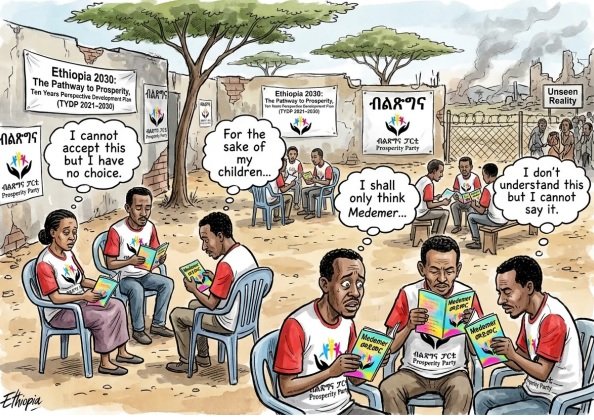
This tension between official rhetoric and lived reality is starkly visible in the political culture surrounding Prime Minister Abiy Ahmed’s administration and the ruling Prosperity Party. Across public addresses and internal party forums, Abiy Ahmed has repeatedly admonished party cadres and public officials against “gossiping” (hamet), rumor-mongering, and informal criticism—framing internal dissent and skeptical commentary not as legitimate political feedback, but as corrosive disloyalty and unproductivity. Cadres have been warned to abandon idle talk and align unconditionally behind official messaging and flagship initiatives.
Beyond party ranks, this intolerance for critical discourse has spilled directly into everyday civic life. Amid tightened restrictions on media freedom, recurring states of emergency, and heightened surveillance, informal political discussion in public spaces has been heavily chilled. Across urban centers, the informal policing of political speech and the fear of state scrutiny or administrative reprisal have led owners of coffee houses, cafes, and restaurants—historically vital arenas of Ethiopian sociality and civic debate—to post explicit written notices warning patrons against engaging in critical political talk on their premises. When ordinary citizens cannot freely debate economic hardship or state policy over a cup of coffee, and when party cadres are instructed to suppress criticism rather than report ground level failures, the feedback loops essential to authentic strategic planning collapse. Crucially, this exercise in narrative management is not merely aimed at containing domestic dissent; the Ten-Year Development Plan (TYDP 2021–2030) is meant to divert domestic and international attention from the mounting diplomatic, legal, and humanitarian pressure created by the mass atrocities the regime has committed. Indeed, the Prosperity Party (PP) regime under Prime Minister Abiy Ahmed faces mounting diplomatic, legal, and humanitarian pressure from international bodies, human rights monitors, and neighboring states over ongoing internal conflicts and regional spillovers (Global Centre for the Responsibility to Protect [GCR2P], 2026b):
1. Genocide Alerts and Calls for International Prosecution: The Lemkin Institute for Genocide Prevention maintains an Active Genocide Alert for
Ethiopia (most recently updated on May 15, 2026). The institute characterizes the regime’s military campaigns—particularly against the Amhara population —as a systematic genocidal campaign utilizing massacres, drone strikes, sexual violence, arbitrary detentions, forced displacement, and aid blockades (Lemkin Institute for Genocide Prevention, 2026).
● Legal & Diplomatic Demands: Both the Lemkin Institute and Genocide Watch have called for international accountability mechanisms—including International Criminal Court (ICC) and International Court of Justice (ICJ) scrutiny, targeted sanctions, UN-mandated independent fact-finding missions, and the dismantling of state-backed militias and genocidal apparatuses (Genocide Watch, 2026; Harris, 2025; Lemkin Institute for Genocide Prevention, 2026).
● Stalled Transitional Justice: The Global Centre for the Responsibility to Protect and partner human rights organizations note that following the UN Human Rights Council’s termination of the International Commission of Human Rights Experts on Ethiopia (ICHREE)—despite the Commission’s warnings of acute risks of further atrocities (Amnesty International et al., 2026, p. 2)—the PP regime’s domestic Transitional Justice Policy has stalled, drawing international criticism for lacking institutional independence, public trust, and meaningful victim participation (GCR2P, 2026b).
2. Massacres in Arsi and Welega (Oromia Region): Sustained ethnic and religious violence in Oromia—specifically targeting ethnic Amharas and Ethiopian Orthodox Christians in the Arsi and Welega zones—has triggered urgent international appeals (Addis Standard, 2026a; European Centre for Law and Justice [ECLJ], 2026).
● Arsi Zone Killings: Coordinated attacks in East Arsi throughout late 2025 and 2026 (including deadly assaults in May/June 2026 around the national elections and in October 2026 in Merti and Sherka districts) killed dozens of Orthodox Christians, destroyed historic churches, and displaced thousands (ECLJ, 2026; The Pathway, 2026). Following these attacks, the European Centre for Law and Justice (ECLJ) submitted an urgent appeal to the UN Office on Genocide Prevention condemning the state’s failure to protect civilians (ECLJ, 2026).
● Welega Atrocities & Advocacy Pressure: Ongoing massacres and forced displacements of Amhara communities in East Wollega and Horo Guduru Wollega—allegedly involving both the Oromo Liberation Army (OLA) and PP aligned forces—have prompted diaspora coalitions and the Addis Ababa Media Council to formally petition the UN, African Union (AU), U.S. State Department, and European Union (EU) to sanction regional security officials and deploy independent investigators (Addis Ababa Media Council, 2026; GCR2P, 2026b). These crises have also been raised in parliamentary and international legislative forums, including U.S. Congressional briefings on Capitol Hill (Addis Standard, 2026a).
3. War Crimes in Alamata: Following the collapse of the Cessation of Hostilities Agreement (CoHA) and the resumption of large-scale fighting in northern Ethiopia in August–September 2026, the regime faces severe scrutiny over indiscriminate warfare in Raya Alamata (GCR2P, 2026a).
● Shelling of Civilian Neighborhoods: In late November 2026, Amnesty International called for war crimes investigations into three consecutive days of heavy artillery and aerial strikes on Alamata city by the Ethiopian National Defense Force (ENDF) and allied Tigray Peace Forces (TPF). Amnesty reported that the attacks disregarded the lives of Alamata’s residents, hitting residential compounds and schools and causing overwhelmingly civilian shrapnel casualties (Amnesty International, 2026).
● UN Intervention: UN Secretary-General António Guterres and Human Rights Watch have demanded immediate de-escalation, civilian protection, unrestricted access for independent observers, and war crimes probes into ENDF airstrikes on residential areas (GCR2P, 2026a; Human Rights Watch [HRW], 2026).
4. Complicity in the Sudan Civil War: The PP regime is under intense regional and multilateral pressure regarding its alleged entanglement in the civil war in neighboring Sudan, which international monitors warn is mutating into genocide in Darfur and Kordofan (Armed Conflict Location & Event Data [ACLED], 2026; Ibrahim, 2026).
● Multilateral Complaints: The Sudanese government has lodged formal complaints against Ethiopia with the UN Security Council (UNSC) and the African Union Peace and Security Council (AUPSC). Khartoum accuses Addis Ababa of committing “direct aggression” by allowing the paramilitary Rapid Support Forces (RSF) to launch long-range drones from Ethiopian airports (such as Bahir Dar and Asosa) against Sudanese power stations, airports, and civilian infrastructure (ACLED, 2026; Ibrahim, 2026).
● Training Camps and Supply Corridors: Satellite imagery and investigative reports by Reuters and ACLED have linked Ethiopia’s Benishangul-Gumuz region to UAE-financed RSF training camps and drone facilities (ACLED, 2026; Committee to Protect Journalists [CPJ], 2026; Ibrahim, 2026). This has resulted in mutual diplomatic expulsions (closing consulates in Asosa and Gedaref), heightened tensions with Egypt and Eritrea, and international warnings that Ethiopia is enabling a transnational logistical corridor fueling atrocities in Sudan (Demir, 2026; Ibrahim, 2026).
It is within this environment of constrained public discourse, escalating international scrutiny over mass atrocities, and deliberate narrative diversion that Ethiopia’s Ten Year Development Plan (2021–2030) must be evaluated.
This manuscript synthesizes the theoretical foundations of national strategic planning, conducts a rigorous academic critique of the Ten-Year Development Plan’s macroeconomic modeling, sectoral targets, and implementation gaps, benchmarks it against international strategic planning standards, predicts its 2030 trajectory amid worsening political, economic, and diplomatic conditions, and sets forth a concrete, sequenced Five-Year Stabilization and Economic Renewal Roadmap (2027-2031) designed to restore state solvency, productive capacity, and social cohesion. Finally, the manuscript concludes by exposing the international financial architecture sustaining this disconnect—specifically, how International Financial Institutions (IFIs) and bilateral donors employ ‘structural compartmentalization’ to wall off internal wars, human rights abuses, and private-sector collapse from lending triggers, functioning in practice as a form of structural complicity through aid fungibility, creditor self interest, and the endorsement of extractive domestic taxation. It further substantiates this critique by contrasting Ethiopia’s 2026 IMF Extended Credit Facility (ECF) macroeconomic benchmarks against real-world household wage compression, and by contrasting Ethiopia’s repression of domestic dissent with Kenya’s civic pushback and Sudan’s collapse to expose how shrinking civic space enables authoritarian regimes to sustain external lending.
Continue reading in PDF
Editor’s Note: Views in the article do not necessarily reflect the views of borkena.com
__
Join our Telegram Channel: t.me/borkena
Like borkena on Facebook
To submit a press release, send the submission to info@borkena.com
Add your business to Ethiopian Business Listing / Ethiopian Business Directory
Join the conversation. Follow us on X (formerly Twitter) @zborkena to get the latest Ethiopian news updates regularly