 has emerged as one of the most consequential external actors in Africa, deploying more than $118 billion in investments and commitments through a network-centered model of neo mercantilist colonialism... Read more.)
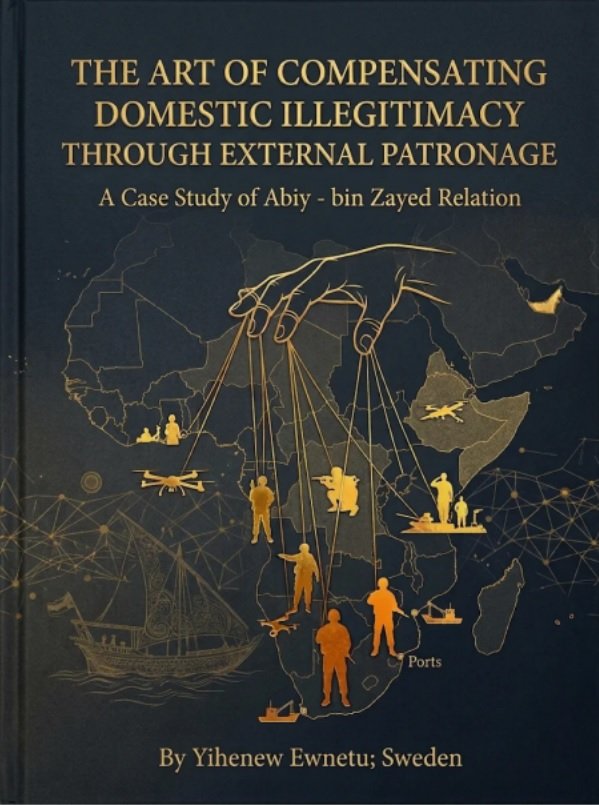
By Yihenew Ewunetu
Sweden
Executive Summary
Over the past decade, the United Arab Emirates (UAE) has emerged as one of the most consequential external actors in Africa, deploying more than $118 billion in investments and commitments through a network-centered model of neo mercantilist colonialism (Transnational Institute, 2025). Rather than pursuing formal territorial annexation, Abu Dhabi and Dubai fuse sovereign wealth capital, state-owned logistics conglomerates (DP World and AD Ports Group), and critical mineral vehicles (ADQ and International Resources Holding) with targeted military and financial patronage for domestically illegitimate rulers and centrifugal armed factions across Northern, Eastern, Central, and Southeastern Africa. Whether bolstering besieged federal leaders such as Ethiopian Prime Minister Abiy Ahmed or arming non-state warlords such as Sudan’s Rapid Support Forces (RSF) and Field Marshal Khalifa Haftar’s Libyan National Army (LNA), Emirati power projection systematically exploits domestic legitimacy deficits and state fragility as a strategic and commercial opportunity—converting political crises and armed chaos into low-cost entry points for maritime chokepoints, fertile agricultural land, and extractive supply chains (European Parliamentary Research Service, 2025, pp. 5–6; Transnational Institute, 2025; Walsh, 2025, pp. 240–243).
The centerpiece of this study—the personal and strategic relationship between Ethiopian Prime Minister Abiy Ahmed and UAE President Sheikh Mohamed bin Zayed Al Nahyan (MbZ)—illustrates how leaders facing deepening internal political crises seek foreign patronage to secure regime survival. Operating through the twin logics of extraversion and the political marketplace, Addis Ababa has compensated for the erosion of domestic political consensus, protracted civil wars in Tigray, Amhara, and Oromia, and severe macroeconomic distress by turning to Emirati emergency bailouts (including an initial $1 billion central bank deposit within a $3 billion rescue package), currency swaps, decisive armed drone air-bridges, Republican Guard training, and high-profile prestige projects (Bayart, 2000, pp. 217– 219; de Waal, 2026, p. 48; Gebru, 2025, pp. 1–2; Sarkar, 2023, pp. 5, 23; Walsh, 2025, p. 253). In return, Ethiopia’s sovereign policy choices, strategic airfields, and regional alignment have become increasingly subordinated to Abu Dhabi’s Red Sea ambitions and regional proxy wars—culminating in severe regional isolation, including Sudan’s May 2026 recall of its ambassador from Addis Ababa (Gebru, 2025, pp. 4–8).
A central finding of this work is that the African Union (AU), the Intergovernmental Authority on Development (IGAD), the European Union (EU), and the United Nations (UN) have failed vividly and consequentially to curb the UAE’s military interference, its profiteering from conflict-induced chaos, and its institutionalization of illicit trade:
United Nations Paralysis: Binding UN arms embargoes in Libya and Darfur are violated with near-total impunity while Security Council resolutions remain blunted by geopolitical vetoes and a refusal to sanction state sponsors operating regional air bridge supply lines (United Nations Security Council, 2024, p. 3; International Rescue Committee, 2025, pp. 7–8).
African Union Enforcement Deficit: Despite robust legal prohibitions in the AU Constitutive Act and repeated Peace and Security Council (PSC) communiqués condemning external interference in Sudan and Somalia, continental bodies have failed to operationalize sanctions against external financiers or enforce airspace and port-sovereignty rules (African Union, 2000, Art. 4; African Union Peace and Security Council [AU PSC], 2025, p. 4; AU PSC, 2026a).
IGAD’s Structural Impasse: Paralyzed by internal divisions, competing mediation tracks, and member states’ own financial dependence on Emirati loans and port concessions, IGAD has proven unable to restrain external spoilers or prevent belligerents from “forum shopping” (Kameir, 2025, p. 3; Clingendael Institute, 2025, p. 3).
European Union Half-Measures and Market Complicity: While the EU enacted targeted sanctions and a July 2026 ban on direct Sudanese gold imports (Council Regulation (EU) 2023/2147, 2026, Arts. 1a–1b), European governments have avoided direct costs against Emirati state enablers and left open origin-laundering loopholes through which Dubai-refined bullion continues entering European and Swiss markets (Clingendael Institute, 2025, p. 3; Ummel & Schulz, 2026, p. 2).
The international community and the multilateral organizations entrusted with maintaining international peace and human rights cannot simply ignore this crisis, react as though powerless, or assume a passive bystander-onlooker posture while hundreds of millions of people across the Horn of Africa and the wider continent suffer mass displacement, economic ruin, and warfare driven by an insatiable appetite for wealth that is insensible to human suffering. The inhuman exploitation of hundreds of millions of Africans by a small state like the UAE should never have been condoned or tolerated. Without binding continental port-sovereignty rules, coordinated airspace monitoring, enforceable secondary sanctions on illicit bullion hubs, and the restoration of domestic constitutional legitimacy, African states will remain trapped in a twenty-first-century architecture of indirect extraction.
Continue reading full article in PDF format here
Editor’s Note: Views in the article do not necessarily reflect the views of borkena.com
__
Join our Telegram Channel: t.me/borkena
Like borkena on Facebook
To submit a press release, send the submission to info@borkena.com
Add your business to Ethiopian Business Listing / Ethiopian Business Directory
Join the conversation. Follow us on X (formerly Twitter) @zborkena to get the latest Ethiopian news updates regularly.