
Why His Message to the Amhara and Tigrayan Peoples and the Emerging Cooperation Among Ethiopian Political Forces Could Mark a Turning Point in Ethiopia’s Political History by Opening a New Direction Beyond Ethnic Polarization, Political Hostility, and Division
Caleb Ta (Dr.)
Independent Researcher in African Political Affairs; Human Rights Advocate
Recently, I have been following discussions and messages circulating about Zemene Kassie and his evolving political position, particularly his message to the Amhara and Tigrayan peoples. What caught my attention was not simply the political developments themselves, but the possibility of something more consequential: a willingness to move beyond historical hostility, ethnic polarization, and the assumption that communities with different political histories must remain permanent enemies.
It made me reflect on a fundamental question: What if Ethiopia’s future does not have to be determined by the same political divisions that have brought the country to the brink of repeated crises? What if former adversaries could recognize their shared interests, engage in constructive dialogue, and begin building a political future based on mutual respect, democratic principles, accountability, and equal citizenship?
These reflections inspired me to write this article. I see Zemene Kassie’s message and the emerging cooperation among previously antagonistic political forces as developments worth examining—not as proof that Ethiopia has already changed, but as a possible opening toward a different political direction.
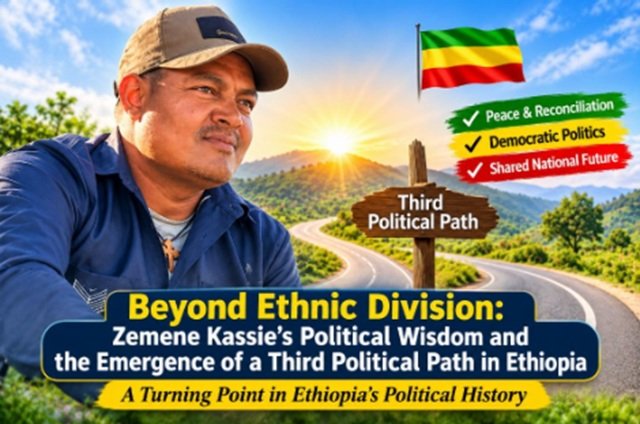
I call this possibility a Third Political Path in Ethiopia: a path beyond ethnic polarization, blind political loyalty, permanent hostility, and the destructive competition that has repeatedly divided the country.
Ethiopia stands at a critical crossroads in its history. Decades of political polarization, competing historical narratives, ethnic nationalism, mutual suspicion, and unresolved grievances have progressively weakened the foundations of the Ethiopian state. What should have been a political struggle over ideas, governance, justice, institutional accountability, and the future of the nation have too often deteriorated into hostility between communities, political movements, and generations.
Against this background, the recent message delivered by Zemene Kassie deserves serious attention. Its significance extends far beyond the immediate political circumstances in which it was delivered. At its core is recognition that the concerns of the Amhara people cannot be separated from those of the Tigrayan people, and equally, that the concerns of the Tigrayan people cannot be separated from those of the Amhara people. Their security, dignity, political aspirations, and long-term futures are interconnected.
This is more than a general appeal for reconciliation. It represents a challenge to a deeply entrenched political mentality that has contributed to Ethiopia’s prolonged crisis: the assumption that different ethnic communities must remain permanent adversaries and that the political advancement of one necessarily comes at the expense of another.
What makes Zemene Kassie’s message particularly important is that it offers an alternative political imagination—one in which former adversaries can recognize shared interests, reconsider established political positions and pursue a future that does not depend on the continued suffering, insecurity, or exclusion of another community. This is the kind of political maturity Ethiopia desperately needs.
The Structural Problem at the Heart of Ethiopian Politics
To understand the significance of Zemene Kassie’s message, it is necessary to examine the political environment that made such a message important in the first place. For decades, Ethiopian political discourse has increasingly been shaped by competing interpretations of historical grievances, political domination, economic inequality, and ethnic identity. Beginning with the political transformations of the 1960s and continuing through subsequent political regimes, questions of class, political power, historical injustice, and institutional accountability became increasingly intertwined with ethnic identity.
Historical grievances and genuine experiences of discrimination must never be dismissed. Communities have legitimate reasons to demand justice, recognition, equality, and accountability. However, reducing nearly every national problem to an ethnic confrontation has produced deeply damaging consequences. Political elites across different communities have frequently portrayed other groups as historical oppressors, beneficiaries of domination, or existential threats. These narratives have gradually filtered into society, encouraging ordinary citizens to view one another with suspicion rather than solidarity.
The result has been a political environment in which communities increasingly perceive themselves as competing victims and political adversaries rather than citizens with shared national interests.
This transformation has been devastating.
Political disagreements have become collective accusations. Historical grievances have been transformed into inherited hostility. Criticism of particular governments and political organizations has frequently become collective condemnation of entire communities.
Such a political culture cannot produce lasting peace, democratic accountability, or national development. The fundamental question is not whether Ethiopia’s communities have different histories, identities, and political aspirations. They unquestionably do. The real question is whether those differences must permanently prevent them from recognizing their shared interests and negotiating a common future.
They do not.
A mature political society must be capable of acknowledging historical injustices without turning historical memory into an instrument of permanent hostility. It must distinguish between the actions of political leaders and the identities of entire populations. No ethnic community should be held collectively responsible for the actions of particular political organizations, governments, military commanders, or individuals. Political accountability must be individual, institutional, and evidence based.
Why Zemene Kassie’s Message Matters
One of the most significant aspects of Zemene Kassie’s recent message is its recognition of mutual responsibility between the Amhara and Tigrayan peoples. The principle is straightforward but politically profound: the concerns of the Tigrayan people are not exclusively Tigrayan concerns, just as the concerns of the Amhara people are not exclusively Amhara concerns.
The same principle must apply to the Oromo and every other community in Ethiopia.
A country cannot survive if its citizens become indifferent to the suffering of other citizens simply because they belong to different ethnic communities. The future of one community cannot be sustainably secured through the destruction, marginalization, or political exclusion of another. Equally, the legitimate aspirations of one community cannot be dismissed simply because another community has its own historical grievances.
This reciprocal recognition is essential.
Amhara concerns deserve recognition and serious consideration by Tigrayan political actors, just as Tigrayan concerns deserve recognition and serious consideration by Amhara political actors. Neither side should expect reconciliation to mean that only the other must make concessions.
A durable relationship requires mutual respect, honest engagement with historical grievances, accountability, and a commitment to protecting the rights and dignity of civilians.
What makes Zemene Kassie’s message especially noteworthy is that it challenges the traditional logic of ethnic political competition. It recognizes that security, dignity, justice, political representation, economic opportunity, and peace are interconnected national concerns.
There is considerable wisdom in understanding that yesterday’s adversary does not necessarily have to remain tomorrow’s enemy.
This is not an argument for forgetting history, abandoning legitimate grievances, or surrendering political principles. It is an argument for refusing to allow historical grievances to determine the future indefinitely. That is a significant departure from the politics of permanent division.
From Former Adversaries to Potential Strategic Partners
The significance of this message becomes even clearer when considered alongside the emerging cooperation among seven Ethiopian political and armed organizations, including forces associated with Fano, TPLF/TDF, and OLA. These organizations have different ideological orientations, political objectives, historical experiences, organizational structures, and approaches to political struggle. Some have previously been on opposing sides of devastating conflicts.
Their differences are real and should not be minimized. Nevertheless, the willingness to recognize common political interests despite those differences represents an important development in Ethiopia’s political landscape.
Zemene Kassie has described a shift away from treating Tigrayan forces as immediate military adversaries and toward recognizing broader shared political interests. His expression, “We do not shoot at ourselves,” captures the central idea: former adversaries should reconsider fighting one another when they recognize that their communities may have common interests and concerns.
He has also described relations with Tigrayan forces positively and expressed support for their struggle.
The political significance of this development is not simply that organizations with different backgrounds may be cooperating. It is that political actors previously defined by mutual hostility may be beginning to recognize that their respective political struggles cannot be understood in isolation from one another.
This raises an important question for Ethiopian politics: Can political movements with different ideological foundations and painful historical experiences recognize common interests without abandoning their respective identities and political principles?
The answer should be yes.
Political cooperation does not require ideological uniformity. It requires the ability to identify areas of common interest while maintaining independence to disagree on other matters.
However, the durability and practical implementation of this emerging cooperation remain to be demonstrated. Its significance must ultimately be evaluated through the participating organizations’ conduct, political commitments, and consequences for ordinary Ethiopians.
The opportunity is important, but its success cannot be assumed.
Political Cooperation Does Not Require Agreement on Everything
One of the most important principles of mature democratic politics is that cooperation does not require complete ideological agreement. Political organizations do not need identical philosophies, economic policies, organizational structures, or political strategies to recognize shared national interests. Individuals do not need to agree on every political question to acknowledge that cooperation may be necessary to address a common challenge.
In my view, this distinction is particularly important for Ethiopia because political disagreements have too often become reasons for permanent hostility. Political actors have frequently treated ideological differences as if they made dialogue, cooperation, or mutual recognition impossible.
That approach has weakened the country’s political culture and limited opportunities for meaningful national dialogue.
A political movement can disagree with another organization’s ideology while recognizing the legitimacy of the concerns that organization claims to represent. It can criticize the historical record and political decisions of another movement while remaining open to constructive engagement on issues of common interest. Similarly, acknowledging a constructive initiative should not be interpreted as political surrender, ideological compromise, or unconditional endorsement.
This is an essential distinction that Ethiopian political actors must learn to embrace.
Political maturity requires the ability to evaluate actions, decisions, and proposals according to their merits rather than automatically accepting or rejecting them based on the identity or affiliation of the individuals and organizations involved.
Blind opposition is not necessarily evidence of political principle. Likewise, unconditional loyalty is not evidence of political wisdom. A credible political actor must be capable of criticizing an organization when its conduct deserves criticism and acknowledging constructive developments when they occur. That standard must apply equally to political organizations, armed movements, opposition groups, and the federal government.
Ethiopia needs a political culture in which facts matter more than loyalty, principles matter more than personalities, and the national interest matters more than organizational rivalry.
Political opposition must be principled, not automatic. Political cooperation must be strategic, not unconditional. And political leadership must be measured by its contribution to the public good, not simply by its ability to mobilize supporters against an adversary.
Breaking the Cycle of Historical Hostility
For generations, Ethiopian politics has been trapped in a cycle of accusation and counteraccusation. Some political narratives portray Amhara political elites as historical oppressors. Others portray Tigrayan political elites as inherently authoritarian or collectively responsible for the country’s political problems. Still others interpret Oromo political aspirations through competing narratives of domination and resistance. Such narratives frequently reduce complicated historical and political realities to simplistic ethnic categories. The danger is that political disagreements with particular leaders, governments, or organizations become collective judgments against entire populations.
This approach is both intellectually flawed and politically destructive. The historical record must be examined honestly, including injustices committed under different governments. Communities must be able to discuss historical suffering, seek accountability, and demand institutional reform. However, historical examination should serve truth, accountability, justice, and reconciliation not the perpetuation of inherited hatred. The younger generation should not be required to inherit the political resentments of previous generations.
The challenge before Ethiopia is to develop a political culture in which historical grievances can be acknowledged without becoming permanent barriers to cooperation. Zemene Kassie’s message is important precisely because it challenges the assumption that historical grievances must forever determine present political relationships. It suggests that communities can acknowledge their painful histories without allowing those histories to dictate an endless future of confrontation.
The Emerging Seven-Organization Cooperation: An Opportunity, Not a Guarantee
The cooperation among seven political and armed organizations should not be evaluated exclusively through its immediate military or strategic implications.Its broader political significance deserves equal attention.
For decades, political forces that might otherwise have recognized common concerns have struggled to establish meaningful cooperation because of ideological disagreements, ethnic mistrust, historical grievances, and competing political ambitions.
The willingness to cross these boundaries could create opportunities for dialogue, reduce hostility between communities, and encourage political forces to consider national solutions rather than exclusively ethnic or organizational priorities. However, the formation of an alliance does not automatically constitute democratic transformation.
Its credibility will depend on whether participating organizations demonstrate genuine commitments to civilian protection, political pluralism, accountability, inclusive representation, constitutional governance, and peaceful political solutions.
They must also explain how they intend to address fundamental questions concerning Ethiopia’s political future, including the nature of the state, constitutional arrangements, regional autonomy, democratic representation, minority rights, and the peaceful resolution of political disagreements.
Most importantly, they must recognize that Ethiopia’s future belongs to its people, not exclusively to armed organizations or political elites.
The objective cannot simply be to replace one concentration of political power with another.
It must be to establish a political system in which all communities can participate freely and equally, without fear of domination, exclusion, or collective punishment. That is the standard by which this emerging cooperation should ultimately be judged.
Political Cooperation Must Not Become an Endorsement of War
Recognizing the potential value of political cooperation among organizations with different backgrounds should not be confused with endorsing armed conflict as the preferred method of resolving Ethiopia’s political problems.
This distinction is essential.
Ethiopia has experienced the enormous human, economic, and institutional costs of prolonged internal conflict. War destroys lives, displaces communities, undermines public institutions, weakens economic development, and creates grievances that can persist across generations.
A country cannot achieve lasting development while continually sacrificing its human resources and national institutions to internal conflict.
In my view, the ultimate objective of political cooperation should be to create conditions in which meaningful negotiations, inclusive political dialogue, and peaceful democratic transformation become possible. Military confrontation cannot substitute for a legitimate political settlement.
The federal government also bears a fundamental responsibility to create conditions in which peaceful opposition, public participation, political competition, and genuine dialogue are possible. When peaceful political participation is obstructed and legitimate grievances remain unaddressed, political instability can become increasingly dangerous.
Nevertheless, the solution must be a political settlement that protects civilians, recognizes legitimate grievances, establishes credible institutions, and guarantees equal political rights not an endless cycle of armed confrontation.
The measure of political leadership should not be its ability to mobilize people for confrontation, but its capacity to create a sustainable future in which Ethiopians no longer have to resolve political disagreements through violence. Political cooperation should ultimately serve the interests of ordinary citizens, protect human life, and open a path toward a peaceful and democratic political order.
Political Maturity Requires Intellectual Honesty
Perhaps one of the most important requirements for transforming Ethiopian politics is intellectual honesty. Ethiopian politics has too often rewarded political loyalty over independent judgment. Political actors are frequently expected to reject everything associated with their opponents, regardless of its merits.
This is not political sophistication.
A person can disagree with TPLF’s historical record while recognizing the importance of constructive engagement with Tigrayan political actors. A person can criticize Fano’s political decisions while acknowledging the legitimate concerns of the Amhara population. A person can disagree with OLA’s ideology while recognizing that Oromo grievances deserve serious political consideration, like others.
The same standard must apply to the federal government and every other political organization.
Political principles should not change depending on who is speaking or which organization is involved.
This is what intellectual independence requires. A credible political movement must distinguish between legitimate criticism and automatic hostility. It must be willing to acknowledge mistakes within its own ranks and recognize constructive actions by its political opponents.
The ability to reconsider established positions in light of new circumstances is not weakness. It is evidence of political maturity.
Political actors must be prepared to challenge their own assumptions, question narratives that have become politically convenient, and recognize when changing circumstances create opportunities for cooperation.
Ethiopia needs leaders who are willing to place the national interest above personal pride, organizational loyalty, and inherited political assumptions.
A political culture that cannot tolerate internal criticism or acknowledge the merits of an opponent’s constructive actions will struggle to develop the institutions and democratic practices necessary for lasting stability.
The Responsibility of the Younger Generation
Perhaps the most encouraging dimension of this development is its generational significance.
The willingness of younger political actors to establish relationships across previously hostile political boundaries offers an opportunity to reconsider the political assumptions inherited from the past.
This is an important challenge to Ethiopia’s next generation of leaders.
Young Ethiopians should not be required to inherit the political hostility, ideological rigidity, and ethnic suspicions of their predecessors. They should be encouraged to build political organizations around ideas, policies, democratic principles, economic development, justice, and accountable governance.
A modern democratic society should allow citizens to organize around competing political philosophies rather than requiring political participation to follow ethnic boundaries. Citizens should be free to support liberal, conservative, social-democratic, or other political traditions without being defined primarily by their ethnic identity.
Ethnic identity is an important part of individual and collective history, but it should not become a permanent political prison. The long-term objective should be a political system in which ideological competition replaces ethnic antagonism as the principal organizing force of democratic politics.
That transformation will require courage, compromise, institutional reform, and a willingness to learn from history. Most importantly, the younger generation must recognize that it has the opportunity and responsibility to build political relationships that previous generations struggled to establish. It must refuse to allow inherited hostility to determine the country’s future.
Toward a Third Political Path: Beyond Hatred and Polarization
Ethiopia needs a political alternative that moves beyond the traditional division between competing political camps. Such an alternative should not be defined by unconditional support for a particular government, political organization, ethnic movement, or armed group.
Nor should it be driven by personal attacks, ethnic hostility, political propaganda, or unquestioning loyalty. Instead, it should provide space for serious political discussion, independent analysis, constructive criticism, and dialogue focused on national challenges and practical solutions. It should promote peace, democratic transition, constitutional governance, national reconciliation, institutional accountability, economic development, and equal citizenship.
Ethiopia needs intellectuals who can challenge political leaders without becoming instruments of political propaganda. It needs political organizations capable of acknowledging historical wrongdoing without making collective guilt the foundation of national identity. It needs citizens who can disagree politically without treating one another as enemies. Most importantly, it needs leaders who understand that reconciliation is not weakness, compromise is not surrender, and cooperation is not ideological betrayal. National reconciliation is not simply a moral aspiration. It is a political and institutional necessity for building a sustainable state.
In my view, this third political path must be grounded in independent thinking and consistent principles. It should neither excuse the wrongdoing of political allies nor automatically condemn the constructive actions of political opponents. It must be willing to challenge every political organization according to the same standards of accountability, human rights, democratic governance, and respect for civilian life. Such a political space could help move Ethiopia away from the destructive choice between competing forms of political extremism and toward a more inclusive national conversation.
The Political Transformation Ethiopia Needs
Ultimately, the importance of Zemene Kassie’s recent message should be measured not merely by the immediate political relationships it may help establish, but by the deeper transformation in political thinking it challenges Ethiopia to undertake. His recognition that Amhara and Tigrayan interests are interconnected directly challenges the logic of permanent ethnic confrontation.
It encourages political actors to reconsider inherited assumptions, recognize mutual responsibilities, and acknowledge that the future of one community cannot be separated from the future of another. This is an important departure in a political environment where recognizing another community’s legitimate concerns has too often been interpreted as political weakness or betrayal. There is considerable wisdom in understanding that yesterday’s adversary does not necessarily have to remain tomorrow’s enemy.
There is political maturity in recognizing that cooperation does not require agreement on every issue, that reconciliation does not erase historical accountability, and that defending one’s community does not require denying the dignity or rights of another. If this principle becomes more deeply established in Ethiopian political discourse, its implications could extend well beyond the relationship between the Amhara and Tigrayan peoples. It could help create a new foundation for relationships among all Ethiopian communities and political movements.
The emerging cooperation among previously antagonistic organizations may provide an opportunity to move in that direction. But the real transformation will depend on whether these organizations can move beyond temporary strategic interests and develop a credible, inclusive, and democratic vision for the country. A change of government alone cannot guarantee a change in political culture. Replacing one group of political elites with another will not resolve the structural problems that have repeatedly weakened Ethiopia. The country needs stronger institutions, accountable leadership, equal citizenship, democratic competition, genuine reconciliation, and a political environment in which peaceful disagreement is protected rather than treated as a threat. That is the deeper transformation Ethiopia needs.
The Choice Before Ethiopia
Ethiopia cannot overcome its political crisis by continuing the same political practices that contributed to it. If ethnic suspicion, collective blame, political exclusion, and permanent hostility continue to dominate national politics, the country risks deeper fragmentation and further human suffering. If, however, political actors begin to recognize their shared interests, respect one another’s legitimate concerns, and establish meaningful mechanisms for cooperation, a different future becomes possible.
The emerging cooperation among previously antagonistic organizations is not, by itself, proof that Ethiopia has entered a new political era. Its intentions, conduct, and commitment to democratic principles must be examined critically. Nevertheless, the willingness to acknowledge that the futures of the Amhara, Tigrayan, Oromo, and other Ethiopian communities are interconnected deserves recognition. This is the kind of political thinking that should be encouraged, debated, and strengthened. The message should reach political organizations, civil society, intellectuals, religious leaders, the Ethiopian diaspora, and particularly the younger generation. The responsibility for Ethiopia’s future cannot belong to one ethnic group, one political organization, or one generation. It must be shared by all Ethiopians.
A country is not saved by the victory of one community over another. It is saved when its citizens recognize that their dignity, security, freedom, and future are interconnected.
Ethiopia does not need another generation defined by inherited hatred. It needs a generation courageous enough to replace suspicion with cooperation, political revenge with accountability, ethnic antagonism with democratic competition, and division with a shared national vision.
The real political transformation Ethiopia needs is not simply a change of government. It is a change in the way Ethiopians understand one another, exercise political power, resolve disagreements, and imagine their collective future.
A country is not built by teaching its citizens to fear one another. It is built by creating institutions and political relationships in which every community can live with dignity, security, equality, and hope. The future of the Amhara people is connected to the future of the Tigrayan people. The future of the Tigrayan people is connected to the future of the Amhara people. And the future of both is inseparable from the future of every other Ethiopian community.
That is the deeper wisdom behind Zemene Kassie’s message. That is the political maturity Ethiopia needs. And that is the transformation its people deserve.
A Third Political Path for Ethiopia
I believe Zemene Kassie’s message deserves attention because it challenges the assumptions that have kept the country trapped in division. The emerging cooperation among previously antagonistic political forces presents an opportunity but also a serious test of political maturity, democratic commitment, and national responsibility.
The real question is whether this moment can become the beginning of something greater than a temporary political alliance: a new political culture in which Ethiopians can defend their communities without dehumanizing others, pursue justice without promoting collective hatred, disagree without becoming enemies, and cooperate without surrendering their principles.
Perhaps the most important legacy of Zemene Kassie’s message will not be the alliances formed today, but the political possibilities it encourages Ethiopians to imagine for tomorrow.
“The third political path is not about choosing one ethnic group over another, replacing one political camp with another, or exchanging one form of domination for a different one. It is about choosing a different future—one in which justice replaces revenge, cooperation replaces hostility, democratic competition replaces ethnic polarization, and the shared dignity and freedom of all Ethiopians become the foundation of our national future.”
That is the turning point Ethiopia needs: not another victory of one group over another, but the beginning of a political future in which all Ethiopians can belong, participate, and prosper.
Editor’s Note: Views in the article do not necessarily reflect the views of borkena.com
__
Join our Telegram Channel: t.me/borkena
Like borkena on Facebook
To submit a press release, send the submission to info@borkena.com
Add your business to Ethiopian Business Listing / Ethiopian Business Directory
Join the conversation. Follow us on X (formerly Twitter) @zborkena to get the latest Ethiopian news updates regularly