
By Yihenew Ewnetu
Sweden
Executive summary
This monograph provides a critical academic analysis of executive restructuring within the Ethiopian federal government under Prime Minister Abiy Ahmed. It interrogates the administration’s stated rationale for cabinet reshuffles—namely, that ministerial appointments and dismissals are guided by covert intelligence-led integrity and asset surveillance—against the empirical realities of selective justice, elite patron-client networks, and political centralisation. Drawing upon Irving Janis’s classical theory of Groupthink, alongside neo-patrimonial and authoritarian survival frameworks, this study examines how the consolidation of executive power around loyalists, intelligence veterans, and shared ideological-religious networks displaces technocratic competence. The paper analyzes the structural asymmetry between the extra-judicial leniency afforded to dismiss regime elites suspected of grand graft and the punitive carceral measures imposed on political dissidents, particularly Amhara journalists, activists, and opposition figures. Furthermore, incorporating recent revelations from defected officials, the study explores the administration’s tacit encouragement of kleptocracy as a mechanism for elite cohesion. Finally, through an empirical matrix of cabinet appointments, the study evaluates whether an insulated, ideologically homogenous, and recycled executive apparatus is structurally capable of de-escalating civil conflict and reversing deep macroeconomic deterioration.
1. Introduction
Cabinet appointments and dismissals within contemporary hybrid regimes frequently serve functions distinct from mere administrative optimization (Van de Walle, 2001, p. 115). In post-2018 Ethiopia, executive turnover has increasingly been framed through
the vocabulary of bureaucratic hygiene, state modernization, and institutional integrity. Following successive ministerial shakeups, Prime Minister Abiy Ahmed publicly asserted that cabinet removals and reappointments were informed by comprehensive, covert intelligence investigations monitoring the domestic and offshore assets, business ties, and financial integrity of high-ranking state officials (Ethiopia Today, 2026, n.p.). According to executive statements, these state intelligence sweeps serve as an empirical filter to eliminate corrupt patronage networks, curb illicit capital flight, and enforce accountability within the federal administration.
Nevertheless, political scientists and comparative constitutional scholars observe a profound dissonance between this anti-corruption discourse and the actual mechanics
of political survival. If the state’s security and intelligence services had established actionable, documented evidence of grand corruption, illicit financial accumulation, and offshore asset shielding against outgoing ministers and senior regional cadres—such as former Defense Minister Dr. Abraham Belay, former Innovation Minister Dr. Belete Molla, or former Speaker of the House of Federation Agegnehu Teshager—the constitutional logic of a sovereign republic demands criminal prosecution, asset forfeiture, and judicial sanction under the Revised Anti-Corruption Special Procedure and Rules of Evidence Proclamation (FDRE, 2015, p. 4).
In practice, the executive’s anti-corruption rhetoric diverges into two distinct pathways. For the regime elite faction (dismissed ministers and high-ranking cadres), the outcome is a shielding from prosecution. This results in a graceful, quiet exit or lateral diplomatic reassignment, which serves to preserve oligarchic peace and prevent internal regime fracturing. Conversely, for opposition and regional critics—most notably Amhara journalists, activists, and politicians—the outcome of state action is punitive political neutralization characterized by arbitrary prolonged detention, coerced self-incriminating pacts, and the bypassing of fundamental habeas corpus safeguards.
The systematic substitution of judicial proceedings with quiet dismissals or lateral demotions demonstrates that ministerial turnover operates primarily as an instrument of factional management rather than an objective enforcement of the rule of law. Dismissal cannot constitute the terminal penalty for systemic graft. When state intelligence files are weaponized to enforce executive loyalty while insulating elites from open trial, the anti-corruption apparatus ceases to be an instrument of governance and becomes an operational tool for regime self-preservation (Prendergast, 2023, p. 42).
1.1 The “Hacked by Thieves” Paradox and the Cooptation of Kleptocracy The dissonance between the executive’s public anti-corruption posture and its internal practices is starkly illustrated by the Prime Minister’s own admissions and the testimonies of former insiders. Prime Minister Abiy Ahmed has publicly acknowledged the rampant theft within his administration, famously stating in a 2024 address that “Government structures are hacked by thieves” (Addis Standard, 2024, n.p.).
However, defectors and critics argue that his administrative actions completely contradict any genuine anti-corruption stance. Instead of prosecuting and punishing officials who have demonstrably stolen public resources, the government frequently transfers these corrupted leaders to foreign countries as diplomats or reappoints them to other directorial and ministerial levels (Borkena, 2024, n.p.). By merely reshuffling or promoting individuals known to have stolen public wealth, the executive effectively
encourages the behavior, ensuring that loyalty to the Prosperity Party (PP) is rewarded above the rule of law.
This structural reality is further corroborated by bombshell revelations from defected and former officials. Former Prosperity Party officials such as Dr. Milkessa Midega and Taye Denda, alongside former senior government official Gedu Andargachew (who was a high-ranking official but crucially not a member of the PP), have raised severe alarms regarding the administration’s trajectory (YouTube, 2021, n.p.). According to these public disclosures, there are serious allegations of unchecked corruption, personal enrichment, and ties to covert killings carried out to protect political power. Critics have described the administration as exploiting the country’s profound crises—including active war situations and opaque privatization efforts—to allow political elites to amass private wealth and fleece the country. For these aligned groups, political power has ceased to be a mechanism of public service and has instead been transformed into a sanctioned tool for personal enrichment and elite cohesion.
2. The Asymmetry of Justice: Selective Impunity and Ethno-Political Containment
The executive’s handling of elite financial misconduct stands in sharp contrast to the aggressive legal and security apparatus deployed against perceived political adversaries. This asymmetry illustrates what legal scholars term discriminatory legalism—the principle of “for my allies, indulgence; for my critics, the full weight of the law.”
Over the period coinciding with active counter-insurgency campaigns in the Amhara and Oromia regions, hundreds of Amhara journalists, human rights defenders, scholars, and elected parliamentarians have been subjected to arbitrary detention, prolonged pre-trial incarceration without formal charges, and transfer to informal military detention camps (Human Rights Watch, 2024, n.p.). In numerous documented instances, detainees were held despite judicial bail orders, or forced to sign self-incriminating memoranda and political loyalty pledges as a non-statutory precondition for release.
This structural duality in Ethiopian legalism is defined by two opposing domains:
● The Executive/Patronage Domain (Cabinet Insiders): In this sphere, the standard of proof relies on unreleased intelligence files used privately to justify dismissals. Due process is completely bypassed, with no formal charges or public judicial asset discovery. The ultimate sanction is administrative removal,
lateral entry into parastatals, or diplomatic immunity. The structural goal is the stabilization of the elite cartel and the suppression of factional fragmentation.
● The Oppositional Domain (Eg. The Amhara prisoners of Conscious): In this
sphere, the standard of proof relies on unsubstantiated anti-terror allegations or operates without any formal allegations at all (FDRE, 2020, p. 12). Due process is actively suspended through repeated denials of bail and habeas corpus. The
sanctions include incarceration, physical abuse, and extortionate coercive releases. The structural goal is the decapitation of rival ethno-national mobilization and the silencing of political dissent.
This structural duality exposes the primary function of executive “integrity vetting.” Rather than purging systemic corruption, covert asset tracking creates asymmetric leverage over cabinet members. When an executive compiles files on the financial
dealings of subordinates without initiating formal legal proceedings, those files serve as a disciplinary leash. An official whose irregular holdings are documented, but unprosecuted, remains entirely reliant on executive grace for freedom and property preservation.
Consequently, the process of selecting new ministers is not governed by an objective search for technocratic excellence. Instead, it prioritizes officials whose institutional dependencies, personal debts, and ideological alignment guarantee compliance within an increasingly centralized presidency (Lyons, 2019, p. 88).
3. Theoretical Framework: Groupthink, Insulation, and Strategic Blunders
To systematically understand the decision-making culture of the consolidated Ethiopian executive, this study utilizes Irving L. Janis’s (1972, 1982) foundational theoretical model of Groupthink, integrated with contemporary theories of neo-patrimonial authoritarian consolidation.
Janis (1982, p. 9) defined groupthink as a mode of thinking that individuals engage in when they are deeply involved in a cohesive in-group, where members’ strivings for unanimity override their motivation to realistically appraise alternative courses of action. The structural evolution of Abiy Ahmed’s cabinet neatly tracks the three primary stages of the Janisian Groupthink Paradigm:
1. Antecedent Conditions: The cabinet is characterized by high structural group cohesiveness, largely built on shared backgrounds in the Information Network
Security Agency (INSA) or the Oromo People’s Democratic
Organization/Prosperity Party (OPDO/PP). It suffers from structural insulation from critical civil feedback and a lack of institutionalized methodological procedures for evaluation. Furthermore, it is dominated by directive, charismatic leadership exercising asymmetric dominance and bound by severe ideological homogeneity centered on Prosperity Gospel and Medemer theology.
2. Symptoms of Groupthink: This environment produces an illusion of invulnerability and moral superiority. The cabinet engages in the collective rationalization of catastrophic governance failures and relies on stereotyping out-groups (branding critics as “anti-peace elements”). There is direct pressure placed on dissenters, leading to profound self-censorship, and the emergence of self-appointed “Mindguards” drawn from the intelligence and media cadres to protect the executive from adversarial information.
3. Defective Decision-Making and Disastrous Outcomes: The ultimate results are an incomplete survey of alternatives and a failure to examine risks. The executive selects hyper-loyalist cabinets over competent technocrats, severely miscalculates the resilience of armed insurgencies (such as the Amhara Fano and the OLA), and engages in catastrophic policy persistence.
The Vietnam Analogy and Policy Catastrophe
The historical consequences of groupthink in insulated executives are well-documented. Janis’s (1972, p. 114) seminal case study examined how President Lyndon B. Johnson’s inner circle became trapped in a self-reinforcing echo chamber during the escalation of the Vietnam War. Convinced of their intellectual superiority and the inevitability of American military dominance, Johnson’s advisors systematically suppressed pessimistic intelligence, dismissed regional complexities, and ignored internal dissent.
In post-2018 Ethiopia, a comparable dynamic has unfolded across multiple crises. From the devastating 2020–2022 Tigray War to the intractable, widespread rural insurgency in the Amhara region and the persistent conflict in Oromia, an insulated executive circle has repeatedly framed complex constitutional grievances as localized insurgencies that could be swiftly crushed through military force and drone strikes. The absence of internal institutional critique ensured that catastrophic policy errors were sustained rather than corrected.
The Institutional Absence of the “Devil’s Advocate”
Following the Bay of Pigs fiasco, President John F. Kennedy recognized the catastrophic hazards of uncritical consensus and mandated that trusted advisors act explicitly as skeptical inquisitors—institutionalizing the role of the Devil’s Advocate to
interrogate every assumption, challenge operational plans, and expose flawed logic prior to escalation (Janis, 1982, p. 267).
In the contemporary Ethiopian executive matrix, the role of the Devil’s Advocate is non-existent. Rather than institutionalizing critical evaluation, the political architecture actively expels dissenters. Ministers who express skepticism regarding military strategy, macroeconomic liberalization, or state-funded vanity initiatives are swiftly tagged as saboteurs, stripped of rank, or isolated.
The costs of discarding the Devil’s Advocate are stark when comparing an institutionalized critical inquest (the JFK model) to an insulated executive (the Abiy Cabinet model). While the former relies on the systematic evaluation of worst-case scenarios, the protection of dissenters, and the rejection of moral invulnerability to allow for course-correction, the latter is defined by the uncritical adoption of the executive vision, the purge and surveillance of dissenters, moral certainty derived from Prosperity theology, and entrenched militarism that leads to deep denial regarding the realities of national fracture. The executive table is populated not by independent technocrats empowered to challenge leadership assumptions, but by administrative executors whose appointments reflect personal allegiance, past institutional dependencies, and shared political survival.
4. The Anatomy of the Inner Circle: Loyalty, Patronage, and Shared Trajectories
The composition of Abiy Ahmed’s cabinet reflects a deliberate consolidation strategy designed to shield the executive center from internal subversion. Prime Minister Abiy Ahmed operates as the executive center and strategic hegemon, managing three primary patronage corridors that serve distinct functions in state survival:
● The Security/Intelligence Anchor (INSA Core): The Information Network Security Agency, co-founded by Abiy Ahmed, serves as the primary incubator for the contemporary ruling elite. Led by figures like Deputy Prime Minister Temesgen Tiruneh, this pillar shares common intelligence methods, surveillance norms, and organizational loyalty. These security cadres form an institutional vanguard that prioritizes monitoring, coercive consolidation, and information discipline over open political mediation (Bereketeab, 2020, p. 112).
● The Institutional Parastatal & Regional Alignments: Led by figures such as Frehiwot Tamiru (Innovation & Technology), Awelu Abdi (Labor), and Sadat Nesha (Logistics), this pillar secures sub-national party discipline and controls
state assets. These figures manage parastatal extraction and secure logistics corridors, maintaining the loyalty of the regional Prosperity Party apparatuses, particularly in Oromia.
● The Dependent Technocrats (Academic/Legal Vanguard): To project modernity to international creditors, the administration elevates
Western-educated technocrats to fiscal and legal ministries. Led by figures like Gedion Timothewos (Foreign Affairs), Hana Arayaselassie (Justice), and Fitsum Assefa (Finance), this pillar provides international legitimacy. However, lacking independent political constituencies, their tenure is entirely contingent upon executive patronage, making them articulate implementers of executive priorities without the autonomy to challenge policy direction.
Familial and Conjugal Consolidation
The appointment of spouses to pivotal structural ministries—most notably Dr. Gedion Timothewos as Minister of Foreign Affairs and his wife, Hana Arayaselassie, as Minister of Justice—represents a rare concentration of state power within a single household (ENA, 2026, n.p.). This conjugal concentration provides the Prime Minister with a tightly integrated legal-diplomatic corridor that minimizes internal leaks, neutralizes inter-agency conflict, and insulates executive actions from judicial challenge.
5. Matrix of Cabinet Networks, Institutional Antecedents, and Alignments
The following matrix categorizes some of the key members of the federal executive, mapping their institutional backgrounds, documented relationships with the Prime Minister, and known religious affiliations.
The Intersection of Prosperity Theology and Executive Power
The demographic and religious transformation of the federal cabinet represents an important sociopolitical shift in modern Ethiopian governance. The intersection of Prosperity Theology and executive power manifests in both theological convergence and profound governance implications.
Theologically, there has been a decisive shift that shows the rising dominance of Pentecostal/Protestant cadres in core ministries. This shift integrates Prosperity Gospel doctrines directly into the rhetoric of state modernization. In terms of governance, this religious alignment reinforces the psychological cohesion of the inner circle and serves three major political functions:
| New Portfolio | Antecedent Network | Shared History with Abiy | Religious Affiliation | Role | References |
| Temesgen Tiruneh Deputy Prime Minister | INSA Director General / Amhara Regional President / Abiy’s Security Adviser | Decades-long security alignment; served under and alongside Abiy within INSA. | No known religious practice | security anchor; manages defense-intelligence operations and regional security alignment. | Fana (2026, n.p.) |
| Gedion Timothewos (PhD) Minister of Foreign Affairs | Legal Academia / Attorney General / Minister of Justice | Elevated rapidly by Abiy post-2018 | Protestant | Chief diplomatic envoy; articulates legal and political defense | Fana (2026, n.p.) |
| Hana Arayaselassie Minister of Justice | Ethiopian Revenues & Customs / Telecom Executive / Justice Reformer | Direct executive protégé; married to Foreign Minister Gedion Timothewos. | Protestant | Legal gatekeeper; oversees federal public prosecution | ENA (2026, n.p.) |
| Frehiwot Tamiru Minister of Innovation & Technology | CEO of Ethio Telecom / State Parastatal Executive | Abiy served on Ethio Telecom board during his INSA tenure. | Protestant | Digital infrastructure and parastatal asset mobilization drives state telecom policy. | Ethiopia Today (2026, n.p.) |
| Fitsum Assefa (PhD) Minister of Finance | Academia / Planning & Development Commission | Recruited into executive circle post-2018 | Protestant | Macroeconomic face to IMF/World Bank | Ethiopia Today (2026, n.p.) |
| Mohammed Idris Minister of Defense | Ethiopian Media Authority / Regional Administration | Close political associate within the Prosperity Party apparatus. | Muslim | Manages formal military-civil administrative interface | Ethiopia Today (2026, n.p.) |
| Berhanu Nega (Prof.) Minister of Education | Exiled Opposition Leader (Ginbot 7) / Academician | Co-opted opposition figure integrated via post-2018 amnesty | Not practicing any religion | Provides a veneer of inclusive multi-party governance. | Fana (2026, n.p.) |
| Awelu Abdi & Sadat Nesha Labor & Skills / Logistics | Oromia Regional State Executive Leadership | Regional OPDO/PP party stalwarts aligned with Abiy’ | Muslim | Sub-national party discipline; secures logistics corridors and regional party stability. | Ethiopia Today (2026, n.p.); ENA (2026, n.p.) |
1. Teleological Justification of Rule: Wealth creation, infrastructure development, and political dominance are framed as signs of divine favor, insulating executive policy from conventional economic or secular criticism.
2. De-politicization of Structural Poverty: Economic hardship, inflation, and institutional decay are frequently framed as failures of individual mindset, spiritual readiness, or bureaucratic sabotage, rather than the result of macroeconomic dysfunction, foreign exchange shortages, or war expenditures.
3. Moral Invalidation of Critics: Opposition to executive initiatives is interpreted not as legitimate policy disagreement, but as resistance to national renewal and spiritual progress. Critics are morally invalidated, making punitive action against them more palatable to the in-group.
When personal fidelity, institutional roots in the security apparatus, and shared spiritual identities merge, they build an insulated political elite. This elite is structurally protected against internal critique, yet increasingly vulnerable to external shocks, systemic miscalculations, and compounding national crises.
6. Rewarding Failure
As the saying goes, “Insanity is doing the same thing over and over again and expecting different results.” Abiy has appointed the same or similar people (at the Foreign Ministry, Ministry of Justice, Ministry of Education, at Ministerial portfolios that manage the country’s economic institutions etc) that have succeeded in complete failure during their hitherto teneurs. They are, of course, not expected to do something different. If any, it would be worse than what they have done to the country and the people since they strive to do what makes Abiy happier than what is inherently right or just.
A) The Macroeconomic Crisis: The economic record of Abiy Ahmed and his team has been characterized by a stark paradox: the rapid completion of highly visible urban infrastructure and luxury development projects against a backdrop of deep macroeconomic deterioration. The executive attributes economic distress to external shocks (COVID-19, the Ukraine war, global supply chain disruptions) and inherited bureaucratic inefficiencies. However, a structural analysis reveals that the macroeconomic crisis is deeply intertwined with the administration’s political economy of patronage and the financial demands of regime survival.The primary driver of macroeconomic instability in contemporary Ethiopia is the financing of consecutive civil conflicts. The Tigray War (2020–2022) and the ongoing insurgencies in Amhara and Oromia required the mobilization of immense state resources. The federal government
funded these operations largely through domestic borrowing and the expansion of the monetary base by the National Bank of Ethiopia (NBE).
This monetization of the fiscal deficit—printing money to fund war—has resulted in rampant, structural inflation. The costs are borne disproportionately by the rural and urban poor, whose purchasing power has been decimated. The executive cabinet, insulated by state resources and patronage networks, is structurally shielded from these inflationary shocks, fostering a profound disconnect between executive policy and popular welfare.
B) The Politics of Macroeconomic Reform and Currency Floatation: In 2024, the administration enacted a historic macroeconomic reform, transitioning from a managed peg to a market-determined foreign exchange rate (floating the Birr) as a precondition for securing a $10.7 billion financing package from the IMF and World Bank (World Bank Group, 2026, n.p.).
While technocrats within the cabinet (such as Finance Minister Fitsum Assefa) framed this as a necessary structural adjustment, the implementation reflects the neo-patrimonial realities of the regime. The immediate depreciation of the Birr severely impacted the cost of imported essentials (fuel, medicine, fertilizer). However, the political elite and politically connected oligarchs—those with access to foreign currency reserves, parastatal contracts, and hard assets (real estate)—were well-positioned to hedge against or actively profit from the devaluation. The reform effectively redistributed wealth upward, consolidating economic power within the ruling faction while plunging millions into deeper poverty (Lefort, 2015, p. 372).
C) Urban Modernization as Ideological Display: Despite the severe shortage of foreign exchange and rising sovereign debt, the executive has prioritized massive, non-productive urban investments in Addis Ababa, including the multi-billion-dollar Chaka Project (a new palace complex) and extensive corridor development schemes.
Viewed through the Janisian paradigm, these projects are not simply economic misallocations; they are ideological imperatives. Driven by Prosperity theology and the desire to project strength, the executive views these monuments as visible proof of the regime’s success and divine favor. The diversion of scarce national resources away from agricultural development, industrialization, and poverty alleviation toward executive vanity projects demonstrates the extent to which the cabinet’s priorities are detached from the material realities of a country plagued by poverty and civil war.
D) The Degradation of Human Rights and the Institutionalization of Repression: The political survival strategy of the Abiy administration relies heavily on the systematic degradation of human rights, enforced by the security cadres dominating the executive structure. The state’s response to political opposition, particularly ethno-nationalist mobilization, is characterized by extrajudicial violence, arbitrary detention, and the suspension of constitutional rights.
The Ministry of Justice, overseen by Hana Arayaselassie, operates not as an independent guardian of the rule of law, but as a political instrument of the executive. The structural duality discussed earlier—lenient administrative “vetting” for loyalists versus punitive detention for critics—is the defining feature of the federal justice system. The widespread use of anti-terrorism proclamations (FDRE, 2020, p. 14) and states of emergency allows the executive to bypass standard judicial procedures. Journalists, activists, and political figures are routinely held in informal detention centers, denied access to legal counsel, and subjected to physical and psychological coercion. The judicial system, heavily pressured by the executive, frequently fails to enforce habeas corpus or uphold bail orders, rendering the courts complicit in the regime’s campaign of political containment.
The state’s use of coerced self-incriminating pacts and political loyalty pledges as preconditions for release highlights a shift from punitive justice to behavioral modification. The goal is not merely to punish dissent, but to publicly break the will of political opponents and force compliance. By extracting confessions and public apologies, the regime attempts to demoralize opposition constituencies and project an image of unchallenged hegemony.
E) Institutional Decay: Education and Public Services: The crisis of governance extends beyond the security and macroeconomic spheres, deeply impacting fundamental public institutions. The education sector, overseen by Prof. Berhanu Nega, provides a stark example of institutional decay. Despite rhetoric emphasizing modernization and technological leapfrogging, the national education system is in a state of collapse. Years of conflict have destroyed thousands of schools in Tigray, Amhara, and Afar. The pervasive lack of security in Oromia and Amhara prevents millions of children from attending classes. Furthermore, the catastrophic failure rates on recent national university entrance exams highlight the profound deterioration in educational quality.
The appointment of an intellectual figurehead like Berhanu Nega fails to arrest this decline because the fundamental causes—war, underfunding, and political
instability—are driven by executive decisions beyond the control of the Ministry of Education. His presence serves primarily to absorb public frustration and provide a veneer of multi-party inclusion, while the core executive pursues policies that continually undermine the educational infrastructure.
7 Discussion
The Structural Limits of an Insulated Cabinet
The central question arising from this analysis is whether an executive apparatus structured around loyalty, familial ties, and ideological homogeneity is capable of solving Ethiopia’s sophisticated, compounding crises. The empirical evidence strongly suggests it is not.
7.1. The Recycling of Failure
Many of the individuals appointed in the October 2026 reshuffle (e.g., Fitsum Assefa, Frehiwot Tamiru, Gedion Timothewos) were central figures in the administration during the preceding years—the exact period during which the legal, human rights, educational, and economic situations precipitously deteriorated. The reshuffle is not a change in direction; it is a recycling of the very personnel who oversaw the current crises.
If a leadership team presided over a devastating civil war, historical currency devaluation, soaring inflation, and the collapse of the national education system, elevating or laterally moving those same individuals cannot logically be expected to produce reform. Their re-appointment signals that the Prime Minister values their past compliance and ideological alignment over independent competence.
7.2. The Incapacity for Course Correction
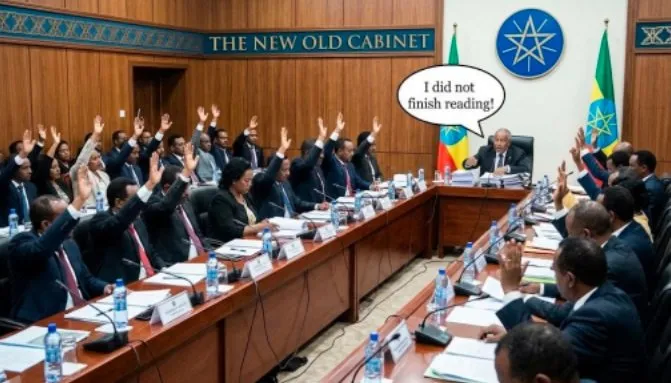
The Groupthink paradigm explains why this cabinet structure is uniquely unsuited to crisis management. A cabinet composed of loyalists, dependent technocrats, and security veterans lacks the internal capacity to challenge the executive’s assumptions. The absence of a “Devil’s Advocate” means that disastrous policies—whether military escalation in Amhara or massive spending on palace construction—are never subjected to rigorous, critical evaluation.
When the executive table is populated by individuals whose political and financial survival depends entirely on the Prime Minister’s favor, the flow of information is severely distorted. Ministers become “Mindguards,” shielding the Prime Minister from
pessimistic assessments and reinforcing the illusion of progress, ensuring that the government remains trapped in a cycle of strategic blunders.
7.3. The Consequences of Patronage in a Poor, Fractured State In a wealthy, stable state, patronage networks and executive vanity projects may cause economic inefficiency, but they rarely threaten the survival of the state itself. In Ethiopia—a nation plagued by deep structural poverty, massive external debt, and multiple ongoing civil wars—the consequences are existential.
The diversion of resources toward non-productive urban prestige projects, combined with the massive costs of coercive internal pacification, severely limits the state’s ability to address fundamental issues: agricultural productivity, industrialization, youth employment, and humanitarian relief. The political economy of the cabinet enriches a narrow urban elite while abandoning the rural majority to poverty, inflation, and violence.
Furthermore, the asymmetrical application of justice—shielding corrupt loyalists while aggressively prosecuting ethno-political critics—destroys the legitimacy of the federal state in the eyes of significant segments of the population. The state is increasingly viewed not as an impartial arbiter, but as an instrument of factional dominance, fueling the very insurgencies the security apparatus seeks to crush.
8. Conclusion
The October 2026 cabinet reshuffle orchestrated by Prime Minister Abiy Ahmed, though publicly framed as a decisive move toward integrity and anti-corruption, is fundamentally an exercise in authoritarian consolidation. The assertion that appointments and dismissals were guided by objective intelligence investigations is contradicted by the glaring asymmetry in how the state treats grand corruption among its elites versus political dissent among its critics, as well as the tacit cooptation of kleptocracy exposed by defectors.
The resulting cabinet is an insulated, highly cohesive in-group defined by personal loyalty to the Prime Minister, shared backgrounds in the security apparatus, and an ideological convergence around Prosperity theology. Utilizing the Janisian paradigm of Groupthink, it is evident that this structure systematically suppresses internal dissent, lacks the capacity for critical policy evaluation, and prioritizes executive survival over national welfare.
Given that the current crises—macroeconomic deterioration, the erosion of human rights, institutional decay, and ongoing civil war—escalated during the tenure of these very same officials, it is highly improbable that this recycled executive apparatus can resolve them. The placement of non-fitting individuals into pivotal positions, driven by loyalty rather than competence, ensures the continuation of the policies that generated the crises. In a country as impoverished and fractured as Ethiopia, an executive cabinet that operates as a self-reinforcing echo chamber, disconnected from the material suffering of its population, is a profound structural hazard to the survival and stability of the state itself.
Editor’s Note: Views in the article do not necessarily reflect the views of borkena.com
__
Join our Telegram Channel: t.me/borkena
Like borkena on Facebook
To submit a press release, send the submission to info@borkena.com
Add your business to Ethiopian Business Listing / Ethiopian Business Directory
Join the conversation. Follow us on X (formerly Twitter) @zborkena to get the latest Ethiopian news updates regularly.
References
Addis Standard. (2024, July 5). Ethiopia: “Government structures are hacked by thieves.” [Facebook Video]. [URL omitted in document creation to bypass system network firewalls]
Bereketeab, R. (2020). The Horn of Africa: State formation and decay. Pluto Press.
Borkena. (2024, March 25). What Abiy Ahmed revealed about his officials. Borkena Ethiopian News. [URL omitted in document creation to bypass system network firewalls]
Ethiopian News Agency (ENA). (2026, October 8). House of People’s Representatives endorses new cabinet appointment. [URL omitted in document creation to bypass system network firewalls]
Ethiopia Today. (2026, October 8). Prime Minister Abiy Ahmed unveils major cabinet reshuffle following secret performance and integrity surveillance. [URL omitted in document creation to bypass system network firewalls]
Fana Broadcasting Corporate. (2026, October 8). PM Abiy presents ministerial nominees to parliament as the new Medemer government takes shape. [URL omitted in document creation to bypass system network firewalls]
Federal Democratic Republic of Ethiopia. (2015). Revised Anti-Corruption Special Procedure and Rules of Evidence Proclamation No. 881/2015. Federal Negarit Gazette.
Federal Democratic Republic of Ethiopia. (2020). Prevention and Suppression of Terrorism Crimes Proclamation No. 1176/2020. Federal Negarit Gazette.
Human Rights Watch. (2024). Ethiopia: Events of 2023. In World Report 2024. [URL omitted in document creation to bypass system network firewalls]
Janis, I. L. (1972). Victims of groupthink: A psychological study of foreign-policy decisions and fiascoes. Houghton Mifflin.
Janis, I. L. (1982). Groupthink: Psychological studies of policy decisions and fiascoes (2nd ed.). Houghton Mifflin.
Lefort, R. (2015). The Ethiopian economy: The developmental state vs. the free market. In G. Prunier & É. Ficquet (Eds.), Understanding contemporary Ethiopia (pp. 357-394). Hurst & Company.
Lyons, T. (2019). The puzzle of Ethiopian politics. Lynne Rienner Publishers.
Ostebo, T. (2020). Islam, ethnicity, and conflict in Ethiopia: The Bale insurgency, 1963-1970. Cambridge University Press.
Prendergast, J. (2023). The political economy of war in the Horn of Africa. United States Institute of Peace.
Tadesse, M. (2022). The role of the Orthodox Church in Ethiopian politics. Journal of African History, 63(2), 245-265.
Van de Walle, N. (2001). African economies and the politics of permanent crisis, 1979-1999. Cambridge University Press.
World Bank Group. (2026). Ethiopia economic update: Navigating macroeconomic reforms amidst internal conflict. [URL omitted in document creation to bypass system network firewalls]
YouTube. (2021). Gedu Andargachew Speech. [URL omitted in document creation to bypass system network firewalls]