
By Staff Writer
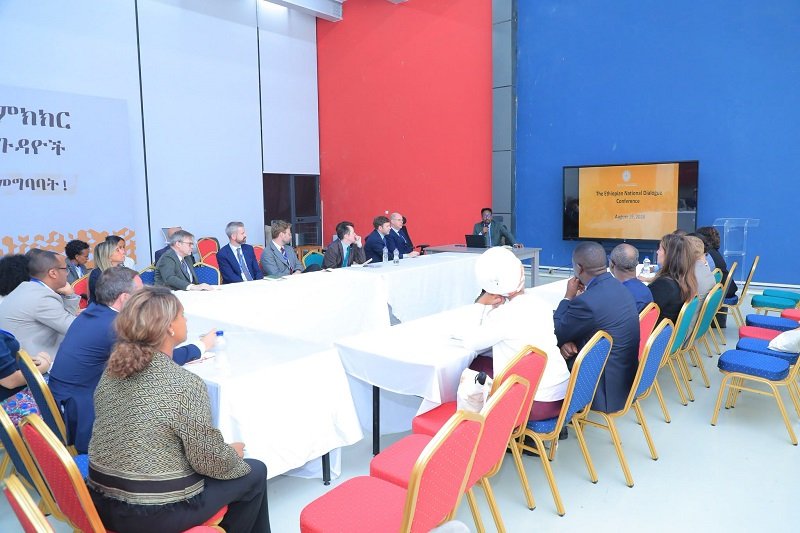
NAIROBI, Kenya — The National Dialogue Assembly presented finalized recommendations for the Federal Cities agenda—covering Addis Ababa and Dire Dawa—marking the culmination of 36 days of committee deliberations.
The Joint Verification Group compiled 21 structured recommendations under Agenda 3. Sources report that 20 of these proposals achieved working group consensus, while alternative options were drafted to resolve contentious constitutional debates surrounding Addis Ababa’s legal status and regional ties.
Working groups reached unanimous agreement on securing self-governance for Addis Ababa under federal jurisdiction. However, handling the constitutional provision designating the city as the seat of the Oromia Regional State required drafting two distinct legislative alternatives: Option 1 incorporates a general constitutional principle affirming the legal right of regional states to select and establish their administrative capitals, while Option 2 amends Article 49(5) of the FDRE Constitution to stipulate that specific administrative matters, service ties, and joint arrangements stemming from Addis Ababa serving as Oromia’s seat will be determined by specific statutory law.
Additionally, the proposals recommend replacing the existing Article 49(5) “special interest” phrasing with a framework centered on “mutual benefit” between the federal capital and the surrounding regional state, alongside mandating independent legal and constitutional expert analyses to define and reconcile contested terms, specifically distinguishing “jurisdiction” from “part” and “capital” from “seat.”
The submitted report outlines specific operational, financial, and administrative recommendations for the capital: mandating that federal budget allocations to Addis Ababa correspond directly to the city’s overall tax and revenue contributions to the national treasury; calling for full judicial and law enforcement autonomy in the city charter, establishing independent municipal court and police systems that operate in structured coordination with federal law enforcement to safeguard diplomatic hubs and international institutions; directing the federal government, Oromia Regional State, and Addis Ababa City Administration to finalize legal boundary lines between Addis Ababa and Sheger City following formal statutory procedures; recommending the renaming of public spaces, historical sites, and municipal institutions to reflect national diversity, alongside adopting all federal working languages—Amharic, Afan Oromo, Tigrigna, Somali, and Afar—for municipal administration; and initiating legal studies and statutory frameworks to grant direct legislative representation to both Addis Ababa and Dire Dawa in the House of the Federation.
Proposals for Dire Dawa parallel the capital’s structural reforms, formally establishing Dire Dawa as an autonomous, self-governing federal charter city accountable to its elected city council, serving urban and rural populations while establishing mutual-benefit clauses with the surrounding Oromia and Somali regions. These measures grant proportional representation in the House of Peoples’ Representatives, independent municipal courts, dedicated police services, revenue-proportional budget support, and the adoption of federal working languages.
The revised 21 recommendations will go before the full 4,000-delegate plenary assembly on August 21, 2026.
The National Dialogue Commission confirmed that the general assembly will utilize an en bloc approval process, voting on the combined package without taking individual floor amendments, provided the draft does not face organized opposition from plenary delegates.
__
Join our Telegram Channel: t.me/borkena
Like borkena on Facebook
Join the conversation. Follow us on X (formerly Twitter) @zborkena to get the latest Ethiopian news updates regularly. Subscribe to the YouTube channel. To share information or for submission, email info@borkena.com
So far not bad at all. I commend those from the opposition groups that decided to participate in the dialogue. That gave us the opportunity to hear from them what transpired during the prolonged discourse. Like I said before, the current status of Addis/Finfinnee should be left along. In fact, if things go my way, I would like to see more large cities becoming chartered cities like Addis/Finfinnee. The current leaders of the regional states except Somali and Afat regions have proven themselves to be ineffective and not qualified. Their skill to be the leaders of their regions is not up to snuff. Their major achievement has been being effective echo chambers of whoever is their boss at Arat Kilo except of course Debre and his entourage in Tigray who chose their guns to do all the talking.