
By Staff Writer
(Nairobi, Kenya) — Researchers examining Ethiopia’s flagship Green Legacy Initiative have raised critical concerns regarding the program’s long-term efficacy, warning that minimal post-planting care has resulted in low seedling survival rates despite high-profile national planting drives.
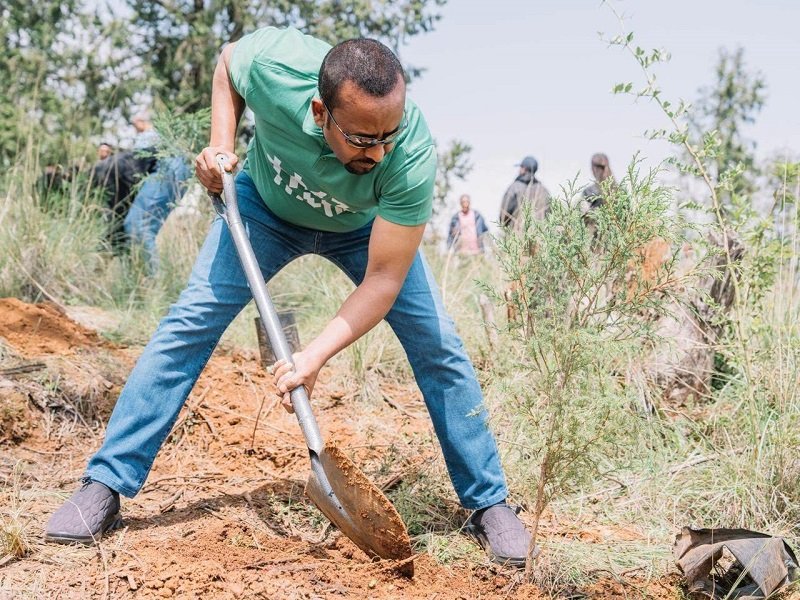
The academic assessment emerges as the Ethiopian government launched its latest single-day national planting campaign under the slogan “Let’s Plant Hope,” aiming to plant 800 million tree seedlings nationwide. Official tallies recorded over 578 million seedlings planted by midday.
Initiated seven years ago by Prime Minister Abiy Ahmed, the initiative aims to reverse land degradation, expand national forest cover, and position Ethiopia as a regional leader in climate action.
Addressing the public during the single-day mobilization, Prime Minister Abiy underscored the environmental vision behind the project. “A tree has no meaning for today, but its meaning for tomorrow is immense,” the Prime Minister stated. “It is food, it is shade, it is beauty, and beyond that, it is a shield that protects our resources from erosion and loss.”
He further noted that international recognition of Ethiopia’s environmental campaigns contributed to the decision selecting the country to host the upcoming COP32 global climate conference.
Despite official optimism, a research paper authored by scholars Tekle Gebresadik and Rafael Uaiene, titled “The Integration of Environmental and Socio-Economic Outcomes for the Sustainability of Ethiopia’s Green Legacy Program” and published in the peer-reviewed journal Discover Conservation, presents a contrasting analysis.
The study identifies a central structural vulnerability in the initiative’s reliance on top-down political targets and raw planting tallies rather than long-term ecological viability. According to the authors, inadequate post-planting monitoring, irrigation, and protection protocols have led to highly variable and low survival rates across multiple implementation zones—a reality the study notes diverges sharply from official progress reports.
Beyond seedling survival rates, the study highlights socio-economic inequities in how the program’s costs and benefits are distributed. While national and global carbon-sequestration goals are widely publicized, the immediate burdens fall disproportionately on smallholder farmers and vulnerable rural populations.
The researchers documented that designating land for afforestation routinely reduces available grazing areas for livestock and restricts crop production plots. Additionally, mandatory unpaid public labor requirements for seasonal planting exert significant operational pressure on lower-income rural households and women.
The paper concluded that the absence of a transparent, scientific data management system prevents reliable measurement of seedling growth and carbon stock accumulation, ultimately limiting Ethiopia’s ability to access international carbon markets. To achieve sustainable outcomes, the researchers recommended transitioning the Green Legacy Initiative away from political campaign structures toward institutionalized, community-centered management.
The study urged the integration of modern spatial tools—including Geographic Information Systems (GIS), satellite monitoring, and drone technologies—alongside independent verification mechanisms to accurately evaluate tree survival and ensure equitable benefit-sharing among host communities.
__
Join our Telegram Channel: t.me/borkena
Like borkena on Facebook
Join the conversation. Follow us on X (formerly Twitter) @zborkena to get the latest Ethiopian news updates regularly. Subscribe to the YouTube channel. To share information or for submission, email info@borkena.com
As you know, the country is among the poorest nations in the world, yet it is striving to improve its circumstances by making the best use of the skills and resources that are available. My question to the researchers is this: If you possess the knowledge and expertise, why did you not offer your services or help organize resources such as Geographic Information Systems (GIS), satellite monitoring, and drone technologies? Your study recommends that the Green Legacy Initiative integrate these modern spatial tools, yet you also know that the country may not have the financial capacity to acquire and implement them. This is similar to a doctor advising a severely ill person living in poverty that, in order to recover, they need to eat a diet rich in protein and vitamins, while knowing they cannot afford such food. Recommendations are most useful when they are accompanied by practical, realistic solutions that take existing resource constraints into account.