
By: Getahun Tsegaye
Staff Reporter
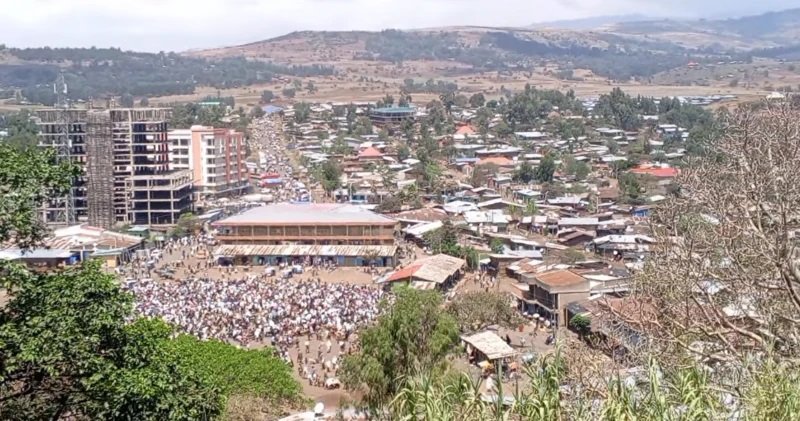
Addis Ababa, Ethiopia – Over 100 people are reported to have been killed in a drone strike near a school in the small rural town of Gedeb, in the Enarji Enawga district of East Gojjam zone, Amhara region, on Thursday, April 17, 2025, according to local residents and eyewitnesses who spoke to the BBC. Bokena reported about it last week.
They described how “peaceful people” who had gathered for “development work” – building a fence for the local Gedeb Primary School and constructing houses – were killed in the attack.
However, local authorities told the BBC that the strike targeted “Fano militants” who had gathered in the area, not civilians.
The Ethiopian Human Rights Commission (EHRC) has stated that it is monitoring the alleged drone attack.
Residents recounted to the BBC that the strike hit a group of people who were “gathered” and building a fence for the Gedeb Primary School in the town.
Another eyewitnesses, who were near the area when the attack occurred, said there were immediate screams, chaos, and panic. “We didn’t know what happened,” they said, recalling the immediate aftermath.
Upon reaching the scene of the attack, “you couldn’t distinguish one person from another” due to the extent of the casualties, added one of the eyewitnesses.
“Everything was just black. There were no people left in the area. There were some crying and rolling around in the wreckage. What happened was horrific. It was an extremely gruesome act for any human being,” they stated.
Another resident, who sustained injuries to their right hand while building the school fence, described a “heavy explosion” and said “many people were injured.”
“There were people cutting eucalyptus trees, hitting nails, cutting rafters, and holding things,” another eyewitness said, describing the community gathering, adding that the number of dead was “many.”
Another witness who helped collect bodies stated that most of the victims died instantly, and that the majority of the deceased were young people.
Witnesses reported that over 24 injured individuals were taken for medical treatment, with many dying after arriving at the Gedeb Health Center in the town.
One eyewitness, who claimed to have transported over 70 bodies to a church by Bajaj (three-wheeled motorized vehicle), estimated the total death toll to be around 120, including teenagers and the elderly.
“Around 115 to 120 bodies were buried. I think there might be some unknown as well, because we were in shock,” they said.
Another eyewitness indicated they were present until 57 bodies were recovered and estimated the death toll to be over 100.
Witnesses stated that the bodies were disfigured, making identification difficult. Due to this and out of fear, they said the bodies were buried in a mass grave at the Gedeb Giorgis Church by 2:00 P.M. local time.
“When they said to bury them quickly so that vultures wouldn’t eat them, the community quickly buried them in about five graves,” a resident said.
A resident reported that some locals fled after government forces entered the town following the attack, fearing further violence. They indicated that additional attacks did occur.
Residents also said that tents were erected for the deceased after the community calmed down, and a traditional condolence program called “Fraj” was held in the area days later.
“It’s been terrifying lately. The whole population is in fear,” one resident said, adding that they spent the Easter holiday in fear of another drone attack, stating, “There was nothing that felt like a holiday.”
“They are in deep mourning. Easter didn’t feel like anything. Children who usually come from the city for the holiday didn’t come,” another resident said, describing the somber atmosphere in the area.
Residents reported that the town has been under the control of Fano militants since the conflict in the Amhara region escalated in late 2023.
However, they indicated that Fano militants were not in the town when the attack occurred and that there had been no clashes in the area.
“They are not seen in the town unless they come to do some work,” one resident said of the militants.
A trader who claimed to be an eyewitness said they knew “many of the deceased through their businesses,” confirming that they were civilians.
“If they were Fano members, we would have found armed individuals [when collecting bodies]. We [can distinguish] Fano and the community. [Fano] move together,” another resident stated.
Another resident speculated on the possible reason for the attack, saying, “Whether those who gathered – the people building fences and houses – were thought to be a Fano gathering based on drone surveillance, we don’t know. … Maybe they were thought to be Fano because they gathered; that’s how we understood it.”
The administrator of the Enarji Enawga district, Mulu Gete, dismissed the reports of civilian deaths as “enemy propaganda,” telling the BBC that the action was taken against Fano militants he described as “extremists.”
“There is a large number of armed groups gathered in this area. I have information that they even gather for training. The talk of school fences and house construction is a cover-up…” he said, denying that civilians were killed, even by shrapnel.
Fano militants, on their part, indicated that they operate extensively in the district but stated that there were “no armed forces of any kind” in the Gedeb town area at the time of the attack, adding that no member of their group was killed in the strike.
Asres Mare Damte, the deputy chairman of Amhara Fano in Gojjam, who said they do not use the area for training, stated, “All those killed in the attack were civilians. Not a single armed person was at the scene,” linking the killings to an attempt to intimidate the community.
The Ethiopian Human Rights Commission (EHRC) told the BBC that it is monitoring the drone attack.
Background on the Conflict in the Amhara Region
The drone strike that occurred in Gedeb, East Gojjam zone, reportedly resulting in over 100 fatalities, is one of the most significant and tragic events linked to the ongoing conflict in Ethiopia’s Amhara region. This incident is situated within a broader context of rising tensions that began in mid-2023, following the federal government’s decision to dissolve regional special forces across the country. The move led to unrest in several areas, particularly in Amhara, where some communities perceived it as weakening their capacity for local security and defense.
The Fano militia, an armed group with roots in the Amhara community, has become increasingly prominent during this period of conflict. Once more loosely organized and locally based, the group has grown in structure and influence, asserting that its aim is to protect Amhara interests. The militia’s operations have coincided with increased confrontations with federal forces, contributing to the wider instability in the region.
The conflict has had significant humanitarian consequences. Thousands of people are estimated to have died since the escalation of violence in 2023, with the recent drone strike in Gedeb alone reportedly causing between 100 and 120 deaths, according to various local sources. While the identities of the victims remain a matter of dispute, several witnesses have stated that most of those killed were civilians engaged in community activities.
Widespread displacement has also been reported. Humanitarian organizations, including the United Nations, estimate that more than 900,000 people have been internally displaced within the Amhara region as a result of the conflict. These individuals have often fled violence and insecurity, seeking shelter in temporary or informal settlements.
Reports of human rights violations have emerged throughout the conflict. The Ethiopian Human Rights Commission (EHRC), along with international organizations, has documented allegations of abuses, including extrajudicial killings, arbitrary detentions, and enforced disappearances. Both federal forces and armed groups have faced accusations, though the details and accountability remain contested.
The federal government declared a state of emergency in Amhara in August 2023. This measure granted security forces broad powers, including the ability to detain individuals without warrants and impose curfews. Since then, communication restrictions and reduced access to information have been reported, complicating the ability of humanitarian agencies to respond effectively.
Access to aid remains a critical challenge. Relief organizations cite road closures, ongoing clashes, and bureaucratic constraints as barriers to delivering food, medicine, and other essential supplies. Many of those displaced by the conflict have limited or no access to basic services, exacerbating the humanitarian situation.
The conflict has had a wide-ranging impact on everyday life in the Amhara region. Educational institutions in some areas have closed due to insecurity, disrupting the education of millions of children. Health facilities have also been affected, with some becoming overwhelmed or inaccessible. Economic activity has slowed significantly in many towns, with market closures and transportation disruptions.
The psychological impact of the violence has been considerable. Community members in Gedeb and elsewhere have described how public holidays, such as Easter, have passed in an atmosphere of mourning and fear, rather than celebration. The recent drone strike and subsequent fears of further violence have led to subdued gatherings and emotional distress among residents.
As of early 2025, the conflict in Amhara shows no signs of resolution. The situation remains fluid and complex, with continuing reports of violence, displacement, and humanitarian need. Many observers and humanitarian actors are calling for renewed efforts toward dialogue, access to humanitarian assistance, and long-term solutions that prioritize the safety and wellbeing of civilians.
__
Subscribe : https://borkena.com/subscribe-borkena/
Join our Telegram Channel : t.me/borkena
Like borkena on Facebook
Add your business to Ethiopian Business Listing / Ethiopian Business Directory Business Listing Toronto
Join the conversation. Follow us on X (Formerly Twitter) @zborkena to get the latest Ethiopian News updates regularly. Subscribe to YouTube channel To share information or for submission, send e-mail to info@borkena.com