
Borkena
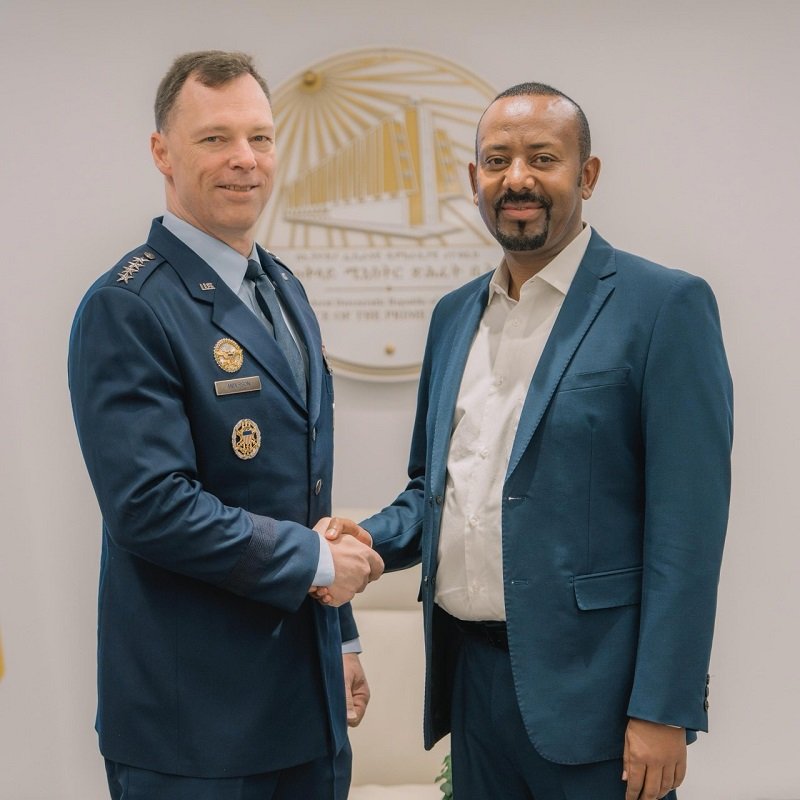
Toronto – General Dagvin R. M. Anderson , Commander of the U.S. Africa Command, on Tuesday met with the Ethiopian Prime Minister in the capital Addis Ababa.
Some observers expressing views on social media tend to think that the visit has something to do with the tension in the Horn of Africa as Ethiopia and Eritrea have been escalating a war of words over the former’s pursuit to recover Assab which the latter sees as a violation of Eritrea’s sovereignty.
Abiy Ahmed shared two lines of statement about the meeting with the U.S. general withholding details. However, it indicated that the security situation in the region was part of the conversation.
“I welcomed General Dagvin R. M. Anderson, Commander of the U.S. Africa Command, this morning for a constructive exchange on regional security and opportunities for enhanced cooperation,” he said.
Ethiopian Prime Minister unveiled during his latest speech in the parliament that he has approached state actors including the United States of America to mediate him with Eritrea.
General Dagvin R. M. Anderson’s arrival in the country is seen by some against the backdrop of what Ethiopian authorities have described as “diplomatic effort”- something Eritrea dismisses as a cover.
Notably, Eritrea has announced a few weeks ago that it will not allow any foreign interference on the issue of Assab.
Commander of the U.S. Africa Command and the delegation he led also held discussion with Defense Chief of Staff Field Marshal Berhanu Jula.
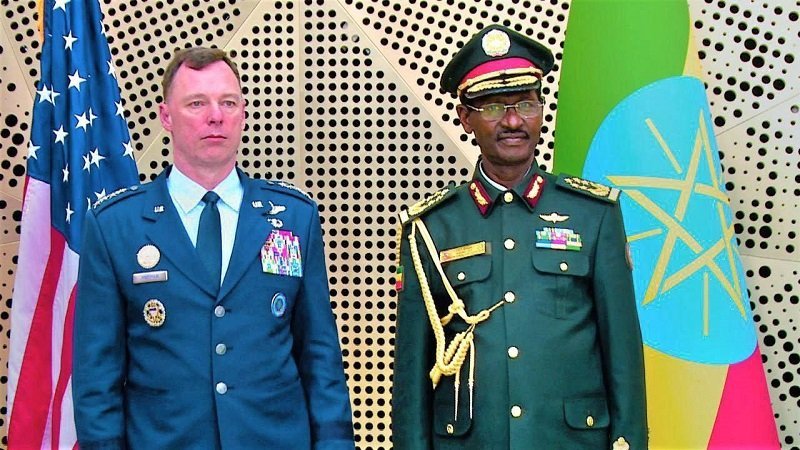
Based on the update from the Ethiopian Defense Force, the discussion was about security and stability in the Horn of Africa.
Berhanu Jula has reportedly briefed the U.S. Commander that “Ethiopia’s interest on sea access is for peaceful purposes and building its economy.” Eritrea has been advancing a position that it did not deny Ethiopia access to the sea for commercial purposes based on international laws.
Senior Ethiopian officials, including the Prime Minister and Defense Chief., have been speaking with a sense of certainty that Ethiopia will get back access to the sea. The Navy which has been demobilized right after the secession of Eritrea was reinstituted a few years ago.
General Dagvin R. M. Anderson is cited, in the defense force update, as saying that “the United States supports Ethiopia’s effort to get sea access in a peaceful way.”
Another issue raised during the discussion is Al-Shabab. The U.S. Embassy in Addis Ababa has not published any update on the issue at the time of this writing.
The issue of Al-Shabab was also discussed during their meeting. “Ethiopia will continue to take military action against Ashabab to foil its plot and weaken it,” the Defense Chief is cited as saying.
The United States has been partnering with the post-colonel Mengistu Ethiopian governments in the fight against terrorism in the Horn of Africa.
__
Support Borkena : https://borkena.com/subscribe-borkena/
Join our Telegram Channel : t.me/borkena
Like borkena on Facebook
Borkena Ethiopian News Youtube Channel
To submit Press Release, send submission to info@borkena.com
Add your business to Ethiopian Business Listing / Ethiopian Business Directory
Join the conversation. Follow us on X (Formerly Twitter) @zborkena to get the latest Ethiopian News updates regularly.
This is Good Ole USA at its best working hand in hand with its staunch ally against terrorism. This is a reassuring news that the more than a century old friendship between Ethiopia and USA is still intact and air-tight strong.
‘
Trump would also need to get Saudi Arabia and the UAE to push Sudan higher up their list of priorities.
**For both countries, Sudan comes below issues such as Gaza and Syria, as well as finance and commerce.**
Despite his personal appeal to the US president, it is not clear whether Bin Salman offered to set aside his differences with the Emirati leader in order to make peace in Sudan.
And Burhan appears to interpret the prince’s intervention in Washington as overriding the Quad plan, not bolstering it, as it could imply excluding the UAE.
He wants to see a bigger role for Saudi Arabia in the mediation, and the UAE shut out of it – which is a green light to intensify the war, not end it.BBC
–Free Ethiopia from Abiy Ahmed’s toxic leadership—
The visit of U.S. AFRICOM Commander General Dagvin R. M. Anderson to Addis Ababa represents a critical moment of renewed diplomatic rapprochement between the United States and Ethiopia, driven by converging interests in regional stability amid a tense geopolitical climate. The discussions, focused on regional security and “enhanced cooperation,” underscore a mutual desire to rebuild a strained partnership, with the United States positioning itself as an indispensable mediator in the volatile Horn of Africa.
From the U.S. perspective, the core interest remains counter-terrorism and containing instability. The explicit discussion of Al-Shabab reaffirms Ethiopia’s role as a primary security partner on land, crucial for U.S. strategy in Somalia. However, Washington’s most significant move was its positioning on the explosive Red Sea access issue. By endorsing Ethiopia’s pursuit of sea access “in a peaceful way,” the U.S. attempts to balance its relations—acknowledging Addis Ababa’s vital economic and security concerns while implicitly cautioning against military escalation with Eritrea. This aligns with the broader U.S. objective of preventing a regional war that could disrupt maritime chokepoints and create openings for adversarial actors.
For Ethiopia, the meeting served to legitimize its diplomatic campaign for sovereign port access and secure a powerful, if cautious, external validator. By framing its goal as “peaceful” and economic, and by briefing the U.S. commander on its stance, Ethiopia seeks to leverage American influence to pressure Asmara to the negotiating table, a hope explicitly mentioned by Prime Minister Abiy. Furthermore, reaffirming the counter-terrorism partnership strengthens Ethiopia’s request for continued U.S. security and potential economic support.
The renewed dialogue signifies a pragmatic recalibration. The U.S. needs a stable, cooperative Ethiopia to anchor its regional interests, while Ethiopia requires international backing, not isolation, to achieve its historic ambitions. The success of this rapprochement hinges on Washington’s ability to translate its “peaceful way” endorsement into genuine diplomatic leverage, and on Addis Ababa’s willingness to prioritize multilateral diplomacy over unilateral rhetoric. Should both sides navigate these narrow straits, this meeting could mark the beginning of a more stable, cooperative chapter.