
1. Introduction
Generally, development is seen as a positive and progressive feature. It is the duty of the government to develop infrastructure and further public services and to promote economic development. However, alongside analyzing the extent of infrastructure and building development, it is equally important to evaluate the impact that these developments can have on people’s lives and on their rights and self-worth.
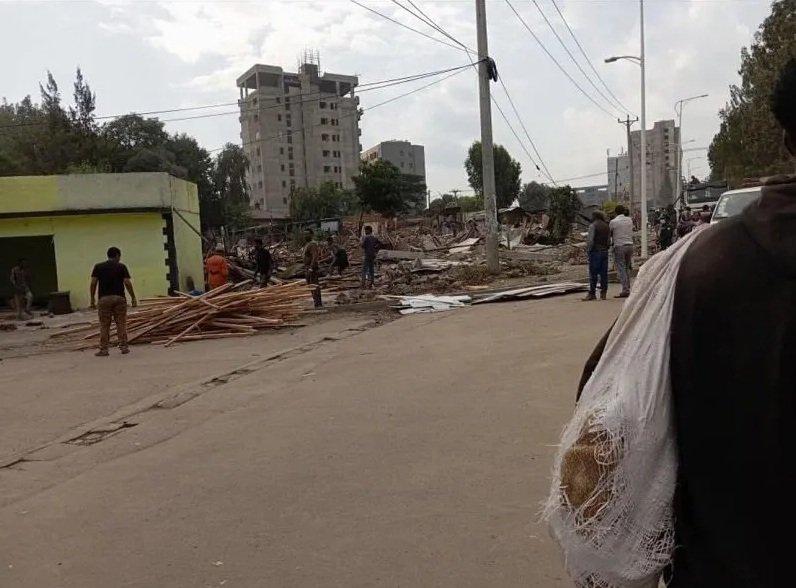
There have been major concerns in Ethiopia surrounding the management of people who are relocated as a result of urban development and infrastructure enhancement. Although there is certainly a need for development, the key issue is whether this is being done in a manner that is both appropriate and sensitive to people’s rights and which does not further disadvantage those who are already in difficult situations.
Alongside providing suitable rehousing and sufficient financial compensation, the government should also offer affected individuals the necessary assistance in order for them to re-establish themselves. If development leads to some people gaining advantages, whilst others become homeless and/or are left in poverty, then it cannot be deemed as truly progressive.
2. The contradiction between development and citizens’ rights
There has been substantial change within Addis Ababa as a result of regeneration and development. Roads, footpaths, parks, street lights, and public areas have all been updated. These can therefore enhance transport, security, and the general standard of living within a city.
While there are few grounds to oppose modernization, there is still a need to enhance city planning, housing, transportation, sanitation, and recreational places throughout Ethiopia. Nonetheless, the rights of existing inhabitants and workers in a certain area should not be jeopardized.
Issues emerge when the methods used to achieve development goals cause substantial difficulties for local people. Human rights groups and the Ethiopian media have reported that in some instances, residents and companies have been relocated without proper consultation. There has also been a lack of appropriate warning and/or payment for displacement and a lack of clarity regarding new housing options.
In April 2025, Amnesty International stated that in November 2024, a minimum of 872 people (including both property owners and renters, as well as children and the elderly) had been evicted from sections of Bole and Lemi Kura. Again, those impacted had not been sufficiently consulted, and there had not been enough prior warning. In addition, properties within the areas investigated had not been compensated.
This leads onto a key policy issue. Can a development scheme still be deemed successful if, despite the successful physical aspects of such schemes, the local community suffers preventable difficulties as a result?
3. Awassa: Development and the displacement of thousands
Awassa is also an area that illustrates issues related to urban regeneration in Ethiopia. Approximately 3000 homeowners in the city appear to have been affected by city development with insufficient consultation and/or reparation. Some of the houses that were demolished were rented out and so formed a key part of the income for their owners. As a result of the development, many families have thus been affected in both their housing and their ability to earn money. Ex-tenants have then had difficulty in locating suitable new housing; this is further complicated by the current housing shortage. This therefore emphasizes that city development can affect a wide range of people within a community, including homeowners, tenants, and even families who earn money through renting. Development that is undertaken without sufficient consultation, reparation, and regard for those it affects cannot be fairly or inclusively labelled as such.
Such statistics provoke concern regarding both the application of urban regeneration strategies and the duties of relevant authorities. Even where there are prospects of urban development, those who have had their homes taken away face little comfort if they do not have appropriate housing to move into.
Those who have lived in a community for many years have a particularly tough time transitioning to living elsewhere. People may be distanced from places of employment, education, health care, and commerce, as well as sources of community support. Furthermore, less well-off families may face financial insecurity when they are forced to pay for accommodation once their property is taken away.
There is also cause for concern regarding the efficiency of the government’s rehoming procedures. Following eviction from government housing, what specific provisions have been put in place to avoid people becoming homeless? In addition, when home owners have their property repossessed, how is it ensured that the reparation they receive is appropriate and that this then allows them to find new housing?
Such expectations are entirely reasonable and pertain to fundamental issues of transparency.
While reviewing the Awassa data, it is important to note the significantly bigger number of evictions in Addis Ababa. According to reports, this issue is not limited to a particular city or redevelopment initiative. According to reports, evictions in Addis Ababa are three times higher than in Awassa. However, accurate and comparable statistics have yet to be identified.
Clearly, therefore, this issue should be addressed on a national level and not merely in individual localities.
4. Addis Ababa: A larger urban displacement challenge
Addis Ababa has undergone significant regeneration based on the government’s ‘corridor’ and ‘modernization’ initiatives.
The city has seen road, footpath, leisure, and parkland improvements. Again, these developments can be of advantage to both locals and tourists.
Despite this, there are important human issues to consider in relation to Addis Ababa’s regeneration.
Amnesty International recorded in April 2025 that a minimum of 872 people were forcibly removed from Bole and Lemi Kura sub-cities in November 2024. Of these, 254 were homeowners and 618 were renters. In addition, Amnesty noted that none of the households it investigated had been compensated for their displacement.Whilst this is an example of displacement in Addis Ababa, it does not represent the overall number of people who have been displaced.
Furthermore, the Ethiopian Human Rights Commission had previously highlighted worries about widespread destruction within the city. Data from a September 2025 country report by the UK government indicates that a total of 5,400 houses were destroyed in March 2024. As of mid-April, it was noted that as many as 20 percent of those impacted had yet to be offered new housing or property.
These data emphasize the extent of the housing and rehousing issue. It is therefore essential that the government release detailed and independently checkable data concerning the numbers of people that have been displaced, how many have been compensated, and the provision of new housing. It is also important to identify how many households continue to require support.
The capital must be modernized without compromising the housing stability of its population.
5. Displacement is more than losing a house
Often there is a narrow view of the issue of rehousing within urban regeneration debates. However, in truth, the impacts of being rehoused can be much broader than just loss of housing.
Housing is linked to work, schooling, health, and transport and is integral to people’s lives. Many people work, send their children to school, and draw their clients from their local area.
Being moved out of someone’s local community can then have an effect on these facets of life. For example, a local shop owner who relies upon local trade may suffer financially as a result of regeneration. Low-income families may also incur extra transport costs. Furthermore, children may need to transfer schools, and the elderly may be unable to continue accessing their usual health services and support systems.
In January 2026, Shegar published a report demonstrating how a small business owner was rehoused as a result of Megenagna regeneration efforts. Despite the new location’s more modern business facilities, this guy was significantly harmed by having to relocate away from his local town, as he had relied on local trade for his livelihood. In addition, his rent increased.
This demonstrates that simply offering an alternative house does not always re-establish someone’s economic prospects.
Alongside determining reparation based on the value of the house that is being demolished, it is essential that the further ramifications of rehousing are also considered. People should be enabled to both continue to effectively earn a living and to do so in a dignified manner.
6. The question of compensation and fairness
Compensation is often a highly debated area of urban renewal. Where properties are expropriated or people are relocated in the interests of the greater good, how can individuals be assured that they will be treated fairly?
Although Ethiopia has set out rules regarding rehousing, relocation, and financial compensation, there is no assurance that these are always applied and that compensation is adequate.
Whilst it may be stated what compensation is to be provided, it is not always guaranteed that all those who should benefit from it actually will.
People can be offered new housing. However, there may be confusion about whether someone is eligible for compensation, how their property has been valued, and when compensation is due. Those living in rented or informal housing can also experience issues, as they do not have the same legal standing as property owners. Despite this, they can still be just as greatly impacted by relocation.
The government should clearly set out the rules relating to compensation and easily convey to the public what people are entitled to. Individuals should be informed of how their property has been valued, what housing they can expect to be offered, and when compensation is due. There should also be information regarding the procedures for disputing decisions.
If people are asked to vacate their property prior to these issues being clarified, then this can lead to a sense of instability, rather than progress being made.
In addition, there is also concern that Ethiopia’s culture and history are being lost to facilitate modernization. Alongside the Ethiopian Hotel, many buildings and sites of historical interest have been demolished. As well as being old buildings on prime city space, these sites are integral to the nation’s history and shared memory. Urban development should not involve the loss of key historical elements. Destruction of historically relevant buildings must be openly and appropriately decided upon and with careful evaluation of their cultural and historical importance.
Furthermore, people living in Ethiopian cities are becoming increasingly anxious about the safety of their houses and possessions. Often individuals are unaware as to whether or not their area or property will be impacted by forthcoming development. This lack of knowledge instills fear and inhibits people and organizations from effectively planning for the future. Where decisions regarding urban development are made in an unpredictable and/or haphazard manner, without clear reasoning, discussion, and accurate information, people are unable to be assured that their property rights will be upheld. Urban development ought to be based upon clear legislation and open processes so that people are not left in doubt as to whether their house and means of earning a living may be arbitrarily removed.
7. Human and social impact
While the impact of displacement can be studied on an individual basis, it can also affect larger communities and even society as a whole. Communities grow and frequently form robust social networks. Businesses also tend to expand, and these networks can be critical in assisting people, particularly those from more impoverished backgrounds, to meet their day-to-day needs.
It can be hard to quantify the social impact of breaking up a community. Nevertheless, this often has significant impacts on both families and individuals.
Studies of urban renewal in Awassa have shown issues to do with compensation, land, and the economic situation of displaced people. A previous study by the International Institute for Environment and Development emphasized the increasing housing problems within the city and the particular problems faced by more disadvantaged and vulnerable sections of society.
Consequently, along with being a technical process, displacement should also involve social analysis. There should be consultation and planning, and ongoing support should be provided.
8. Governmental duty and citizens’ rights
Whilst the government is legitimately responsible for updating Ethiopia’s urban areas, it has duties to resolve housing issues, to develop infrastructure, and to encourage investment so that the urban environment is more efficient. These aims can be pursued in tandem with citizens’ rights.
Ideally urban renewal will enhance the interaction between the public and government.
To achieve this, the government should:
Ensure that sufficient notice is given to households before they are displaced, that proper consultation is undertaken, and that reasons for displacement are clearly explained.
Prior to displacement, compensation and new housing should be decided and made available. In the event of disagreements, independent bodies should analyze these, and appropriate legal channels should exist for residents to appeal.
New locations for displacement should include suitable facilities. Housing that lacks basic facilities such as water, electricity, and sanitation, together with schools, healthcare, and cost-effective transport, does not necessarily represent an enhancement in people’s lives.
Furthermore, the government should recognize that commerce—formal and informal—is integral to urban areas. Compensation should account for loss of earnings, together with costs incurred as a result of displacement. Issues such as ease of access for customers and the viability of small businesses also require consideration.
Independent bodies should also oversee urban renewal schemes. Periodic reports should then be issued analyzing the social and economic impacts of these. This will assist in distinguishing between authentic and spurious public gains and in highlighting areas for improvement prior to them becoming entrenched issues.
9. For the people
In addition, there is a wider political aspect to this topic. As well as being influenced by a country’s constitution and political rhetoric, the state-citizen interaction is also affected by the manner in which governmental bodies wield power.
People’s trust in government can suffer if they feel their views are not valued, if they do not receive consultation on important issues and/or if they lack effective means to contest government decisions.
Rather than undermining citizenship, urban development should further bolster it. People should be actively involved in, not just passively subjected to, the nation’s evolution.
While accepting that people’ rights and the right to growth are distinct, the government should recognize that both areas are actually mutually beneficial. Alongside being aesthetically updated, an up-to-date urban area should therefore also offer an enhanced standard of living, additional economic prospects, and improved safety for its population.
10. Whose development?
Development is required in Ethiopia. Urban areas require updating; infrastructure needs to be developed, and with an increasing population, more housing and improved public services are required. Nevertheless, development should not be considered solely in terms of impressive physical features and visually appealing urban settings.
Issues such as those experienced by 1,030 homeowners who are yet to receive suitable compensation and the extensive nature of displacement issues in Addis Ababa all require serious public concern to be directed towards them.
Whilst resistance to development is not the real issue, the government has a duty to ensure that urban renewal does not result in a new section of society comprising both economically disadvantaged and displaced people.
Whereas a family is evicted without suitable compensation, or a small business is adversely affected by the loss of its customer base as a result of displacement, or people are relocated to areas lacking key facilities, the social ramifications of development need to be recognized.
Although the government can analyze the extent to which development has been achieved, it cannot ignore the impact that this has on people.
Fundamentally, it is not so much a question of whether or not Ethiopia should develop, but rather whose interests’ development will best serve. Will it benefit all members of society, or will it mainly advantage a section of the population, with other people shouldering the associated costs?
Development should thus be assessed not just by reference to what a government constructs, but also by considering how it deals with those whose lives are affected by this construction.
Editor’s Note: Views in the article do not necessarily reflect the views of borkena.com
__
Join our Telegram Channel: t.me/borkena
Like borkena on Facebook
To submit a press release, send the submission to info@borkena.com
Add your business to Ethiopian Business Listing / Ethiopian Business Directory
Join the conversation. Follow us on X (formerly Twitter) @zborkena to get the latest Ethiopian news updates regularly