
Editor’s Note: Views in the article do not necessarily reflect the views of borkena.com
Historical territorial claims, Ethiopia’s repeated state commitments, and the implications for peace and security in the Horn of Africa
By Simon Stefanos
Introduction
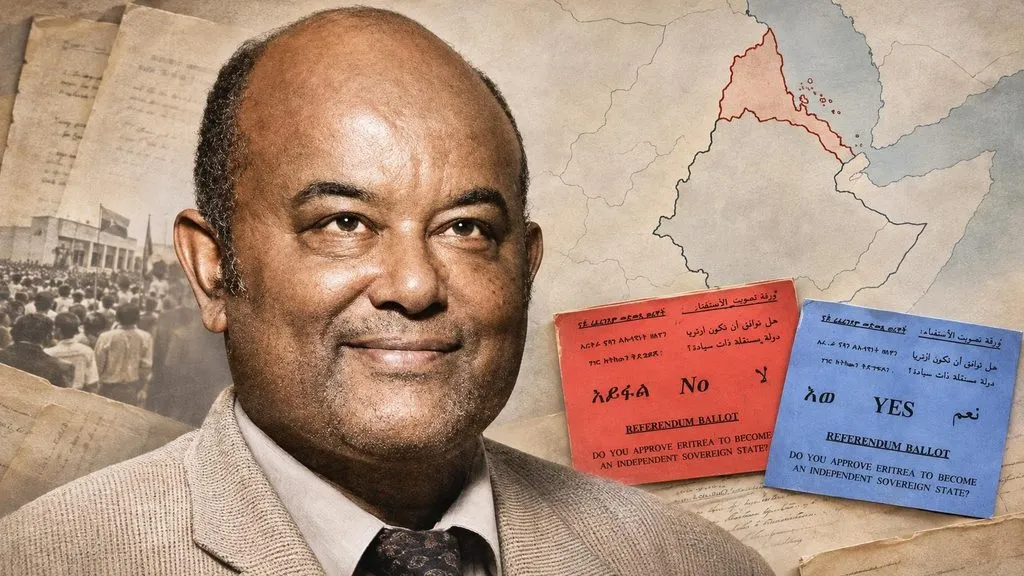
On November 25, 2026, Fana Television published an hour-long presentation entitled Eritrea’s Fake Referendum (የኤርትራ ፌኩ-ፈረንደም), drawing extensively upon the writings of the late Professor Negussay Ayele (September 1936 – February 7, 2018), an Ethiopian political scientist, diplomat, educator and author.
The issue here is not Bereket Belay, the presenter. Personalizing the matter would distract from its far more consequential political and institutional dimensions. The subject deserving scrutiny is the revival, through Ethiopian government-aligned media, of arguments challenging the historical and legal foundations of Eritrea’s independence, territorial integrity and sovereign existence.
Professor Ayele developed these arguments prominently during the 1998–2000 Eritrean–Ethiopian war. His paper, On Ethiopia’s Legitimate Claim to Its Natural Seashores, dated September 26, 2000, appears to provide much of the intellectual foundation for the November 2026 presentation. [1]
What was advanced by an Ethiopian academic twenty-six years ago is now being disseminated through a major broadcasting institution whose management is closely associated with the incumbent Ethiopian government. That institutional context cannot be ignored.
The most revealing statement in the presentation comes towards its conclusion:
“The problem is one, and that is Eritrea’s statehood.”
This statement, translated from the supplied Amharic transcript, exposes the central premise of the presentation. The issue being advanced is not merely Ethiopia’s access to the Red Sea, commercial arrangements concerning Assab and Massawa, the policies of the TPLF, or the consequences of the 1998–2000 war. It is the existence of Eritrea as an independent sovereign state.
Two additional sources sharpen this inquiry: the November 26, 2026 opinion article by Dr. Mengistu Muse, and a retrospective interview with former Ethiopian foreign minister Seyoum Mesfin. Read together, these sources reveal both disagreements within Ethiopian political discourse and the recurrent question of how successive Ethiopian governments account for their own historical commitments. [24, 30]
1. From academic argument to government-aligned political discourse
Professor Negussay Ayele’s writings addressed Ethiopia’s territorial claims, colonial treaties and the legitimacy of Eritrean independence. Relevant publications include Reflections on Border Regimes and Colonial Treaties on the Horn (June 17, 2000), On Ethiopia’s Legitimate Claim to Its Natural Seashores (September 26, 2000), and EPLF/TPLF and Ethiopia-Eritrea Today: Sow the Wind; Reap the Whirlwind (October 12, 2001). [1–2]
In the September 2000 paper, Ayele described the developments surrounding Eritrea’s independence and the subsequent war as a “bloody comedy of errors.” His arguments about colonial boundaries, independence and the loss of Ethiopia’s coastline recur in the Fana presentation.
The significance of this revival becomes clearer when one examines the institutional structure of the broadcaster. On December 5, 2024, Fana Broadcasting Corporate and Walta Media and Communication Corporate were consolidated into Fana Media Corporation. Its official inauguration was attended by Adam Farah, Vice President of the Prosperity Party; Legese Tulu, then Minister of Government Communication Service; and Daniel Kibret, Social Affairs Advisor to Prime Minister Abiy Ahmed and chairman of the corporation’s management board. [3–4]
Although Fana is formally constituted as a share company rather than a conventional state broadcaster, independent media monitoring identifies its ruling-party ownership and political governance. Consequently, the broadcast cannot be examined in the same institutional context as an article independently published by an academic.
This does not by itself prove that the particular presentation was commissioned by the Ethiopian government. It does, however, raise a legitimate question about the relationship between the narrative being disseminated and Ethiopia’s contemporary foreign policy. The presenter is the vehicle; the intellectual arguments and their institutional amplification are the principal subjects of scrutiny.
2. The contradiction in Ethiopia’s historical territorial narrative
One recurring proposition is that Eritrea and Ethiopia were essentially one country that should never have become two. Ethiopian nationalists frequently celebrate Ethiopia’s resistance to European colonial domination, yet some insist that the entirety of modern Eritrea, including its Red Sea coastline, was historically an inseparable part of Ethiopia.
How can these two propositions be reconciled? Massawa and portions of the Eritrean coastline came under Ottoman domination in the sixteenth century. Ottoman administration was followed by Egyptian administration and then Italian occupation. Italy occupied Massawa in 1885, following its earlier acquisitions around Assab, and proclaimed the colony of Eritrea in 1890.
If these territories were continuously and inseparably Ethiopian, those advancing the claim must also account for the centuries during which substantial portions of their purported historical territory were ruled by foreign powers. This is a challenge to the claim of continuous sovereignty, not a denial of Ethiopia’s well-documented resistance to European conquest.
Furthermore, the history of Medri Bahri, the Bahri Negasi, coastal communities and political entities north of the Mereb River cannot simply be erased or retrospectively incorporated into the territorial definition of modern Ethiopia.
Historical relationships were complex and changed over time. Commerce, religion, ancestry, language, political influence and military power crossed what are now international boundaries. Such connections, however, do not establish perpetual territorial sovereignty. If shared ancient history were sufficient to invalidate contemporary boundaries, the territorial integrity of numerous states would become permanently negotiable.
3. Italy’s invasion of Ethiopia did not extinguish Eritrea’s colonial boundaries
A consequential legal argument in Ayele’s work is that Fascist Italy’s invasion of Ethiopia rendered the previously established Eritrean–Ethiopian boundary treaties invalid. The establishment of Italian East Africa in 1936 is presented as having erased the territorial distinction between Ethiopia, Eritrea and Italian Somaliland.
This proposition confuses wartime occupation and administrative reorganization with the permanent extinction of international territorial title. The principal instruments establishing the Eritrean–Ethiopian land boundary were bilateral treaties involving Ethiopia itself:
| Treaty | Principal geographical application |
|---|---|
| 1900 | Central sector |
| 1902 | Western sector and modification of the central boundary |
| 1908 | Eastern sector |
These were not administrative lines imposed unilaterally by Italy. Italy’s subsequent aggression did not automatically extinguish them. If the incorporation of the three territories into Italian East Africa had permanently eliminated their separate territorial identities, why was Ethiopia restored as a separate state in 1941? Why did Italian Somaliland follow its own independence process? Why was Eritrea treated separately by the victorious Allied powers?
Article 23 of the Treaty of Peace with Italy, signed on February 10, 1947, expressly identified Eritrea, Libya and Italian Somaliland as Italian possessions over which Italy relinquished its rights and title. Their future was to be determined through an international process. [5]
The postwar settlement therefore recognized the distinction between liberated Ethiopia and the former Italian colonies. Italy’s occupation of Ethiopia could not confer upon Ethiopia permanent sovereign title over Italy’s other possessions. More importantly, Ethiopia itself subsequently reaffirmed the legal relevance of the three treaties in the Algiers Agreement of December 12, 2000. [13–14]
4. The United Nations federation was not an unconditional transfer of Eritrea
United Nations General Assembly Resolution 390 A (V), adopted on December 2, 1950, provided for Eritrea to constitute an autonomous unit federated with Ethiopia under the sovereignty of the Ethiopian Crown. The operative concept was federation. Eritrea was not simply transferred to Ethiopia as an ordinary province without constitutional guarantees.
The federal arrangement recognized Eritrea’s separate territorial identity, legislature, executive, judiciary and authority over domestic affairs. Article 2 of the Eritrean Constitution of 1952 expressly stipulated:
“The territory of Eritrea, including the islands, is that of the former Italian colony of Eritrea.” [7]
This provision directly contradicts the contention that Eritrea’s former colonial territorial definition had ceased to exist. It survived Italy’s defeat, British military administration and the establishment of the federation.
The Ethiopian imperial government accepted the Federal Act and the constitutional arrangements arising from the United Nations resolution. Ethiopia was not merely the beneficiary of the international settlement: it also accepted the obligations accompanying it. Federal sovereignty did not confer an unrestricted right to dismantle Eritrea’s autonomous institutions or extinguish its territorial identity. [6–8]
A recurring objection: “The Ethiopian people were never consulted about Eritrea’s independence.”
This objection invokes popular consent at the end of the federation while overlooking the manner in which the federation began and ended.
The Ethiopian people were not asked in a nationwide referendum whether Eritrea should be federated with Ethiopia in 1952. The settlement was reached through the United Nations, consultations with Eritrea’s inhabitants and political organizations, and the formal acceptance of the imperial government. Likewise, the Ethiopian population was not asked in a nationwide referendum whether the federation should be abolished in 1962. [6–8]
It is therefore inconsistent to insist that the Ethiopian population should have had a referendum veto over Eritrean independence when no such Ethiopian popular vote was required to establish or dissolve the federation in the first place.
This does not mean Ethiopia had no voice in Eritrea’s future. The Ethiopian government presented its claims and interests in the international deliberations and accepted the federal settlement. In 1991, its successor expressly accepted that Eritrea’s future would be determined by the Eritrean people through an internationally observed referendum. Ethiopia formally recognized the resulting sovereignty on May 4, 1993. [9–11]
The question put to the Eritrean electorate concerned the future political status of Eritrea. It was not a referendum on the future political status of Ethiopia. Ethiopia’s participation through its government did not create an additional requirement for a nationwide Ethiopian plebiscite.
Why should a popular vote in Ethiopia suddenly become a prerequisite for Eritrea to leave a political arrangement that the Ethiopian population had never been asked to approve, either at its establishment or at its dissolution?
5. The destruction of the federation and the origins of the liberation struggle
Eritrea’s armed liberation struggle commenced in September 1961, following years of progressive encroachment upon its constitutionally protected autonomy. In November 1962, the federation was formally dissolved and Eritrea was incorporated into Ethiopia.
Even the Fana presentation acknowledges that the dissolution occurred under Ethiopian government pressure and may have involved coercion. Having conceded this point, it nevertheless maintains that Eritreans were entitled only to struggle for the restoration of the federation.
Where did the United Nations resolution stipulate that Eritreans must remain permanently subordinate to Ethiopia regardless of what Ethiopia did to the federal arrangement? What effective mechanism protected Eritrea against the dismantling of its autonomous institutions? What meaningful remedy remained after the arrangement itself was abolished?
The Eritrean question was an international question decades before the establishment of the TPLF or OLF. It originated in the disposition of a former colonial territory and the subsequent destruction of an internationally established constitutional arrangement. It cannot simply be assimilated into Ethiopia’s later disputes over ethnic federalism and regional self-determination.
The abolition of the federation did not automatically create an independent state. Independence was subsequently achieved through the liberation struggle, the agreed referendum process, formal Ethiopian recognition and international acceptance. To condemn the outcome while minimizing the destruction of the federation is to discuss the consequences while disregarding their historical causes.
A recurring objection: “Eritrea should have seceded only within the Derg’s final administrative boundaries.”
A related argument maintains that Eritrea’s independence should have been confined to the last administrative configuration established by the Ethiopian military junta, particularly its 1987 reorganization separating the autonomous regions of Eritrea and Assab.
This argument reverses the historical sequence. Eritrea as a distinct political and territorial entity was not a creation of the Ethiopian state, much less of the Derg. Its colonial territorial identity preceded the federation by decades, and the boundary with Ethiopia had been established through the international treaties of 1900, 1902 and 1908.
It was that territorial entity, including its coastline and islands, which was federated with Ethiopia in 1952. Article 2 of the Eritrean Constitution is unambiguous on this point. The administrative authority exercised by Ethiopia thereafter cannot be confused with the power to extinguish the underlying territorial definition by unilateral decree.
The Organization of African Unity’s 1964 Cairo resolution affirmed respect for existing borders at independence. Eritrea’s independence followed this broader African principle of preserving inherited territorial boundaries, rather than redesigning states according to ethnic claims or the most recent internal administrative decree. [13–14]
The distinction was confirmed by Ethiopia itself in Article 4 of the Algiers Agreement. Ethiopia and Eritrea accepted the colonial treaties and applicable international law as the basis of the international boundary, not the Derg’s administrative map of 1987.
Eritrea entered the federation as a defined territorial entity; it emerged as an independent state on the basis of that inherited territorial identity. Its precise land boundary was subsequently determined through the EEBC’s final and binding award.
Had the last administrative map of the Derg been the decisive instrument, there would have been no reason for Ethiopia to submit the treaties of 1900, 1902 and 1908 to international arbitration. The Ethiopian state’s own legal commitments answer this objection.
6. Eritrea was liberated, not given away
Throughout the presentation, the TPLF is accused of having surrendered Eritrea and gifted Assab and Massawa to the EPLF. This disregards the political and military reality of 1991.
By May of that year, Eritrean liberation forces had defeated the Ethiopian military administration in Eritrea and established effective control over the territory. The TPLF did not possess Eritrea and subsequently decide to hand it over. Eritreans had fought successive Ethiopian governments for approximately three decades, beginning long before the establishment of the TPLF in 1975.
The transitional Ethiopian authorities inherited a situation in which Eritrea was already under the effective control of its liberation movement. Their recognition of Eritrean self-determination was politically and diplomatically significant, but it was not the origin of Eritrea’s struggle or its achievement of de facto independence.
Recognition of a political reality is not equivalent to gifting that reality to those who brought it into existence. To reduce Eritrean independence to a personal concession by Meles Zenawi is to erase the political agency, sacrifices and historical experience of the Eritrean people.
Testimony from Ethiopia’s own former foreign minister
In a retrospective interview, Ambassador Seyoum Mesfin, Ethiopia’s foreign minister during the independence process and the 1998–2000 war, explicitly rejects the claim that the TPLF was responsible for Eritrea’s separation as historically inaccurate (08:58). He then asks what legal basis could have brought Assab into Ethiopia and explains that, after thirty years of struggle, Eritreans already controlled the country from Assab to Karora before the EPRDF entered Addis Ababa (10:02–10:29). [24]
“After thirty years of struggle, the Eritrean people had taken control of the country they claimed as their own, from Assab to Karora, before the EPRDF had even entered Addis Ababa.”
This passage is an English translation from the supplied interview transcript. It is particularly important because it comes from an Ethiopian official who subsequently represented his country during the war and the arbitration process, not from a representative of an Eritrean liberation organization. His testimony does not establish agreement with every Eritrean historical claim; it does establish that his own account of the events of 1991 is incompatible with the simplistic proposition that the TPLF possessed Eritrea and gave it away.
7. The alleged fake referendum and the documentary record
Critics cite the composition of the 1991 Addis Ababa conference, Isaias Afwerki’s attendance as an observer, the establishment of a provisional Eritrean administration and the celebrations following liberation. None of these circumstances establishes referendum fraud.
A provisional government preceding the formal completion of an independence process is neither unprecedented nor inherently illegitimate. Celebrations in May 1991 do not invalidate participation in a referendum in April 1993. De facto liberation and internationally recognized independence are distinct events.
| Date | Historical and legal development |
|---|---|
| May 1991 | Collapse of Ethiopian military administration in Eritrea |
| December 1991 | Ethiopia communicates acceptance of Eritrean self-determination to the UN |
| December 16, 1992 | UN General Assembly Resolution 47/114 establishes referendum verification mission |
| January 7, 1993 | Deployment of UNOVER |
| April 23–25, 1993 | Eritrean independence referendum |
| April 27, 1993 | Results and UN observer assessment announced |
| May 4, 1993 | Ethiopia formally recognizes Eritrean sovereignty and independence |
| May 24, 1993 | Formal Eritrean independence |
| May 26, 1993 | UN Security Council Resolution 828 recommends admission |
| May 28, 1993 | UN General Assembly Resolution 47/230 admits Eritrea |
Approximately 99.8 percent of participating voters supported independence. The UN observer mission found the referendum process free and fair overall. The Secretary-General’s report A/48/283 records its assessment. [9–12]
A recurring allegation: “Eritreans were asked to choose between freedom and slavery.”
This allegation is contradicted by the wording of the actual referendum ballot. The question was not “freedom or slavery,” nor were the options labeled in those terms. As the reproduced ballot cards show, the question printed in English was:
DO YOU APPROVE ERITREA TO BECOME AN INDEPENDENT SOVEREIGN STATE?
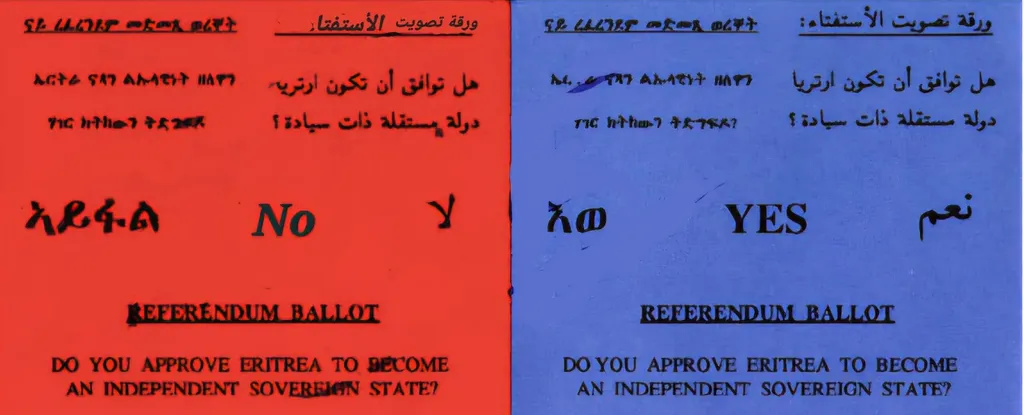
Figure 1. Eritrean independence referendum, April 23–25, 1993. Red: NO; blue: YES. Both cards display the same question in Tigrinya, Arabic and English. Image supplied by the author; reproduced without alteration.
Voters selected between two clearly distinguishable responses to the same question: the red ballot portion represented NO, and the blue ballot portion represented YES. Color coding accommodated voters who could not read the printed question or response, enabling them to distinguish the options visually.
The United Nations’ published account describes numbered, perforated ballot sheets with a red negative portion and a blue affirmative portion. The selected portion was placed in the ballot box and the unused portion discarded separately. UNOVER teams covered almost all 1,012 polling stations during the three voting days. [12, 19]
In 2001, the Immigration and Refugee Board of Canada investigated precisely the claim that the question made reference to freedom and slavery. Its response cites contemporaneous reporting and the Canadian NGO observation delegation, corroborating the independence question and the color-coded affirmative and negative choices. [20]
Some observers, including Freedom House, criticized the possible symbolism of the colors and the absence of alternative constitutional options. Such criticism may be examined on its merits, but it does not change the words printed on the cards or establish that the official question presented a choice between freedom and slavery. [21]
The ballot itself is documentary evidence against the alleged wording. The UN observation report is the appropriate evidence for assessing the broader conduct of the referendum. Anyone asserting fraud must present evidence of manipulation or violations capable of undermining those findings, not substitute a different question for the one actually put to voters.
8. Ethiopian governments may change; international commitments remain
Consider the sequence of Ethiopian governments involved. The imperial government concluded boundary treaties with Italy and accepted the federal arrangement. The transitional government accepted Eritrean self-determination and recognized independence. The Federal Democratic Republic of Ethiopia entered into the Algiers Agreement in 2000. The government under Abiy Ahmed reaffirmed implementation of the boundary decision in 2018.
These were acts undertaken on behalf of the Ethiopian state, not personal commitments made by unrelated individuals. The popularity or subsequent reputation of a government does not independently determine the validity of all its international commitments. Otherwise, every change of government could reopen Ethiopia’s own borders, diplomatic recognition arrangements and treaty obligations.
International legal continuity cannot be invoked selectively.
9. The Algiers Agreement: Ethiopia’s own answer to Professor Ayele
Ayele’s September 2000 paper preceded the Algiers Agreement by less than three months. On December 12, 2000, Ethiopia and Eritrea agreed to establish a neutral Boundary Commission. Article 4 expressly identified the treaties of 1900, 1902 and 1908, together with applicable international law, as the basis for determining their boundary. The parties agreed that the Commission’s determinations would be final and binding. [13–14]
Here lies a decisive contradiction. Ayele argued that the colonial treaties had become invalid in 1936. Ethiopia itself subsequently agreed that they constituted the legal basis for determining its boundary with Eritrea. Ethiopian legal representatives participated in the proceedings and submitted their own treaty interpretations.
On April 13, 2002, the EEBC issued its delimitation decision. On November 30, 2007, the Commission confirmed that the boundary stood demarcated by the coordinates established under its procedure. The international boundary was legally determined. The absence of physical pillars in particular areas does not invalidate the decision, and continuing territorial claims do not transform an adjudicated boundary into a legally undetermined one.
Seyoum Mesfin and the meaning of a binding award
The former foreign minister’s interview also reveals the distinction between Ethiopia’s commitments and its later objections. At 04:11 he describes Badme as a flashpoint rather than the underlying cause of the war. At 10:39 he says that boundaries cannot be changed through war. At 11:34–12:08 he acknowledges that arbitral decisions are binding, while arguing that states sometimes refuse to comply with decisions they consider unjust. At 12:52–13:39 he describes Ethiopia’s desire to revisit practical issues concerning villages, homes, churches and cemeteries during demarcation. When pressed on Badme at 16:59–17:07, he defers to a future demarcation rather than giving a direct answer. [24]
These statements should be read with the contemporary record. On April 13, 2002, both governments initially announced acceptance of the award; Seyoum Mesfin publicly welcomed it, mistakenly claiming that Badme had been awarded to Ethiopia. Ethiopia later challenged aspects of the ruling, and in November 2004 accepted it only in principle. The Commission held that its rules did not permit substantive alteration of the binding delimitation decision. [25–26]
Human consequences of a boundary may warrant practical arrangements for residents, property, access to churches and cemeteries, and cross-border relations. Those arrangements are distinguishable from a unilateral revision of the adjudicated line. Under Article 4 of the Algiers Agreement, acceptance of the outcome was not optional whenever it proved politically inconvenient. [13–14]
10. The 2018 agreements and the responsibility of the present Ethiopian government
The documented sequence in 2018 is instructive: on June 5, the Executive Committee of the then-ruling EPRDF announced full acceptance and implementation of the Algiers Agreement and EEBC decisions; the Ethiopian foreign ministry communicated the decision to diplomats. Prime Minister Abiy Ahmed subsequently defended rapprochement in Parliament on June 18. [27–29]
The political significance of that decision must be understood in the context of Ethiopia’s governing structure. Following the May 2015 election, the EPRDF and its affiliated parties held all 547 seats in the House of Peoples’ Representatives, leaving no parliamentary opposition. [34] Although constitutionally distinct from Parliament, the ruling coalition exercised complete control of the lower house and effectively determined government policy. Its June 5 decision therefore represented the authoritative position of Ethiopia’s governing political establishment, rather than a personal undertaking by the prime minister.
On July 9, 2018, Prime Minister Abiy Ahmed and President Isaias Afwerki signed the Joint Declaration of Peace and Friendship in Asmara, committing to implementation of the boundary decision. The Jeddah Agreement of September 16, 2018, reaffirmed that commitment. [15–16]
How does the Ethiopian government reconcile these commitments with the dissemination of arguments maintaining that the colonial boundary treaties are invalid? How does it reconcile recognition of Eritrean sovereignty with a broadcast identifying Eritrean statehood as the fundamental problem?
Whether the discussion concerns Badme in the western sector, Wede Akele–Akhran in the western portion of the central sector, Ambesete-Geleba, Irob or the eastern sector, the relevant legal reference is the EEBC determination. Historical claims, political maps and administrative assertions cannot independently supersede an international award.
The Claims Commission and the unfulfilled mandate to investigate the origins of the war
A further distinction is essential. The December 19, 2005 partial award of the Eritrea–Ethiopia Claims Commission (EECC) on Ethiopia’s jus ad bellum claims must not be presented as the definitive investigation into who started the 1998–2000 war. The peace settlement assigned the investigation of the conflict’s origins to a separate body. The EECC’s assertion of jurisdiction over responsibility for the resort to force was disputed by Eritrea and has been subjected to substantial legal criticism. [13, 17, 35–37]
The Organization of African Unity (OAU) had already recognized that determining the origins of the conflict required examining events preceding May 1998. Its Proposals for a Framework Agreement for a Peaceful Settlement of the Dispute between Eritrea and Ethiopia contain the following provision (item 5 in the supplied HTML transcription; paragraph 7 in the official UN-circulated text, S/1998/1223, p. 26, approved on December 17, 1998):
In order to determine the origins of the conflict, an investigation be carried out on the incidents of 6 May 1998 and on any other incident prior to that date which could have contributed to a misunderstanding between the two Parties regarding their common border, including the incidents of July – August 1997.
This provision was carried forward into Article 3 of the Algiers Agreement of December 12, 2000. Article 3(2) specified that the investigation was to be undertaken by an independent and impartial body appointed by the OAU Secretary-General in consultation with the UN Secretary-General and both parties. Article 3 also required the parties to cooperate with that body. [13, 35]
The agreement thus created three distinct institutional functions:
Article 3 — An OAU-appointed independent body to investigate the origins of the conflict, including the events of July–August 1997 and May 6, 1998.
Article 4 — The Eritrea–Ethiopia Boundary Commission (EEBC), empowered to delimit and demarcate the international boundary through final and binding determinations.
Article 5 — The Eritrea–Ethiopia Claims Commission (EECC), empowered to adjudicate claims for loss, damage or injury resulting from violations of international humanitarian law or other international law related to the conflict, subject to the limitations specified in the agreement.
Article 5(1) also excluded claims arising from the costs of military operations, preparations for such operations or the use of force, subject to its humanitarian-law exception. The EECC interpreted this exclusion in light of a 2001 agreement between the parties as relating to costs, and treated the broader reference to violations of international law as permitting Ethiopia’s jus ad bellum claims. It also considered the Article 3 inquiry factual rather than legal and noted that the independent body had never been constituted. [13, 17, 36]
The crucial objection is that the failure to establish the Article 3 body did not, in itself, transfer its mandate to the Claims Commission. Nor did consent to an interpretation excluding military costs necessarily establish consent to adjudicate responsibility for the outbreak of the war.
In her peer-reviewed article, “The Eritrea/Ethiopia Claims Commission Oversteps Its Boundaries: A Partial Award?” (European Journal of International Law, Vol. 17, No. 4, 2006, pp. 699–721), international law scholar Christine Gray argues that the EECC should have declined jurisdiction over the question of responsibility for initiating the conflict. She identifies the absence of unequivocal consent, the separate Article 3 mandate, and the inadequacy of the Commission’s treatment of the evidence and the law of self-defence. [36, sections 3, 7–8]
Gray also draws attention to the EECC’s own Decision No. 1 on its mandate and temporal jurisdiction, which cautioned against examining and judging events before May 6, 1998 because the agreement assigned earlier events to other institutions. This makes the subsequent assertion of jurisdiction particularly problematic: the peace agreement expressly required examination of earlier incidents, while the claims process restricted its temporal scope. [36–37]
The distinction matters especially in relation to Badme. The EEBC’s 2002 decision established that Badme lay within Eritrea. Gray criticizes the Claims Commission for giving decisive weight to the administrative situation and the withdrawal line specified in the June 2000 ceasefire arrangements, rather than adequately addressing the adjudicated international boundary. The OAU Framework Agreement expressly stipulated that the proposed redeployment around Badme would not prejudge the area’s final status, which was to be determined through boundary delimitation, demarcation and, if necessary, arbitration. Gray argues that the EECC’s approach risked undermining the binding boundary decision at a time when Ethiopia was resisting its implementation. [14, 35–36, sections 4–5]
The earlier allegations concerning Ethiopian incursions and administrative changes in 1997, and the incidents of May 6, 1998, therefore cannot simply be excluded from a historical assessment of the conflict’s origins. Eritrea and Ethiopia advanced competing accounts of those events. The independent inquiry intended to investigate them was never constituted, and the EECC’s award did not resolve every disputed factual question concerning them. [35–36]
The legal distinction should nevertheless be maintained: Article 3 prescribed a factual investigation, not an express mandate to issue a binding legal verdict assigning aggression. Gray’s jurisdictional criticism is a scholarly legal assessment, not an annulment of the EECC award. The award remains part of the arbitral record and found a violation of Article 2(4) of the UN Charter by Eritrea in relation to its specified resort to force. The Commission’s finding did not adjudicate every act of either party throughout the war. [17, 36]
Accordingly, it is misleading to cite the December 2005 award as a comprehensive, uncontested determination of who started the war. The separate inquiry into its origins expressly envisaged by the OAU and agreed by the two governments was never carried out. The award neither displaced the EEBC’s binding territorial determination nor invalidated Eritrea’s independence. The obligations of the Ethiopian state under Article 4 of the Algiers Agreement stand independently of the disputed scope of the Claims Commission’s jurisdiction.
Seyoum Mesfin, the selective invocation of arbitration, and the Algiers Agreement
The jurisdictional issue is directly relevant to the retrospective testimony of the late Ethiopian foreign minister, Ambassador Seyoum Mesfin. At 04:54–05:50 of the supplied interview, the interviewer invokes the Claims Commission as having established Eritrea’s aggression. Seyoum agrees, assigns responsibility to Eritrea and cites the pre-war Ethiopian administration of Badme, as well as the OAU’s demand for withdrawal. Yet at 04:11 he describes Badme as a flashpoint and maintains that the underlying cause of the war was something else. [24]
This interpretation needs to be tested against the very OAU framework on which it relies. The withdrawal provision expressly reserved the question of territorial sovereignty for delimitation and demarcation, while the separate investigation provision required examination of earlier incidents, including those of July–August 1997. The OAU’s interim redeployment demand was not a final adjudication of aggression or territorial title. The Article 3 investigation was never carried out. Consequently, invoking the OAU’s withdrawal demand and the EECC’s later liability finding together cannot establish that the comprehensive inquiry envisaged by the peace settlement was completed. [13, 17, 35–37]
The distinction becomes particularly consequential when Seyoum acknowledges the binding nature of the boundary award at 11:38, but subsequently argues that states sometimes decline to comply with awards they regard as unjust. He also maintains that the delimitation was accepted while seeking changes or accommodations during demarcation. [24, 11:38–13:39] These are two distinct positions: acceptance of a favorable claims finding and objections to implementation of a boundary determination. The interview does not establish that he expressly proposed terminating the Algiers Agreement on the strength of the EECC award, but the juxtaposition illustrates why selective reliance on the two commissions requires scrutiny.
For Ethiopian political and intellectual figures advancing irredentist claims — that is, claims to incorporate territory internationally recognized as belonging to a neighboring state — the same legal answer applies. Even accepting the December 2005 finding on its own terms, it supplies no authorization to abandon Article 4 of the Algiers Agreement, reopen the EEBC’s final territorial determination, or treat Eritrean sovereignty as conditional. Article 4(15) requires both parties to respect the adjudicated boundary; Article 5(17) likewise makes the claims awards final and binding. Neither provision makes compliance with one commission contingent upon a favorable outcome before the other. [13–14, 17]
The chronology is equally revealing. Ethiopia’s objections to the boundary award were already explicit in 2003, before the EECC’s December 2005 finding. Its subsequent renewed acceptance in 2018 occurred after that finding. [15–16, 26–29, 38] The claims award therefore cannot explain the original rejection, and it cannot plausibly be treated as a new legal basis to disregard a boundary decision that Ethiopia subsequently reaffirmed. Gray’s concern was precisely that the EECC’s approach could reinforce resistance to implementing the earlier territorial award. [36, sections 4–5]
The central principle is consistency: a party cannot invoke an award issued under one article of a peace agreement as though that award released it from obligations imposed by another. Criticism of the Claims Commission’s jurisdiction does not itself annul its award; equally, the award does not annul the boundary determination. Responsibility for the outbreak of the war, liability for particular acts and sovereign title remain distinct questions. The appropriate response to historical grievances is not unilateral repudiation of the agreed boundary.
Horn Review and the contemporary case for terminating the Algiers Agreement
The argument has not remained confined to retrospective interviews or older academic writings. On November 13, 2025, Foreign Minister Gedion Timothewos addressed a foreign-policy forum co-organized by Horn Review and Addis Ababa University. His address, published by the Ministry of Foreign Affairs the following day, invoked the EECC award to attribute the outbreak of the war to Eritrea. This repeats the broad reading of the award advanced by Seyoum Mesfin, without addressing the unfulfilled Article 3 investigation or the jurisdictional objections examined by Christine Gray. [24, 36, 39]
Horn Review subsequently published two articles that moved from attribution of responsibility to arguments about treaty termination. On December 14, 2025, its executive director, Blen Mamo, argued that alleged Eritrean breaches had deprived the Algiers Agreement of its protective force. She invoked Articles 60 and 62 of the Vienna Convention on the Law of Treaties, referred to the EECC finding, repeated the proposition that earlier colonial treaties had been nullified, and linked the 2018 rapprochement to an expectation of negotiations over Assab. On December 17, Amanuel Tadesse explicitly argued that Ethiopia could terminate or suspend the agreement under Article 60 on grounds of alleged material breach. These arguments rely also on allegations of subsequent conduct, not solely on the 2005 award. [40–41]
The institutional context is relevant. Horn Review identifies its founder, Getachew Nigatu W/Mariam, as a former director-general in Ethiopia’s Ministry of Foreign Affairs. The Ethiopian News Agency has reported collaboration between Horn Review, the Foreign Affairs Institute and the agency itself. The platform describes itself as independent and disclaims official endorsement of contributors’ opinions. These documented connections justify examining its publications alongside official foreign-policy discourse, but do not establish that it is formally an organ of the Ministry or that the government has adopted its contributors’ calls for termination. [39, 42–43]
Blen Mamo Diriba: wartime commentary and the contemporary sovereignty debate
The executive director of Horn Review has a public record extending back to the Tigray war. On April 11, 2021, Borkena reproduced an ESAT interview with Sisay Agena in which Blen Mamo discussed the federal government’s war against the TPLF, Western pressure on Ethiopia, and the security implications of Ethiopia’s partnership with Eritrea. On October 29, 2021, the Ethiopian News Agency reported her OBN interview opposing sanctions and negotiations with the TPLF at that stage; she also described the humanitarian crisis in Tigray as a pretext for external pressure. In December 2021, ENA reported her opposition to a proposed special session of the UN Human Rights Council on Ethiopia. [46–48]
Her later writings provide a particularly relevant comparison. On October 29, 2025, she questioned the national legitimacy and consensual character of Eritrea’s separation. On December 14, 2025, she advanced the argument that the colonial treaties had been nullified and that Eritrea’s alleged breaches undermined its reliance on Algiers. On October 7, 2026, she adopted the foreign minister’s expression “decaffeinated sovereignty” in the title of an article about Eritrea. Her November 15, 2025 commentary also explicitly portrayed Ethiopia’s maritime policy as peaceful and denied that it had a war agenda. These are her published positions; they should not be conflated with an independently established intention to wage war. [40, 49–51]
Horn Review’s biography identifies her legal and international-security qualifications and her specialization in Ethiopian law, politics and national security. These credentials do not resolve the historical and legal questions raised here. The relevant test is whether the arguments account for the primary instruments, including the 1947 peace treaty, the 1952 constitutional settlement, Article 3 of the Algiers Agreement, the final and binding EEBC determination, and Ethiopia’s renewed acceptance in 2018. [52]
The author also recalls an earlier public appeal by Blen Mamo on X (formerly Twitter), under the handle @_PoliticsAddict, requesting written historical material on Eritrea extending back several centuries. The author is searching for a retained record of that post; the original has not yet been recovered for independent verification. Readers who have preserved the post are invited to share its original link, a dated screenshot or an archived copy, preferably with its surrounding context. If authenticated, it would help establish the chronology of her engagement with Eritrean history and allow readers to assess her later historical arguments against that record.
Public commentary that questions the continuing force of a peace settlement also warrants scrutiny of its practical consequences. The risks of renewed confrontation are borne directly by soldiers, civilians, displaced families and communities on both sides of the boundary. Those participating in public policy debates should address those costs and explain how their proposals remain consistent with the prohibition on the use of force and the permanence of established international boundaries. The merits of the arguments, rather than conjecture about a commentator’s private motives or personal exposure to harm, must remain the focus.
Why treaty termination cannot erase an adjudicated international boundary
The distinction between an allegation of material breach and the legal consequences of an established breach is fundamental. Article 60 of the Vienna Convention sets out grounds on which a party may invoke a material breach of a bilateral treaty to terminate or suspend it; it does not establish that an allegation automatically terminates a treaty. Article 65 provides procedural safeguards, and Article 70 preserves legal situations created by prior execution of a treaty, subject to its stated qualifications. Article 62(2)(a) expressly excludes reliance on fundamental change of circumstances where a treaty establishes a boundary. These provisions are relevant as expressions of treaty-law principles, with the applicability of particular rules assessed separately. [44]
The International Court of Justice’s 1994 judgment in Territorial Dispute (Libya/Chad), paragraphs 72–73, further explains that an established boundary has a permanence independent of the continuing operation of the treaty that established it. Even if a lawful basis for terminating particular obligations under Algiers were established, it would not follow that the already adjudicated international boundary disappeared or that either state acquired title to the other’s territory. Nor would treaty termination itself authorize military force. [44–45]
Allegations of present-day incursions or other violations must be assessed on their own evidence, using the EEBC boundary rather than pre-award administrative maps as the territorial reference. Neither those allegations nor the EECC’s 2005 award, standing alone, proves an entitlement to reopen the boundary or to acquire Assab. The 2018 agreements reaffirmed the boundary decision without stipulating a transfer of coastal sovereignty or conditioning implementation on negotiations over Assab. [13–17, 26–29]
11. Maritime access does not confer ownership of Eritrea’s ports
Ethiopia has legitimate economic interests arising from its landlocked position. Dependable access to international maritime commerce is important for its development. However, access and sovereignty are different legal concepts.
Article 125 of the United Nations Convention on the Law of the Sea provides a framework for access to the sea and freedom of transit for landlocked states, while protecting the sovereignty and legitimate interests of transit states. Such arrangements depend on agreement and applicable international law. They do not establish an automatic entitlement to acquire another country’s ports or coastline. [18]
A commercial port agreement does not transfer sovereignty. A transit corridor does not extinguish territorial jurisdiction. A port lease does not convert a neighboring coastal state into an extension of a landlocked country. Population size, historical grievances and economic necessity cannot independently establish territorial title.
Eritrea’s maritime sovereignty has itself been addressed through international arbitration: the Eritrea–Yemen territorial award of October 9, 1998, and maritime delimitation award of December 17, 1999. Those proceedings established the boundary in the area covered by the arbitration and addressed sovereignty over Red Sea islands. [22]
The right to seek access to a port is not the right to possess that port.
12. Economic interdependence does not invalidate political independence
The presentation portrays Eritrea’s economic relationship with Ethiopia as evidence of dependency or the artificial nature of its independence. Yet sovereign countries throughout the world share markets, transport networks, infrastructure and commercial arrangements without surrendering their identities.
Ethiopia can benefit from access to Eritrean ports. Eritrea can benefit from providing commercial services to the Ethiopian economy. The appropriate question is not whether the two countries should maintain economic relations, but on what mutually agreed terms.
The economic issues discussed by Ambassador Andebrhan Welde Giorgis in his TIGHAT interview are relevant here, particularly the distinction between arrangements appropriate to sovereign states and the previous arrangements within a single political system. [23]
Specific allegations involving currency, customs duties, coffee exports, taxation and commercial practices require specific documentary evidence. Even if established, the remedies would be economic, contractual, diplomatic or legal, not the retroactive invalidation of independence.
To argue both that Eritrea cannot survive economically without Ethiopia and that Ethiopia cannot adequately develop without Eritrea’s ports is to demonstrate the potential importance of cooperation, not the necessity of political subordination.
Economic disagreements in Seyoum Mesfin’s account
Seyoum Mesfin attributes much of the underlying conflict to differences over Ethiopian sovereignty, currency and economic policy. In the supplied interview (18:52–21:07), he describes the introduction of the Nakfa, a proposal for parity with the Birr and the circulation of both currencies, and disagreements over hard-currency settlement of trade and port payments. He also alleges illicit trade and argues that Eritrea sought to impose a change in Ethiopia’s policy by force. [24]
These are the former Ethiopian foreign minister’s claims, not independently established findings on every disputed transaction. They are useful alongside Ambassador Andebrhan Welde Giorgis’s account precisely because the two officials offer different perspectives on the economic relationship. Documentary verification would require the bilateral agreements, monetary records, customs data and contemporary correspondence. Even if the allegations of economic misconduct were substantiated, they would not constitute a legal basis for extinguishing either state’s sovereignty.
13. The contemporary political significance of the broadcast
The Fana presentation did not occur in a political vacuum. Ethiopian officials have emphasized the strategic importance of maritime access and have also advocated peaceful, negotiated arrangements. Such assurances must be acknowledged. A distinction nevertheless needs to be drawn between seeking commercial access and challenging the sovereign existence of the state through which such access might be obtained.
The presentation claims that the countries should never have become separate, that colonial boundaries were invalidated, that the referendum was illegitimate, and that Eritrean statehood constitutes the underlying problem. That goes beyond discussion of port accessibility and transportation costs.
Its institutional dissemination creates understandable concern in light of contemporary Ethiopian maritime demands. Whether these narratives are being revisited for discussion or are helping establish public acceptance of territorial revision is a question that warrants scrutiny. The broadcast does not itself conclusively demonstrate an official decision to initiate military action. Its institutional context, however, cannot be dismissed solely because a television presenter delivers the arguments.
A second contemporary contribution: Dr. Mengistu Muse
On November 26, 2026, one day after the Fana presentation, Borkena published an opinion article by Dr. Mengistu Muse concerning the Eritrean question. Unlike the arguments attributed to Professor Ayele, Muse identifies the destruction of the federation as a major Ethiopian policy failure. He credits Aklilu Habte-Wold and Wolde Giyorgis Wolde Yohannes for their diplomatic efforts to secure federation and attributes its subsequent dismantling to the policies of the imperial establishment, including the roles of Asfaha Gebre Selassie and Ras Kassa. He criticizes the Derg’s reliance on military means and the EPRDF’s handling of independence and maritime access. [30, pp. 2–3]
Muse expressly acknowledges that Eritrea had its own territory, constitution, legislative assembly, executive, courts and official languages within the federation. He also discusses Ambassador Zewde Retta’s historical account of the period 1941–1963 and Dr. Mesfin Araya’s critique of explanations that assign primary responsibility to internal Eritrean divisions. These observations reinforce the distinction between Eritrea’s constitutionally recognized territorial identity and Ethiopia’s later internal administrative arrangements. [30, pp. 3–5]
Yet the article’s concluding aspiration is for future Ethiopian diplomatic leadership capable of bringing the countries together again. The difference between this argument and the Fana presentation is significant: Muse emphasizes failed Ethiopian diplomacy and acknowledges the constitutional framework, whereas the Fana presentation challenges the legitimacy of the independence process itself. Their political aspirations nevertheless raise a common question: is the historical record being examined to improve relations between two sovereign countries, or to identify a different means of reversing Eritrea’s independence?
Democratic government and voluntary cooperation are entirely compatible with the independent existence of both countries. Political reunification, if ever genuinely contemplated by the populations concerned, could not be imposed unilaterally by one country on the other. The article is an individual opinion contribution; Borkena expressly disclaims responsibility for its author’s views. Publication on consecutive days does not prove coordination with Fana or the Ethiopian government. [30, p. 6]
14. Ethiopia’s domestic challenges and the externalization of responsibility
Ethiopia faces considerable internal political, economic and security challenges, including disputes over its constitutional structure, competing nationalisms, regional boundaries, representation, governance and relations between the federal and regional administrations.
Eritrea did not enact Ethiopia’s present constitution, establish its ethnic federal arrangement, or determine internal boundaries between Ethiopia’s regional states. The conflicts involving Tigray, Amhara, Oromia and the Somali region have important domestic historical and institutional dimensions. External involvement in particular conflicts must be assessed separately on the evidence.
Acquiring a Red Sea port would not by itself resolve these contradictions. It is essential to distinguish legitimate economic development from narratives that identify a neighboring country’s sovereignty as the explanation for domestic difficulties. Both peoples have endured the consequences of prolonged conflict. Reopening settled territorial questions introduces additional risks without resolving those underlying problems.
15. Questions for the Ethiopian government
The principal questions arising from the Fana broadcast are not questions for Bereket Belay personally. They are questions for the Ethiopian government, its diplomatic representatives and institutions articulating national policy.
1. Does Ethiopia continue to recognize the legitimacy of Eritrea’s internationally verified independence referendum?
2. Does it continue to recognize its own formal recognition of Eritrean sovereignty and independence on May 4, 1993?
3. Does it recognize Assab, Massawa and Eritrea’s coastline as sovereign Eritrean territory?
4. Does it remain committed to the Algiers Agreement and the final and binding EEBC determination?
5. Does it remain committed to the Asmara and Jeddah agreements of 2018?
6. Does it distinguish commercial maritime access from the acquisition of sovereign coastal territory?
7. How does it reconcile assurances of peaceful maritime access with the dissemination, through government-aligned media, of arguments identifying Eritrean statehood itself as the fundamental problem?
These questions arise directly from Ethiopia’s existing commitments. They require clarification of whether those commitments continue to be respected.
Conclusion: Ethiopia must reckon with its own historical decisions
The central issue is not whether Ethiopians are entitled to debate the policies of their past governments. They are. The issue is whether dissatisfaction with decisions made by successive Ethiopian governments can justify reopening the sovereign status and international boundaries of a neighboring state.
For those who regard Eritrea’s independence or Ethiopia’s present landlocked status as a historical grievance, the starting point for accountability is Ethiopia’s own political and diplomatic record. Five milestones are especially instructive.
First — The Treaty of Wuchale, May 2, 1889
Emperor Menelik II concluded the Treaty of Wuchale (also known as Uccialli) with Italy. Its territorial provisions established a frontier between Ethiopia and the areas then under Italian possession in what became Eritrea. The disagreement over Article 17, Menelik’s denunciation of the treaty in 1893 and the subsequent war are important parts of this history. The treaty did not establish every part of the eventual Eritrean boundary, nor did it remain the controlling instrument after Adwa. Nevertheless, the initial agreement was made by Ethiopia’s own imperial government, not by the TPLF, the EPLF or any modern Eritrean administration. [14, 31]
Second — The post-Adwa peace settlement, October 26, 1896
Following Ethiopia’s victory at Adwa on March 1, 1896, Menelik’s government negotiated the Treaty of Addis Ababa with Italy. It secured recognition of Ethiopia’s independence and the abrogation of the Wuchale treaty, but did not secure the termination of Italian colonial rule in Eritrea. The frontier question was left for subsequent negotiations. The boundary treaties of 1900, 1902 and 1908 then defined the relevant frontier. [14, 31–32]
Whether Menelik could realistically have pursued the expulsion of Italy from Eritrea, and at what military or diplomatic cost, is a counterfactual question. The historical fact remains that the peace settlement left Eritrea under Italian rule and that Ethiopia later negotiated the boundary with Italy. It is for Ethiopian critics of that outcome to examine the choices of their imperial government rather than assign responsibility for those decisions to Eritreans generations later.
Third — Ethiopia’s recognition of Eritrean independence, May 4, 1993
After the collapse of Ethiopian military administration in Eritrea in 1991 and the internationally verified referendum in April 1993, the Ethiopian transitional government formally recognized the sovereignty and independence of Eritrea on May 4. The United Nations admitted Eritrea on May 28. [9–12]
This recognition was an act of the Ethiopian state, not a personal gift by Meles Zenawi. As Seyoum Mesfin himself acknowledges, Eritrea was already under the control of its liberation movement before the EPRDF entered Addis Ababa. [24] Those who object to the Ethiopian government’s decision should distinguish their criticism of its policies from the rights of Eritreans who determined their own political future.
Fourth — The Algiers Agreement of 2000 and the EEBC decision of 2002
On December 12, 2000, Ethiopia signed the Algiers Agreement, accepting that the Eritrea–Ethiopia Boundary Commission would determine the common boundary using the relevant colonial treaties and international law, and that its delimitation and demarcation determinations would be final and binding. On April 13, 2002, Ethiopia initially publicly accepted the award. Its subsequent objections and qualified acceptance in 2004 did not undo the binding obligation it had voluntarily undertaken. [13–14, 25–26, 33]
That agreement was concluded by Ethiopia after the war, when the parties chose binding arbitration rather than continuing armed confrontation. It is inconsistent to invoke Ethiopia’s military victory while disregarding the terms of the peace agreement that Ethiopia itself signed. The outcome of binding arbitration cannot be treated as valid only when it accords with one party’s preferred territorial claims.
Fifth — The renewed Ethiopian commitment of 2018
On June 5, 2018, under Prime Minister Abiy Ahmed, the EPRDF Executive Committee announced full acceptance and implementation of the Algiers Agreement and the EEBC decision. The government conveyed its position through its foreign ministry, and the prime minister addressed the issue before Parliament on June 18. The commitment was subsequently formalized between the two countries in the Asmara Joint Declaration of July 9 and reaffirmed in the Jeddah Agreement of September 16. [15–16, 27–29]
This was not merely an inherited decision of the Meles Zenawi government. It was a renewed commitment under different Ethiopian leadership, backed by a ruling coalition and its affiliates that controlled all 547 seats in the House of Peoples’ Representatives. [34] In practical political terms, the EPRDF’s decision carried the authority of the governing establishment that controlled Parliament. The party’s decision and a formal parliamentary resolution remain constitutionally distinct, but the subsequent diplomatic communication and bilateral agreements establish that full implementation was the declared policy of the Ethiopian state.
A recurring pattern of Ethiopian state commitments, not a one-time occurrence
The cumulative record is clear. The Wuchale treaty, the post-Adwa settlement, the subsequent colonial boundary treaties, the 1952 federal arrangement, Ethiopia’s recognition of independence in 1993, the Algiers Agreement, the 2002 boundary decision and the renewed commitments of 2018 span different historical periods, political systems and leaderships. These instruments have different legal functions and some superseded earlier arrangements; they are not all identical or presently operative. What connects them is the repeated involvement of Ethiopia’s own governments in determining or recognizing the relationship between the two territories and, later, the two sovereign states.
The imperial government negotiated with Italy and accepted the UN federal settlement. The imperial establishment dismantled the federation; the Derg pursued war rather than a political settlement; the transitional government recognized Eritrean independence; the EPRDF-led federal government accepted binding arbitration; and the government headed by Abiy Ahmed, supported by the ruling coalition’s complete parliamentary control, renewed the commitment to implement that award in full.
Those decisions were not made by the Eritrean people on Ethiopia’s behalf. Nor were they the work of a single Ethiopian leader, a single political organization or a single generation. If Ethiopian commentators believe their country’s leaders made mistakes, the appropriate object of their historical criticism is those leaders and the institutions that made the decisions. This is a matter of governmental accountability, not collective blame of ordinary Ethiopian citizens, many of whom had no direct voice in the original decisions.
What cannot legitimately follow from such criticism is the proposition that Eritreans must now surrender their sovereignty in order to compensate for alleged errors of successive Ethiopian governments.
The three recurring objections examined in this paper further illustrate the problem. The Ethiopian electorate was not consulted in a nationwide referendum on the establishment or abolition of the federation. The Derg’s administrative reorganization did not create Eritrea or supersede its inherited territorial identity. And the 1993 referendum was a documented YES or NO vote on independent sovereign statehood, not a choice labeled freedom or slavery.
The same continuity applies to the two commissions established at Algiers. The December 2005 EECC finding is not a legal exemption from Article 4, and the separate Article 3 inquiry into the origins of the conflict was never conducted. Those who invoke the former to justify refusing the EEBC decision must also confront Ethiopia’s subsequent 2018 reaffirmation of the boundary award. Acceptance of the international arbitration process cannot be made selective according to its political outcome. [13–17, 35–38]
The recent Horn Review arguments for treaty termination must also confront this historical and legal record. The Ministry’s November 2025 invocation of the EECC award, and the December 2025 articles advocating termination, illustrate why the separate mandates of the Algiers institutions must be kept in view. Even a legally established ground for terminating a treaty does not, without more, extinguish the international boundary already determined under it. [39–45] The documented wartime and subsequent commentary of its executive director also illustrates the importance of assessing public advocacy against both the legal record and the human consequences of renewed confrontation. [46–52]
Professor Ayele’s arguments, the Fana broadcast, Dr. Mengistu Muse’s article and Seyoum Mesfin’s testimony deserve to be evaluated against this record, rather than treated as substitutes for it. Ethiopian political grievances may be debated, and practical questions about trade, transit and affected border communities may be negotiated, but neither academic argument nor political dissatisfaction unilaterally extinguishes a neighboring state’s sovereignty.
Ethiopia’s economic development, peace and access to international markets are legitimate aspirations. Eritrea has the same right to peace, development and territorial integrity. Both countries can benefit from cooperation based on mutual respect rather than the assumption that one must cease to exist in order for the other to prosper.
Eritrea’s independence is not a pending question awaiting another Ethiopian political decision. Ethiopia’s own historical and legal commitments are part of the documentary record that establishes why.
Let the audience examine that record and be the judge.
Documentary references and further reading
1. Negussay Ayele, On Ethiopia’s Legitimate Claim to Its Natural Seashores, September 26, 2000 (later reproduction).
2. Negussay Ayele, EPLF/TPLF and Ethiopia-Eritrea Today: Sow the Wind; Reap the Whirlwind, October 12, 2001.
3. Fana Media Corporation, Inauguration announcement, December 5, 2024.
4. State Media Monitor, Fana Media Corporation: ownership and governance, 2026.
5. Treaty of Peace with Italy, February 10, 1947, Article 23 and Annex XI.
6. UN General Assembly, Resolution 390 A (V), December 2, 1950; see also UN Commissioner in Eritrea.
7. United Nations, Eritrean Constitution, 1952, Article 2, Yearbook on Human Rights.
8. UN General Assembly, Report of the United Nations Commissioner in Eritrea, 1952; and Foreign Relations of the United States, 1951, document 701, on the Federal Act and ratification process.
9. UN, A/C.3/47/5, communications concerning Eritrean self-determination and referendum observation, 1992.
10. UN, General Assembly Resolution 47/114, December 16, 1992; Resolution 47/230, May 28, 1993.
11. Ethiopian Ministry of Foreign Affairs, Statement recognizing the sovereignty and independence of Eritrea, May 4, 1993.
12. UN Secretary-General, Report A/48/283 on UNOVER, 1993; UNOVER mission overview.
13. Algiers Agreement, December 12, 2000, Article 4; references the OAU Cairo resolution of 1964.
14. Permanent Court of Arbitration, Eritrea–Ethiopia Boundary Commission, decisions and mandate.
15. Joint Declaration of Peace and Friendship, July 9, 2018.
16. Jeddah Agreement on Peace, Friendship and Comprehensive Cooperation, September 16, 2018.
17. Permanent Court of Arbitration, Eritrea–Ethiopia Claims Commission, partial award on jus ad bellum, December 2005.
18. United Nations, UNCLOS, Part X, Article 125.
19. United Nations, The United Nations and the Independence of Eritrea, 1996, section on voting procedure.
20. Immigration and Refugee Board of Canada, Exact wording of question for referendum of April 1993; whether or not the question made reference to a choice between slavery and freedom, ETH37038.E, 2001.
21. Freedom House, Freedom in the World 1993–1994, Eritrea entry, p. 248 (discussion of ballot colors).
22. Permanent Court of Arbitration, Eritrea–Yemen arbitration, 1998–1999.
23. TIGHAT, Interview with Ambassador Andebrhan Welde Giorgis.
24. Ambassador Seyoum Mesfin, retrospective interview (undated recording; supplied nine-page automated Amharic transcript, “transcribe – Google Search.PDF”). Relevant excerpts: 04:11–05:50, 08:17, 08:58, 10:02, 10:39, 11:34–13:39, 16:59–17:07, 18:52–21:07. Interview date and host not independently established.
25. The New Humanitarian, “Ethiopia ‘wholeheartedly’ accepts ruling,” April 13, 2002.
26. UN Security Council, Special report of the Secretary-General on Ethiopia and Eritrea, S/2008/226, April 7, 2008; includes both parties’ initial acceptance and Ethiopia’s subsequent challenge.
27. Ethiopian News Agency, “Ethiopia to Fully Implement Algiers Agreement: EPRDF Executive Committee,” June 5, 2018.
28. Ethiopian News Agency, “Ministry Briefs Diplomatic Community about Recent Developments,” June 7, 2018.
29. Ethiopian Ministry of Foreign Affairs, A Week in the Horn, June 22, 2018, on the June 18 parliamentary remarks and the June 5 commitment.
30. Dr. Mengistu Muse, Borkena, “On the Eritrean question, yesterday and today” (English rendering of the Amharic title), November 26, 2026. Supplied six-page PDF; see pp. 2–6.
31. EEBC, Decision Regarding Delimitation of the Border, April 13, 2002, historical background and interpretation of the 1900 treaty; UN document S/2002/423.
32. Library of Congress, Ethiopia: A Country Study, historical discussion of Menelik, Adwa and subsequent diplomacy.
33. Los Angeles Times, “Ethiopia Accepts Panel’s Ruling on Eritrea Border,” November 26, 2004, reporting Meles Zenawi’s qualified acceptance in Parliament.
35. Organization of African Unity, Proposals for a Framework Agreement for a Peaceful Settlement of the Dispute between Eritrea and Ethiopia, paragraph 7, UN Security Council document S/1998/1223, p. 26, December 1998. The supplied HTML transcription numbers the investigation clause as item 5; see also its item 3 on redeployment without prejudice to final status.
36. Christine Gray, “The Eritrea/Ethiopia Claims Commission Oversteps Its Boundaries: A Partial Award?”, European Journal of International Law, Vol. 17, No. 4 (September 1, 2006), pp. 699–721. DOI: 10.1093/ejil/chl023.
37. Eritrea–Ethiopia Claims Commission, Decision No. 1: The Commission’s Mandate/Temporal Scope of Jurisdiction, August 2001, Reports of International Arbitral Awards, Vol. XXVI, Preliminary Decisions.
38. Eritrea–Ethiopia Boundary Commission, Statement of November 27, 2006, with Annex (List of Boundary Points and Coordinates), Reports of International Arbitral Awards, Vol. XXVI, pp. 771–799; records Ethiopia’s 2003 objections and obstruction of the demarcation process. https://legal.un.org/riaa/cases/vol_XXVI/771-799.pdf
39. Ethiopian Ministry of Foreign Affairs, Speech by Foreign Minister Gedion Timothewos at the Foreign Policy Forum on Developments in the Horn of Africa, delivered November 13, 2025, published November 14, 2025. https://mfaethiopia.blog/2025/11/14/speech-by-foreign-minister-gedion-timothewos-at-the-foreign-policy-forum-on-developments-in-the-horn-of-africa/
40. Blen Mamo, The Algiers Agreement: Eritrea’s Breaches Nullify Its Own Defense, Horn Review, December 14, 2025. https://hornreview.org/2025/12/14/the-algiers-agreement-eritreas-breaches-nullify-its-own-defense/
41. Amanuel Tadesse, From Promise to Material Breach: 25 Years of Eritrea’s Defiance of the Algiers Agreement, Horn Review, December 17, 2025. https://hornreview.org/2025/12/17/from-promise-to-material-breach-25-years-of-eritreas-defiance-of-the-algiers-agreement/
42. Horn Review, Members (founder and executive director biographies; legal disclaimer). https://hornreview.org/member/
43. Ethiopian News Agency, Media Professionals Urged to Prioritize Ethiopia’s National Interest in Dynamic World. https://www.ena.et/web/eng/w/eng_6174552
44. United Nations, Vienna Convention on the Law of Treaties, 1969, Articles 60, 62, 65 and 70. https://legal.un.org/ilc/texts/instruments/english/conventions/1_1_1969.pdf
45. International Court of Justice, Territorial Dispute (Libyan Arab Jamahiriya/Chad), Judgment, February 3, 1994, I.C.J. Reports 1994, p. 6, paragraphs 72–73. https://api.icj-cij.org/sites/default/files/case-related/83/083-19940203-JUD-01-00-BI.pdf
46. Borkena, Blen Mamo shares her reflection on current situation, pressure on Ethiopia, April 11, 2021 (ESAT interview with Sisay Agena). https://borkena.com/blen-mamo-shares-her-reflection-on-current-situation-pressure-on-ethiopia/
47. Ethiopian News Agency, Sanctioning Ethiopia Not Only Unjustifiable, But Also Illegal: Int’l Security Expert, October 29, 2021. https://www.ena.et/web/eng/w/en_29978
48. Ethiopian News Agency, UNHRC Call to Hold Special Session On Ethiopia Attempts to Discredit, Disqualify JIT Report, December 2021. https://www.ena.et/web/eng/w/en_31702
49. Blen Mamo, Can Abiy Ahmed Reconcile Ethiopia’s Past with its Future?, Horn Review, October 29, 2025. https://hornreview.org/2025/10/29/can-abiy-ahmed-reconcile-ethiopias-past-with-its-future/
50. Blen Mamo, Beyond the “Small State Syndrome”: Why the World Must Confront the Realities of the Ethiopia–Eritrea Crisis, Horn Review, November 15, 2025. https://hornreview.org/2025/11/15/beyond-the-small-state-syndrome-why-the-world-must-confront-the-realities-of-the-ethiopia-eritrea-crisis/
51. Blen Mamo, “Decaffeinated Sovereignty”: Eritrea’s One-Way Street with Ethiopia, Horn Review, October 7, 2026. https://hornreview.org/2026/10/07/decaffeinated-sovereignty-eritreas-one-way-street-with-ethiopia/
52. Horn Review, Blen Mamo, executive director biography. https://hornreview.org/member/blen-mamo-diriba/
Source note: The Fana and Seyoum Mesfin interview quotations are translations from supplied automated transcripts, not independently audio-verified. The date and host of the Seyoum interview are unverified. The Borkena article was examined in the supplied PDF. The opening artwork is an AI-generated editorial illustration, not a historical photograph or authoritative boundary map. The original supplied ballot photograph (Figure 1) is reproduced without alteration; the wording and design are corroborated by documentary sources, but the photograph’s provenance has not been independently authenticated. The earlier X request for historical literature on Eritrea is included as the author’s recollection, not as an independently verified source. Readers are invited to provide the original public record.
Editor’s Note: Views in the article do not necessarily reflect the views of borkena.com
__
Join our Telegram Channel: t.me/borkena
Like borkena on Facebook
To submit a press release, send the submission to info@borkena.com
Add your business to Ethiopian Business Listing / Ethiopian Business Directory
Join the conversation. Follow us on X (formerly Twitter) @zborkena to get the latest Ethiopian news updates regularly