
A review of Ethiopian Modernization: Opportunities and Derailments, and an introduction to Modernization from Below
Review essay
By Tegegne Tefera
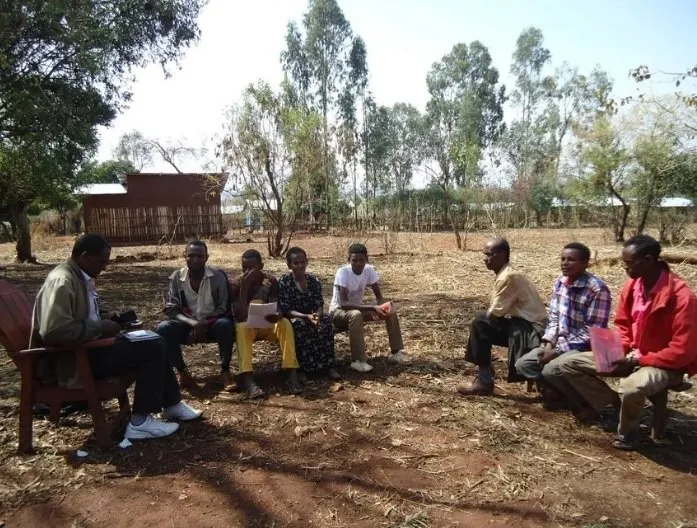
Most Ethiopians have direct experience of an Iddir. When a death occurs in a neighbourhood, the association to which the households belong takes on the practical work — the tent, the chairs, the cooking, the arrangements for the burial — and pays the bereaved family a fixed sum set by its own rules. It is funded by members’ monthly contributions. No government office approves it, no donor pays for it, and nobody running it was appointed from outside.
This essay is about why that familiar arrangement may bear on a question Professor Messay Kebede raises in his book Ethiopian Modernization: Opportunities and Derailments, and about a working paper that takes up his argument at the point where he leaves it.
The question the book asks
For more than a century Ethiopia has tried to modernise. The emperors built schools, ministries and a modern army. The Derg promised socialism and an end to feudal privilege. The EPRDF promised ethnic self-rule and a developmental state. These projects differed widely in ideology, but the outcome in each case shared certain features: power concentrated at the centre, little room for organised society, and recurring conflict over control of the state.
Messay’s book, which is freely available online through the University of Dayton, asks why the outcome has been so similar under such different governments. It moves from theories of modernization and Ethiopia’s long history of survival through the imperial era, the student movement, the Derg and the ethnonationalist period, and ends with a roadmap for change. Readers need not accept every historical judgment in it to find it useful. It offers Ethiopians of different backgrounds and generations a common starting point for a discussion that often divides into arguments about one ruler, one period or one community.
Derailment
Messay’s central idea is derailment. Ethiopia did not fail to acquire modern things. It acquired a great many of them: schools, bureaucracies, weapons, political doctrines and new forms of organisation. The difficulty lay in what they were used for. Modern means were repeatedly put to an older purpose, which was keeping power concentrated in the hands of whoever held the centre.
This is why a change of ideology produced so little change in the result. The Ethiopian state, Messay writes, is designed to “suck all power from the society” in favour of a group and, in the end, of one person. He is equally direct about the remedy. Neither conflict nor derailment will end without reform that “gives back some power of the state to the society,” so that communities and individuals move from “passive subjects into active participants.”
He adds a warning. New institutions remain “empty shells” unless people develop the habits and values that make them work. A constitution cannot by itself teach anyone to hold leaders to account.
What the book leaves open
Two questions follow from that remedy, and the book does not set out to answer either.
The first is what power would be given back to. Society is not a single body that can receive it. Power needs somewhere to live: organisations that ordinary people belong to, run themselves, and are able to defend.
The second is who would hand it over. If the state is built to draw power upward, asking those who hold it to give some of it away is asking a good deal. Reform of this kind is more likely to happen, and more likely to last, where an organised society already exists to ask for it and to hold it in place.
Messay sets out the direction of change clearly. He does not set out the institutions through which ordinary Ethiopians would receive, exercise and defend returned power. That is not a defect. His question is why modernization derailed, and he answers it at length. But it leaves an opening, and the working paper Modernization from Below takes up his argument at that point. It extends his account rather than disputing it. Its candidate for the missing institution is the Iddir.
Why the Iddir?
Not because it is traditional or familiar. The case rests on properties that follow from Messay’s own diagnosis:
- It pays its own way. Most Iddirs are funded entirely by members’ monthly contributions rather than by the state or by donors. Their treasuries are not government grants, and their officers do not hold their positions through a party.
- The people who pay in are the people who decide. This is the point that separates the Iddir from most comparable institutions, and it is easy to pass over. Churches are funded by the faithful, and many cooperatives by member shares; being paid for by its members is not in itself unusual. What is unusual is that the rules governing the fund are written by the members in assembly and amended there, that the officers who hold it are elected by the contributors and replaced by them, and that no body above the association can direct what it does with what it has. Funds contributed by members but governed by someone else leave those members as beneficiaries. Funds governed by the members who contribute them make those members participants, which is the change Messay’s remedy calls for.
- It is open across divisions. It is organised around death, which everyone faces. Membership is therefore not limited in principle by ethnicity, religion or class, and as Iddirs spread through the twentieth century many came to include mixed communities.
- It runs by rules. Iddirs have written by-laws, elected or rotating officers, accounts and penalties. Membership is chosen rather than inherited.
- It outlives its leaders. Officers are replaced and the institution continues. In some Iddirs every household takes its turn in office.
- It is Ethiopian, and it is modern. The Iddir developed among migrants to Addis Ababa in the early twentieth century and spread across the country. It is not a survival from the past. It is an instance of what Messay calls the “Ethiopianization” of modernity, produced from below during the same century in which the state-led version derailed.
None of this means that every Iddir is a model. Some exclude outsiders, and some penalise members who cannot pay. The claim concerns what the institution is capable of, and how widely that capability already exists.
The objection that Iddirs are too small
This is the first objection most readers will raise. A single Iddir has a small treasury, serves one neighbourhood, and buries the dead. How could it matter to the fate of a country?
The objection measures the wrong quantity. It looks at the size of one Iddir rather than at how many there are and how many people they reach. One estimate puts the number of Iddirs in Addis Ababa alone at more than 7,800, covering over 85 percent of households. Few institutions in Ethiopia, public or private, reach that many people, and almost none do so without being paid for by the state.
Iddirs have also worked at scale before. Between 2004 and 2009, some 270 Iddirs took part in community care for people living with HIV, alongside government, health agencies and NGOs. Commercial banks now offer accounts designed for Iddirs, and Iddirs were among the founding shareholders of Addis International Bank. The commercial sector has evidently found them substantial enough to design products for.
They have also operated under the imperial government, under the Derg and under the EPRDF, and they continue to operate now. Few Ethiopian institutions have that record.
Their smallness was partly a choice. Researchers have found that Iddirs often avoided wider roles, and that many declined to register, because they were wary of state interference. Where coordination between Iddirs did occur, it tended to arrive from above: a confederation of 395 Iddirs was proposed in Addis Ababa in 1972, at a time when the imperial government appears to have treated Iddirs as a means of preserving the existing order. Remaining local was, in part, a way of remaining independent.
That points to the more substantial answer. The usual way for an organisation to become large is to merge into a single body with a head office. But a head office is also the easiest thing for a government to take over, since replacing the people who run it gives control of everything beneath it. Modernization from Below proposes a different route, and is careful about the word for it. It does not propose a federation, because a federation is a body set above its members, and that body is what tends to be captured — the confederation proposed in 1972 would have had one, and the British friendly societies had one, whose central administration the state first used and then dispensed with. What it proposes is a network. Thousands of independent Iddirs would keep their own rules, members and funds while cooperating on agreed tasks, such as confirming that a member who has moved to another city is in good standing with their own Iddir. Nothing would sit above them. This is less unfamiliar than it sounds. In parts of Kembata, Iddirs already cooperate within a wider community institution, the Hera, without giving up their own affairs.
What has changed is the technology. Coordination used to require a central office because the shared records had to be kept somewhere, and whoever kept them acquired a position of authority that the arrangement itself did not require. Records can now be held in common without being held in one place. This does not create trust, which Iddirs already have. It allows institutions that work locally to cooperate at a distance without building a new centre that someone could take over.
On this view the number of Iddirs matters more than the size of any one of them. Taking control of thousands of small, self-funded associations would have to be done separately in each case, and in each case in front of that association’s own members.
An independent economic base
This leads to the point that may matter most if Messay’s conclusions are to be acted on.
His diagnosis is economic as much as political. Under the old order and under all three modern governments, he writes, “everything (social status, wealth, opportunities, etc.), revolves around one’s closeness to the exercise of power.” Holding the state means controlling access to jobs, land, licences, credit and standing. This is why competition for the state becomes competition for access to everything else.
If that is right, giving power back to society cannot mean political rights alone. A citizen may vote and an association may be legally registered, but where livelihoods depend on the goodwill of officials, participation remains fragile. Power returned to a society with no resources of its own can be withdrawn again. Messay’s epigraph puts the matter directly: “People have only those rights that they can effectively defend.” Defending rights requires organisation, and organisation requires resources that someone else cannot simply withdraw.
This is where the Iddir is unusual. Its money comes from its members rather than from closeness to power, and, as above, the members govern it themselves. In Messay’s own terms it is a small but real instance of resources that are not allocated by proximity to the state.
The effects extend beyond the Iddir. A family supported at a funeral has less need of a patron. A neighbourhood with an organised, self-funded association can negotiate with local officials rather than petition them; a study of Iddirs in Addis Ababa found that associations funding neighbourhood projects from their own members’ contributions appeared to negotiate from a stronger position.
Each contribution is modest. But it is paid by most households in the capital, every month, year after year, under rules the members write and through officers they replace. Taken together that is a large and continuous flow of resources governed by citizens outside the state’s system of allocation, and little else in Ethiopia can be described that way.
One qualification is needed here, because the figure invites a misreading. Nobody commands that flow. There is no body above the Iddirs that could spend it, and the working paper argues that the absence of such a body is the point of the arrangement rather than a gap in it. The figure does not describe a fund available to anyone. It describes a population that has somewhere to turn other than a patron, and a household that does not need a patron at the moment of bereavement is to that extent less dependent on one. What this could develop into once Iddirs cooperate — through shared protection against shocks, and through other forms of community economic organisation built alongside them — is a question that deserves study rather than a promise.
A caution belongs here as well. Because the Iddir’s funds and membership have value to others, attempts have been made to use them. Under the Derg, Iddirs were enlisted to promote state objectives. In Akaki, officials used Iddir leaders to collect contributions for state projects, and poorer members who could not pay were excluded from their own Iddir’s benefits. Elsewhere officials sought to redirect member funds, or to use Iddir meetings for election campaigns. An independent economic base can be captured. The lessons the working paper draws are practical: keep funds to the purpose members agreed, make every movement of money visible to members, place nothing at a centre that anyone could seize, and establish new economic ventures as separate bodies rather than attaching them to the Iddir. The aim is not an Iddir that does everything, but an Iddir that remains independent, around which other independent institutions can grow. The working paper sets out these safeguards, and the record of capture behind them, in detail.
Where to read further
Messay’s book should be read first on its own terms. It is a serious account of why a century of modernization kept arriving at the same impasse, and it deserves readers well beyond those who already agree with its conclusions.
Modernization from Below: Iddir and the Missing Institutional Mediation in Messay Kebede’s Ethiopian Modernization takes his argument a step further, and contains the analysis, evidence and sources behind this essay. It asks where returned power would live, why the Iddir is the strongest candidate, how Iddirs might cooperate at national scale without a head office, and how they might resist capture. It is a working paper offered for correction. It touches on law, anthropology, economics and public administration, and it needs readers in each of those fields, and members of Iddirs, to test it.
Readers who want to go further again will find the question of how such a network would actually be built — the rules, the safeguards, the technical arrangements and their costs — worked out in a separate set of papers published under the name Hibreteiddir, Iddirs in union. Those papers are a design proposal rather than a finding. Their design includes elements the working paper does not require, among them treasuries that act only by rule, one for each Iddir and one shared across the network, and a token, Dir. Each Dir is minted on a member’s contribution and owed by the Iddir’s main service Iddir, the association within it that collected the money, which keeps the money and repays the debt by paying members’ claims from it and by buying Dir, so that the Dir in existence equals the debts outstanding. Dir’s legal position is one of the questions those papers leave open. They are offered on the same terms as the working paper and this essay: freely, without attribution, and for correction.
The claim in all of this is not that the Iddir resolves Ethiopia’s political difficulties. It is narrower. An institution of the kind Messay’s remedy requires may already exist in Ethiopia, in a form communities have maintained for a hundred years through every change of government, and it is worth examining on those terms.
It is not an offer of any token, membership or service, and it is not legal, financial or tax advice.
Authors note :Prepared with AI assistance.
Works discussed :
Messay Kebede. Ethiopian Modernization: Opportunities and Derailments. Open-access manuscript, 2023. University of Dayton eCommons, https://ecommons.udayton.edu/kebede_ethiopiamodernization/.
Modernization from Below: Iddir and the Missing Institutional Mediation in Messay Kebede’s Ethiopian Modernization. Working paper for discussion, Version 0.4, November 2026. https://iddir.org
Hibreteiddir: Human-Scale Mutual Risk Sharing in the Digital Age. Version 0.4, 2026. https://iddir.org
Editor’s Note: Views in the article do not necessarily reflect the views of borkena.com
__
Join our Telegram Channel: t.me/borkena
Like borkena on Facebook
To submit a press release, send the submission to info@borkena.com
Add your business to Ethiopian Business Listing / Ethiopian Business Directory
Join the conversation. Follow us on X (formerly Twitter) @zborkena to get the latest Ethiopian news updates regularly