
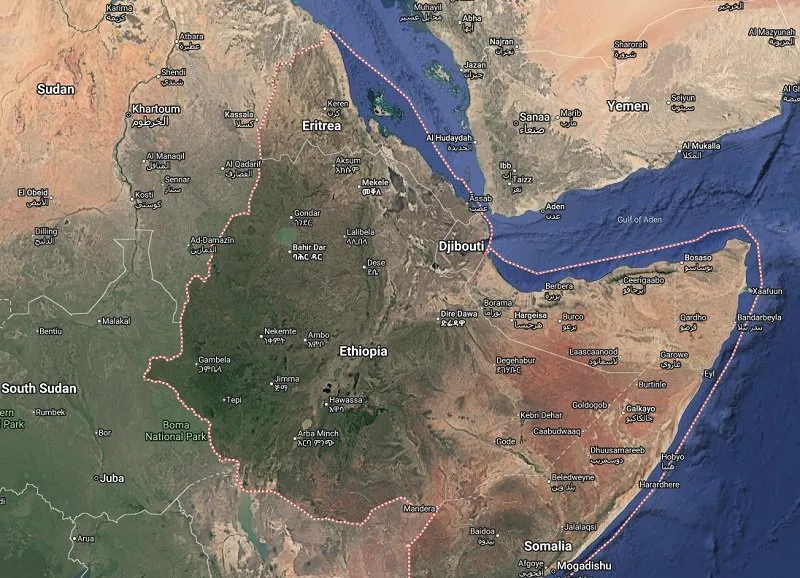
Ethiopia’s historic relationship with the Red Sea is real and very old. Its recent loss of a coastline was the product of the sequence of imperial, colonial, Post war and Cold War developments. Therefore, Ethiopia has a strong case of secured, reliable sovereignly respected access to the sea, as well as negotiated Maritime facilities.
- There is a genuine geopolitical struggle over whether Ethiopia should become a significant Red Sea power again with a coordinated effort to “block Ethiopia”.
- Ethiopia’s Red Sea connection is much older than the Eritrean state with all due respect to Eritrea as a sovereign state since 1993. The Ethiopian highlands and the Red Sea coast have been economically, militarily and politically interconnected for thousands of years.
- The Ancient Ethiopian region was connected to the Red Sea commerce through ports such as Adulis, which the Axumite kingdom developed into a major Red Sea trading power.
- The important point is that the deep historical relationship with Ethiopian Highlands, Red Sea, Arabia, and Indian Ocean was there for thousands of years. This is why Ethiopian strategic thinking has historically treated the Red Sea as part of its national strategic and economic environment.
The modern Eritrean coastline was incorporated into Italian Eritrea, taken away from Ethiopia, in the late nineteenth century. The Ethiopian state and civilization has historically been deeply connected to the Red Sea, and the loss of direct access was relatively recent in historical terms and resulted from colonial and post-colonial territorial transformation. The latest being the agreement between EPLF and TPLF with the total disregard to Ethiopia’s national and historical interest as well as a lack of sophisticated vision and understanding of the issue of Maritime and sea access by TPLF leaders. This agreement that led to Ethiopian loss of access to the sea was done by two guerrilla movements that captured political power through a barrel of a gun with no popular mandate as well as legal support.
The Italian colonial Period
The Italian colonial period was decisive in affecting and establishing precedence in Ethiopians continued access to the sea. Italy established colonial control over Eritrea in the 19th century. That separated the Ethiopians Highland from the Red Sea coast in a way that had not existed under the same modern territorial framework before. This created the basic geopolitical problem that Ethiopia continues to face. A large continental power taking the narrow coastline territory of Ethiopia.
After Italy’s defeats in World War II, what happened to Eritrean, the anti-colonial struggle of Ethiopia, the British administration, and all activities that had taken place put the land mines and problems for Ethiopia to regain its access to the sea.
The United Nations and the Federation
The United Nations actually recognized Ethiopia’s need for sea access. The UN general assembly resolution 390 A (V) adopted in 1950, the UN explicitly referred to the Ethiopian’s legitimate need for adequate access to the sea. The resolution recommended that Eritrea become an autonomous unit federated with Ethiopia under the sovereignty of the Ethiopian crown. It also placed ports and external communications under the federal government jurisdictions. This is extraordinarily significant. It means that the post-world II international settlement did not treat Ethiopia’s Maritime interest as an illegitimate aspiration. Quite the opposite, the UN settlement deliberately attempted the reconcile Eritrea autonomy with Ethiopia’s strategic and economic need for Maritime access.
The 1952 Federation therefore gave Ethiopia a Red Sea connection and back to its historical access and ownership. From 1952 to 1962 Eritrea was federated with Ethiopia. The arrangements gave Eritrea substantial internal autonomy, while the federal Government handled defense, foreign affairs, currency, external commerce, communications, and ports. Those provisions are explicitly contained in resolution 390 A (V). So in modern historical terms before Italian colonialism and after the end of Italian colonialism and British administration as well as after Eritrea rejoined the motherland as an autonomous entity 1952 to 1962 Ethiopia was not landlocked. It posed sovereign federal responsibility for an Eritrean territory that included the Red Sea port. The two major ports of access for Ethiopia were Massawa and Assab.
Then came the critical transformations in 1962 when Emperor Haile Selassie’s government abolished the federation. That transformed the constitutional arrangement. This led to the Eritrean independence struggle supported by Egypt and so-called “progressive” Arab countries such as Libya, Iraq, Syria, PLO etc. That historical episode is essential because it is one of the reasons the modern Ethiopian state can truthfully say that “Ethiopia’s loss of the Red Sea is historically recent. This might not by self-create a modern legal entitlement to sovereignty over Eritrea but does not also deny Ethiopian right to Maritime, strategic and economic access to the Red Sea.
EPLF and TPLF
EPLF and TPLF with their coordinated efforts became militarily victories over the Mengistu Regime. EPLF captured Asmara in 1991, declared its independence in close cooperation with the TPLF. Eritrea was admitted to the UN in 1993 with the Ethiopian government spearheading the effort giving it a legal water shade. Before 1993 Ethiopia had sovereignty over Eritrea. Meles Zenawi, Boutros Ghali (Former Egyptian Foreign Minister and UN secretary General) ……………………….
Ethiopia did not lose its legitimate need for Maritime access
This is where history and international law meet. The UN conventions of the law of the sea recognize the special position of landlocked state. Article 125 states that landlocked states have a right of access to and from the sea and freedom of transit through transit states, while the precise modalities are to be agreed.
- At the same time a country of Ethiopia’s size and geographic position has a legitimate strategic and economic interest in secured, predictable, affordable, and diversified access to the Red Sea and Gulf of Eden. The orchestrated denial of Ethiopian Sovereign and access to the sea by two Guerilla movements who overthrew the Mengistu regime had no legal-right to deny Ethiopia access to sea without the legitimate approval of the Ethiopian people.
Today Ethiopia relies heavily on Djibouti for maritime trade. That gives Djibouti enormous leverage. And it gives Ethiopia an obvious strategic vulnerability and one small principal maritime corridor controlled by another sovereign state allowing military establishments for many Western powers and China. For a country of Ethiopian’s size and growing economy, that is strategically dangerous.
Ethiopia therefore began searching for alternatives. This explains Ethiopia’s interest in Eritrean ports, Djibouti, Somaliland/Berbera, potential Sudanese ports and other Red Sea/Gulf of Eden arrangements. The January 2024 Ethiopia-Somaliland memorandum was therefore not an isolated event. It represented the culmination of much broader Ethiopian strategic problem. How does a 130 million plus continental power obtain reliable maritime access without becoming permanently dependent upon a single small neighboring state which as getting increasingly expensive as Djibouti’s technical capacity in weaker and dependent on other contractors as the Ethiopian port service and strategic needs to expand
Somalia’s Reaction
Somalia reacted strongly to the Ethiopian Somaliland memorandum. Somalia regards Somaliland as part of its sovereign territory and therefore considered the agreement as infringement of its territorial integrity. It became Ethiopia’s maritime strategy versus Somalia’s territorial integrity strategy.
This is where Egypt entered the equation
This is strategically much more consequential. Egypt and Ethiopia already have their dispute over the GERD, Nile water and regional influence. When Ethiopia announced Red Sea access and Somaliland agreement, Somalia moved closer to Egypt providing military assistance to Somalia. Eritrea and Egypt hosted Egyptian, Somalia and Eritrean diplomatic engagement. Egypt sent military shipment to Mogadishu as well as military personnel by way of encircling Ethiopia via Somalia, Eritrea and Sudan. This is where Ethiopia’s access to the Sea becomes a regional balance of powers issue orchestrates by Egypt.
There is substantial evidence that Egypt is increasingly putting pressure on Ethiopia by allying with actors like Sudan, Eritrea and Somalia while simultaneously maintaining its longstanding confrontation with Ethiopia over the Nile. Egypt is trying to create an environment where Ethiopia’s maritime ambitions can be constrained. Egypt has an organized plan to permanently deny Ethiopia a Red Sea access. It is working to prevent Ethiopia from becoming an autonomous maritime power capable of altering the regional balance. This is because an Ethiopia with economic power, Nile leverage, and Military power with access to the Red Sea will be fundamentally different from today’s Ethiopia. It means Ethiopia becoming a naval force with a Red Sea Naval facility, merchant shipping, its own port, maritime logistics, coastal surveillance and independent access to Gulf shipping. That would transform Ethiopia from a landlocked African power into a Red Sea power. For Egypt, that changes the strategic equation enormously and diminishes its effort to keep the monopoly use of the Nile water.
Egypt’s opposition to Ethiopia obtaining access to the red sea is rooted in a combination of Nile river politics, regional power competition, military and security calculation and Egyptian desire to preserve its strategic influence in the horn of Africa and the red sea. My assessment is that Egypt’s concern goes considerably beyond Ethiopia simply acquiring a sea port. Cairo is concerned about what a strategically stronger, economically more independent, and more influential Ethiopia could mean for Egypt’s position in the horn of Africa.
Eritrea is Important
Eritrea currently occupies the most obvious geographic answers to Ethiopia’s maritime needs. If one looks at the map strategically Ethiopian Highlands, Eritrean escarpment, Assab/Massawa and the Red Sea in that order. This is why Ethiopia’s relationship with Eritrea cannot be separated from the Red Sea question. And it explains why Ethiopia-Eritrea reconciliation can potentially transform the entire regional balance benefiting the Ethio-Eritrea population. The two people have much more in common than any country in the region.
The Eritrean government’s strategic logic is not beneficial for the long-term interest of the Eritrean as well as the Ethiopian people. Ethiopia having access to the sea with mutual agreement will not make Eritrean Sovereignty vulnerable. The national strategic, economic, cultural and Ethnic relations between Ethiopian and Eritrean people is much stronger and if handled well, very beneficiary for the two people.
The deeper strategic issue
Ethiopia getting trade access does not necessarily solve Ethiopia’s need for strategic maritime autonomy. There is a huge difference between commercial access and sovereign naval access. There is also a difference between the port lease and territorial sovereignty. Ethiopia’s long-term strategy is sovereign naval access.
One can divide Ethiopian’s maritime objective into four levels.
Level one – minimum reliable commercial for port access which is essential. Level two – strategic long-term port concession/a lease under Ethiopian control or the joint control, which is much more valuable. Level three – Maritime security, naval logistics, coast guard, anti-piracy and maritime surveillance facilities. This gives Ethiopia strategic autonomy without necessarily demanding sovereignty over the coastline. Level four – maximum sovereign Ethiopian territory on the Red Sea. This is the most difficult objective because it directly challenges existing territorial arrangements.
If it is not possible to reach an agreement for territorial acquisition the second best option is Ethiopia reaching an agreement for 50-99 years concession, naval logistics agreements, Fuel-trade zone, Rail corridors, special economic zones and joint maritime security arrangements. That could provide Ethiopia with substantial maritime capability while respecting neighboring sovereignty. This will also make it much harder for Egypt, Somalia, Eritrean governments or others to portray Ethiopian maritime access as territorial expansion; their arguments totally ignore Ethiopian historic ownership and access to the Sea before and after European colonialism.
The real consent is therefore over the three things.
- Geography – who controls the ports?
- Legal Status – who has sovereignty?
- Strategic capability – who can actually use three ports for military, commercial and geopolitical purposes?
Ethiopia should retain the long-term objective. There is nothing inherently illegitimate about Ethiopia wanting to become a maritime state in strategic terms. The country can pursue commercial maritime access, port ownership and concession, maritime industry, naval capability and Red Sea diplomacy. Ethiopia’s historical argument is very effective. Ethiopia’s relationship with the Red Sea predates modern colonial borders. Ethiopia processed direct maritime access through the twentieth century. The 1950 UN settlement explicitly recognized Ethiopia’s legitimate need for adequate access to the Sea. Ethiopia’s present landlocked status is a relatively recent geopolitical condition. Ethiopia recognizes the sovereignty of neighboring states, but we cannot accept permanent strategic dependence on one single and small maritime corridor. Ethiopia’s maritime security is a legitimate regional interest.
All that Ethiopia wants is not contradictory to the interests of Eritrea. Through genuine consultation and give and take the two nations can address the issue.
Above all the people of Ethiopia and Eritrea share deep historical, linguistic, cultural, religious and social connection and commonalities. These ties developed over centuries, long before the modern international borders and Eritrea’s independence in 1993. There are major shared ethnic and family ties; related languages and common heritage, religious tradition, food and hospitality; social values and family life. Ancient historical connection through the Axumite Civilization. Tigrigna speaking people, Afar, Sahos/Irob, Kunamas, Naras, Bilen and related communities live in both countries. The two countries also have important shared traditions such as coffee ceremonies; music and dance, agriculture and pastoralism, marriage and community relationships, trade and migration. The two people have a connection that predates the modern border.
Therefore with this extensive human, cultural and historical as well as economic connection a close cooperation between the two countries is much more beneficial than continued conflict or setting a vengeful score. The two countries can rapidly grow and develop. Ethiopia’s access to the sea is a key that can open the flood gate of development, mutual beneficial cooperation through give and take.
Editor’s Note: Views in the article do not necessarily reflect the views of borkena.com
__
Join our Telegram Channel: t.me/borkena
Like borkena on Facebook
To submit a press release, send the submission to info@borkena.com
Add your business to Ethiopian Business Listing / Ethiopian Business Directory
Join the conversation. Follow us on X (formerly Twitter) @zborkena to get the latest Ethiopian news updates regularly