
Yonas Biru, PhD
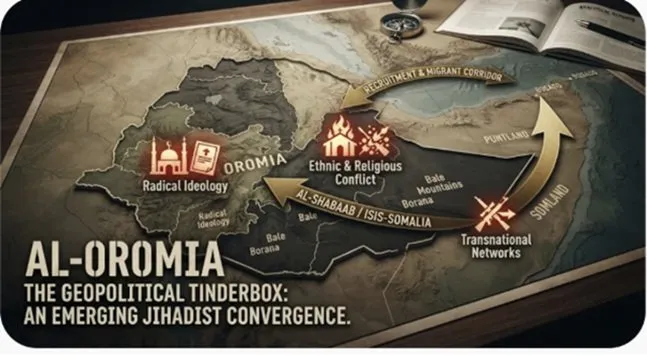
Western security and policy attention in the Horn of Africa remains largely fixed on two familiar threats: Houthi attacks in the Red Sea and al-Shabaab’s insurgency in Somalia. Yet a third jihadist threat is gestating between these two theaters, inside Ethiopia’s Oromia Regional State, largely outside the international radar screen.
The movement may not yet have reached the level of organization, operational capacity or visibility necessary to attract the attention of international jihadist networks. However, its ideological undercurrents, recruitment patterns and organizational evolution suggest the beginnings of an embryonic movement — a nascent pulse of jihadist mobilization beating beneath the surface and emitting the early signs of gathering momentum.
It warrants noting neither al-Shabaab nor ISIS-Somalia emerged fully formed. Both evolved within particular political, economic and social environments that enabled their emergence and eventual expansion. Their development was shaped not only by extremist ideology but also by institutional weaknesses, insecurity and socioeconomic conditions in the societies where they took root.
The central argument of this article is that Oromia may be approaching a more dangerous convergence of political, security and socioeconomic conditions for jihadist expansion than regional and international observers recognize. The underlying ethnic conflict, the region’s enormous population and territorial expanse, and the weakening capacity of the Ethiopian state to exercise effective control make the emerging jihadist insurgency difficult to contain.
What is even more alarming is that, as ethnic politics increasingly lost its currency as an instrument of polarization and divide-and-rule, PM Abiy began relying more heavily on religious actors. The contrast between the Somali government’s declared campaign against al-Shabaab and Abiy’s policy of accommodation toward Islamic extremists is particularly troubling. His close association with leaders of radical Islamic movements, coupled with his administration’s failure to prosecute individuals implicated in jihadist violence, has created a no-man’s land for radical Islamists to exploit. The U.S. government’s International Religious Freedom Report has documented allegations of extrajudicial killings of Christians involving Ethiopian government security forces, raising further questions about the state’s role in aiding and abetting religiously motivated violence.
Even more troubling is the political and socioeconomic environment in which this threat is developing. Ethiopia’s increasingly fractured political landscape, accumulated politicized grievances, deteriorating security apparatus and expanding mass poverty create conditions potentially conducive to jihadist recruitment and radicalization. There are already scattered indications that extremist networks may be seeking to exploit these conditions, some of which have been documented by international observers.
The First Fire: Ethnic Conflict Changing Its Creed
The tribalization of conflict has been entrenched in Oromo politics for over half a century. Since Prime Minister Abiy Ahmed took office, law and security have deteriorated sharply across the Oromo tribal homeland. Orthodox Christian communities have faced repeated killings, attacks on churches, destruction of homes and forced displacement.
The pattern of rapidly growing violence in East Arsi represents a particularly troubling development. Religion is increasingly overtaking ethnicity as an ideological reference point and organizing principle.
The distinction between ethnic and religious conflict matters. Ethnic conflict, however destructive, tends to remain relatively bounded by ethnic identities and political grievances. Religious radicalization transcends those boundaries and attracts external actors, including al-Shabaab and ISIS, who find opportunities to exploit local grievances.
The Second Fire: Radical Islam as an Emerging Ideology and Organizing Principle
Oromo nationalism once supplied much of the organizing energy of Ethiopian opposition politics. That energy is increasingly struggling to sustain a constituency when communities face economic hardship, displacement and persistent armed instability, with little tangible political dividend to show for it. This is one opening through which Islamic radicalism has entered the political field, drawing on both domestic grievances and transnational ideological networks.
There are already identifiable ideological indicators pointing to the nascent formation of an Islamic radical movement. A 2023 study by the U.S. Military Academy’s Combating Terrorism Center, titled The Islamic State Somalia Propaganda Coalition’s Regional Language Push, documented a deliberate expansion of pro-ISIS media networks targeting Somali-, Oromo-, Amharic- and Swahili-speaking audiences. The study documents not merely the translation of propaganda but the development of interconnected media networks designed to facilitate ideological indoctrination, recruitment, fundraising, and violent incitement. The Oromo space is more impacted by this campaign, as suggested by the scale and breadth of religion-based violence in the region.
This was not simply the occasional translation of extremist material. The researchers identified an emerging propaganda ecosystem comprising dedicated translation outlets, media channels and interactive online networks disseminating ISIS ideological and religious material. The networks operated across platforms including Facebook, Telegram, YouTube and WhatsApp. Of particular significance was Al-Hijrateyn, a pro-ISIS media network producing and distributing Oromo-, Somali- and Swahili-language propaganda.
The controversial Indian televangelist and proponent of political Islam, Zakir Naik, is among the prominent transnational preachers whose lectures have circulated among Oromo-speaking audiences. His teachings extend beyond ordinary religious conservatism into a more overtly ideological conception of Islam, raising questions about the potential influence of transnational Islamist narratives on an already politically fractured society.
Naik supports the death penalty for apostasy and argues against non-Muslims being permitted to build or repair houses of worship in Muslim-majority states. He also advocates an Islamic political order and rejects Muslim allegiance to secular or minority-led governments.
Naik’s teachings supply an ideological vocabulary through which claims of religious superiority can evolve into justifications for violence. This is precisely the ideological progression that extremist mobilizers seek to exploit. It is also precisely the paradigm that figures associated with the Ethiopian radical Islamist movement led by Ahmedin Jabel appear to be drawing on—exploiting it to politicize religious identity and perceived grievances, turning them into instruments of political mobilization and confrontation.
Naik’s message is not dependent on conventional religious institutions. His lectures circulate through social media platforms, most importantly in Oromigna. Local preachers can reproduce the format and message, while digital platforms deliver it directly to young audiences.
That matters because political radicalization no longer requires a formal organization. A mosque, madrasa, Telegram channel, TikTok account or informal religious network can become a node of mobilization. Naik’s transnational message acts as an accelerator.
The Third Fire: Networks Across the Red Sea
Oromia’s vulnerability becomes more consequential because it does not exist in isolation. There are already identifiable transnational extremist networks operating in the region. Al-Shabaab has maintained a presence in southeastern Ethiopia since its July 2022 incursion.
Sahan Global’s assessment of Jaysh al-Habash estimates that more than 2,500 al-Shabaab fighters took part in the July 2022 incursion, which lasted about 10 days. Although Ethiopian and Somali regional forces repelled much of the assault, several hundred fighters are believed to have remained in southeastern Ethiopia. Sahan estimates that approximately 1,500 subsequently embedded themselves across parts of Bale, Liban and Afdheer. The assessment says the group prioritized recruitment and the development of militant networks over high-profile attacks, identifies the remote Bale Mountains as an area of particular interest, and reports efforts to recruit Salafi converts in remote Borana communities.
Al-Shabaab has demonstrated an ability to exploit Ethiopia’s internal conflicts to establish recruitment networks and operational footholds beyond Somalia. Its strategy in southeastern Ethiopia has included recruiting from displaced and economically marginalized communities and cultivating relationships with local religious figures.
The Islamic State-Somalia network presents another concern. A 2024 Combating Terrorism Center analysis, drawing on a Somali security source, reported that Ethiopians were among the largest foreign-recruit populations and that the group had recruited ethnic Oromo and Amhara fighters as well as Somali-Ethiopians. The International Crisis Group has independently identified Ethiopia among the countries most frequently cited as origins of foreign recruits. These are attributed intelligence and field assessments, not a verified census of the group’s membership; the evidence supports the presence of Ethiopian recruits, including reported Oromo recruits, rather than a complete regional recruitment profile.
ISIS-Linked Networks Operating Inside Ethiopia are not Merely Hypothetical
A December 2025 report by the U.N. Security Council’s Analytical Support and Sanctions Monitoring Team recorded Ethiopia’s announcement of the 82 arrests and stated that the individuals had been trained by ISIS-Somalia and involved in intelligence, financial and logistical support for the group. The U.N. report corroborates the announcement and places it in the wider regional threat picture.
Independent field reporting by Inkstick in November 2025 reveals another dimension. Its investigation, “Along Somalia’s Overlooked Migration Trail, Dangers Lie in Wait,” documented the vulnerability of Ethiopian migrants moving through Puntland, the presence of Ethiopian foreign fighters in ISIS-Somalia’s ranks and the recruitment risks facing stranded migrants in and around Bosaso.
The Migration Corridor is Especially Important
According to the International Organization for Migration, 234,015 exit movements from Ethiopia were tracked along the Eastern Route in 2024, a 27% increase over 2023. During the same period, tracked transit movements increased by 56% in Djibouti and 23% in Somalia. Across the route, IOM tracked 446,194 movements in 2024; it reported that 89% were driven by economic reasons and 7% by conflict, violence or persecution.
Inkstick’s investigation documented how vulnerable Ethiopian migrants stranded in and around Bosaso are exposed to exploitation by traffickers and armed groups. Puntland officials and an International Crisis Group researcher described how ISIS-linked operatives may exploit migrants’ desperation by offering money, food, protection or work in exchange for logistical assistance, with some potentially drawn toward military training. The article also recounts an Arsi migrant’s account of being taken to a military camp and forced to train without pay before fleeing.
The implications are serious. Recruitment does not always begin with ideological conviction. For people who are hungry, stranded, financially desperate or fleeing conflict, the initial attraction may be money, food, shelter or protection. Ideological indoctrination can follow material dependence.
The transnational dimension extends beyond recruitment. ISIS-Somalia has developed a financial infrastructure that makes it more consequential than its relatively modest territorial footprint might suggest.
How the Three Fires Could Meet and Combust
The convergence of the above-discussed three fires is what makes the emerging Islamic threat particularly dangerous. They are not necessarily components of a single coordinated movement today. Rather, they are parallel developments that could reinforce one another.
There is another political development that deserves attention: the campaign by Ahmedin Jabel and his associates to institutionalize religious identity within Ethiopia’s constitutional and political architecture.
Ahmedin argues that citizenship alone cannot adequately address historical religious and cultural marginalization and calls for constitutional recognition of collective religious institutions. His proposal goes beyond protecting religious freedom or ensuring equal representation. It calls for amending the Constitution to introduce religion as an additional political or institutional organizing principle alongside ethnic federalism.
Under the current constitutional framework, sovereignty, state ownership and the right to self-determination are vested in the tribal homelands, with ethnic identity forming the basis of the regional-state structure. The foundational principle of Ahmedin Jebel’s proposal is that it seeks to introduce a second axis of political sovereignty into a constitutional order already organized around ethnic self-determination.
But how can two competing centers of sovereignty coexist in Oromia? Oromummaa’s “I am first Oromo above my religion” allegiance seeks to transcend religious boundaries, while some of its advocates regard Waaqeffannaa as the indigenous spiritual pillar of Oromo civilization. In Ahmedin’s world, would Oromo Muslims and Christians owe their primary political allegiance to their respective religious constituencies or to the Oromo national community?
This would fundamentally transform the Ethiopian constitutional order, moving away from an ethnic-federal model toward a dual identity-based system in which both ethnicity and faith become formal pillars of political organization. Rather than resolving competing identity-based claims, it risks creating yet another constitutional framework for competing claims to political power.
There is another dimension to Ahmedin’s campaign that provides a glimpse of Ahmedin’s strategy. His camp advances claims that Muslims constitute the majority of Ethiopia’s population and translates and widely circulates Zakir Naik’s lectures, including his positions restricting the construction and repair of churches in Muslim-majority countries.
The recent division of Oromia into six administrative clusters also raises questions about the institutionalization of religious identity. The arrangement has been described as comprising four predominantly Muslim clusters administered by Muslim officials and two predominantly Christian clusters in which Christians control the levers of regional administration. This is the very religious division that Ahmedin’s constitutional proposal seeks to elevate.
There is a fundamental difference between protecting religious communities and organizing political authority around religious blocs. The former is a constitutional obligation. The latter risks turning religious identity into another instrument of political competition, territorial bargaining and political power.
In Oromia, this debate intersects with the political philosophy of Oromummaa, whose proponents often present Waaqeffannaa, an indigenous Oromo identity, as an overarching national bond transcending religious divisions, and see Islam as an invader.
Conclusion: Extinguishing the Fires Before They Become an Inferno
Calling the emerging threat Al-Oromia may be premature because the evidence does not yet establish a unified domestic jihadist organization with a clear chain of command, sustained territorial presence and demonstrated operational capacity. But early warning is not limited to identifying a fully formed organization. It requires recognizing the conditions, networks and recruitment pathways that could allow one to emerge. Ignoring those warning signs would amount to a reckless disregard of a potentially serious security threat.
The Combating Terrorism Center has documented the multilingual propaganda infrastructure. The United Nations has documented recruitment intermediaries, transportation networks and financial facilitators operating through Puntland. IOM has documented the scale of migration along the Eastern Route and the substantial displacement burden in Oromia. ACLED and the EHRC have documented patterns of civilian targeting and attacks on religious sites in Arsi. Inkstick has reported firsthand accounts of vulnerable Ethiopian migrants and Ethiopian foreign fighters in the Puntland environment. Taken together, these sources establish sufficient warning indicators.
The international community should be mindful of the danger associated with the possible emergence of Al-Oromia and look beyond the familiar security theaters of the Red Sea and Somalia. The space between them is not merely a geographic corridor. It is a potential human, ideological, financial and logistical bridge through which extremist networks could penetrate an increasingly fragile Ethiopian state.
The three fires have not yet merged. But combustible materials are accumulating, and the political and security conditions for their convergence are becoming increasingly visible. The greatest danger is that, by the time the international community recognizes the threat, the conditions that made it possible may have become too deeply entrenched to reverse.
Editor’s Note: Views in the article do not necessarily reflect the views of borkena.com
__
Join our Telegram Channel: t.me/borkena
Like borkena on Facebook
To submit a press release, send the submission to info@borkena.com
Add your business to Ethiopian Business Listing / Ethiopian Business Directory
Join the conversation. Follow us on X (formerly Twitter) @zborkena to get the latest Ethiopian news updates regularly