
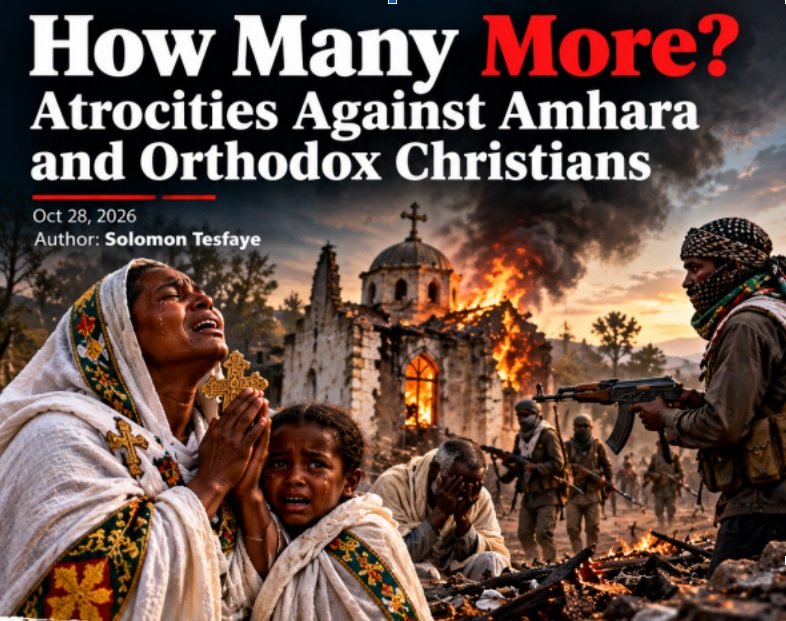
By Solomon Tesfaye
How many more innocent Amhara and Orthodox Christian civilians must be massacred before the international community takes meaningful action?
At least 60 Orthodox Christians were killed in two attacks in Oromia on 20 and 24 October 2026, the Ethiopian Orthodox Tewahedo Church reported (Reuters, 2026; Holy Synod statement via OSV News, 2026). In 2022, Amnesty International warned that a “pervasive culture of impunity” was driving Ethiopia’s cycles of violence (Amnesty International, 2022). Four years later, the killings continue.
The central question is no longer simply who carried out these attacks. It is why the Ethiopian state has repeatedly failed to prevent them, protect vulnerable communities and deliver justice for victims. This article sets out the facts, analysis, impact and recommendations, following the reporting approach used by the UN, Amnesty International and Human Rights Watch.
Fact: What happened
On 20 October, 14 Orthodox faithful were killed at Gora Silingo, Angada Kebele, Merti district. On 24 October, 46 more were killed at Tereta Chole Birbo in Sherka district, both in Arsi Zone (Holy Synod via OSV News, 2026). More than 20 people were hospitalised with severe injuries and more than 20 homes were burned (Reuters, 2026). Residents and the conflict monitorACLED counted at least 43 dead in Sherka alone (The Rio Times, 2026). The Synod said massacres and forced displacement of its faithful in Arsi and elsewhere have continued and worsened over time.
These killings sit within a documented record:
Nov 2020, Wollega: the Ethiopian Human Rights Commission (EHRC) found Amhara residents were dragged from their homes and killed after federal troops withdrew; at least 32 died (EHRC, 2020).
Jun 2022, Tole, Gimbi: Amnesty reported more than 400 Amhara residents killed, mostly women and children (Amnesty International, 2022). Human Rights Watch found security forces did little to protect them (HRW, 2022).
Feb 2023, Shashemene: EHRC confirmed eight Orthodox faithful killed by security forces using excessive force (Addis Standard, 2023).
Nov 2023, Shirka: residents reported 36 Orthodox Christians killed in identity-based attacks (Addis Standard, 2023).
Oct 2025, East Arsi: the Church reported more than 25 of its followers killed in one month (AllAfrica, 2026).
Feb 2026, Shirka: EHRC confirmed a 26 February attack with killings and abductions (EHRC, 2026); about 20 Orthodox Christians, including a priest, died (Open Doors, 2026).
May to Jun 2026, Arsi: at least 12 killed, a 101-year-old church burned and more than 280 displaced (Open Doors, 2026).
Aug 2026, East Wollega: the Amhara Association ofAmerica, an advocacy group, documented at least 68 civilians killed in under two weeks (AAA, 2026).
Sources for this section: Reuters (27 Oct 2026); OSV News; The Rio Times; EHRC 2020; Amnesty; HRW; EHRC 2026; Open Doors.
Analysis: a pattern of failure and impunity
A systematic pattern. The same communities, in the same zones, have been attacked repeatedly for six years. Open Doors’ East Africa researcher found the attacks on Orthodox Christians in Arsi to be targeted and organised, with minimal state protection (Open Doors, 2026). This is not random ethnic tension.
Failure to protect. In 2020, EHRC asked authorities to explain why troops withdrew from an area long known to be vulnerable, hours before a massacre (EHRC, 2020). In 2022, Human Rights Watch found Ethiopian security forces did little to protect Amhara civilians in western Oromia (HRW, 2022).
State forces as perpetrators. The UN human rights office documented 1,106 people killed in Amhara and Oromia in 2023, and implicated both government forces and the Oromo Liberation Army (OLA) in at least 188 incidents in Oromia (OHCHR via AllAfrica, 2024). A Reuters investigation found a secretive Oromia security committee, the Koree Nageenyaa, ordered dozens of extrajudicial killings and hundreds of illegal detentions (Reuters, 2024). The US State Department said its abuses particularly targeted ethnic and religious minorities (US State Department, 2025).
Impunity. The same State Department report found the government took only limited steps to punish officials who committed abuses (US State Department, 2025). EHRC, Ethiopia’s own rights body, has accused the federal government of ignoring its recommendations (The Reporter, 2024).
Contested responsibility. After the October attacks, the Oromia regional government and a source linked to a rebel alliance traded blame; the government offered no evidence for its claim (Reuters, 2026). After the 2022 Tole massacre, the OLA denied responsibility and blamed a militia created by the regional state (Addis Standard, 2022). Competing claims, unanswered questions and unimplemented recommendations mean only an
How Many More? Atrocities Against Amhara and Orthodox Christians
independent international investigation can establish the facts. That includes whether state institutions enabled, facilitated or tolerated violence through discriminatory policy, complicity or deliberate inaction.
Sources for this section: Open Doors; EHRC 2020; HRW; OHCHR; Reuters investigation; US State Department; The Reporter; Addis Standard; Reuters (27 Oct 2026).
Impact: lives, communities and stability
On victims and families. Sixty people are dead, more than 20 are in hospital and families have lost their homes (Reuters, 2026). Earlier attacks in Arsi left survivors stranded in open areas without shelter (Open Doors, 2026).
On rights and social cohesion. The Holy Synod said the killings violate the constitutional rights to life and religious freedom and undermine peaceful coexistence (Holy Synod via OSV News, 2026). Open Doors warns such attacks erode the trust between Orthodox and Muslim neighbours who lived peacefully together for years (Open Doors, 2026).
On national stability. The killings come as Ethiopia faces renewed war nearly four years after the 2022 Pretoria agreement, with the TPLF joining six other armed groups in an alliance against the government (OSV News, 2026). The regional government itself warned the attacks were meant to spark religious conflict (Reuters, 2026). Left unpunished, each massacre raises the risk of reprisals and wider sectarian violence.
Sources for this section: Reuters (27 Oct 2026); Holy Synod via OSV News; Open Doors Australia; Open Doors UK.
Recommendations
I call upon the United Nations, the African Union, international human rights organisations and Ethiopia’s international partners to demand:
1. An independent international investigation into the reported atrocities and patterns of persecution. The UN Human Rights Council should resume scrutiny of Ethiopia, as Human Rights Watch has urged (HRW, 2024), and Ethiopia must grant investigators full access (Amnesty International, 2022).
2. Effective civilian protection forAmhara communities, Orthodox Christians and all vulnerable populations, through the immediate and sustained measures in Arsi that EHRC has called for (EHRC via AllAfrica, 2026).
3. Investigation of potential state involvement, including the Koree Nageenyaa, troop withdrawals before massacres and failures to respond to warnings.
4. Accountability for perpetrators and any officials found responsible, regardless of position, with reparations for victims, as EHRC has recommended (Addis Standard, 2025).
5. Urgent action under UN Sustainable Development Goal 16: Peace, Justice and Strong Institutions, in particular its targets to reduce violent deaths and guarantee equal access to justice.
No Ethiopian citizen should face persecution, displacement or death because of their ethnicity or religious identity. Silence, impunity and the failure to protect civilians must not become normalised.
Justice for victims. Protection for civilians. Accountability for those responsible. Sources for this section: HRW; Amnesty International; EHRC; Addis Standard; UN SDG 16.
References
News agencies and church statements
Reuters (27 Oct 2026). Attackers kill 60 people in Ethiopia’s conflict-hit Oromiya region, Orthodox Church says.
Reuters (2024). In Ethiopia, a secret committee orders killings and arrests to crush rebels.
Holy Synod of the Ethiopian Orthodox Tewahedo Church, via OSV News (2026). Church demands protection as 60 Orthodox Christians killed in Ethiopia. The Rio Times (26 Oct 2026). Ethiopia attack kills over 40 Christians (citing ACLED).
UN and human rights organisations
OHCHR, via AllAfrica (2024). Conflict killed 1,106 in Amhara, Oromia in 2023. Amnesty International (2022). Ethiopia: Authorities must investigate massacre of ethnic Amhara in Tole.
Human Rights Watch (2022). Ethiopia: Civilians in western Oromia killed, security forces did little to protect.
Human Rights Watch (2024). Ethiopia: Military executes dozens in Amhara region. Ethiopian Human Rights Commission (2020). Wollega Zone massacre of civilians. Ethiopian Human Rights Commission (2026). Statement on attacks in Arsi Zone. US State Department (2025). 2024 Country Reports on Human Rights Practices: Ethiopia.
United Nations. Sustainable Development Goal 16.
East Africa researchers and regional media
Open Doors UK (Mar 2026). Orthodox Christians killed in spate of attacks in Ethiopia. Open Doors Australia (Jun 2026). Ethiopia: Christians killed, church burned, 280 displaced.
Addis Standard (2022). Amnesty calls for independent investigations into Tole massacre.
Addis Standard (2023). EHRC says eight people killed in Shashemene. Addis Standard (2023). 45 believers killed in Arsi and Kellem Wollega. Addis Standard (2025). EHRC reports widespread extrajudicial killings in Amhara and Oromia.
AllAfrica (Mar 2026). Religious councils condemn killing of civilians in East Arsi. AllAfrica (Mar 2026). EHRC urges urgent federal and Oromia action in Arsi. The Reporter (2024). Gov’t not implementing our recommendations: EHRC. Amhara Association ofAmerica, advocacy group (Sep 2026). Preliminary report, East Wollega.
Editor’s Note: Views in the article do not necessarily reflect the views of borkena.com
__
Join our Telegram Channel: t.me/borkena
Like borkena on Facebook
To submit a press release, send the submission to info@borkena.com
Add your business to Ethiopian Business Listing / Ethiopian Business Directory
Join the conversation. Follow us on X (formerly Twitter) @zborkena to get the latest Ethiopian news updates regularly.