
By Lissan Al-Gharib
If Tigray is under control, why won’t Abiy Ahmed go there?
Tigray is still part of Ethiopia, isn’t it? And last time I checked, Abiy was still its prime minister and commander-in-chief. If his government has restored the authority it claims, a visit to Mekelle should hardly be an extraordinary undertaking.
Yet the man who wants credit for controlling the country remains absent from a region he insists belongs firmly within it.
Ervin Massinga, the unofficial governor of Ethiopia, can visit Tigray. Abiy Ahmed, the official prime minister, apparently cannot. The American ambassador makes the journey while Ethiopia’s own leader keeps his distance.
Then there is Dubai.
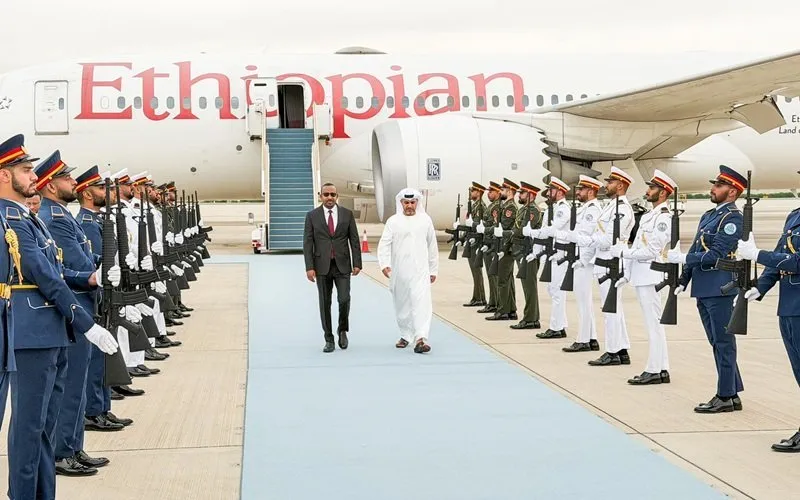
The “leader” of Ethiopia can find the courage to fly to Dubai amid the threat of Iranian drones and missiles to check on his patron and sponsor, Mohamed bin Zayed. Yet somehow, he cannot find his way to Mekelle.
What explains this selective courage? Does facing Ethiopian citizens trouble him more than the prospect of missiles? Or does a meeting with a wealthy patron offer rewards that a meeting with the people of Tigray cannot?
And this is the same man who talks about Assab. He projects ambition beyond Ethiopia’s borders while avoiding a city within them. How does he expect anyone to take his Red Sea posturing seriously when he cannot bring himself to visit Mekelle? Before talking about reaching Assab, perhaps he should demonstrate that he can reach Tigray.
Perhaps he doubts his own assurances. Is he staying away because he is unsure whether his government’s control will last? Does he fear that a triumphant appearance in Mekelle could become another image of premature victory—one that events would later turn against him?
We have seen the danger of his declarations before. The TPLF was supposedly finished, expired, reduced to dust. Yet the forces he had written off subsequently advanced toward Addis Ababa. Apparently, the dust could march.
Does he remember that humiliation more clearly than his speeches suggest? Is he reluctant to attach his face to another declaration of success that he cannot guarantee will survive?
Or is he ashamed to face the people of Tigray over the war he pursued alongside Isaias Afwerki? Does he fear questions about their partnership, the decisions made between them and the suffering that followed?
Those questions would be harder to evade in Mekelle than in a carefully arranged interview in Addis Ababa.
His interview in Tigrinya makes the distance particularly striking. Does he imagine that speaking Tigrinya from Addis is a substitute for speaking Amharic in Mekelle? What matters is whether he will stand before the people he claims to govern, hear their grievances and answer them directly. Changing the language of an interview does nothing to meet that obligation.
Abiy cannot claim the prestige of restored sovereignty while avoiding the responsibilities that come with it. If Tigray is his government’s success story, he should be prepared to stand there and defend that claim.
An army can hold positions and secure roads. It cannot manufacture public trust. A military briefing cannot substitute for facing people who endured the war.
In Mekelle, the questions would be unavoidable. What has been rebuilt? What happened to the missing? Who answers for the destruction? What future does his government offer those whose lives were shattered?
He owes answers to people who may have no applause for him.
Or is the explanation simpler? You dance with the one who brought you. If MBZ’s money sustains Abiy’s grip on power, perhaps that explains why Dubai commands his attention while Mekelle waits. The people of Tigray can demand accountability. His patron can demand his presence—and apparently knows how to get it.
The spectacle recalls Malcolm X’s description of the “house Negro”: someone so identified with the master that the master’s illness becomes our illness, his danger our danger. The political analogy concerns allegiance. Whose security produces an immediate response? Whose suffering can be left waiting?
When danger threatens the patron, there is urgency. When citizens demand their prime minister’s presence, there is distance. A leader who treats his sponsor’s security as a personal emergency should expect questions about whose interests he serves.
The people of Tigray have no oil fortune to purchase his attention. Their claim on him rests on their citizenship. That should be enough.
What does it say about his leadership that he can brave danger to visit his patron in Dubai, but cannot face his own citizens in Mekelle?
Editor’s Note: Views in the article do not necessarily reflect the views of borkena.com
__
Join our Telegram Channel: t.me/borkena
Like borkena on Facebook
To submit a press release, send the submission to info@borkena.com
Add your business to Ethiopian Business Listing / Ethiopian Business Directory
Join the conversation. Follow us on X (formerly Twitter) @zborkena to get the latest Ethiopian news updates regularly.