
By Andargachew Tewodros
Now it is official: the UAE has come out in the open that it is supporting the Abiy Ahmed Ali government. As the new coalition forces, more than seven forces in the country, unite against the government, the UAE has officially released a strong statement, sending a clear warning to the TPLF and its armed alliance while supporting its puppet government of Abiy Ahmed Ali. The world knows that the UAE has been heavily investing in port-based colonialism for more than a decade across the Gulf of Aden, Red Sea and Mediterranean Sea, from Yemen, Somalia, Eritrea, Sudan, Egypt and Libiya. Since its ambition to seize Assab in 2012 failed, the UAE has invested heavily in Ethiopia and in the incompetent Abiy Ahmed Ali so that he can bring Red Sea dominance to it. The UAE’s investment in Abiy Ahmed Ali started very early in his premiership. In 2018, the UAE gave him $2 billion at the time. Since then, the UAE has given Abiy Ahmed Ali several billion dollars. The UAE is not naïve in investing in him. It is investing to control ports across Africa and its resources, such as gold and other minerals, and, most importantly, its farmland. To protect its interests in him, the UAE has assigned several people to work around Abiy Ahmed Ali and advise him. In addition, the UAE has equipped him with drones and personnel to operate them. This is how Abiy Ahmed Ali has been able to carry out drone strikes that have killed thousands of civilians across large parts of the country, including Oromia, Amhara, Tigray, and other regions.
Recently, when Ethiopians understood that Abiy Ahmed Ali was not prioritizing the well-being of Ethiopians and the country, they united against him. They saw that he is terrorizing most of the country. He is attacking civilians indiscriminately with drones, just to stay in power so that the UAE can have its way. Ethiopia has become more isolated diplomatically, just look what Egypt, Eritrea, Somalia and Sudan met and what they agreed to do. Economically, the people are suffering. Ethiopians’ safety in town and rural area have deteriorated significantly. They united against him because their priority became their existence. Even though they do not have the same political agenda, they prioritize standing up for their existence and have agreed to establish a transitional government together. They met more than 20 times to discuss the matter for more than eight months and to agree on such terms. Now that they have made it clear that they have established a coalition and started operations, it is not only Abiy Ahmed Ali and his gangs who are scared, but also the UAE, which has a lot to lose by losing its costly mole in the country. So, they came up with a strategy.
The UAE devised its usual strategy: EASTABLISH PEACE FORCE
The nature of UAE leadership is that they do not only equip one force in a country. They go a step further and equip alternative forces in different parts of the countries where they are involved. You can take the examples of Libya, Yemen, and Sudan. Now in Ethiopia, they are not only supporting Abiy Ahmed Ali, the genocider; they go beyond that and have started equipping regional forces. That means money is flowing not only to Abiy Ahmed but also to other power- and money-hungry actors. Actually, it started months ago: to establish peace forces in every region of the country. You have heard about the Tigray Peace Force (TPF). The TPF is led by Getachew Reda and Tsadkan. Now, they have just established the Amhara Peace Force. This is being led by people like Maserasha Sete, the man who was spying on Fano forces for Abiy Ahmed Ali. We all remember the saga when he surrenders to the government under the recognition of African Union representatives. Right now, many peace forces are being established across different regions. This is not the first time the UAE has established forces. The Rapid Support Forces (RSF), which have destroyed Sudan and its people, are another example. It has also supported forces in Libya, Somalia, and Yemen. Recruiting such forces and destabilizing countries is a signature of the UAE!
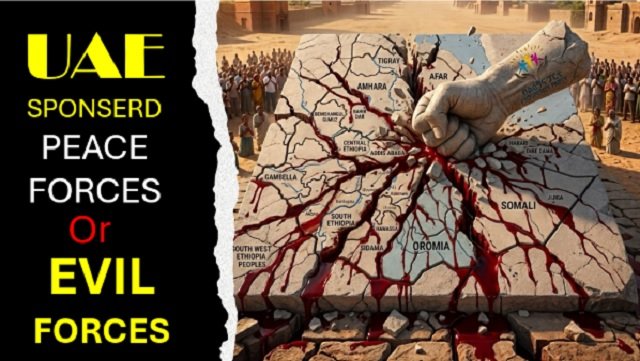
The Paradox: PEACE FORCE or UAEs EVIL FORCE
(መልከ ጥፉን በስም ይደግፉ)
UAE ‘s high investment in the so-called peace force is a paradox. Consider the Tigray Peace Force (TPF) a few days ago in Alamata. They killed other forces that were aligned with the government forces. These militias were killed in broad daylight, and the government’s military was there while this happened. The question is, where is PEACE? Another example: RSF has destroyed the people of Sudan in the past few days. The world has ignored that millions are suffering greatly. So, what is this about the Peace force of UAE? In Ethiopia, since Abiy Ahmed Ali came to power, he has been engaged in a continuous war. He witnessed the death of millions in the two-year Tigray war. He used UAEs advanced technology to destroy masses of youth. It is an abomination to be called Amhara Peace Force, Tigray Peace Force, Oromo Peace Force, Afara Peace Force, and so on. The goal is to destroy the country. ETHIOPIANS SHOULD CALL ALL THESE PEACE FORCES UAE EVIL FORCERS.
The word PEACE has become one of the most powerful and, at the same time, most misused words in Ethiopia today. A force does not become a peace force simply because the word “peace” is placed in its name. Peace should mean the protection of human life, the end of violence, the security of civilians, reconciliation, and the creation of conditions in which people can live without fear. When a group carrying the name “Peace Force” becomes involved in armed confrontation, killings, or the suppression of other forces, the word PEACE itself becomes a contradiction. This is why Ethiopians should ask a simple but fundamental question: What kind of peace is being offered, and peace for whom? If the language of peace is being used to organize, recruit, finance, or legitimize armed forces, then the word may become a political instrument rather than a genuine commitment to peace. Ethiopia has suffered enough from the misuse of political language. The country needs peace that can be measured by fewer deaths, fewer displaced people, greater security for civilians, genuine dialogue, and an end to the cycle of armed conflict, not peace merely as a name attached to another armed organization.
Why are Ethiopians so easily recruited to support the UAE’s “Peace Forces” initiative?
There are plenty of reasons why, in my view, the UAE and Abiy Ahmed Ali have been able to gain significant influence in Ethiopia. Among the main reasons are the following:
(i) It has become a business opportunity for a few powerful individuals. People like Abiy Ahmed Ali, Getachew Reda, and others are accused of benefiting politically or financially from the situation. These people come from poor backgrounds, yet they have accumulated access to wealth and influence that would have been difficult for them to imagine earlier in their lives. The broader issue is not simply individual enrichment; it is the creation of a political and economic system in which powerful external actors can develop relationships with influential Ethiopian figures and use those relationships to advance their strategic interests. The UAE’s relationship with Ethiopia became particularly important after Abiy Ahmed Ali came to power. In 2018, the UAE announced a $3 billion support package for Ethiopia, consisting of $2 billion in proposed investments and a $1 billion deposit with Ethiopia’s central bank. This demonstrated the scale of the economic relationship at an early stage. From my perspective, such investments should not be viewed only as economic transactions; they must also be examined in the context of the UAE’s wider strategic interests in the Horn of Africa, the Red Sea, ports, logistics, agriculture, and natural resources.
The political dimension is equally important. The presence of influential Muslim officials in senior government positions has been interpreted by some Ethiopians as another signal of the UAE’s growing influence. However, this should be distinguished from evidence of direct UAE control: holding a particular religious identity by itself does not establish political allegiance to a foreign government.
(ii) There are millions of economically vulnerable young people in the country. Ethiopia has a very large and predominantly young population, while poverty, unemployment, displacement, and insecurity have created conditions in which young people can become vulnerable to recruitment by armed or political organizations. This is one reason why the availability of poorly paid or unemployed young people can become an important factor in prolonged conflict. We have also seen reports and testimonies concerning combatants who describe the salaries or financial incentives they receive for joining armed groups. Such testimony illustrates how economic hardship can become a powerful recruiting tool. When a young person has few economic opportunities, the promise of regular income, food, protection, or status can become extremely influential. Abiy Ahmed Ali himself have said on National TV, for him “it is easy to recruit one million youth every year.”
(iii) Many Ethiopians are not yet fully aware of what is happening in the country and across the region. Ethiopia’s political crisis cannot be understood only through domestic politics. It is connected to developments in the Horn of Africa, the Red Sea, the Gulf states, ports, trade routes, security alliances, and competition over strategic resources. The UAE’s involvement in the wider Horn of Africa therefore deserves serious public scrutiny. Many ordinary Ethiopians are understandably focused on survival, employment, food prices, displacement, security, and the safety of their families. Under such circumstances, it is difficult for people to follow complicated geopolitical developments or identify the connections between events occurring in different parts of the region.
(iv) Much of the Ethiopian diaspora is also divided or insufficiently informed about the broader picture. Some diaspora Ethiopians are deeply engaged in Ethiopian politics, while others have limited access to reliable information or view the country through political and ethnic perspectives formed many years ago. Social media has also created an environment in which propaganda, misinformation, selective reporting, and emotionally charged narratives can spread very quickly. As a result, many people may understand individual events without seeing the larger pattern. They may see the conflict inside Ethiopia as purely an ethnic or domestic political struggle while overlooking the economic, military, geopolitical, and strategic interests of external actors.
All these factors, and many others, have created an environment in which a relatively small external power such as the UAE can acquire considerable influence in Ethiopia. The central question, therefore, is not simply whether the UAE is investing money in Ethiopia. The deeper question is what strategic objectives accompany that investment, who benefits from it, and whether those interests ultimately serve the Ethiopian people. From this perspective, Ethiopia’s enormous population, strategic location, agricultural potential, natural resources, and proximity to the Red Sea make the country far too important to be treated as merely a battlefield for the interests of external powers. Ethiopians must understand the wider geopolitical picture and carefully examine who is benefiting from the country’s continuing instability.
Call A Spade A Spade
We have to call all those PEACE FORCES, like TPF, APF, and so on, EVIL UAE forces. Since they are designed by evil-minded people who have only selfish ambitions and want to destroy a nation of 130 million people. Ethiopians from all ethnic groups and walks of life should wake up and consider solidarity instead of individualism before they lose everything. Today, the parliament was not able to hold its live meeting because of fear of drone attacks. The whole world saw it. Ethiopian Airlines is reportedly considering moving its headquarters to Nairobi. Since Abiy Ahmed Ali came to power, many international organizations, headquarters, and embassies have moved to Nairobi. Before losing the whole country, Ethiopians should stand in solidarity. The coalition forces and the political gathering that politician Lidetu Ayalew is calling for are the right direction. Get up and unite and root out the evil in the system. Make Ethiopia again a place where all ethnic groups live in harmony, with the rule of law, building a nation for all.
Editor’s Note: Views in the article do not necessarily reflect the views of borkena.com
__
Join our Telegram Channel: t.me/borkena
Like borkena on Facebook
To submit a press release, send the submission to info@borkena.com
Add your business to Ethiopian Business Listing / Ethiopian Business Directory
Join the conversation. Follow us on X (formerly Twitter) @zborkena to get the latest Ethiopian news updates regularly.