
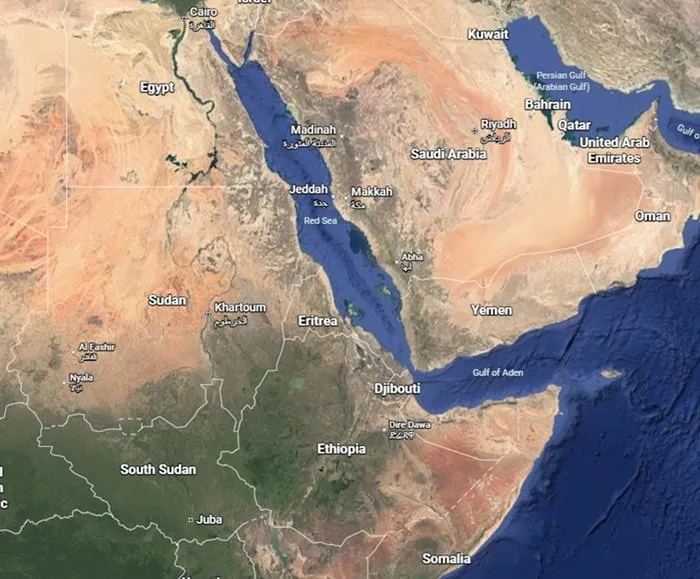
The Red Sea area is becoming contentious. Ethiopia is pushing for access to the Sea. Egypt is trying to be a major actor. Saudi, Turkey, Eritrea, Djibouti, Sudan and Somaliland have vested interests. Somalia is serving Turkey’s and Egypt’s interest as a backup to the southern flank to the red sea from the Indian Ocean. Major Global powers are also interested. Therefore a comprehensive strategy analysis about this interrelated and complex interest in the red sea area is critical.
The Red Sea is no longer simply a maritime-security issue. It is becoming a single strategic system linking the Horn of Africa, Nile Basin, Arabian Peninsula, Gulf, Suez Canal and Indian Ocean. Ethiopia’s search for reliable sea access is one of the forces changing the system created after Eritrean secession from Ethiopia. The Red Sea issue is now interacting with much larger contests involving Egypt, Saudi Arabia, Turkey, UAE, Israel, Iran, the US, China, Russia and European powers.
The most important point is that the central context is not simply “who controls the Red Sea”. It is who can acquire enough strategic leverage over the ports, islands, military facilities, shipping lines and political states around the Red Sea to prevent rivals from becoming dominant.
The situation has become considerably more urgent in 2026 because instability around the Bab el-Mandeb is again demonstrating how quickly regional conflicts can become a global economic problem. Recent Houthi advances towards the Red Sea and Bab el-Mandeb strait have heightened the strategic importance of Djibouti, Eritrea, Sudan, and the Somali Coast as well as the giant land mass in the neighbourhood- Ethiopia.
A. The emerging Red Sea strategic system: the competition in this strategic area could be divided into five overlapping layers
The first layer is a maritime layer where the central quest is who can influence Bab el- Mandeb, ports, island, and shipping. The second layer is the military where the central quest is who can establish bases, naval facilities, airfields and surveillance networks. The third layer is economic where the central quest is who controls ports, logistics, trade corridors and investments. The fourth layer is political where the Central quest is which government became aligned with which external powers. The fifth layer is strategic and geography where the central quest is can Ethiopia, Egypt Turkey, Sudan, Saudi Arabia, Iran or others prevent rivals from dominating the region. Here the key factor is the active attempt to block Ethiopia from having access to the Red Sea coordinated by Egypt with the support of Eritrea, Sudan, and tactical but hidden tacit understanding with Saudi, Somalia and Djibouti.
These layers of strategic activities overlap. For example, Berbera is simultaneously a commercial port, an Ethiopian sea access option, Somaliland sovereignty issue, a Somali territorial integrity issue, a UAE/DP world economic interest, an Israeli strategic interest and a potential military position near Bab el-Mandeb. This is why apparently separate disputes are becoming interconnected.
B. Ethiopia is a principal actor that wants it’s rightful historical access to the Red Sea that was illegally taken away be reinstated
Ethiopia’s position is fundamentally different from most other regional actors. Ethiopia is (a) the country with the largest population and land mass in the Horn. (b) It is one of Africa’s largest militaries. (c) Geographically adjacent to the Red Sea. Its Sovereign Coastline was unfairly and illegally taken away during Eritrea secession with an illegal agreement between EPL and TPLF. (d) Ethiopia is economically dependent on Maritime trade (e) and heavily dependent on Djibouti literally keeping Ethiopia hostage with the continuous price increase and services that demanded heavy improvement. (f) Ethiopia is strategically dissatisfied with permanent land locked status created by short sited tribal warriors who did not properly understand the Strategic, Economic and Political stranglehold of the historical right and interest of hundreds of millions of people. Consequently Ethiopia increasingly views access to the Sea as a Strategic rather than merely commercial requirement.
The Ethiopian position has several components. Economically, it wants alternative ports, lower logistic costs; reduce dependency on Djibouti, diversified import export corridors, greater bargaining power over port fees and transit, and long-term maritime structure.
Strategically Ethiopia also wants to avoid becoming strategically dependent upon another state’s good will. That is particularly important because 130+ million people and one of Africa’s largest economies is effectively dependent on external territory for maritime access.
The Ethiopian military needs a permanent naval facility, military base or sovereign controlled maritime position where its strategy and security depends. The surrounding military balance, the multiple numbers of countries with strategic interest and involvement requires Ethiopia to do so. Egypt, Eritrea and Somalia are actually opposing Ethiopia’s access to the sea. To keep Ethiopia landlocked and encircled. A military and strategic situation which Ethiopia needs to break out since the intention is hostile and confinement.
As a result Ethiopia signalled through the 2024 Somaliland initiative that it would one way or another fulfill its military, strategic, and economic needs. The 2024 Somaliland initiative potentially indicated Ethiopia can have a strategic presence on the Gulf of Eden and Red Sea area one way or the other with cooperation or non-cooperation. The subsequent Turkish mediated Ethiopia Somalia re-approchement reduced the immediate tension but did not eliminate Ethiopia’s underlying strategic requirement.
C. For Egypt the Red Sea is an extension of the Nile question: Egypt’s strategic calculation is much broader than simply protecting the Suez Canal. Cairo has three major calculations
1. Egypt regards Ethiopia’s growing power as a potential long term strategic challenge because of the Nile and GERD dispute where 86% of the Nile water flow comes from Ethiopia.
2. Red Sea security: Egypt wants to remain one of the principal Arab African powers influencing Sudan, Eritrea, Somalia, Djibouti and red sea military security.
3. Preventing an Ethiopian military presence in the red sea: this is probably the most critical and sensitive issue. Egyptians are trying to limit Ethiopians military and naval presence in the Red Sea as a bargaining power over the Nile.
Egypt’s geographic and geopolitical, as well as military strategy has several possible pressure points around Ethiopia. From the north through Sudan; from the east through Eritrea; from the southeast from Somalia, and then maritime pressure through the red sea. In addition it puts its political pressure through the Arab League and African diplomat networks as well as using its proximity to the US. Through this Egypt is generally working to create a strategy containment and encirclement of Ethiopia.
The recent important development is Egypt’s increasing relationship with Eritrea. Cairo and Asmara held a high-level Summit in June 2026, reinforcing the strategic importance of the Eritrean coast in Egyptian calculation.
Egypt therefore has an incentive to maintain relationships with countries surrounding Ethiopia without necessarily seeking direct confrontation.
D. Eritrea:
Geography has given Eritrea strategic value. It is extraordinarily important because it possessed something Ethiopia desperately wanted and exploited it to the maximum. That is the Sovereign red sea Coastline that Ethiopia desperately needs based on historic rights and political injustice that deliberately denied her one of his foremost ports.
Eritrea currently has Masawa, Assab, long red sea coastline, proximity to Ethiopia, proximity to Bab el- Mandeb, proximity to Yemen and the Strategic depth between the Gulf and the Horn.
Eritrea therefore possesses disproportionate geographical value relative to economic size. This is a strategic dilemma for Ethiopia. If Ethiopia acquires substantial access to the Red Sea via Assab, Eritrea could gain enormously.
Eritrea’s preference of maximum sovereignty, a maximum bargaining leverage and minimum Ethiopian presence in the Red Sea is unlikely to be sustained and acceptable to a much larger neighbour Ethiopia. There are many commonalities, better advantages and win-win solutions that can be pursued. Ethiopia and Eritrea have a long history of partnership and interconnected National life.
The current deadlock with Ethiopia makes Eritrea valuable to Egypt, Saudi Arabia, UAE, Turkey and others. Recent Ethiopia Eritrean tension demonstrates how maritime access can become intertwined with broader security competition.
E. For Saudi Arabia
That Red Sea is now a national security artery. Saudi Arabia’s interests are enormous. The Red Sea connects Saudi Arabia’s western coast to the Suez Canal, Europe, East Africa, the Indian Ocean, and to global energy markets. Saudi Arabia therefore wants secure shipping, protection of its Western coast, prevention of Iranian/Houthi domination, stability in Yemen, influence over Sudan in the Horn, control or influence over the Strategic Red Sea islands, and protection of NEOM and western Saudi developments, and diversification of Maritime trade routes. NEOM is a massive $500 billion futuristic mega development zone. It is 26,500 square kilometres along the Red Sea.
The current crises around Bab el-Mandeb demonstrates why this matters to Saudi Arabia. Recent Houthi advances have created a direct threat to Saudi maritime and energy security, this gives Riyadh a powerful incentive to cultivate relationships with Egypt, Eritrea, Djibouti, Sudan and Somalia as well as other Red Sea, Horn of Africa, and Middle Eastern actors.
F. Turkey is promoting its interest in the region by acting as a balancing power
Turkey is different from Egypt and Saudi. Turkey wants influence across the Red Sea, Horn of Africa, and the Indian Ocean. Its relationship with Somalia is particularly important.
Turkey has developed a substantial security and economic presence in Somalia, including the TURKSOM military training relationship, while simultaneously maintaining relationships with Ethiopia, Sudan and Djibouti. This gives Turkey an unusual strategic position. It can speak to Somalia, Ethiopia, Egypt, Sudan, Gulf States and Red Sea actors. Turkey therefore has a potential to become a broker rather than simply another member of a fixed alliance. This explains Ankara’s role in mediating Ethiopia-Somalia tension.
G. Somalia : Somalia even if a weak state is strategic because of the location
Somalia’s strategic position increasingly overlaps with Turkish and Egyptian interests, while Mogadishu is trying to use external partnership to strengthen Somalia security, sovereignty and stability as well as revival.
Somalia’s coastline is enormous. It faces the Gulf of Aden, Arabian Sea, and the Gulf. Somalia is seen as a southern strategic flank of the red sea system. Turkey and Egypt benefit from this. The US is eager to benefit more.
In addition Somalia has its own interest. Preserving territory integrity, preventing Somaliland independence, controlling its Maritime territory, defeating Al-Shabab, building naval capacity, attracting investment, and also preventing Ethiopia from
obtaining strategic leverage which is actually an idea in services of countries like Egypt without much benefit for Somalia
H. The issue of Somaliland
Somaliland is one of the most strategically valuable territories in the Horn of Africa: its importance has increased dramatically in the last two years. Its value is driven from Berbara its port, Gulf of Aden, proximity to Bab el Mandeb and Ethiopia. Barbara has a strategic chain with Ethiopia, Somaliland, Gulf of Aden and Red Sea and Indian Ocean which is much stronger than Djibouti’s strategic chain with Ethiopia, Gulf of Eden, and Red sea.
That creates competition between the two maritime corridors which might be a future advantage for Ethiopia if the conflict and contention ends between Somalia and Somaliland.
Israel’s recognition of Somaliland has further complicated and internationalized the contention and strategy positioning, adding another layer in the Red Sea power struggle. Israel’s recognition is part of a broader context for influence in the Horn.
I. Djibouti:the smallest state in the Horn of Africa that converted geography into Political capital
Djibouti sits at the Strategic location between Bab el-Mandeb, Gulf of Aden and Ethiopian trade corridor.
Djibouti also hosts military and logistical facilities associated with several major powers. Djibouti rents strategic access to multiple actors which may have an indirect disadvantage for Ethiopia. However it provides enormous diplomatic leverage for the small country. Its importance is increased because the international power needs Naval resupply facilities; use their base in Djibouti for intelligence services; surveillance; anti-piracy operations;
protection of shipping; provision of logistics services; and access to the horn. The EU’s recent arrangement with Djibouti illustrates how the country’s strategic value continues to increase.
J. UAE the quiet infrastructure power and sophisticated operator in the region behind the scene:
The UAE deserves much greater attention than it often receives. Its strategy is fundamentally based upon ports, logistics, investment, political relationship, and security partnership. Barbara is a particular example.
The UAE broader African strategy has involved ports, infrastructure, agriculture, mining and logistics, with DP World* playing an important role. The UAE does not necessarily need territorial control. It acquires influence through ownership, investment, management, security relationship and logistics network.
UAE is strategically sophisticated with huge resource capacity as well as short, medium and long-term strategic view.
K. Israel sees the Red Sea as a strategic depth in the Middle East, Persian Gulf, Red Sea and Horn of Africa
Israel’s Red Sea interests include maritime security, access to Asia and Indian ocean, protection of Eilat, monitoring Iranian activity, monitoring Houthi activity, intelligence collection, and relationship with the Horn of Africa governments and preventing hostile powers from controlling Bab- El Mandab.
Therefore, Israel has a strong reason to cultivate relationships on the African side to the Red Sea particularly with Ethiopia. The Somaliland question significantly expands this strategic dimension. Israeli interest is particularly connected to the Iranian/Houthi’s problem and growing potential and Strategic isolation related to its war in Gaza and Southern Lebanon.
L. Iran the systemic actor related its confrontation with Israel, the US and their allies in the Gulf, to the horn and the Middle East at Large
Iran does not need to control the red sea conventionally. It can obtain strategic leverage by enabling forces capable of threatening shipping. The Houthi’s action demonstrates that.
Iran’s strategic formula is you do not need a Navy if you can create enough risk that the focus of commercial ships change course. This is extraordinarily powerful. The current escalation around the Bab el Mandab demonstrates how a relatively inexpensive asymmetric capability can impose enormous costs on Saudi Arabia, Egypt, Europe, the US, Asia exporters, and global Shipping. Recent development in the Housti’s capture of a strip of land on the red sea coast demonstrates the potential for the Bab el-Mandeb to become a global economic chokepoint.
M. Sudan: Sudan sits between Egypt, Ethiopia, the Red Sea, Saudi Arabia, the gulf and Africa.
Sudan is critical for a serious Red Sea analysis. The Sudanese Civil War is not merely an internal conflict. It implicates Egypt, Ethiopia, Saudi Arabia, UAE, Turkey, Iran, and Russia. If Sudan fragments further, the Red Sea becomes significantly more militarized. Sudan’s relation with Egypt, Ethiopia and Saudi Arabia is critical and can become a bridge between Egypt, Ethiopia and Saudi Arabia.
N. United States interest in particular may be freedom of navigation in addition to strategic and military calculation
The US priorities are to ensure that the Bab el-Mandad remains open, Suez remains open, Iran does not dominate regional chokepoints, China does not obtain uncontested dominance, ensures control terrorism and piracy and retains sufficient military capacity in cooperation with allies.
Therefore the US can still simultaneously cooperate with Egypt, Saudi Arabia, Djibouti, Ethiopia, Somali and Israel. The US will resist any regional actor turning the Red Sea into an exclusive sphere of influence. The recent lifting of the sanction on Eritrea and signals US interest to cooperate with Eritrea in the context of the Red Sea Security.
O. China: is the long-term structural competitor
Its primary interest is economic and strategy continuity. Its core requirements are connection with Asia, Red Sea, Suez, Mediterranean and Europe. China therefore needs safe shipping, Port service, logistics, infrastructure development through its Silk Road programs, and general political stability to do business.
Djibouti is particularly important since there is a Chinese military logistics presence there. China’s advantage is different from the US. China combines infrastructure, financing, commercial ports, trade and strategic relationships. Its approach is therefore less visible militarily but politically very durable.
P. Russia’s interest is based on opportunistic strategic expansion
Moscow seeks naval access, strategic leverage against Europe, access to Africa, influence in Sudan, relationship with Eritrea and other Red Sea states. Opportunity created by the Western distraction. Russia does not possess China’s economic resources or America’s naval reach. But it can exploit instability. Sudan is therefore particularly important. A Russian foothold on the Red Sea would have consequences far beyond Sudan.
Q. Europe
Has three fundamental interests in the red sea which is becoming Europe’s vulnerability. For example, the Swiss canal, energy flows and trade are important. A Red Sea crisis affects European imports from Asia, Oil, LNG, container shipping, supply chain and inflation causing effects.
European policymakers increasingly recognize that instability in Horn can directly affect European security, can increase illegal migration and can cause economic instability.
Europe is likely to increase Maritime security, cooperation with Egypt, Djibouti, Saudi Arabia and other regional actors including Ethiopia.
R. The real Strategic setup and strategic map as well as the different interests
The main strategic actors will be Ethiopia, Egypt, Eritrea, Djibouti, Somali, Somaliland, Saudi Arabia, Turkey, UAE, Israel, Iran, USA, China, Russia, and Europe. The primary objective of each of these countries sometimes overlaps and sometimes contradicts and sometimes is competitive. Ethiopia needs reliable sovereign possible permanent Maritime access. Egypt’s objectives are to continue the lion’s share of the Nile water and its monopoly, prevent Ethiopian military maritime access in the Rea Sea, and continue weakening Ethiopia through covert and overt actions, destabilization and encirclement. Eritrea’s main interest is regime survival, preventing Ethiopian domination in the Horn of Africa, and preventing Ethiopia from having its own military and Maritime access to the Red Sea. Djibouti objectives are to monetize its strategic geographic location, preserve its autonomy through multiple alliances, and continue one port access dependency of Ethiopia. Somalia’s main interest is sovereignty, security, preventing the recognition of independence of Somaliland and preventing Ethiopian strategic moves to have strategic access to maritime presence in the Red Sea and Indian Ocean. Somaliland key objectives are recognition, economic development and security and alliance to fend off possible undercutting of its independence. Saudi Arabia’s main interest is security, containing Iran and its allies –Houthi’s, and protecting its access to the Red Sea Coast. Turkey’s main interests are regional influence, economic and military presence in Somalia, trade, fishing, oil exploration in Somalia and strategic presence in the Horn, Red Sea and Indian Ocean area. UAE’s interests are ports and related developments, logistics, commercial interest, and regional information security. Israel’s interest is maritime security, controlling Iranian influence, Houthi’s containment and strategic military and economic access. Iran’s interest is asymmetric leverage over maritime chokepoints and trade. UAE’s interest is freedom of navigation, preventing hostile domination in the area. China’s interests are trade, ports access, and longer term strategic access. Russia’s interest is military access and geopolitical leverage. Europe’s interests are securing the Swiss Canal for the trade flow, Red Sea trade and energy.
S. Emerging fault lies, Strategy Concepts, and their level of importance
There are three competing strategy Concepts developing:
Strategic concept A: Ethiopian maritime normalization. Ethiopia gets commercial Port access on a permanent basis, additional logistics, infraction to the Red Sea and Indian Ocean and limited maritime security capability. This may be the least contentious and destabilizing move.
Strategic concept B: Ethiopia becoming a strategic maritime power with naval and commercial facilities, military base, air base, long term sovereign control over the coastal territory. This will change the regional balance and break up the Egyptian led Eritrea and Somalia’s attempt to contain, encircle and deny Ethiopia direct sovereign access to the Sea. Egypt, Eritrea and Somalia will resist with possible covert support from others.
Strategy Concepts C: continued containment of Ethiopia. Egypt and partners will continue their efforts to ensure that Ethiopia remains landlocked and dependent on Djibouti, dependent on commercially controlled foreign ports and non-military arrangements, limiting Ethiopia’s strategic Independence. This is the central contest.
T. The possibility of an Alliance system that could affect the Horn and the Red Sea
The most dangerous development of stubbornly denying Ethiopia access to sea and the possible emergence of two rigid blocks. First, Ethiopia might be forced to look for an alternative and try the Ethiopia, UAE, Israel, Somaliland card with various degrees of support from other actors. Second, the possible status-quo network of Egypt, Sudan, Somalia and Eritrea. The Trump card here for the two groups is which group is supported by Saudi and Turkey. Their interest for now is served by remaining neutral and friendly to both, with Saudi tilting a little bit to Egypt and Sudan. There is a different degree of cooperation here. These analyses should not be interpreted as a formal alliance structure. These countries have conflicting interests among themselves. Turkey and Egypt for example have their own competition. Israel and Egypt have their Camp David peace treaty that might not permit crossing a line. Saudi and UAE have different priorities. Somalia and Egypt have different strategic interests. However an alignment tendency exists and can shift constantly as we have seen with Eritrea. Some analysts see increasing competition between Gulf-backed and Turkish / Egyptian linkage Networks in the Horn and Red Sea area.
U. The Red Sea becoming an extension of the Middle Eastern conflict
V. What happens if Ethiopia obtains a red sea foothold
This is Strategic and maybe a critical question that should be watched carefully. It will be very difficult to keep on denying Ethiopia access to the Sea for a long time with more than 130 million people, a country with historical access and legitimate questions.
The contention will be is it possible to limit Ethiopia only with commercial access or allow a long-term commercial in naval facility which will change the regional balance and deny Egypt a bargaining power to keep the Monopoly on the Nile flow and blocking Rea Sea access for Ethiopia.
If Ethiopia gets both commercial and naval facilities, Ethiopia would become a continental as well as a regional power. That would change its relationship with Eritrea, Egypt, Somalia, Djibouti, Saudi, UAE, and Turkey.
This will also eventually permit Ethiopia to develop naval forces, Maritime surveillance, Coastal missile system, Maritime logistics and red sea intelligence capability.
What is interestingly questionable is why the neighbouring states allow US, Turkey, France, China, and other powers commercial, military and intelligence facilities and try to deny Ethiopia things they have permitted to a number of outside powers.
W. Major strategic risks in the Red Sea
Because the region now contains several actors capable of asymmetric disruption there are high and medium risks.
The high risks include
1. Ethiopian-Eritrean confrontation because of maritime access, historical rights being denied with EPLF and TPLF agreement without the Ethiopian people having a say, sovereignty concern by Eritrea, and Regional Alliance increasingly intersecting.
2. Somali-Ethiopia strategy confrontation, especially if Somaliland becomes independent and develops economic and maritime relations with Ethiopia and due to involvement of other actors the issue increasingly becomes internationalized.
3. Egypt-Ethiopia strategic competition and conflict, since Egypt continues using diplomatic pressure, regional alliance, proxies to destabilise and to put pressure on Ethiopia.
The medium risk includes
A. The Saudi, Iran, Houthi escalation which already started with Houthi’s military advance in the Red Sea and Bab- El Mandeb. This could turn to be a wider conflict in the Gulf, the Middle East and possible involvement of Anti-Iranian forces.
B. Great power confrontation, particularly involving US, China, Russia also all three have a strong incentive to avoid direct military confrontation.
X. The Paradox
There is a fundamental paradox at the heart of the Red Sea. Every country wants security through greater strategic presence. But when every country increases its strategic presence everybody also feels less secure with legitimate and logical reasoning or power play.
Ethiopia wants Maritime and Naval access because of its historic right denied by political intrigue and it feels increasingly vulnerable without it more than anyone in the region.
Egypt wants to prevent Ethiopian military access as a result of a strategy either to press Ethiopia to allow Egypt to continue monopolies of use of the Nile water or keep on working to weaken and disintegrate with its proxies until Ethiopia surrenders.
Eritrea wants to prevent Ethiopian access to the Sea through its historical routes until Ethiopia makes a huge compromise by accepting Eritrean unrealistic demands (such a change of regime and Eritrean say in Ethiopian affairs etc). If the two governments could reach a sensible compromise arrangement it should be a huge benefit for both the Ethiopians and Eritrea people. Both people have suffered enough.
Somalia wants to prevent Ethiopia Somaliland closer relationship and prevent Ethiopia from bypassing Somalia sovereignty with its relation with Somaliland.
Somaliland wants recognition from Ethiopia and others and external security guarantee against Somalia.
Saudi Arabia wants bases and partnership to protect the Red Sea.
Turkey wants strategic depth, economic benefits such as offshore maritime oil drilling and other relations.
UAE wants ports and Logistics.
Israel wants a strategic depth to watch Iran, Houthi’s involvement.
Iran wants asymmetric leverage.
The USA wants freedom of navigation and avoids Chinese and Russian presence.
Russia wants strategic access.
Thus everybody’s defensive strategy can appear offensive to somebody else. That is the fundamental security dilemma.
Conclusion!
Overall strategy and conclusion indicates that: The emerging system can be characterized as a multiple polar red sea competition. The most important strategic triangle is Ethiopia-Eritrea and Egypt. However this triangle sets in a much larger six sided big actors that include Ethiopia, Egypt, Saudi Arabia, Turkey and UAE. This also sits inside an even larger strategic system involving the USA, China, Russia, Iran, Israel and Europe. The crucial geographical hinges are Eritrea, Djibouti, Somaliland, Somalia and Yemen. These territories surround the entrance to the Red Sea and the single most important chokepoint in BAB-el Mandeb.
As far as most likely the Strategic Future is concerned one power cannot win or dominate the red sea. The more likely outcome over the next 5 to 10 years is a highly competitive multipolar maritime order.
Ethiopia will continue seeking maritime access. It is likely to succeed if the internal conflicts end peacefully and the external destabilized actors are effectively deterred.
Egypt will continue trying to prevent an Ethiopian military foothold on the Red Sea while preserving its own red sea influence as long as the current alliance system holds and its relationship with Israel and US regarding the Middle East continue as it is, which is unlikely. The growing power shift in the Middle East is unlikely to permit that scenario. Or Egypt might reach an agreement over the Nile and Red Sea access with Ethiopia.
Eritrea will attempt to maximize its benefit by switching alliances and leveraging its strategic location. However the best scenario for Eritrea is to reach a peaceful and mutually beneficiary agreement with Ethiopia. The people of the two countries have much in common and their peace and prosperity depends on their mutual supported agreement
Somalia will increasingly use Turkey and other partners to strengthen itself.
Somaliland will continue seeking International recognition and external security partnership.
Saudi Arabia will increase its red sea security architecture and activities to promote its engagement in the horn.
Turkey will remain deeply involved from Somalia through Ethiopian and Sudan but there might grow a competition and conflict with the Egyptian, Saudi and UAE interest in those countries or even with the global powers and Israel.
UAE and Israel will continue seeking strategic positions around the southern Red Sea.
China will protect its Commercial and Military interests.
America and Europe will increasingly treat the Red Sea as a major Global Security theatre and this open opportunity for Ethiopia.
Iran and Houthi’s capability will remain the principal asymmetric threat to maritime stability.
The greater danger is therefore not necessarily a single Ethio Egypt or Ethio Eritrea war. It is the entire Red Sea system, where a local conflict can activate several external powers simultaneously.
That is also why the Ethiopian quest for sea access is strategically much bigger than a port question. It is potentially the most consequential change in the Horn’s geopolitical balance since Eritrean independence.
*DP World is (Dubai Ports World)- One of the most powerful and prominent state owned global logistic companies based in Dubai
About the author :
Dr. Tegegnework Gettu has served United Nations Under-Secretary-General and Associate Administrator of the United Nations Development Programme (UNDP).
Editor’s Note: Views in the article do not necessarily reflect the views of borkena.com
__
Join our Telegram Channel: t.me/borkena
Like borkena on Facebook
To submit a press release, send the submission to info@borkena.com
Add your business to Ethiopian Business Listing / Ethiopian Business Directory
Join the conversation. Follow us on X (formerly Twitter) @zborkena to get the latest Ethiopian news updates regularly.