
By Abdi Mohammed
The war in Sudan appears to be heading toward further escalation, as achieving a humanitarian truce seems difficult, at a time when the humanitarian crisis is worsening, with internal and external displacement continuing.
Sudanese Sovereignty Council Chairman Abdel Fattah al-Burhan said on Saturday that his country “will not respond to any pressure or blackmail” and that its voice will remain “loud,” against the backdrop of the United States’ refusal to grant him a visa to attend the United Nations General Assembly meetings in New York, signaling his rejection of a proposed humanitarian truce.
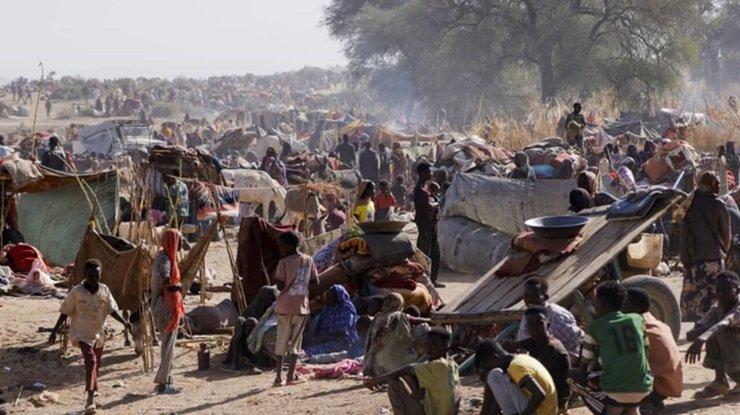
This came after the United Nations High Commissioner for Refugees said on Friday that there had been a sharp increase in the number of people fleeing Sudan for Chad to escape fighting and deteriorating living conditions, while aid funding was failing to keep pace with needs.
The UNHCR added that more than 400 people crossed daily from Sudan into eastern Chad during the past week, representing a 20-fold increase compared with the numbers recorded in recent months.
Sudanese people are fleeing areas of Darfur, Kordofan and Blue Nile, where clashes are taking place between the Sudanese army and the Rapid Support Forces in a civil war that has continued for more than three years.
The rejection of the truce proposal means the worsening of one of the world’s largest humanitarian crises, as nearly 200,000 Sudanese have been killed, while the United Nations says another 14 million have been forced to flee their homes.
US Move
A few days ago, the United States said that neither the Sudanese Armed Forces nor the Rapid Support Forces, nor the leaders of either side, represent a legitimate and constitutional government of Sudan; they govern only by force of arms.
US State Department spokesman Tommy Pigott confirmed in a statement on Tuesday that the conduct of each leader of the warring factions makes him unfit to govern the country, stressing that the United States and President Trump are prepared to work with any party that is a serious partner for peace in Sudan.
In January 2025, Washington said that al-Burhan had opposed a return to civilian rule in Sudan and refused to participate in international peace talks to end the fighting, preferring war to negotiations and a good-faith resolution of the escalation.
The sanctions statement said: “The Sudanese Armed Forces under al-Burhan’s leadership have carried out deadly attacks against civilians, including airstrikes on protected infrastructure such as schools, markets and hospitals. They are also responsible for the deliberate and systematic denial of humanitarian access and the use of starvation of civilians as a tactic of war.”
Isolation and Popular Rejection
Meanwhile, analyst Ehab Mohamed Madbo said: “After Washington closed its doors to al-Burhan and prevented him from obtaining a visa to enter its territory, al-Burhan began looking for any opportunity to appear among Sudanese people, even if it was at a condolence gathering or a circumcision celebration, perhaps he would find in attendance something to fill the gap of international isolation and restore his lost popular image.”
He added that “when the Islamists failed to mobilize million-person marches to spare him the embarrassment of isolation and give him some of the legitimacy of the street, as his ousted predecessor al-Bashir used to do, he decided to seek popularity by chance.” He continued: “Yesterday, he passed near Khartoum Stadium and was stopped by the sight of a large public gathering. He said to himself, ‘Oh, this is my golden opportunity. These Sudanese are standing with me, and all I need is a picture and a public scene that we can use to sell the illusion to the world, just as al-Bashir used to do!’”
He added: “But as soon as his feet touched the stadium grounds, the scene turned upside down, as the crowds rushed toward the exits in a scene that appeared as though they were voting with their feet to reject his presence, leaving him with the bitter truth that not every public gathering is political capital.”
Thus, instead of finding in the stadium a platform to promote the narrative of popular support for him, according to the analyst, “he found himself facing a scene that needs no translation: isolation abroad, a confused scene at home, and popularity that cannot be imported from stadium stands.”
Will the International Community Act?
Now, more than three years into the devastating war, the international community is being called upon to exert real pressure on al-Burhan so that the war can come to an end, as the latter has repeatedly stressed that the war will end only through a military victory.
The economic consequences are worrying. Sudan lost billions of dollars in gross domestic product during the first year of the war, and projections indicate that extreme poverty could exceed 60% of the population if the conflict continues.
Writer Hamdy Abdel Rahman Hassan says that “the belief in a military solution must be abandoned.” He added that “nevertheless, the data clearly show that a prolonged conflict leads only to catastrophic collapse, and the African Union and regional organizations must play a more effective role in conveying this reality and facilitating negotiations that recognize the impossibility of achieving a complete victory.”
He continued: “Accountability and transitional justice must be integrated into the peace process. The scale of atrocities — including ethnic violence and the systematic targeting of civilians — cannot be ignored in the pursuit of stability. A transitional justice mechanism, such as a truth and reconciliation commission, could serve symbolic and practical functions. It would signal a break with the culture of impunity that has characterized Sudanese politics and establish a framework for long-term reconciliation.”
Are Saudi Positions Hindering Peace Efforts?
Meanwhile, Saudi Arabia entered the Sudanese scene as a mediator between the two sides, but it is no longer standing neutrally between them, having politically and diplomatically aligned itself behind al-Burhan, a move that observers regarded as normalization with perpetrators of war crimes.
Reuters had revealed that Saudi Arabia may have mediated a Pakistani arms deal for the Sudanese army worth around $1.5 billion, before Riyadh requested that the deal be canceled and informed Islamabad that it would not finance it.
In a report published on September 23, 2026, a military source in the army told Sudan Tribune that the Armed Forces had recently received shipments of modern tactical reconnaissance and attack aircraft from an Asian country — which he declined to name. Observers did not rule out that Saudi Arabia had financed the deal, which could further fuel the war.
Egypt and Turkey: A Different Path to Peace
As for Egypt, it had been involved in peace efforts on the grounds that the war in this country threatened its national security, but it changed its diplomatic stance and became a party to the conflict that has caused one of the world’s largest humanitarian crises.
Egypt and Saudi Arabia officially announced their recognition of the army alone, despite their participation in the Quad initiative, which also includes the United States and the United Arab Emirates.
Reuters reported last November that a powerful model of Turkish combat drones had been deployed on an airstrip near Egypt’s southwestern border, while satellite images from Vantor, a US company specializing in space technology, showed a large drone on the runway of one of the airports in East Oweinat on September 29, December 28 and January 9.
In the same context, The New York Times also published images of Akıncı drones at East Oweinat Airport, which it reported were being used to carry out airstrikes in Sudan.
The Akıncı is one of the most advanced drones produced by Turkish defense company Baykar. It is capable of flying at high altitudes, remaining airborne for 24 hours and carrying a wide range of munitions, and the army may have obtained it as part of its relations with Ankara.
Ankara is considered one of the most prominent military supporters of the Sudanese Sovereignty Council and the Sudanese army led by Abdel Fattah al-Burhan. Turkey has long-standing ties with army leaders who worked for many years with former President Omar al-Bashir and have links to the Islamist movement and the Muslim Brotherhood current that dominated the government for nearly three decades.
The Washington Post revealed in March 2025 documents, communications, commercial records and flight data that it said documented the arrival of Turkish-made weapons and drones to the Sudanese army.
The Sudanese Defense Industries Corporation signed a contract worth approximately $120 million with Turkish company Baykar to provide drones and munitions. The shipments arrived in Sudan in 2024, with Turkish technicians present to assist in operating the equipment.
Editor’s Note: Views in the article do not necessarily reflect the views of borkena.com
__
Join our Telegram Channel: t.me/borkena
Like borkena on Facebook
To submit a press release, send the submission to info@borkena.com
Add your business to Ethiopian Business Listing / Ethiopian Business Directory
Join the conversation. Follow us on X (formerly Twitter) @zborkena to get the latest Ethiopian news updates regularly.