
Eyassu Epheaim G Hanna
London ,UK
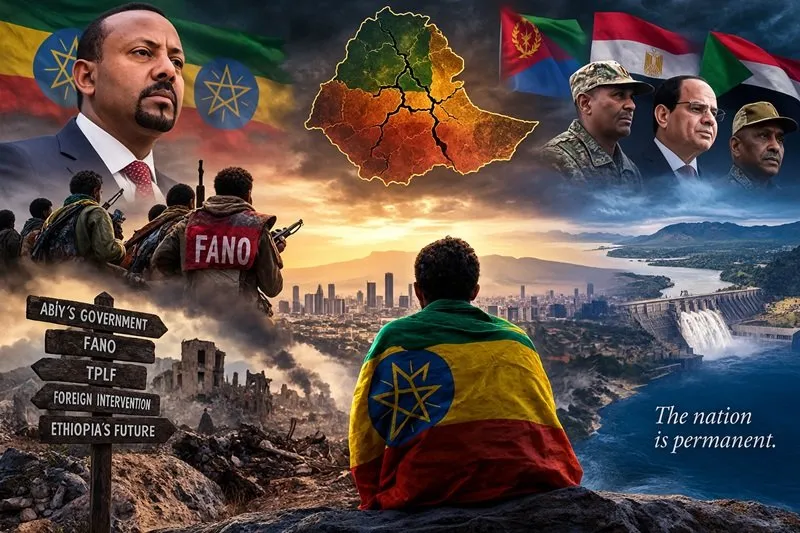
I am standing between the devil and the deep blue sea.
I am not the only Ethiopian facing this dilemma. I have followed Ethiopian politics long enough to understand that political choices are rarely as simple as they appear. As an Amhara, I support the Fano movement, and I believe there are legitimate grounds for resisting Abiy Ahmed’s government and, ultimately, seeking its removal from power. But there is a line I cannot cross: I cannot support the removal of one government at the expense of Ethiopia’s national sovereignty, territorial integrity and long-term survival.
This is where my dilemma begins.
I know the nature and character of the current government. I consider Abiy Ahmed’s administration deeply damaging to Ethiopia. His personal political ambition, combined with the way power has been exercised under his leadership, has made his government intolerable to many Ethiopians, including me.
But opposing Abiy does not mean that I must support every force that opposes him. That distinction has become increasingly important as Ethiopia enters another dangerous phase of its political and military crisis.
Ethiopia has seen this contradiction before
Ethiopian history offers uncomfortable examples of the difference between patriotism and political judgement.
Emperor Tewodros II is remembered by many Ethiopians as a symbol of resistance, national unity and opposition to foreign interference. Yet admiration for his patriotism does not require us to ignore the destructive consequences of some of his political decisions. An old Amharic verse captures this contradiction:
አንድ እግር በርበሬ መንቀል አቅቷችሁ፤ አቃጥሎ አቃጥሎ ለብልቦ ፈጃችሁ።
The metaphor is striking. Instead of uprooting even one pepper plant, you allowed its burning heat to scorch and destroy you.
The lesson is not that Tewodros was simply a good or bad ruler. History is rarely that convenient. It is that patriotic intentions do not automatically make every political decision wise, nor does a ruler’s commitment to national sovereignty absolve him of responsibility for the consequences of his actions.
The same contradiction can be found in modern Ethiopian history. Mengistu Hailemariam remains a deeply contested figure. Some Ethiopians remember his government’s defence of Ethiopia’s territorial integrity, particularly against Somali expansionism, while others
remember the Derg dictatorship and its mass violence. Patriotism and political legitimacy are therefore not synonymous.
This is precisely why I am uncomfortable with the political argument that increasingly seems to be emerging in Ethiopia today: that because Abiy is the enemy, anyone fighting him must necessarily be on the side of the Ethiopian people.
History teaches us to be more careful.
Abiy and the crisis of the present
Abiy Ahmed has also become part of this long Ethiopian contradiction.
Abiy has publicly recounted that his mother told him when he was seven years old that he would become Ethiopia’s seventh king. That statement, by itself, does not establish anything about his character or political intentions. But it is difficult to ignore the symbolism when assessing the political personality that has emerged around his leadership.
Whatever one’s interpretation of Abiy’s political ambitions, the consequences of his government’s rule are not difficult to see.
Ethiopia has experienced persistent armed conflict and political instability throughout his tenure. According to reporting by Ahram Online, which cited international conflict-tracking projects, more than 7,500-armed attacks were recorded across Ethiopia between January 2022 and May 2026, with more than half reportedly occurring in Amhara.
The precise number should not be interpreted as a measure of Abiy’s personal responsibility for every incident. But it illustrates the scale of violence and instability that has developed during his administration.
For me, therefore, opposition to Abiy is not theoretical.
I understand why people want his government removed. I understand why the Amhara people have taken up arms. I understand why Fano has become a powerful expression of Amhara resistance.
But understanding the reason for a struggle does not mean surrendering one’s political judgement to the struggle itself.
And this is where the current war changes the equation.
The conflict is no longer simply Abiy versus his domestic opponents
Seven armed and political movements, including the Tigray People’s Liberation Front (TPLF), Fano and the Oromo Liberation Army (OLA), have formed the Ethiopian Peoples’ Forces Alliance for Survival and declared their intention to remove Abiy’s government.
Whatever the internal balance of power within this alliance, the participation of the TPLF fundamentally changes the political meaning of the conflict for many Ethiopians. This is not
because every Tigrayan is an enemy of Ethiopia. Nor does the participation of the TPLF automatically invalidate the grievances of other groups within the alliance.
It is because Ethiopia’s recent history cannot simply be erased.
The war between the federal government and the TPLF from 2020 to 2022 left deep political, territorial and psychological wounds. The Pretoria Agreement created a framework for ending that war, but it did not resolve every underlying dispute.
Now the TPLF is again at the centre of an armed confrontation with the federal government.
The battlefield situation remains fluid. Federal forces and Tigrayan forces have been engaged in intense fighting across Tigray and neighbouring Afar, while strategic locations have changed hands and the conflict has created serious humanitarian concerns. It is too early to predict the outcome.
And that uncertainty is precisely why I am worried.
The question of Eritrea, Egypt and Sudan
The most disturbing part of the present situation is not simply the fighting between Ethiopians.
It is the possibility that Ethiopia’s internal conflict is becoming entangled with the strategic interests of neighbouring states.
Ethiopia’s military leadership has accused Eritrea, Sudan and Egypt of supporting forces fighting the federal government. Eritrea and Sudan have denied such allegations, while independent reporting has described widespread suspicions of Eritrean support for the TPLF.
These claims must be treated carefully. Allegations are not the same as independently verified facts. But neither should they simply be dismissed.
The strategic geography alone should make every Ethiopian concerned.
Ethiopia sits at the centre of a region in which Eritrea, Sudan, Egypt, Somalia and other states have significant interests in Ethiopia’s political and military trajectory. The Nile, the Grand Ethiopian Renaissance Dam, the Red Sea, the Ethiopia-Djibouti corridor and the politics of the Horn of Africa all connect Ethiopia’s internal instability to wider regional calculations.
That is why the possibility of foreign involvement changes the nature of the question. I can oppose Abiy.
I can support Fano.
I can believe that Abiy’s government should eventually leave power.
But if the removal of Abiy becomes dependent upon foreign governments whose strategic interests’ conflict with Ethiopia’s sovereignty, I must stop and ask a different question:
What exactly are we fighting for?
The dangerous simplicity of “him or us”
This is where I disagree with the increasingly binary political logic that surrounds the conflict.
The argument appears to be:
Abiy is the enemy.
Those fighting Abiy are therefore our allies.
Anyone who does not support the war is therefore supporting Abiy.
I reject that logic.
Opposing Abiy does not oblige me to endorse every organisation, government or foreign power that opposes him.
Nor does concern about foreign intervention make me a supporter of Abiy. A government is not the same thing as a country.
A regime is not the same thing as a nation.
And opposing a government is not the same thing as opposing the state. This distinction is fundamental.
Abiy Ahmed is temporary. His government is temporary. Political alliances are temporary. Foreign governments pursue their own national interests. But Ethiopia is not temporary. The Ethiopian people will remain after today’s politicians have disappeared from the political stage.
We must be careful about who benefits from our anger
There is nothing unusual about foreign states attempting to influence the internal affairs of another country. Great-power and regional politics have always operated this way. The question for Ethiopians is whether our legitimate grievances can be used by others to advance objectives that are not necessarily ours.
This is not an argument for passivity.
It is not an argument for surrendering to Abiy. It is not an argument against Fano.
And it certainly is not an argument that Ethiopians should tolerate injustice because foreign powers might exploit resistance to it.
It is an argument for political independence.
If the Ethiopian people decide that Abiy must leave power, that decision should ultimately belong to Ethiopians. If Amhara people demand security, political representation and protection of their rights, those demands should be addressed. If Tigrayans demand political
rights and security, those concerns should be addressed. If Oromos, Afar, Somalis, Benishangul-Gumuz and other Ethiopian communities have legitimate grievances, those grievances should also be addressed.
But the solution to Ethiopia’s political problems cannot be to replace one form of domination with another. Nor should Ethiopians allow legitimate domestic grievances to become instruments in a regional power struggle.
The international calls for dialogue matter
The African Union, European Union and United Nations have called for restraint, de escalation and dialogue as fighting has intensified. Some Ethiopians may interpret such calls with suspicion. Given the history of international involvement in Ethiopia and the wider Horn of Africa, that suspicion is understandable. But there is an important principle behind calls for de-escalation that should not be dismissed simply because they come from international institutions: A war that begins as an internal political struggle can develop consequences that are much harder to control. Once neighbouring states become directly or indirectly involved, the interests of the original combatants may no longer determine the trajectory of the conflict.
The danger is not necessarily that Ethiopia would suddenly disappear from the map.
The more immediate danger is fragmentation, prolonged war, weakened sovereignty and the transformation of an Ethiopian political crisis into a regional conflict whose consequences Ethiopians may no longer be able to control.
That is the danger, I fear.
I do not want to choose between Abiy and Ethiopia
This is why I find myself standing between the devil and the deep blue sea.
On one side is a government whose political record I strongly oppose and whose removal I believe can be justified. On the other side is the possibility that the struggle against that government becomes entangled with foreign strategic interests and ultimately damages the very country for which Ethiopians are fighting.
I refuse to believe that these are the only two choices. I can oppose Abiy without surrendering my judgement to those who oppose him. I can support legitimate Amhara resistance without pretending that every alliance is harmless. I can recognise the failures of the federal government without confusing the government with Ethiopia. And I can demand political change without accepting foreign manipulation as the price of that change.
This is not neutrality.
It is not cowardice.
It is not support for Abiy.
It is a different form of patriotism — one that asks not only who is fighting whom, but what kind of Ethiopia will remain after the fighting ends.
We can fight Abiy if we still have a country in which to fight for a better government.
We can remove a government.
We can replace a political leadership.
We can rebuild institutions.
But if Ethiopia’s sovereignty, territorial integrity and ability to determine its own future are destroyed in the process, what exactly will we have achieved?
Abiy is temporary.
His government is temporary.
Every political leader eventually leaves.
The nation is permanent.
Ethiopia is the home of millions of people, including those who support Abiy today, those who oppose him, those who support Fano, those who support the TPLF, and those who support none of them. That is why, despite everything I feel about Abiy’s government, I cannot allow my opposition to one man to blind me to the permanent interests of the country.
I will oppose the government when I believe it is wrong. I will support the legitimate struggle of my people. But I will not support the destruction of Ethiopia in order to defeat Abiy.
Editor’s Note: Views in the article do not necessarily reflect the views of borkena.com
__
Join our Telegram Channel: t.me/borkena
Like borkena on Facebook
To submit a press release, send the submission to info@borkena.com
Add your business to Ethiopian Business Listing / Ethiopian Business Directory
Join the conversation. Follow us on X (formerly Twitter) @zborkena to get the latest Ethiopian news updates regularly.