
(This commentary appears in two parts. Part one examines the silences in the founding statement; part two takes up the distribution of power inside the alliance.)
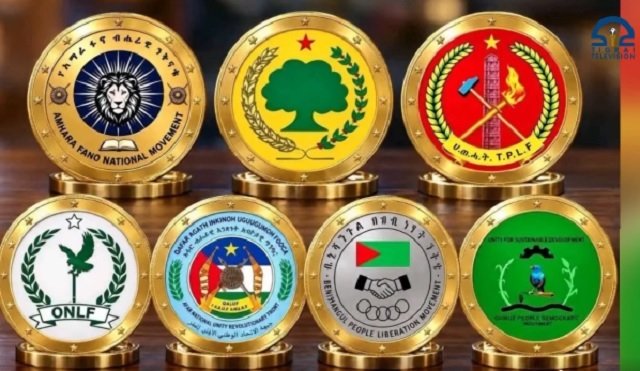
Part Two: The Distribution of Power
By Worku Aberra
Part one argued that the Alliance for Survival was bought with silence: its statement postponed the questions that divide its members, from the future of the state to their territorial claims. It also set out three characteristics of an alliance that can remove a government but fail to replace one: incompatible purposes, the absence of a guarantor, and the indivisibility of the territory they contest. Part one addressed the first: its three largest signatories pursue programmes that cannot all be realized. This part takes up the other two, and a prior question: if the partners cannot agree on the object of the struggle, which of them could impose its own?
The Government’s Lost Arithmetic
The government can no longer set one armed movement against another. Between 2020 and 2022 it fought the TPLF alongside Fano and Eritrea; neither partner signed the Pretoria agreement, and both fell out with Addis Ababa afterwards. Taye Dendea, former State Minister of Peace, alleges that Abiy Ahmed allowed Tigrayan forces to advance into Amhara by design, and that a plan to defend Dessie and Woldia was reversed so that the region would be weakened (Borkena 2025). A commentator writes that Abiy told a gathering of party members the government had deliberately drawn Tigrayan forces into Amhara to destroy the forces there (Wasyihun 2026); the account is unverified and comes from a partisan source. The government rejects such charges, and independent verification is unavailable. The strategic point survives whether or not they are sustained. A government needs a willing partner for that arithmetic, and the partners that once did the fighting now fight the government.
Who Could Impose Terms? The TPLF or Its Partners
Military capability within the alliance is distributed unevenly. The TPLF alone commands a conventional army: artillery, corps-level formations, a general staff, and an officer corps trained in the Ethiopian tradition. It governs a region, collects its revenue, and conscripts from a population it administers. Its operations of 23 September showed the difference: the seizure of three airports and the opening of two regional fronts in a single night required a synchronization neither of its partners has displayed (Raleigh and Getachew Birru 2026).
On 27 September an explosion was reported at the air force facility at Bishoftu, near the capital, and the alliance claimed a long-range strike, saying a helicopter pilot had been killed and two people critically injured, one of them a foreign national; Ethiopian authorities have confirmed neither the attack nor the casualties (ChimpReports 2026). Whatever the damage, the weapon is the point. No member of the alliance manufactures drones, and a strike at that range implies a supplier. Getachew Reda, the Prime Minister’s adviser on East African affairs, has accused Eritrea and Egypt of backing the alliance’s members through a proxy campaign; Asmara denies any such role, and no independent monitor has confirmed it. A pattern of that kind would be unremarkable. Groups under heavy government pressure tend toward alliances involving outside sponsors, while groups less exposed cooperate bilaterally (Bapat and Bond 2012). Sponsorship of that sort marks weakness. A movement able to sustain itself has less need of a patron.
The TPLF’s strength rests on a fractured base. It emerged from the war of 2020 to 2022 with heavy losses, and two of Tigray’s most senior wartime figures now stand outside it. Getachew Reda, removed as interim president in 2025, advises the Prime Minister and has founded a rival Tigrayan party, registered in May 2025 after the electoral board struck the TPLF from the national register. Lieutenant General Tsadkan Gebretensae, the TDF’s first commander-in-chief and chief of the Ethiopian general staff from 1991 to 2001, served as vice president of Tigray until April 2025 and now leads a movement to remove the TPLF through civil resistance, reportedly with federal backing. Fighters who rejected their commanders’ decision to support the organization formed the Tigray Peace Forces in March 2025 under former TDF generals, organized divisions from Afar, and have fought Tigrayan forces in Wajerat and along the southern border (Ross 2026). Getachew’s party, Tsadkan’s movement, and the Tigray Peace Forces aligned in May 2026, and the TPLF accuses Addis Ababa of arming the last of them, much as the allegations described above accuse the government of arming its adversaries in the previous war.
Dissent extends to the current command, and the leadership treats it as treason. On the night the fighting began, armed men detained four veteran military leaders who had questioned the new war, among them Lieutenant General Tadesse Werede, the TDF’s commander-in-chief through the last war and head of the interim administration until the TPLF removed it in April, along with the TDF’s head of intelligence; the accusation against them is that they shared information with the federal government (Ross 2026; Raleigh and Getachew Birru 2026). The head of the Tigray Police Force and a senior TPLF member defected to Addis Ababa the same day. A leadership that imprisons its commanders and loses its police chief on the first day of a war has narrow margins of consent. The qualifications nonetheless leave the ranking undisturbed. Measured by organization, equipment, and training, the TPLF remains the strongest member of the alliance, and a weakened conventional army still outmatches partners who have yet to demonstrate that they possess one.
Capacity and standing are separate matters. Residents of Mekelle told Reuters that the mood has changed since the last war, when the leadership could draw on widespread animosity toward the federal government; its grip on Tigrayan society has weakened significantly since (Ross 2026). A population exhausted by one war supplies the soldiers for the next, and reports of forced recruitment suggest that voluntary enlistment falls short of what the leadership requires. The independence question has moved in the opposite direction. The Voice for Independent Tigray made secession its central demand on 31 May 2025, and Tigrayan commentators describe the question as newly mainstream and sharply polarizing (Fitwi 2025). A leadership under domestic pressure has reason to adopt an objective its constituency endorses more readily than it endorses the organization, and Fano alone among its partners has committed itself against that objective.
Fano’s strength lies elsewhere. It draws on a more populous region, claims control of much of rural Amhara, and sits astride the road between Tigray and the capital. Its cohesion remains untested, and its advantage lies in position; its organization has yet to be tested at scale. The OLA commands the smallest force of the three and has undertaken the least. As of 26 September, no fighting had been reported on its front (Raleigh and Getachew Birru 2026).
Why TPLF Hegemony is Unlikely
No member of the alliance can reach its object without the help of a partner whose object contradicts its own. The TPLF wants a border it can defend; Fano wants a state that holds together. A conventional force concentrated in a contained region can hold a border but cannot take a capital six hundred kilometres south while defending its own frontiers, and the road runs through Amhara territory held by the partner with the strongest reason to close it, as the stalled advance of November 2021 showed. The TPLF holds the strongest instrument and the weakest path; Fano holds the reverse.
Superiority of that kind falls short of hegemony. The TPLF can outfight its partners, and it cannot bargain for them, discipline them, or reach Addis Ababa without their participation. The 1991 precedent shows what a hegemon does: formal inclusion of multiple organizations in the transitional government mattered less than the EPRDF’s military superiority, and the OLF broke with that government in 1992 and returned to insurgency (Human Rights Watch 1998; Young 1997). The present alliance has no such dominant partner, and the balance among its members holds only while the federal army obliges them to keep it.
Competing Territorial Claims and Doubtful Partners
One commitment deserves acknowledgment. The signatories pledged to resolve their own differences peacefully, and groups that have fought one another do not make such a pledge lightly. Its value lies in treating the postponed questions as matters for bargaining rather than for force. Its weakness is that a pledge holds only under the circumstances in which it was made, and the circumstances that produced this one are a common enemy and a shared need. Both weaken on the day the alliance succeeds.
The record offers little encouragement. The African Union brokered the Pretoria agreement and calls itself its guarantor. Its response to the seizure of the airports was a statement calling the action inconsistent with that agreement and urging de-escalation (CNN 2026), and it has said nothing about an alliance whose declared purpose is to remove the government it spent three years treating as the agreement’s other party. A guarantor whose settlement has collapsed, and whose remaining instrument is a communiqué, gives partners weighing each other’s promises little to rely on.
The finding in the literature is that civil war settlements survive when a third party guarantees them, since disarming leaves each side exposed to the other (Walter 1997, 2002). One member of the alliance has said as much on its own account: the OLA’s manifesto holds that only international actors can guarantee the enforcement of a mediated agreement (OLF-OLA High Command 2023). The alliance has not met the condition its own signatory identifies.
Indivisibility is the characteristic already at work in the fighting. The alliance’s members hold territorial claims against one another, and those claims concern ground that admits no division satisfying both sides (Toft 2003; Hassner 2003). The claims are a legacy of ethnic federalism, an arrangement two of the three largest signatories defend and the third seeks to revise: boundaries drawn to give each people a territory produced districts that two peoples claim.
Welkait, Tselemt, and Raya are claimed by Amhara and Tigrayan nationalists alike, and the corridor where Tigrayan and Fano units now fight together runs beside them. In Wollega the dispute takes another form. Fano formations say they protect Amhara residents from attacks, and they have operated in western Oromia since 2022 (Getachew Birru 2026). The OLA describes the armed group there as a faction the federal government trained and armed, and has demanded that Amhara forces dissociate themselves from it; Fano’s leader says the Wollega groups now answer to his command (Addis Standard 2026b; Lema 2026). The two fought each other in August. The Tigray and Afar boundary is among the fronts opened on 23 September, and two signatories face each other across it. The status of Addis Ababa divides the OLA from the others, and no boundary procedure reaches it.
Each of these disputes sets one signatory against another rather than against the government. The alliance postponed every one of them. Kjetil Tronvoll, who has studied Ethiopia’s conflicts for three decades, puts the consequence at its sharpest: were the members ever to reach the palace, a war would begin between them at once (Al Jazeera 2026c).
The Weakest Commitment
Ideology compounds grievance in Oromia. Oromo nationalists have long read the Fano movement as an attempt to restore the pre-1991 order: a unitary state, Amharic as the language of administration, and the arrangements the Oromo national movement organized itself to overturn. Fano’s programme gives the reading material to work with, since its leadership seeks Ethiopia’s territorial integrity and the revision of the constitution that created Oromia as a self-governing region. The killings of Oromo civilians attributed to Fano fighters in Wollega, and of Amhara civilians attributed to the OLA, then confirm prior beliefs rather than establishing new ones, and that is what makes the objection hard for the OLA’s leadership to answer.
Opposition to the alliance is public. Jawar Mohammed, the most prominent Oromo figure outside the government, said he had not seen anything as unpopular among the Oromo, after years of accusations that Fano fighters killed Oromo civilians in Wollega, and he denied that the signatories share a political objective or even a tactical one (Al Jazeera 2026c). Advocacy for Oromia, a diaspora organization, rejected the alliance outright on the ground that its statement speaks of suffering in general while declining to name the Oromo as its victims, and reads the accommodation of self-determination for seven peoples as formal recognition without substantive change. The name drew its sharpest objection: survival, the group argues, reveals a scope too narrow for what the moment requires (Advocacy for Oromia 2026). The established Oromo opposition parties have said nothing.
The OLA’s own position is not new. When it allied with Tigrayan forces in 2021, its commander-in-chief described an agreed “level of understanding” to cooperate against a common enemy, especially in military terms; the reporting of the time describes exchanged information and parallel operations rather than combined ones (Anna 2021). The 2026 formulation, a procedural consensus with no commitment to joint operations, restates the position five years on.
Two conclusions follow. A signatory obliged to defend its membership to its own constituency has reason to leave, and one that has assumed no commitment to joint operations has the means. The record of the preceding months gives it cause as well. Fano militia activity in western Oromia rose by eighty per cent between January and August 2026 against the same period a year earlier, and the Amhara Fano National Movement claimed the Wollega command conducting it as its own (Getachew Birru 2026). Two signatories were expanding operations against each other’s constituencies in the weeks before they signed.
A precedent also exists for the direction a departure might take. On 8 August 2026, in Fandaqaa kebele of Gida Ayana woreda in East Wollega, OLA fighters under a commander named Jaal Mose gave cover to Oromia regional forces and local militia against a Wollega Fano formation, the first such coordination on record. ACLED’s local sources attribute the move to the protection of civilians rather than to political alignment, and it involved one commander rather than the movement (Getachew Birru 2026). The episode nonetheless shows that cooperation between OLA fighters and government forces against Fano is possible, and it occurred six weeks before the alliance was signed. Should federal authority weaken, the capital, its institutions, and the Oromo position within them would be at stake, and Prosperity has presented itself at moments as an Oromo government. Realignments of that kind are ordinary in alliances of this type, since members choose partners by the distribution of power rather than by prior commitment (Christia 2012).
What Abiy’s Removal Would Leave
Ethiopia’s regional states already hold armed forces, revenue, and administrations, and every member of the alliance either governs one or fights to govern one. That distribution is what makes victory over the federal government worth less than it appears. A regime falls, and the ministries in Addis Ababa change hands; the armies, the treasuries, and the administrations stay where they are, in the regions that held them before. Each member would hold the day after exactly what it holds today, and the claims they press against one another would remain open, with nothing above them able to decide.
Secession would tempt a regional actor under two conditions: federal authority collapses, and a patron offers recognition or protection. The alliance can produce neither. Its members cannot confer recognition on themselves, and a patron grants it for reasons of its own, so backing from abroad is not the same thing as a seat among states. Countervailing incentives are strong. African Union practice on inherited boundaries offers a seceding region little prospect of recognition, and Tigray is landlocked, its access to the sea running through Eritrea or through federal Ethiopia.
The Risk of Fragmentation
Fragmentation is a risk rather than a forecast. The federal government retains the air force, the revenue base, and international recognition, and it survived an alliance that reached closer to the capital in late 2021. Prolonged war without a decisive result remains the likelier near-term outcome.
Four developments would indicate the trajectory: whether Tigrayan and Fano units sustain joint operations; whether the OLA opens a front in Oromia; whether any member accepts a bilateral settlement from Addis Ababa, the cheapest strategy available to a government facing a divided opponent (Cunningham 2011); and whether an external actor emerges able to guarantee an agreement among the partners.
Four commitments would reduce the risk: a public position from the TPLF on the application of Article 39 to Tigray; a stated terminus for the OLA’s self-determination; an agreed mechanism for the contested districts, whether referendum, commission, or adjudication; and a formula for the status of the capital.
A less grim outcome remains available. A single opposition bloc gives Addis Ababa something it has lacked: a counterpart able to deliver on an agreement. The government has long objected that no interlocutor exists with authority to bind the armed opposition, and the alliance weakens that objection. Should the fighting produce a stalemate rather than a victory, the alliance’s existence would make a negotiated settlement easier to reach than the separate accommodations attempted since 2018, each of which collapsed because the parties excluded from it had no reason to honour it. A mediator would then face one table rather than seven.
That outcome depends on commitments the partners have yet to make. They have agreed on whom to remove, and they have left the state itself to a dialogue of unnamed rules, timing, and participants. Measured against the three characteristics, the alliance has all of them. Its members pursue ends that cannot be reconciled, nobody guarantees what they promise one another, and the ground they claim cannot be divided between them. The claims themselves are a legacy of ethnic federalism, and no transition that leaves the arrangement untouched will settle them. The risk of fragmentation is correspondingly serious, and it will remain so until the partners settle what they have postponed. The signatures were bought with silence, and the Ethiopian people will pay the price.
References
Addis Standard. 2026b. “OLA Describes Emerging Alliance among Opposition Armed Groups as Procedural Consensus, Not Political Agreement.” 18 September. https://allafrica.com/stories/202609180258.html
Advocacy for Oromia. 2026. “Rejection of the ‘Ethiopian Peoples’ Forces Alliance for Survival’ from an Oromo Nationalist View.” 21 September. https://advocacy4oromia.org/2026/09/21/rejection-of-the-ethiopian-peoples-forces-alliance-for-survival-from-an-oromo-nationalist-view/
Al Jazeera. 2026c. “Can Ethiopia’s Seven-Group Rebel Alliance Challenge Abiy Ahmed?” 23 September. https://www.aljazeera.com/news/2026/9/23/can-ethiopias-seven-group-rebel-alliance-challenge-abiy-ahmed
Anna, Cara. 2021. “Ethiopia Armed Group Says It Has Alliance with Tigray Forces.” Associated Press, 11 August. https://apnews.com/article/africa-only-on-ap-ethiopia-b280e6622d66b7e7f9b12cd1d0041ae8
Bapat, Navin A., and Kanisha D. Bond. 2012. “Alliances between Militant Groups.” British Journal of Political Science 42 (4).
Borkena. 2025. “From Hope to Horror: Taye Dendea’s Testimony on the Curse of Abiy Ahmed.” 18 June. https://borkena.com/2025/06/18/ethiopia-taye-dendeas-testimony-on-the-curse-of-abiy-ahmed/
ChimpReports. 2026. “Ethiopian Rebel Alliance Claims Air Base Strike.” 28 September. https://chimpreports.com/ethiopian-rebel-alliance-claims-air-base-strike/
Christia, Fotini. 2012. Alliance Formation in Civil Wars. Cambridge: Cambridge University Press.
CNN. 2026. “War Has Returned to Ethiopia’s Tigray, and Former Enemies Are Now Fighting Together. What Changed?” 25 September. https://edition.cnn.com/2026/09/25/africa/war-returns-to-ethiopias-tigray-intl
Cunningham, Kathleen Gallagher. 2011. “Divide and Conquer or Divide and Concede: How Do States Respond to Internally Divided Separatists?” American Political Science Review 105 (2).
Fitwi, Abrar. 2025. “Tigray Needs Democracy before Secession.” Ethiopia Insight, 22 July. https://www.ethiopia-insight.com/2025/07/22/tigray-needs-democracy-before-secession/
Getachew Birru, Jalale. 2026. “Is Fano Militias’ Activity Increasing in the Western Part of Ethiopia’s Oromia Region?” ACLED, 28 August. https://acleddata.com/expert-comment/fano-militias-activity-increasing-western-part-ethiopias-oromia-region
Hassner, Ron E. 2003. “‘To Halve and to Hold’: Conflicts over Sacred Space and the Problem of Indivisibility.” Security Studies 12 (4).
Human Rights Watch. 1998. World Report 1998: Ethiopia. New York.
Lema, Luis. 2026. “Zemene Kassie, chef de la milice Fano.” Le Temps, 16 August. https://www.letemps.ch/monde/afrique/zemene-kassie-chef-de-la-milice-fano-nous-luttons-contre-la-desintegration-de-l-ethiopie
OLF-OLA High Command. 2023. A Brief Political Manifesto: From Armed Struggle to the Prospect for Peace. January. https://www.fnnmedia.org/blog/2023/1/24/brief-political-manifesto-olf-ola
Raleigh, Clionadh, and Jalale Getachew Birru. 2026. “Ethiopia Conflict: Expert Insights.” ACLED, updates of 23 and 26 September. https://acleddata.com/expert-comment/ethiopia-conflict-expert-insights
Ross, Aaron. 2026. “Flush with Allies, Tigray’s Leaders Face Internal Discord in New Ethiopia War.” Reuters, 24 September. https://www.reuters.com/world/africa/flush-with-allies-tigrays-leaders-face-internal-discord-new-ethiopia-war-2026-09-24/
Toft, Monica Duffy. 2003. The Geography of Ethnic Violence. Princeton: Princeton University Press.
Walter, Barbara F. 1997. “The Critical Barrier to Civil War Settlement.” International Organization 51 (3).
Walter, Barbara F. 2002. Committing to Peace: The Successful Settlement of Civil Wars. Princeton: Princeton University Press.
Wasyihun Kebede. 2026. “The 21st Top Genocider, Abiy Ahmed, Have Taken Out Two of His Last Cards.” Borkena, 8 February. https://borkena.com/2026/02/08/ethiopia-the-21-st-top-genocider-abiy-ahmed-have-taken-out-two-of-his-last-cards/
Young, John. 1997. Peasant Revolution in Ethiopia: The Tigray People’s Liberation Front, 1975–1991. Cambridge: Cambridge University Press.
Worku Aberra is a scholar in residence in the Economics Department at Dawson College in Montreal.
Editor’s Note: Views in the article do not necessarily reflect the views of borkena.com
__
Join our Telegram Channel: t.me/borkena
Like borkena on Facebook
To submit a press release, send the submission to info@borkena.com
Add your business to Ethiopian Business Listing / Ethiopian Business Directory
Join the conversation. Follow us on X (formerly Twitter) @zborkena to get the latest Ethiopian news updates regularly.
With due respect to genuine Ethiopian political activists, I disagree with such an alliance, which, in my view, has neither genuine national integrity nor honesty. It appears to be an attempt to establish another armed group for the purpose of removing the regime currently in power. The so-called EPRDF with Ethiopian name by tribalist TPLF alliance was established with similar intentions in the past and, in 1991, took power from the Derg military junta. The subsequent period was marked by serious crimes and abuses against the Ethiopian people, including attacks targeting the Amhara people, accompanied by the demonization of them through labels such as “Neftegna” that means warlords. This time, the same manifesto appears to be resurfacing without any meaningful political revision. Even a major OLF leader, Jiregna Gudeta, has stated the OLF’s position regarding the dismantling of the Ethiopian Empire. This remains a common objective among these ethnically divided armed groups. At this critical moment, the essential political and military priority should be to safeguard the lives of Ethiopians who are being targeted and killed because of their ethnicity and religion, including Amhara people and followers of the Ethiopian Orthodox Church, who face violence from armed ethnic groups and forces associated with both the regime and the OLF. How on earth can we believe that such an alliance has any serious common objective beyond using “survival” as an excuse to remove the current regime? What guarantee is there that these groups will not turn their weapons against one another tomorrow, allowing the suffering of our people to continue? May the Ethiopia we love stretch out her hands toward mercy, and may God, who alone cares for her, guide and protect her (Book of Psalm 68;31) Pastor Degone Moretyew