
By Dawit W Giorgis
Introduction: A Miscalculated Global Crisis
The rapidly deteriorating situation in the Horn of Africa can no longer be dismissed as a series of isolated, localized conflicts; it has evolved into a global security crisis that demands the immediate attention of international stakeholders. Yet the current geopolitical response is marked by dangerous blindness. As international focus shifts, under the assumption that the crisis in the Strait of Hormuz is well on its way to resolution, the world is failing to recognize that the crisis at the Red Sea choke point is only just beginning.
This looming catastrophe is compounded by a stark vacuum in global and regional leadership. Chief among these failures is the conspicuous absence of the United States, whose foreign policy architecture reflects a profound lack of understanding of the situation on the ground. Washington has failed to identify the true culprit behind the destabilization—the current dictatorial regime in Ethiopia. Compounding this Western disengagement is the African Union’s (AU) total abdication of duty. Rather than serving as a neutral, objective arbiter capable of steering the region away from the abyss, the AU has actively chosen to side with the Ethiopian regime, shielding state-sponsored atrocities from international scrutiny. This failure of multilateralism, combined with absolute state desperation, has left the door wide open for aggressive sub-imperial powers to weaponize the Horn of Africa.
At the center of this storm is the United Arab Emirates. The UAE is just 54 years old—a relatively small country of 33,000 square kilometers with a domestic population of 1.8 million Emiratis and a modest army of 65,000, 40 percent of which is composed of foreign nationals. Yet despite these compact demographics, Abu Dhabi has transformed itself into a global energy powerhouse, a commercial logistics hub, and a potent “sub-imperial” force capable of projecting aggressive military and political influence across the African continent. Under the presidency of Sheikh Mohamed bin Zayed Al Nahyan (MbZ), the UAE permanently abandoned its historical posture of neutrality. In its place, Abu Dhabi engineered a hyper-assertive foreign policy that fuses massive capital investments with militarized control over trade routes, maritime choke points, and mineral wealth, driving deep regional entanglements. https://borkena.com/uae-imperial-outpost-uae-in-africa/by (Dawit Giorgis)
The Red Sea Choke Point and the Port Monopoly
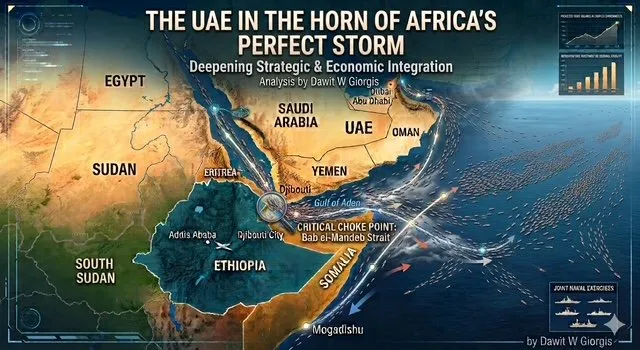
The Horn of Africa has become the world’s next hyper-complex security zone, with Eritrea, Ethiopia, Somalia, Somaliland, Sudan, and Djibouti at its center. At the core of Abu Dhabi’s strategy is the systematic monopolization of regional trade routes through Dubai Port (DP) World. By masking geopolitical ambitions behind “transformative logistics,” the UAE has consistently exploited nations with weak central governance to secure strategic hubs such as Berbera, Bosaso, and Assab.
This aggressive maritime positioning was designed to close the western gate of the Red Sea. Yet, as the Red Sea morphs into an increasingly dangerous maritime choke point, these coastal networks are no longer just commercial assets—they are forward-operating bases for proxy warfare.
The Yemeni Spillover: Binding the Two Shores of the Red Sea
The geopolitical explosion in the Horn of Africa cannot be separated from the shifting sands of the war in Yemen. The Red Sea is no longer a barrier between continents; it is a fluid corridor where Middle Eastern conflicts directly shape African realities. The collapse of the traditional Saudi-Emirati alliance was accelerated by their competing, zero-sum maneuvers in Yemen—culminating in Saudi Arabia’s direct military pushback against the UAE-backed Southern Transitional Council (STC). After setbacks on the Arabian Peninsula, Abu Dhabi aggressively pivoted across the water, seeking to secure the western shore of the Red Sea by weaponizing its relations with fractured states such as Ethiopia and with paramilitary factions in Sudan. As Iran-backed Houthi forces launch rapid offensives to choke off the critical Bab al-Mandeb Strait, the maritime security of Gulf oil routes has become inextricably tied to the coastal stability of East Africa. Riyadh now views the UAE’s fragmentation-driven strategies in Sudan and Somalia as a direct threat to its domestic security and Red Sea trade. By transforming nations like Eritrea and Sudan into tactical staging grounds, logistics bases, and recruitment pools for the broader Yemen conflict, the Gulf powers have ensured that the flames of the Yemeni civil war systematically fuel destabilization across the Horn.
The UAE–Saudi Fracture: A Dangerous New Rivalry
The most critical and destabilizing development in the region is the collapse of the traditional alliance between the UAE and Saudi Arabia. Once coordinated partners in regional intervention, Abu Dhabi and Riyadh are now direct competitors with starkly opposing interests in the Horn of Africa. This fractured relationship has turned the region into a chessboard for a dangerous zero-sum game.
In Sudan’s brutal civil war, this rivalry has directly reshaped the theater of conflict. While the UAE remains the primary patron of General Mohamed Hamdan Dagalo’s (Hemedti) Rapid Support Forces (RSF)—facilitating the smuggling of Sudanese gold through Dubai to finance the paramilitary group’s operations—Saudi Arabia has steadily shifted toward a defensive realignment. Riyadh is positioning itself alongside the official Sudanese government and the Sudanese Armed Forces (SAF) to check Emirati overreach. This geopolitical rift is shattering what little stability remained in the Horn. Rather than containing the violence, the competing financial and military interventions of these two Gulf powerhouses are actively guaranteeing a prolonged, industrialized slaughter.
Ethiopia: A Captive Proxy and the New Civil War
If Sudan wins the war for the coast, Ethiopia remains the ultimate prize for the UAE. The relationship between Ethiopian Prime Minister Abiy Ahmed and Abu Dhabi has evolved from a strategic partnership to a bond of existential dependence. As the Ethiopian economy faces a catastrophic collapse, the UAE has become the regime’s sole lifeline. Abiy’s government depends entirely on Emirati capital, currency swaps, and direct military support to survive. This dependency has effectively turned the Ethiopian state into a captive proxy for Abu Dhabi’s regional ambitions.
This puppet dynamic is most evident in Ethiopia’s latest domestic crisis, where a massive new war has erupted across the north. True to form, the UAE has firmly aligned with the regime, maintaining an aggressive air bridge to supply the state with advanced weaponry. In a striking escalation, the Sudanese government recently recalled its ambassador from Addis Ababa, citing documented evidence that UAE-supplied drones (including the identified S8 series) have been launched from within Ethiopian territory—specifically from Bahir Dar airport—to strike critical infrastructure such as Khartoum International Airport. Uncrewed aerial vehicles, including Chinese-made FH-95 heavy reconnaissance and strike drones, continue to flood these proxy battlegrounds. This cross-border drone warfare underscores that Ethiopia is no longer fighting only an internal war; it is serving as a launching pad for the UAE’s regional proxy battles.
Meanwhile, the internal landscape has shifted dramatically. A unified opposition alliance, the Ethiopian People’s Forces Alliance for Survival (EPFAS), representing a broad coalition of heavily aggrieved regional forces—including the Amhara Fano National Movement, the Tigray People’s Liberation Front (TPLF), and the Oromo Liberation Army (OLA)—has risen against Abiy’s administration. History shows that when a populace forms a collective alliance encompassing every major opposition element in a fractured country, it inevitably wins. Prime Minister Abiy Ahmed now stands entirely at odds not only with his own populace but also with virtually every major leader in the region.
Western Delusions: The Failure of US Diplomacy
As the Horn of Africa burns, the international response remains dangerously detached from the socio-political reality on the ground. A prime example of this failure is the recent rhetoric from Washington. In official statements on the renewed fighting in the north, U.S. Ambassador to Ethiopia Ervin J. Massinga issued a sharp warning, calling the offensive an “unwinnable fight” and threatening further sanctions against opposition leadership. This warning is unhelpful; it reveals a profound lack of realism. By simplifying a complex subject and labeling the conflict an “unwinnable war,” the U.S. State Department effectively ignores the years of deep-seated structural grievances that have driven Ethiopians to risk everything against a dictatorial center. Washington’s stance inadvertently serves as a diplomatic shield for the Abiy regime, miscalculating the sheer momentum of a united domestic opposition. Rather than issuing empty, blind threats of sanctions that fail to acknowledge state-sponsored atrocities, the United States should anchor its role in pragmatism. True stability will be achieved only when Western powers embrace a policy of realism—one that recognizes that a desperate regime propped up by foreign Gulf capital cannot simply be subsidized into peace.
The Evolution of the Mercenary Pipeline
To sustain these simultaneous proxy conflicts, the UAE has dramatically increased its reliance on foreign fighters, shifting from localized security enforcement to an industrialized mercenary pipeline. The Kremlin-backed Africa Corps (formerly the Wagner Group) remains deeply embedded in this network, using neighboring states, including the Central African Republic, Chad, and Somaliland, to smuggle Emirati-supplied weapons directly to the RSF in Sudan.
However, the boots on the ground have become an even more cynical enterprise. While elite operators from Colombia continue to be recruited under the guise of private security contracts to operate and maintain these high-tech drone networks, the bulk of the front-line combatants are now drawn from a much more tragic demographic. The UAE is actively exploiting the continent’s severe economic desperation, buying up unemployed African youth from various regions to serve as expendable, low-cost foot soldiers in its foreign campaigns. Furthermore, Abu Dhabi’s ongoing efforts to construct an “Emirati Foreign Legion”—spearheaded by former French special forces officers—signal that the UAE has no intention of scaling back its covert military footprint.
The Illusion of European Neutrality and the Power of Leverage
While the United States continues to issue ineffective warnings disconnected from the reality on the ground, the European Union (EU) has immense, untapped leverage it can no longer afford to ignore. For too long, European capitals have viewed the conflicts in the Horn of Africa through a purely humanitarian lens. In reality, by maintaining deep financial, trade, and diplomatic ties with the United Arab Emirates, Europe is inadvertently subsidizing the very destabilization that threatens its own borders.
If Europe wishes to avert an unmanageable migration crisis stemming from a collapsing regime, it must move from passive concern to aggressive diplomatic realism. European leverage over the UAE rests on several key areas:
- Financial Sanctions and Capital Flight: Abu Dhabi and Dubai rely heavily on integration with European financial markets, luxury real estate investments, and banking systems. The EU can restrict Emirati sovereign wealth funds, enforce strict anti-money laundering protocols on illicit gold flowing from Sudan through Dubai into European hubs, and freeze the assets of entities funding the mercenary pipelines.
- The Trade Weapon: The EU remains one of the UAE’s largest trading partners outside the oil sector. Imposing targeted trade restrictions or conditioning bilateral economic agreements on the immediate cessation of the UAE’s clandestine air bridges to Ethiopia and Sudan would compel Abu Dhabi to weigh the true cost of its sub-imperial ambitions.
- Conditional Development and Defense Aid: Europe can leverage its considerable diplomatic weight within international financial institutions (such as the IMF and the World Bank) to ensure that any economic restructuring or financial bailouts for Ethiopia are strictly conditioned on political inclusivity and an end to state-sponsored military offensives. Furthermore, European nations that supply defense technology or engage in maritime security cooperation with Gulf states must make such cooperation contingent on regional non-interference.
In Europe, acting is no longer a matter of altruism; it is a matter of self-preservation. Brussels must make clear to Abu Dhabi that it cannot enjoy the privileges of a global commercial partner while simultaneously lighting a geopolitical match in the Horn of Africa that will ultimately burn at the gates of the Mediterranean.
Conclusion: A Continent at the Brink and the Danger to Europe
The illusion that the UAE’s investments constitute “neutral capital” has been thoroughly dispelled. As Djibouti’s President Ismail Omar Guelleh previously warned, every infrastructure and port deal engineered by Abu Dhabi is directly tied to a destabilizing geopolitical objective. Today, those objectives are pushing the Horn of Africa toward a catastrophic breaking point.
The fallout of this conflict will not be confined to East Africa. Ethiopia is a vast country of 135 million people—the second most populous nation on the entire African continent. If the state collapses entirely under the weight of a widening multi-front war, the UAE and its surrogates should not be allowed to sabotage the change by prolonging the war through a different alignment of Ethiopia’s enemies. Prolonging the war will trigger a migration crisis that will send an unprecedented global shockwave. The sheer scale of potential displacement raises the terrifying probability that hundreds of thousands of desperate refugees will trek across the harsh expanses of the Sahara Desert, descend directly upon the gates of the Mediterranean, and pose an unmanageable security and humanitarian challenge to Europe.
Unless this destabilization is halted in a way acceptable to the Ethiopian people and the wider region—meaning an end to the destructive, isolated policies of a Prime Minister at war with his own population and the leaders of neighboring countries—the Horn of Africa will solidify as the world’s most explosive security zone. Ultimately, if international stakeholders continue to indulge Abu Dhabi’s reckless proxy wars and the blind hubris of the Abiy regime, they will not merely orchestrate a regional tragedy; they will trigger a sprawling global conflict that draws in global superpowers and systematically ensures the starvation, fragmentation, and complete extermination of an innocent, hyper-vulnerable populace already crushed by systemic poverty, catastrophic climate shocks, and engineered instability. Research indicates that the UAE acts as an aggressive external actor in regional conflicts, exacerbating humanitarian crises and instability. Academic reviews further note that this indirect intervention model contributes to prolonged warfare and displacement.
Editor’s Note: Views in the article do not necessarily reflect the views of borkena.com
__
Join our Telegram Channel: t.me/borkena
Like borkena on Facebook
To submit a press release, send the submission to info@borkena.com
Add your business to Ethiopian Business Listing / Ethiopian Business Directory
Join the conversation. Follow us on X (formerly Twitter) @zborkena to get the latest Ethiopian news updates regularly.