
By Dahilon Yassin Mohamoda
A. Key players, their political objectives and external backers
Yemen’s conflict is best understood as a collection of overlapping conflicts rather than a simple two-sided civil war. There is a principal confrontation between the Houthi movement and forces opposed to it, but the anti-Houthi side itself contains competing political, regional and military actors.
One useful shorthand is the three-way categorization used by Al Jazeera in January 2026: the Saudi-backed Presidential Leadership Council (PLC), the UAE-backed Southern Transitional Council (STC), and the Iran-backed Houthi movement (Al Jazeera). This is useful for identifying the principal centers of power, but it can obscure fragmentation and rivalries within the anti-Houthi camp.
A second, broader way of understanding the conflict is to divide it into two broad camps: the Houthi/Ansar Allah camp and the fragmented anti-Houthi camp (UK House of Commons Library). This framework is useful because the anti-Houthi side contains forces with substantially different political objectives, underscoring that the conflict cannot be reduced to a straightforward Houthi-versus-government war.
The Houthi-versus-anti-Houthi distinction is therefore useful as a first layer, but the internal divisions within the anti-Houthi camp are essential to understanding Yemen’s crisis. A central theme of this analysis is the contrast between the Houthis’ relatively coherent political-military organization and an anti-Houthi coalition whose members share a common enemy but do not necessarily share the same political vision for Yemen. To clarify these dynamics, it is useful first to identify the principal Yemeni actors, their political objectives, their sources of military and political influence, and the external powers that support them.
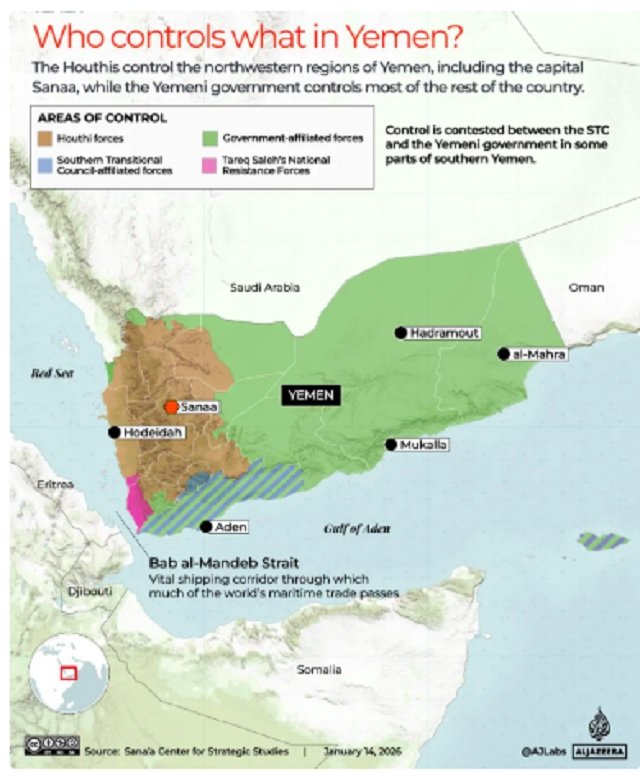
The map illustrates the fragmented territorial configuration of the conflict and the principal areas controlled or contested by the Houthis and the various anti-Houthi forces. It should be read as a snapshot of the situation in early 2026 rather than as a current or permanent representation of territorial control.
1. Houthi/Ansar Allah (أنصار الله)
The Houthi movement, formally known as Ansar Allah (“Supporters of God”), is rooted in northern Yemen’s Zaydi communities and is one of Yemen’s most coherent armed-political actors. It has controlled Sana’a and areas containing a large proportion of Yemen’s population. The movement takes its name from Hussein Badr al-Din al-Houthi, a Zaydi religious and political figure who emerged as its leading figure and was killed by Yemeni government forces in 2004. It grew out of a broader Zaydi revivalist current in northern Yemen and subsequently developed into a powerful political and military organization. (Sana’a Center)
Zaydism is a distinct branch of Shia Islam and should not be equated with the Twelver Shia tradition dominant in Iran. Zaydism has historically had certain theological and jurisprudential similarities with Sunni Islam. Estimates of the Zaydi share of Yemen’s population varies, and reliable demographic data are limited.
The Houthis’ relationship with Iran has become an important dimension of the conflict. Iran is their principal international backer and, as part of its broader regional alliance network, has provided increasing military and technical assistance over time, including weapons, training, intelligence, and technological support. At the same time, the relationship should not be understood as one of simple Iranian creation or control: the Houthis emerged from Yemen’s own political, religious, and tribal environment and retain their own political and military objectives, as well as a degree of independent decision-making. They had already fought six wars against the Yemeni government before the 2011 uprising. The House of Commons Library notes that Iran provided relatively little support during the Houthi conflicts of 2004–2010 but subsequently increased its assistance. (UK House of Commons Library
This distinction is important: describing the Houthis as Iran-backed is accurate but describing them simply as an Iranian creation or Iranian-controlled organization obscures their indigenous origins, political interests and organizational development.
2. The fragmented anti-Houthi camp
Opposing the Houthis is a loose and internally divided collection of Yemeni political, military, tribal and regional forces, with Saudi Arabia playing the principal external role and the UAE having historically supported several important southern and coastal formations.
The important point is that the anti-Houthi camp is not a single organization, army or political movement. It contains a political umbrella, political movements, the formal state military and several separately organized armed formations. These actors share a common enemy—the Houthis—but have different origins, leaders, political interests and foreign relationships.
This fragmentation is not merely organizational. The different factions also have different visions for Yemen’s political future. Some seek to preserve a unified Yemeni state, while others have supported southern autonomy or independence. Some are primarily national political movements, while others are locally or tribally rooted military formations. Consequently, the anti-Houthi camp can cooperate militarily against the Houthis while simultaneously competing over territory, political influence and the future structure of the Yemeni state.
The divisions are not simply historical. In late 2025 and early 2026, Saudi-backed forces confronted UAE-linked southern forces, demonstrating that rivalry within the anti-Houthi camp could develop into direct military confrontation. ACLED describes the episode as part of the wider Saudi-UAE competition within the PLC. (ACLED)
2.1 The Presidential Leadership Council (PLC)
The Presidential Leadership Council (PLC) is Yemen’s internationally recognized governing authority. It was established in 2022 and is chaired by Rashad al-Alimi. It was created to bring together political and military leaders from different parts of Yemen and to provide a common political framework for the anti-Houthi camp. It is backed principally by Saudi Arabia.
It is important, however, to understand what the PLC is not. It is not a conventional political party, and it is not itself a unified army. Rather, it is an umbrella political leadership structure whose members represent different political constituencies and command or influence different armed forces.
The creation of the PLC therefore represented an attempt to consolidate the anti-Houthi camp politically, but it did not automatically eliminate the separate command structures, political interests and external relationships of its constituent forces. ACLED’s documentation of Yemen’s military structures likewise distinguishes between forces under the PLC umbrella and formations that historically retained separate organizational identities and command structures. (ACLED)
2.2 Tareq M. Abdullah Saleh ‘s National Resistance Forces
The National Resistance Forces (NRF) are a substantial anti-Houthi military formation associated with the internationally recognized Yemeni government and the broader PLC camp. They are led by Tareq Mohammed Abdullah Saleh a nephew of former president Ali Abdullah Saleh and a member of the PLC.
The NRF advocates maintaining Yemen’s territorial unity and opposes both the Houthis and southern separatism. In this respect, it represents a pro-unity alternative to both the Houthi project and the southern separatist project. ACLED identifies Tareq M. Abdullah Saleh as a UAE-backed figure whose forces have pursued a pro-unity agenda against the Houthis. (ACLED)
The NRF emerged following the collapse of the alliance between the Houthis and Ali Abdullah Saleh in 2017. After the Houthis killed Ali Abdullah Saleh that year, Tareq M. Abdullah Saleh emerged as an important anti-Houthi military commander. Historically, the NRF received substantial UAE support and established its main area of operations along Yemen’s Red Sea coast, with Mocha serving as its principal base. It subsequently became one of the principal anti-Houthi forces operating on the western coast. (ACLED)
In September 2026, however, the NRF and other anti-Houthi forces withdrew from Mocha and surrounding positions during a major Houthi offensive. The collapse of the western coastal front involved a broader retreat by government-aligned forces, while the precise causes remain disputed. The NRF characterized its withdrawal as a tactical move intended to avoid encirclement, whereas other reporting has highlighted wider problems of coordination, morale, command fragmentation, and preparedness within the anti-Houthi camp. (The Guardian)
The NRF is formally associated with the PLC but retains its own command structure and external relationships, illustrating the distinction between being politically aligned with the government and being fully integrated into a unified military command. In this respect, the NRF provides an example of the broader fragmentation of the anti-Houthi camp.
2.3 Southern forces associated with the Southern Transitional Council
The Southern Transitional Council (STC) emerged in 2017 as an umbrella organization for southern forces seeking greater autonomy or the restoration of an independent South Yemen.
The STC became one of the UAE’s most important Yemeni partners and developed substantial political and military influence in southern Yemen, particularly in Aden. It therefore represented a fundamentally different political project from the pro-unity forces within the PLC. While both opposed the Houthis, the STC historically sought to advance southern self-determination and, ultimately, the restoration of an independent southern state. (UK House of Commons Library)
The STC’s position changed dramatically in late 2025 and early 2026. Its expansion into Hadramawt and Al-Mahra triggered a Saudi-backed military response. In January 2026, the PLC’s counter-offensive backed by Saudi Arabia rapidly reversed STC’s territorial gains, and the group was removed from the PLC. STC subsequently announced its dissolution, although some senior figures disputed that announcement and the group has now been renamed. (UK House of Commons Library)
For this reason, it is more accurate when discussing the current situation to refer broadly to southern forces historically associated with the STC and the UAE, rather than treating the STC as a straightforward, territorially coherent third camp.
The STC’s trajectory illustrates why it is misleading to treat the anti-Houthi camp as a single political coalition. A movement can be anti-Houthi while simultaneously challenging the internationally recognized government’s vision of a unified Yemen.
2.4 The Giants Brigades
The Giants Brigades, led by Abdulrahman al-Muharrami (Abu Zaraa), are a predominantly southern Yemeni military force originally built with UAE support to fight the Houthis along Yemen’s Red Sea coast. They were subsequently redeployed to Shabwa and parts of Marib, where they fought the Houthis.
Abu Zaraa is a member of the Presidential Leadership Council and was appointed a vice-president of the Southern Transitional Council in 2023. His overlapping positions illustrate the complex and fluid alliances within Yemen’s anti-Houthi camp.
The Giants Brigades’ position changed significantly in early 2026. Following the defeat of the UAE-backed STC and the UAE’s withdrawal of its remaining military personnel and assets from Yemen, the Giants Brigades moved toward the Saudi-backed camp. ACLED subsequently reclassified the Giants Brigades as a state-aligned force under the post-January 2026 PLC structure. (ACLED)
The Giants Brigades therefore provide a particularly clear example of Yemen’s fluid alliances: a force originally built and supported by the UAE, whose commander held a senior position in the UAE-backed STC, subsequently shifted toward Saudi-backed government structures.
2.5 The National Shield Forces
The National Shield Forces (NSF) are a Saudi-backed military force established in 2023 to support the PLC. They are distinct from Yemen’s regular armed forces.
Their importance increased substantially in late 2025 and early 2026, when Saudi-backed forces confronted the UAE-backed STC and pushed it out of territory it had seized in southern and eastern Yemen. (ACLED)
The National Shield Forces therefore represent an important element of the Saudi effort to strengthen a more centralized, government-aligned security structure. At the same time, their existence illustrates the continuing reliance of the internationally recognized government on separately organized armed formations.
2.6 Islah
Islah, formally known as the Yemeni Congregation for Reform (al-Islah), is a powerful Sunni Islamist political movement founded in 1990 following Yemen’s unification. It brought together several constituencies, including Sunni Islamists, tribal leaders and religious figures. (Sana’a Center)
Islah has historically had ideological and organizational connections to the Muslim Brotherhood, although it is a distinct Yemeni political movement rather than simply another name for the Muslim Brotherhood. The Sana’a Center describes Islah as a broad coalition incorporating Islamists, Salafis and tribal figures. (Sana’a Center)
Its political influence has traditionally been particularly important in Marib, as well as parts of Taiz and other areas. Its role in Marib has been closely connected to both local tribal alliances and opposition to Houthi expansion. (Sana’a Center)
Islah should not, however, be treated as simply another armed formation alongside the NRF, Giants Brigades and National Shield Forces. It is primarily a political movement, although it has a substantial military and organizational network.
Its associated military personnel generally operate through the official Yemeni armed forces rather than under an independent “Islah army.” National Army forces in Marib and Taiz have historically been politically aligned with Islah while formally operating under the Ministry of Defense. The Sana’a Center’s study of Taiz describes the interaction between Islah’s political network and military formations operating within the government structure. (Sana’a Center)
Islah also illustrates the Saudi dilemma within the anti-Houthi camp. Saudi Arabia has regarded the Houthis and their relationship with Iran as a major security threat, while its relationship with Islah has been more pragmatic and complicated by the movement’s historical connections with the Muslim Brotherhood. Islah has nevertheless remained useful to Riyadh because of its political and military weight in areas such as Marib. (Sana’a Center)
B. The Rise and Transformation of the Houthis: From Northern Insurgency to Yemen’s Dominant Political-Military Force
The current Yemeni crisis can broadly be traced to 2014, when the Houthi movement seized the capital, Sana’a, exploiting the political and institutional weakness of Yemen’s transitional government. Others trace the roots of the crisis further back to the Arab Spring uprising of 2011, when mass protests forced President Ali Abdullah Saleh, who had ruled Yemen for roughly three decades, to step down in 2012. The House of Commons Library identifies the 2011 uprising, the failed transition and the Houthi-Ali Abdullah Saleh seizure of Sana’a in 2014 as central origins of the current conflict. (UK House of Commons Library)
One of the central questions remains how a relatively little-known Zaydi revivalist movement, which emerged from northern Yemen, managed to transform itself into one of the most powerful political and military actors in the country and beyond.
Examining the Houthi movement’s rise and transformation helps illuminate the broader fragmentation of the Yemeni state: the weakening of central institutions, rivalries among tribal and political elites, the collapse of the post-2011 transition, the intervention of regional powers, and the emergence of competing political and military centers of power. In this sense, tracing the evolution of the Houthi movement is not only essential to understanding its own rise, but also provides a broader lens through which to understand the fragmentation and continuing crisis of the Yemeni state.
The Houthi movement emerged from the Believing Youth (Shabab al-Mu’min) movement, established in the 1990s to revive Zaydi religious and cultural identity in northern Yemen. Its transformation into a major armed actor began with the six rounds of fighting against President Ali Abdullah Saleh’s government between 2004 and 2010, which cost the movement its founding leader Hussein Badreddin al-Houthi. The leadership passed to his younger brother, Abdul-Malik al-Houthi, and the movement gained territory, military experience, networks and organizational cohesion. (Sana’a Center)
It is therefore important to note that the Houthis did not emerge from the Arab Spring of 2011 as a newly created militia but entered the political crisis already possessing a military organization and a territorial base.
The 2011 uprising created a broader political vacuum and deepened divisions within Yemen’s political and military structure. A key development was the defection of General Ali Mohsen al-Ahmar, one of Ali Abdullah Saleh’s close allies and a powerful military commander. Ali Abdullah Saleh was subsequently replaced by his former vice president, Abdrabbuh Mansur Hadi, but the transition failed to establish a stable political order. As state authority weakened, the Houthis consolidated their northern base and expanded into neighboring provinces while participating in the National Dialogue Conference (NDC) in 2013–14. Increasingly presenting themselves as a national political movement, they combined political activity with growing military capabilities. By 2014, after defeating important rivals in Amran, the Houthis were positioned to advance toward Sana’a. (Sana’a Center; Carnegie Endowment)
A decisive factor that facilitated their advance was their temporary alliance with their former adversary Ali Abdullah Saleh. Ali Abdullah Saleh retained substantial influence within the military, political institutions and patronage networks after leaving office, weakening the transitional government. His interests increasingly converged with those of the Houthis around their opposition to President Hadi, Islah and the existing transitional order. The resulting Houthi-Ali Abdullah Saleh alliance helped pave the way for the Houthis’ successful seizure of Sana’a in September 2014. (Sana’a Center)
The fall of Sana’a, which eventually forced President Hadi’s government out of the capital in early 2015, marked a decisive turning point. It demonstrated that the Houthis had evolved from a localized insurgency into a national political-military actor capable of exploiting divisions among their opponents and taking control of central state institutions.
Hadi’s escape to Aden transformed the crisis into an open struggle for control of Yemen, and the Houthis subsequently moved southwards. Saudi Arabia launched a military intervention in late March 2015 to prevent further Houthi expansion, transforming what had begun as a Yemeni political and military struggle into a prolonged regional war involving Saudi Arabia, the UAE and Iran.
The Houthi–Ali Abdullah Saleh alliance eventually collapsed as the Houthis strengthened their control over Sana’a and became less dependent on his political and military network. In December 2017, Ali Abdullah Saleh attempted to break with the Houthis and move toward reconciliation with Saudi Arabia. The Houthis responded by killing him, bringing the alliance to an end and eliminating a major rival within Sana’a. (UK House of Commons Library)
The episode illustrates the fluidity of Yemeni politics: Ali Abdullah Saleh, who had fought the Houthis during his presidency, later allied with them to regain influence and ultimately was killed by the movement he had helped empower.
The central explanation for the Houthis’ rise is therefore organizational cohesion combined with the fragmentation of their opponents. The Houthis repeatedly exploited divisions among different key actors, including Ali Abdullah Saleh, Hadi, Islah, tribal networks, southern forces and other political actors. They combined military pressure with political participation, temporary alliances and control of state institutions. The historical record of the 2014 advance provides substantial support for this interpretation. (Sana’a Center)
This pattern is important because it connects the historical rise of the Houthis with the later development of the anti-Houthi camp. The fundamental asymmetry is not simply one of military strength. The Houthis developed a relatively coherent political-military hierarchy, while their opponents remained divided among organizations with different chains of command, external sponsors and visions for Yemen’s political future.
Recent reporting provides a contemporary illustration of this structural problem. Reuters has attributed the September 2026 Houthi breakthrough to several interacting factors, including divisions among anti-Houthi factions, an untested Saudi-led command structure, limited Saudi air support and an underestimation of Houthi preparations. These are reported explanations rather than an established single cause, and the precise circumstances remain subject to investigation. (Reuters)
While Iranian support became important to the Houthis’ later development and strengthened their military capabilities, portraying the Houthis as an Iranian creation misses an important part of the movement’s history. The Houthis were already a genuine Yemeni movement with deep local roots before Iran became central to their external support network. Reuters’ recent historical review similarly traces the movement’s origins to a Zaydi revivalist organization in the 1990s and its evolution through the Saada wars before its later relationship with Iran and Hezbollah. (Reuters)
The Houthis’ subsequent attacks on shipping in the Red Sea and on Israel following the outbreak of the Gaza war in 2023 demonstrated another stage in their evolution. This prompted military action by the United States, United Kingdom and Israel against Houthi targets and made the Yemeni conflict an important component of the broader Middle Eastern security picture.
In September 2026, Houthi forces rapidly advanced along Yemen’s western coast, capturing Mocha and strategically located islands including Perim (Mayun) near the Bab el-Mandeb Strait. These gains strengthened their position around one of the world’s most important maritime chokepoints and increased their ability to threaten or influence maritime traffic through the surrounding approaches.
The advance continued after the initial coastal gains. On 21 September 2026, Reuters reported that Houthi forces were seeking to seize the Kahboub Mountains in Taiz and Lahij provinces, strategic highlands separating the Red Sea coast from government-held areas farther south. Fighting was reported around Al-Wazi’iyah in Taiz province and Ras al-Ara near the coast. According to military sources cited by Reuters, the Houthis sought to secure the rear of their forces around Bab el-Mandeb and strengthen their new positions. (Reuters)
The Houthis’ territorial gains around Bab el-Mandeb have improved their strategic position and increased their ability to threaten or influence maritime traffic in the surrounding waters. These developments could also provide Iran with an additional source of leverage against the United States and its regional partners by giving an Iran-aligned movement a stronger position near one of the world’s major maritime chokepoints. The development is particularly significant for Saudi Arabia, which is already engaged in renewed conflict with the Houthis and depends heavily on secure maritime and energy routes. It also presents new security and economic concerns for the Horn of African states on the opposite side of Bab el-Mandeb, particularly Eritrea and Djibouti. The implications extend beyond the immediate Red Sea littoral: how the changing security environment around Bab el-Mandeb may affect Ethiopia’s efforts to secure access to the Red Sea remains to be seen.
Djibouti, which hosts several major foreign military bases and whose economy and strategic position depend heavily on the uninterrupted operation of its ports, has strong incentives to maintain a careful balance and avoid any move that could provoke a direct Houthi reaction.
Eritrea, on the other hand, appears to have a somewhat different set of incentives. President Isaias Afwerki has likewise avoided openly provoking the Houthis, while Eritrea’s geographic position gives it considerable strategic leverage as maritime traffic and security calculations around the Bab el-Mandeb evolve. Recent analysis has suggested that Eritrea could seek to capitalize on this strategic position by negotiating more favorable arrangements with external powers. In this context, the U.S. decision not to renew the sanctions regime targeting Eritrea’s ruling People’s Front for Democracy and Justice (PFDJ), the Eritrean Defense Forces and other Eritrean entities is potentially significant. Although the immediate legal mechanism was the expiration of the Ethiopia-related national emergency under Executive Order 14046, the U.S. State Department indicated that the decision was intended to advance U.S. regional interests. Given Eritrea’s strategic location on the Red Sea and its proximity to the Bab el-Mandeb, the move could therefore be interpreted as creating greater diplomatic space for engagement with Asmara at a time when Eritrea’s strategic relevance is increasing. (OFAC), (Al Jazeera)
The Houthi leadership has nevertheless sought to present the maritime situation as manageable. On 10 September, Houthi spokesperson Mohammed Abdulsalam stated that navigation and international trade in the Red Sea and Bab el-Mandeb remained safe and regular, while Houthi military spokesman Yahya Saree stated the following day that maritime navigation remained safe for all shipping except Saudi vessels, which were subject to a previously announced ban. (The Economic Times)
Despite these assurances, the Houthis’ territorial advances have generated continuing concern over the security of the maritime chokepoint and surrounding shipping routes.
The situation also needs to be viewed within the wider regional maritime crisis. Concerns over the security of Bab el-Mandeb have emerged alongside disruption surrounding the Strait of Hormuz, creating an unusually difficult environment for commercial shipping and energy transport in the region and beyond. (Reuters)
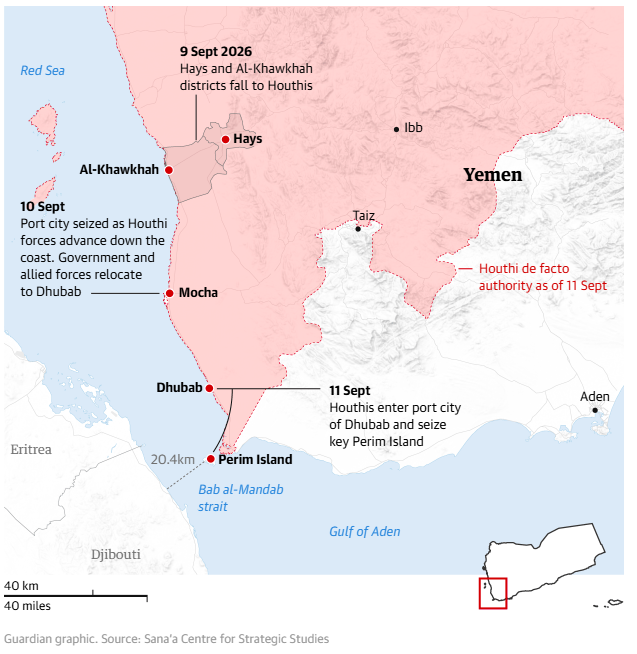
Figure 2. Houthi advances along Yemen’s southern Red Sea coast, September 2026
Source: The Guardian, “Iran’s Houthi allies capture strategic island on vital oil shipping route,” 11 September 2026. (The Guardian)
The map illustrates the territorial changes associated with the Houthi offensive and the movement toward the approaches to Bab el-Mandeb. It should be understood as a snapshot of a rapidly changing battlefield rather than a permanent depiction of territorial control. The significance of the advance lies in the Houthis’ increasingly favorable position along the southern Red Sea coast and their ability to threaten or influence maritime traffic in the approaches to the strait.
The movement that began in the 1990s as a Zaydi revivalist organization in northern Yemen has evolved into a battle-hardened political-military movement possessing missiles, drones, and maritime capabilities. Its success has been closely linked to its ability to exploit the fragmentation of its opponents. In this sense, the Houthi takeover of Sana’a in 2014 and their rapid coastal advances in 2026 reveal a notable recurring pattern, despite their different contexts. In both cases, the Houthis appear to have exploited divisions within the opposing camp and converted political and military fragmentation into rapid strategic gains.
The Houthi evolution also illustrates Yemen’s broader transformation from a state with a single formal political and military center into a fragmented political order characterized by several competing power centers. This does not mean that the Houthis have always been militarily superior, nor that fragmentation alone explains every battlefield outcome. Rather, it highlights a recurring structural feature of the Yemeni conflict: the Houthis have generally operated through a comparatively unified political and military structure, while the anti-Houthi camp has had to reconcile actors whose interests converge on opposing the Houthis but diverge over Yemen’s political future. This asymmetry in cohesion has repeatedly shaped the balance of power and the ability of each side to translate military opportunities into strategic gains.
Behind the headlines of Yemen’s seemingly endless conflict are more than 22 million people in need of humanitarian assistance, nearly half the population. The crisis is compounded by economic collapse, mass displacement, severe water shortages, climate-related shocks, and widespread food insecurity. Together, these pressures have made Yemen one of the world’s most severe and complex humanitarian crises. (UN OCHA)
Selected References
Current conflict and political actors
- Al Jazeera, “Mapping who controls what in Yemen in 2026,” 14 January 2026. (Al Jazeera)
- UK House of Commons Library, “Yemen in 2026: Southern Transitional Council’s fall and intensifying Houthi conflict,” 11 September 2026. (House of Commons Library)
- ACLED, “Middle East Overview: January 2026.” (ACLED)
- ACLED, “Q&A: Southern Yemen: How did we get here, and what happens next?” (ACLED)
- ACLED, “Data Update: Restructuring of government actors in ACLED’s Yemen dataset.” (ACLED)
- Reuters, “Houthi blitz leaves Saudi Arabia exposed, Iran emboldened,” 16 September 2026. (Reuters)
- Reuters, “How Yemen’s Houthis went from a small mountain militia to a big regional threat,” 17 September 2026. (Reuters)
- Reuters, “Houthis push for control of Yemen highlands as Trump is said to have called off strikes,” 21 September 2026. (Reuters)
- The Guardian, “Iran’s Houthi allies capture strategic island on vital oil shipping route,” 11 September 2026. (The Guardian)
Historical development of the Houthis
- Sana’a Center for Strategic Studies, “The Houthis: From the Sa’ada Wars to the Saudi-led Intervention.” (Sana’a Center)
- UK House of Commons Library, “Yemen in 2026,” historical overview of the 2011 transition, 2014 Houthi-Ali Abdullah Saleh takeover and 2015 intervention. (House of Commons Library)
Islah, political networks and fragmentation
- Sana’a Center for Strategic Studies, “Foreign Actors in Yemen: The History, the Politics and the Future.” (Sana’a Center)
- Sana’a Center for Strategic Studies, “How Outsiders Fighting for Marib are Reshaping the Governorate.” (Sana’a Center)
- Sana’a Center for Strategic Studies, “Taiz: A Hotbed of Irregular Militias.” (Sana’a Center)
Note on the 2026 battlefield
The battlefield situation in Yemen is changing rapidly. References to territorial control, military alliances and the organization of armed groups should therefore be understood as describing the situation reported at the time of writing rather than as permanent arrangements. The September 2026 developments around Mocha, Perim and the Kahboub Mountains are particularly fluid. Reuters reported on 21 September that Houthi forces were seeking strategic heights in Taiz and Lahij to strengthen their position around the Bab el-Mandeb area. (Reuters)
Editor’s Note: Views in the article do not necessarily reflect the views of borkena.com
__
Join our Telegram Channel: t.me/borkena
Like borkena on Facebook
To submit a press release, send the submission to info@borkena.com
Add your business to Ethiopian Business Listing / Ethiopian Business Directory
Join the conversation. Follow us on X (formerly Twitter) @zborkena to get the latest Ethiopian news updates regularly.