
Yonas Biru, PhD
The formation of a broad alliance comprising Ethiopia’s most significant armed opposition groups represents a highly consequential development. It signals that Abiy Ahmed’s government—through a combined record of repressive brutality and political failure—has accomplished what few observers thought possible: uniting a deeply fractured opposition.
However, the alliance’s initial communiqué leaves critical questions unanswered and vital issues unaddressed, notably regarding how it intends to earn the trust of the Ethiopian public and the international community that has geopolitical stake in the outcome.
Drawing on the cautionary historical experiences of Sudan and Afghanistan, this article examines both the promise and the peril of the current moment. It focuses specifically on the underlying fault lines that will determine whether the alliance can serve as the structural foundation for a genuine political transition or merely becomes the next chapter in Ethiopia’s recurring cycle of armed conflict.
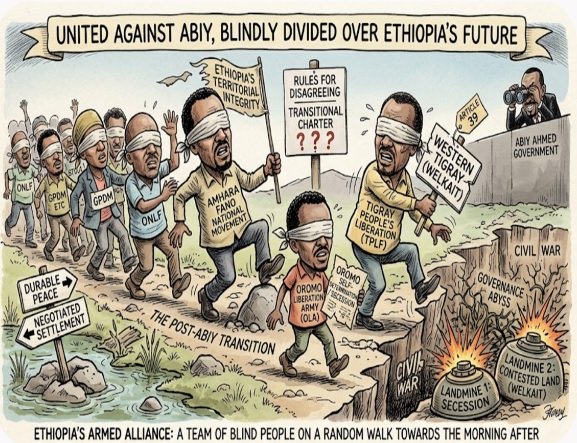
The Ethiopian Peoples’ Forces Alliance for Survival brings together three major armed actors: the Amhara Fano National Movement, the Tigray People’s Liberation Front (TPLF), and the Oromo Liberation Army (OLA). Four smaller regional movements have also joined the fold: the Ogaden National Liberation Front, the Afar Revolutionary Democratic Unity Front, the Benishangul Peoples’ Liberation Movement, and the Gumuz Peoples’ Democratic Movement.
Ethiopia is no stranger to opposition alliances. In 2021, the TPLF and OLA forged a coalition with smaller groups, but that bloc quickly came under severe internal strain and ultimately dissipated after a major counteroffensive by the Ethiopian National Defense Force (ENDF)—then fighting alongside Fano and other Amhara regional forces—turned the tide of the war.
Today’s coalition differs from its predecessor in two crucial respects. First, the ENDF, thoroughly worn down by years of multi-front warfare, is substantially weaker than it was in 2021. Second, Fano—once a critical federal ally against the TPLF—has transformed into the army’s primary adversary and a formidable, rapidly expanding force in its own right.
Yet, the ultimate test of this alliance is not merely whether it possesses the military capacity to defeat Abiy. The true test is whether it possesses the political coherence required to govern Ethiopia in his absence.
The coalition’s founding statement is unequivocal about what it opposes, yet notably silent on what it proposes. This is a significant omission considering two major political landmines sit directly beneath the alliance’s fragile façade: the OLA’s long-standing demand for Oromo self-determination and the country’s explosive, unresolved territorial disputes—most notably those dividing Amhara and Tigray.
In stark contrast to the 2021 TPLF-OLA alignment, the center of gravity within today’s coalition has shifted toward Fano, a highly decentralized Amhara movement composed largely of volunteer fighters benefiting from strong local support. This grassroots volunteer dynamic stands in sharp contrast to a federal military that has increasingly resorted to coercive recruitment to replenish its ranks—a practice also utilized by Tigrayan authorities.
Ultimately, a coalition built solely on shared grievances does not constitute a viable blueprint for governing a nation. Its constituent partners can easily cooperate against Abiy without reaching consensus on the fundamental constitutional, territorial, and political questions that will inevitably surface the moment he is removed from power.
Khartoum and Kabul Provide Sobering Lessons
Consider the precedent set by Sudan. In 2019, a broad coalition of civilian activists and armed rebel movements successfully united to overturn the regime of Omar al-Bashir. The transitional setup that followed attempted to balance fragile civilian and military authority, but ultimately satisfied neither camp. The military seized absolute power in a 2021 coup, and by 2023, the bitter rivalry between the regular army and the Rapid Support Forces erupted into a catastrophic civil war that has claimed hundreds of thousands of lives and displaced over ten million people.
The key takeaway here is not that every opposition coalition is doomed to collapse. Rather, it is that removing a shared adversary does not automatically eliminate power struggles. Without binding, pre-agreed rules of governance, the political transition itself becomes the next battlefield.
Afghanistan offers an equally stern warning. The 2020 Doha Agreement negotiated between the United States and the Taliban systematically excluded the sitting Afghan government, directly laying the groundwork for the Taliban’s swift return to power in Kabul. While Ethiopia’s context is distinct, the broader lesson remains acutely relevant: when armed factions dictate a country’s future without establishing inclusive political institutions or enforceable guarantees, political power will inevitably follow military force.
Within Ethiopia’s emerging alliance, this risk is already taking shape. As Fano’s military standing grows relative to its coalition partners, its leverage over the terms and trajectory of any post-Abiy transition will expand accordingly.
The First Landmine: OLA’s Demand for Self-Determination
The OLA’s demand for Oromo self-determination, potentially including secession, grows out of a long history of Oromo nationalist politics. For the OLA, removing Abiy is not necessarily the end goal. It is a precondition for a larger conversation about the Ethiopian state itself.
For Fano and many Amhara nationalists, Ethiopia’s territorial integrity is a foundational principle. Many regard the ethnic-federal system, including the constitutional right to secession under Article 39, as a root cause of the country’s troubles.
The irony is striking: the system was built largely under the TPLF-led government, which is now Fano’s ally. The alliance therefore contains three competing visions of the Ethiopian state.
- The OLA seeks to radically redefine the state structure.
- Fano seeks to dismantle the existing federal arrangement.
- The TPLF, which created and long defended the current constitutional order, wants to maintain it, but in a confederal form.
The founding statement says little about this fundamental contradiction.
That creates another vulnerability. The OLA is currently the weakest of the three major partners, and its confrontation with Abiy—whom many Oromo nationalists regard as insufficiently committed to Oromo nationalism—is not necessarily permanent. A weakened Abiy, seeking to consolidate his Oromo political base, has an incentive to pursue a separate accommodation, as his government has attempted before.
Should the OLA leave the coalition, the alliance would lose much of its presence in the region surrounding the capital and a significant part of the national footprint that distinguishes it from a predominantly northern alliance. It could then be portrayed as an alliance of Amhara and Tigrayan forces, potentially reinforcing the very political narrative the coalition seeks to overcome.
There is, however, a possible path through this landmine—and it runs through the Oromo political center. Oromos are divided by region, religion, and ideology. Broad Oromo nationalist aspirations command substantial support, but the OLA’s armed struggle and openness to secession do not necessarily command the same breadth of support.
Ethnic federalism delivered recognition, but it has not delivered the security, prosperity, or national cohesion many Ethiopians expected.
Ethiopia’s national dialogue offers lessons that both the OLA and Fano would be wise to heed. The process was far from perfect. None of the major armed movements took part, and critics regard it as shaped by the ruling party. But its deliberations, built on consultations with more than 200,000 Ethiopians and a conference of some 4,000 delegates, pointed in two clear directions.
First, there was little appetite for any single group dominating the state. The contest over Addis Ababa made this plain. The working group’s proposal envisaged the capital as a self-governing federal city. When Oromia’s delegates pressed instead for the constitution to recognize Addis Ababa as Oromia’s capital, delegates from Amhara objected to reopening what they regarded as a settled consensus. Whatever one makes of Oromo historical claims to the city, the message to Oromo nationalists was clear: a settlement perceived as Oromo hegemony will not command national consent.
Second, the dialogue did not reject Ethiopia’s multinational constitutional architecture. It sought to reform it. Its recommendations reportedly include removing the phrase “up to secession” from Article 39 while retaining the multinational character of the federation, alongside new institutions such as a constitutional court and a commission to address unresolved questions of identity and self-administration. The message to Fano was clear: most Ethiopians who took part wanted to democratize the federal system, not dismantle it.
Together, these lessons point both movements toward the same middle ground. They undercut the OLA’s hardline stance and the Fano case for abolishing the federation alike.
An OLA that set aside secession in favor of guaranteed self-rule within a reformed federation that shifts constitutional hegemony from regional states to the Ethiopian national state would gain on several fronts. It could compete more effectively for the Oromo political mainstream that Abiy now claims, blunt one of the government’s most effective arguments against the coalition, and reassure external actors whose deepest concern are OLA’s extremist position and Ethiopia’s possible disintegration.
But moderation cannot be one-sided. If the OLA gives up the option of secession, Fano and its allies would need to accept that meaningful Oromo self-rule, language rights, and a fair share of national political power would be permanent features of any future Ethiopian settlement.
In other words: secession could come off the table in exchange for constitutionally guaranteed self-rule. That bargain could give the coalition a pathway from a marriage of convenience toward a more durable political settlement.
The Second Landmine: Contested Land
The alliance’s most volatile territorial flashpoint is Welkait, known to Tigrayan nationalists as Western Tigray. The area was forcibly seized by Amhara regional forces and allied militias during the Tigray war. The TPLF demands its complete restoration to Tigray, whereas Fano and Amhara political leaders claim the territory as historically Amhara land, citing systematic demographic engineering and forced resettlement that took place after 1991.
Both sides maintain maximalist positions, leaving virtually no immediate common ground for political compromise. As long as Welkait is treated as a zero-sum territorial contest, it will remain an active flashpoint for military conflict and an enduring source of internal mistrust capable of destroying the alliance.
Historically, other nations facing similarly intractable border and ethnic disputes have successfully implemented interim mechanisms to defuse immediate conflict.
In Bosnia, the fiercely contested city of Brčko was established as a neutral, self-governing district under direct international oversight, belonging exclusively to neither entity. Following World War I, the Saar territory that was the source of Franco-German conflict, was placed under League of Nations administration for fifteen years prior to a final status plebiscite.
Fano and the TPLF can draw invaluable lessons from these historical precedents.
A structured five-year or ten-year interim agreement could place Welkait under joint, neutral self-administration. Under this framework, neither Amhara nor Tigrayan military forces would be permitted to maintain a presence in the zone. Instead, public security would be maintained by a locally recruited police force operating under the direct monitoring of the African Union. This transitional setup would mandate and guarantee the safe return of all displaced residents while strictly protecting the civil and economic rights of the population currently residing in the area.
Furthermore, regional agricultural revenues and access routes to the Sudanese border could be shared equitably between both regions, drastically lowering the immediate economic incentives for armed territorial control.
During this five-year or ten-year period, an independent judicial commission could rigorously examine competing historical, legal, and demographic claims to establish transparent criteria for voter eligibility in a final determination. At the end of the interim period, the permanent status of the territory could be conclusively settled either through a referendum based on the certified voter roll or via binding international arbitration.
A similar structured mechanism could be deployed to address the contested boundary of Raya and other disputed border areas.
The strategic objective of this approach is not to instantly solve complex historical grievances. Rather, it is to achieve mutual agreement on the process by which those claims will eventually be adjudicated—ensuring that the interim period cannot be exploited by either party to cement unilateral military or demographic facts on the ground.
Rules for Disagreeing
The coalition does not need to resolve every complex constitutional debate before it can function as an effective opposition. What it cannot afford to leave unaddressed, however, is a clear protocol for managing internal disagreements without resorting back to open war.
This imperative is precisely where external actors—specifically the United States, the European Union, and the African Union—hold vital diplomatic leverage.
Achieving any stable political settlement in Ethiopia will ultimately require direct engagement with the opposition coalition. However, diplomatic engagement must not be mistaken for an uncritical endorsement of an armed bloc that lacks a transparent, democratic vision for the political order it intends to establish.
Washington’s strategic priorities reflect these exact concerns. The United States has recently deepened security ties with Addis Ababa and reportedly harbors serious anxieties regarding potential internal fracturing within the ENDF.
Such concerns are entirely justified. A national military that disintegrates along ethnic fault lines would not result in a clean rebel victory; instead, it would yield multiple competing warlord armies and the complete breakdown of a functioning state.
At the same time, engaging exclusively with Ethiopia’s military leadership without an overarching civilian political framework risks endorsing a military-led transition that side-steps the country’s broader political movements. This is the exact political miscalculation that catalyzed Sudan’s descent from the removal of Bashir into outright war between rival armed factions.
For the coalition, Washington’s apprehensions present a significant strategic opportunity. By presenting a credible, actionable roadmap to integrate all armed movements under a unified, legitimate national security command, the alliance can directly alleviate the primary anxieties of Ethiopia’s international partners.
International actors should utilize their diplomatic leverage not to select a favored political winner, but to firmly press the coalition to convert its basic founding communiqué into a comprehensive, binding Transitional Charter.
This Transitional Charter must explicitly answer five fundamental questions:
- What specific structural modifications will be made to Ethiopia’s federal system?
- What concrete mechanisms will be used to resolve territorial disputes and facilitate the return of displaced populations?
- What is the coalition’s unified stance regarding regional self-determination and the right to secession?
- How will political and military power be shared during the interim transition, and how will diverse armed organizations be integrated into a unified national security force?
- Under what explicit terms and preconditions is the coalition prepared to engage in negotiated peace talks with the current government?
These critical issues must be formally negotiated and settled prior to military victory, not after. Once a transitional government is installed in power, political bargaining power is dictated entirely by the gun.
Two Strategic Blind Spots
Beyond its acute internal fault lines, the alliance is hampered by two major strategic blind spots regarding its broader posture. In both cases, its current approach actively works against its long-term objectives.
Fano and the Outside World
Fano’s primary strengths are domestic: a highly motivated volunteer base, deep roots across Amhara communities, and strong public support. However, this internal focus has fostered an overly defensive, distrustful posture toward international stakeholders. Foreign governments are routinely depicted as hostile meddlers or tacit supporters of the Abiy regime, while diplomatic outreach is often viewed with skepticism rather than utilized as a strategic tool.
The frustration fueling this posture is understandable. Foreign-supplied weaponry, including advanced armed drones, has been deployed extensively against Fano-controlled areas, and many within the Amhara community believe Western diplomacy biased previous peace processes in favor of other belligerents. But while understandable, maintaining an insular diplomatic stance is strategically unwise.
The Horn of Africa is one of the world’s most congested geopolitical battlegrounds. Diverse actors—including the Gulf states, Turkey, Egypt, Eritrea, the United States, the European Union, and the African Union—all maintain vital strategic stakes in Ethiopia. Collectively, these foreign powers influence financial flows, arms transfers, diplomatic recognition, and international humanitarian relief. None of these external actors can be simply defeated or ignored; they must be engaged, neutralized, or persuaded.
This reality is paramount for the alliance as a whole. As Fano’s political and military weight within the coalition increases, its insular posture toward the international community effectively becomes the alliance’s collective posture. An armed movement perceived as hostile or unpredictable will inevitably drive external powers to rally behind the sitting government, however reluctantly.
Fano must therefore develop a sophisticated, proactive foreign policy. This requires analyzing the core strategic interests of key foreign states—whether regarding Red Sea maritime security, the Grand Ethiopian Renaissance Dam (GERD), regional migration, counterterrorism operations, or economic investments—and clearly explaining how a managed political transition will protect those interests. It requires appointing credible, empowered diplomatic representatives capable of advocating for the movement in foreign capitals. Crucially, it requires drawing a clear distinction between opposing the Abiy administration and opposing the foreign governments that currently conduct official business with it.
The goal is not to court foreign masters, but to deprive Abiy of a monopoly on international backing and ensure no major power views the alliance’s potential ascent as an existential threat to its regional interests.
The Missing Offer: A Negotiated Settlement
The second strategic blind spot is even more consequential. The alliance’s founding communiqué completely fails to leave open a path toward a negotiated political settlement with the Abiy government. This represents a major strategic error.
By failing to articulate any conditions for negotiation, the communiqué signals that the coalition believes its only path to political change is total military victory. This reinforces the government’s core narrative that the alliance is an extremist movement seeking power purely through violence. It alienates millions of ordinary Ethiopians who are thoroughly exhausted by years of unending war. Furthermore, it leaves international actors with no option other than choosing sides—a choice most states will make in favor of the recognized sovereign government.
Demonstrating an openness to negotiations is not an act of capitulation; it is the primary mechanism by which effective armed movements leverage military pressure to extract political concessions. Formulating a conditional offer for talks—contingent on verifiable milestones such as a nationwide ceasefire, unrestricted humanitarian access, the release of political prisoners, and an inclusive national dialogue—costs the alliance almost nothing strategically.
Such a move immediately shifts the political burden back onto Abiy: if he rejects the offer, the full moral and political responsibility for continued bloodshed rests squarely on his administration. Additionally, an open diplomatic track provides the coalition with a vital fallback strategy if the military front stalls—as Ethiopian battlefields frequently do.
The alliance must present itself as a pragmatic, stabilizing alternative with a viable path to national peace, rather than an unyielding military force. This shift is crucial for both public relations and political strategy. Publicly, it dictates whether domestic citizens and foreign diplomats view the coalition as a viable solution to the crisis or a recipe for deeper chaos. Strategically, it broadens the opposition’s base, creates political space to peel away moderate government supporters, and keeps vital diplomatic options open that military force alone cannot achieve.
Here again, Sudan and Afghanistan provide stark warnings. Whenever armed movements pursue maximalist outcomes while neglecting a viable political and diplomatic track, the ultimate outcome is rarely stability, but rather a violent new cycle of internal conflict.
Winning Confidence at Home and Abroad
A detailed Transitional Charter is far more than an internal tool to manage friction among coalition partners; it is the alliance’s most compelling argument to the world—an argument that its initial founding communiqué failed to articulate.
While the founding statement clearly informs Ethiopians and international observers what the alliance is fighting against, it fails to explain why they should trust what the alliance stands for.
This trust deficit is critical. The Ethiopian public has endured decades of heavy-handed TPLF rule, the unfulfilled promises of Abiy’s early reform movement, the devastating Tigray war, and ongoing military campaigns across Amhara and Oromia. Consequently, ordinary citizens have little reason to assume that a new coalition of armed actors will govern any differently than those who came before.
For those viewing the alliance with skepticism, the central question is not whether Abiy should remain in power, but what specific system will replace him. This includes Oromo citizens who remain wary of Amhara nationalism, Amharas who fear the eventual dismemberment of the state through secession, displaced families awaiting a safe return to Welkait and Raya, and the urban population of Addis Ababa who fear catastrophic urban warfare at their doorstep.
These same commitments directly target the key concerns of the international community. The United States, the European Union, the African Union, and neighboring states fear total state collapse, regional conflict spillover, massive refugee surges, and the loss of a primary security partner in the Horn of Africa. At present, these international fears work directly to Abiy’s advantage.
A coalition that publicly renounces unilateral secession, commits to resolving territorial claims through peaceful mechanisms, pledges to construct a unified national army, and demonstrates a genuine openness to a negotiated settlement would eliminate the primary reasons foreign powers keep their distance. It would offer international stakeholders a concrete political roadmap to engage with, rather than asking them to support an armed military coalition on blind faith.
Political credibility cannot simply be declared; it must be systematically demonstrated. Drafting a comprehensive Transitional Charter and submitting it to rigorous public review by Ethiopian civil society, religious leaders, the diaspora, and international partners would be the strongest possible demonstration of maturity the alliance could offer. It would elevate the coalition from a formidable military threat into a legitimate, trustworthy political government-in-waiting.
The Morning After
The coalition’s true historic opportunity, therefore, is not merely the potential military defeat of Abiy Ahmed. It is the opportunity to prove that the diverse forces arrayed against him can transcend a short-term marriage of convenience and build a lasting political settlement—one capable of establishing transparent rules by which all Ethiopians can peacefully coexist long after the guns fall silent.
Achieving such an agreement would do far more than keep the alliance intact. It would give the people of Ethiopia a genuine reason to believe in their country’s future, and give the broader world a compelling reason to support it.
Ultimately, Ethiopia’s future may depend less on whether these combined forces can march into Addis Ababa than on whether they can agree on how to govern once they arrive.
Note :
AI assisted in research and editing
Editor’s Note: Views in the article do not necessarily reflect the views of borkena.com
__
Join our Telegram Channel: t.me/borkena
Like borkena on Facebook
To submit a press release, send the submission to info@borkena.com
Add your business to Ethiopian Business Listing / Ethiopian Business Directory
Join the conversation. Follow us on X (formerly Twitter) @zborkena to get the latest Ethiopian news updates regularly.