
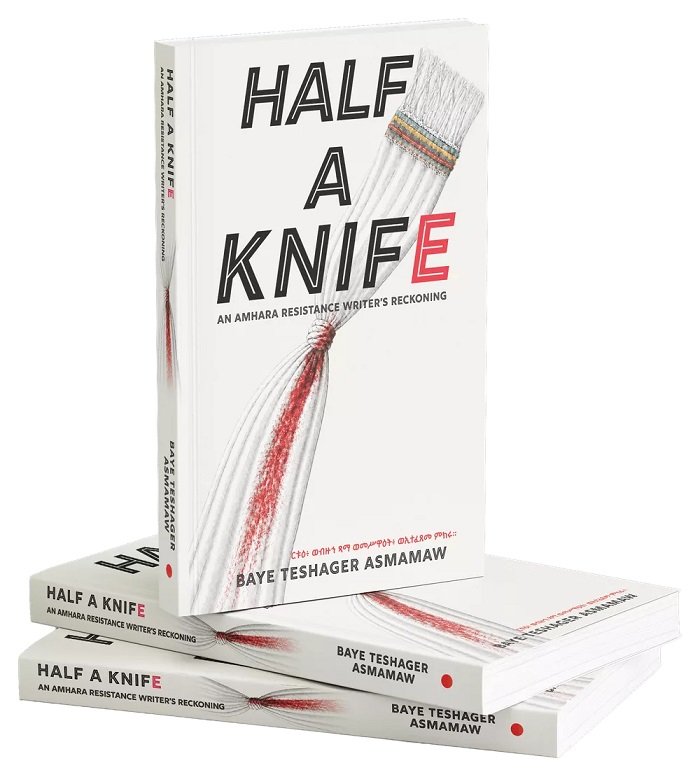
By Baye Teshager Asmamaw
Genre: Political Memoir
Publication date: July 2026
Amazon: 550 pp.
This book will hit you hard—right in the face.
If you are, like myself, an Ethiopian in the diaspora in your seventies or older; if you are, like myself, an ex-self-appointed revolutionary who helped initiate a political upheaval that led to the wholesale demolition of the ancient regime of Emperor Haile Selassie, setting in motion—and leaving behind—a cascade of political, economic, and social disasters in your homeland, Ethiopia, that are still unfolding unabated; if you then ran away and made the West you once loathed your newfound home, becoming an unwitting cultural “innovator” who helped elevate the word diaspora into something of a chic, if not honorific, title; and if you have even a grain of remorse, guilt, or repentance left for the damage you inflicted on that unlucky, poor nation that raised and educated you—then this book will hit you right in the face even harder.
The writer must have been in his teens, attending high school in early 1991, when he experienced his awakening. A reserved and wise friend of his, Abebaw, stood up to challenge an EPRDF cadre who was briefing students in their hometown of Debark about the policies the newly installed government was preparing to pursue.
The writer had already been traumatized by what the TPLF was doing to his veteran father. In his own words (p. 8):
“…My father had been a soldier—he went to the Ogaden as a young man to help throw back Somalia’s invasion of Ethiopia, led by Siad Barre, and he stayed in the national army until the Derg fell. When the forces led by TPLF took power in 1991, they looked at men like him, soldiers of the old army, and saw a threat to be watched. He was arrested more than once in the years after—for nothing he had done, only for what he had been. A boy notices when his father is taken, and returned, and taken again. The grievance was in me before Abebaw stood up in that hall…”
The book could rightfully have been subtitled any one of the following:
a) The Regressive Socio-Political Legacy of the Ethiopian Student Movement;
b) Ethnic Politics and Its Aftermath in Ethiopia;
c) The Rise of Defensive Amhara Consciousness;
d) The Wildfire of Ethnic Politics: Burning the Amhara and Afar and Holding Ethiopia Hostage;
e) The Defiance and Total Rejection of the “Chauvinist” Label Hoisted on the Amhara by Its Adversaries to Psychologically Cajole It into Submission; or
f) The Fire They Started Boomerangs and Burns the Arsonists: How Tigray Is Held Captive to a Defunct Ideology Concocted by Its Children.
I say so because the book is about all of the above.
The book is a political memoir of a young writer who recounts his coming of age while fighting to repel the TPLF’s onslaught on his home region during what is now known as the Tigray War of 2020. In telling his story, the writer unmasks many of our deeply embedded pathologies—social, cultural, and political.
I was particularly impressed by the writer’s piercing insight in tracing our country’s current conundrum to the Ethiopian Student Movement: the incubation ground, in his view, for undermining anything and everything wholesome about Ethiopia, and for undoing the history and institutions that had kept the country going against all odds and invasions and helped sustain its unity—making it one of a handful of countries in the world that can boast of continuous existence as a state for millennia.
Once again, in his own words (p. 61):
“‘The inception of Amharaphobia’…The second study was the student movement, and where its leaders went…Ethiopia’s student movement of the 1960s and 1970s was the most consequential political formation in the country’s modern history, and it was pan-Ethiopian in form. It argued about land and the emperor and the national question, in a shared language, in shared rooms, in Addis Ababa.
And when it broke, the men who walked out of those rooms founded the fronts.
Isaias Afwerki left Haile Selassie University in 1966 for the Eritrean Liberation Front and has ruled Eritrea from independence to this day. Meles Zenawi dropped out of the same university in 1974 to help found what became the TPLF at Dedebit. Aregawi Berhe and the TPLF’s other founders were students of the same university in the same years. And the Oromo Liberation Front’s founders—Baro Tumsa, Ibssa Gutama, Yohannes Lata, Mekonnen Galan, Taha Ali—came out of the same movement. And, one more of a different kind: Andreas Eshete, a philosopher of that generation who never carried a rifle for anybody, put his energy into the constitution the winners wrote, sat through all the thirty-five days of the Constituent Assembly debate, and gave the design its respectable name.”
The book is more than a memoir. It is a record and living testimony of the dysfunctional mindset and short-sighted, intrigue-filled politics that my generation bequeathed to the young.
The book is also the writer’s reckoning: taking responsibility for the mistakes he made, the paths he had forsaken, the less-traveled road he chose to tread, and the courage he mustered to stand alone and walk alone in defense of what he believes is true and self-evident.
I was also impressed by his introspection and by the lengths to which he went to make his arguments as fact- and evidence-based as possible. This is evident in the meticulous documentation and record-keeping of his Facebook postings, the photographs of events he attended, and the ample references he makes to source materials.
The reader may also be surprised by the number of facts the book reveals. For example, how many of us know that of the nine founding members of ANDM—the phony Amhara party that Meles and Co. put together to “represent” the Amhara in the EPRDF as they marched toward Addis Ababa—only two were ethnic Amharas? How many of us know, for example, that the then chairman of ANDM, Tamrat Layne, belonged to the Kembata ethnic group?
Not that I care whether he was this or that ethnic group. But realizing, in hindsight, that he was picked by Meles to head ANDM on the basis of his being non-Amhara is galling!
Finally, one of the book’s merits is that the writer does not limit himself to recounting events. He also carefully draws lessons from the trials and tribulations of the Amhara resistance in which he took part, so that the mistakes of the past may not be repeated.
The only reservation, if at all, that I might mention is that the book—perhaps because of the young man’s disgust with the scheming, subservience, and pettiness of politicians in the Amhara Prosperity Party, and even among some of those within the resistance movement in which he participated—may sound too critical of the young, emerging Amhara consciousness and resistance.
The writer’s honesty and courage in admitting his mistakes, his daring to stand alone, to walk alone, and to bear all the consequences with fortitude—all these put us, his elders, to shame.
The book hit me straight in the face, hard.
I hope it hits yours equally hard.
The book is available on Amazon. To access the book’s media kit, go to halfaknife.com.
__
If you wish to share information about your book and have it featured on Borkena, we encourage you to submit your book details to info@borkena.com.
Join our Telegram Channel : t.me/borkena
Like borkena on Facebook
Support Borkena : https://borkena.com/subscribe-borkena/
Business Listing/Business Directory
Join the conversation. Follow us on twitter @zborkena to get the latest Ethiopian News updates regularly. Ethiopia To share information or send submission, use info@borkena.com