
How technology is changing the way traffickers reach, recruit and control vulnerable people in Ethiopia — and what the numbers reveal about the gap between exposure and protection.
By Tesfaye Worku
Journalism and Communication Professionals Association Ethiopia (JCPAE)
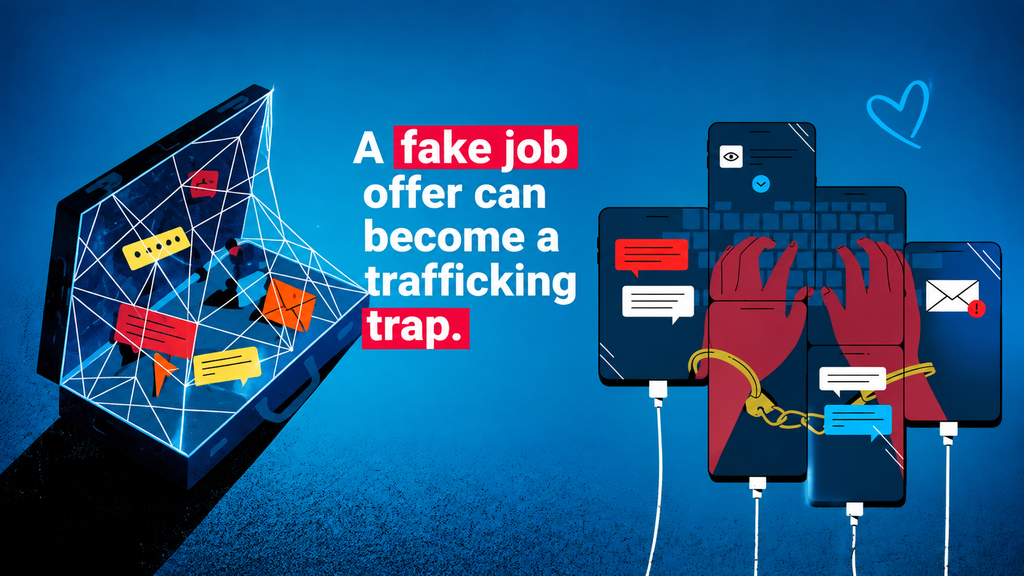
A smartphone can open a door to opportunity. It can also become a tool used by criminals to deceive vulnerable people.
Across Ethiopia, technology is becoming increasingly connected to the way traffickers recruit and exploit people. Social-media accounts, messaging services and online job advertisements can make false promises appear convincing, while allowing recruiters to communicate quickly and anonymously.
The United Nations Office on Drugs and Crime has documented how traffickers around the world use the internet to identify, contact and recruit potential victims. Technology can also help criminals organize transportation and accommodation and communicate across borders.
False Promises, Real Risks
Ethiopia’s trafficking risks are closely connected to economic pressure, migration and limited employment opportunities.
The U.S. Department of State’s 2024 Trafficking in Persons Report says labor recruiters in Ethiopia frequently target young people from rural areas with promises of better opportunities in cities. The report also says traffickers have replicated legitimate app-based recruitment tools to fraudulently recruit vulnerable people for forced labor.
The danger does not always begin with an obviously suspicious message. A fake opportunity can be presented as a normal job advertisement, a recruitment offer or a seemingly successful migration story.
What Ethiopia’s 470 trafficking investigations looked like in 2024
- 364 cases logged as unspecified forms of trafficking
- 79 cases opened for labor trafficking
- 27 cases opened for sex trafficking
Most cases were logged without a specified trafficking type — a reporting gap the government itself has flagged, tied to the lack of a centralized, disaggregated crime database. (Source: U.S. Department of State, 2025 Trafficking in Persons Report — Ethiopia.)
Social Media as a Recruitment Tool
Social media can connect people across enormous distances. That same reach can be abused.
The 2024 U.S. Trafficking in Persons Report states that traffickers in Ethiopia increasingly use social media to recruit children for sexual exploitation and trafficking. It also reports that traffickers have used fake social-media accounts portraying apparently successful migration to attract potential victims.
This does not mean that social media itself causes trafficking. Rather, digital platforms can provide another channel through which existing trafficking networks operate.
How many Ethiopians are actually reachable this way
The “digital” part of the digital trap is smaller and more uneven than it sounds. Ethiopia’s internet population is growing fast, but it still leaves most of the country untouched — and the people traffickers reach through a screen are not necessarily the same people who own the screen.
- 28.6 million people online, about 21% of the population, as of early 2025
- +10.9% growth in mobile connections in a single year (2024–2025)
- 8.3 million active social-media user identities nationwide
Owning a phone is not the same as being online. Among men, 86% own some kind of mobile phone but only 18% own a smartphone. Among women, 65% own a mobile phone but just 6% own a smartphone. Basic phones can still carry a scam through SMS, calls or lightweight messaging apps — but the sharpest gender gap, and the one that shapes who sees a polished fake job post on Facebook or TikTok, is in smartphone access. (Source: Birr Metrics / GSMA-linked national survey data, 2024–2025.)
When a Job Offer Is Not What It Seems
Fraudulent recruitment is particularly concerning when someone is promised employment but receives little reliable information about the employer, contract, working conditions or destination.
Ethiopia has regulations governing overseas employment agencies, including requirements concerning registration and licensing. The government has also used inspections and other measures to monitor recruitment agencies — reviewing more than 800 licensed agencies through desk reviews and site visits. At the same time, international reporting has identified fraudulent recruitment as an ongoing concern.
For researchers and investigators, one important challenge is distinguishing legitimate recruitment from deceptive recruitment before exploitation occurs.
Recruitment agencies are required to register, get licensed, and confirm that workers understand their rights and the laws of the destination country before they leave. In practice, oversight has to compete with recruiters who move faster than the paperwork.
Based on Ethiopia’s Overseas Employment Proclamation 1246/2021 and monitoring described in the 2025 Trafficking in Persons Report
Vulnerability Does Not Have One Face
Trafficking can affect different groups and can occur both inside Ethiopia and across international borders.
The U.S. Department of State reports that women and girls have been exploited in domestic servitude and sex trafficking, while boys and men have been exploited in forced labor in areas including construction, agriculture, traditional weaving, street vending and forced begging. The same report identifies internally displaced people and people with limited access to justice, education and economic opportunities as particularly vulnerable.
These vulnerabilities mean that a digital prevention strategy cannot focus only on one platform or one type of victim.
Where exploitation happens most
- 62% of identified Ethiopian trafficking victims were exploited in forced labor
- 22% were exploited in sex trafficking
- 16% faced other forms, including forced marriage and forced military recruitment
(Source: Counter Trafficking Data Collaborative / IOM, victims exploited in Ethiopia.)
Domestically, the government’s own count of identified victims doubled in a single reporting cycle — from 264 to 541, of whom 278 were trafficked for sex and 263 for labor, and roughly one in five were children. Separately, among Ethiopian victims registered internationally between 2004 and 2024, nearly half were identified in just the last three years of that period, and the large majority were adult women.
The Response
Ethiopia has taken steps to strengthen its response. The government has conducted awareness campaigns, regulated employment agencies and operated trafficking-reporting mechanisms. A trafficking-specific hotline in Addis Ababa has also been used to refer potential cases for investigation and connect callers with legal services.
- 941 calls received by the national trafficking hotline in a year
- 56 cases referred from the hotline to police for investigation
- 697 individuals prosecuted under the anti-trafficking proclamation
Investigations opened, 2021–2024
- 495 investigations opened in 2021
- 498 investigations opened in 2022
- 728 investigations opened in 2023
- 470 investigations opened in 2024
Investigations climbed for two years, spiked in 2023, then dropped by more than a third in 2024 — the same year identified victims roughly doubled. Read together, the two trends suggest better victim identification has not yet translated into matching investigative capacity. (Source: U.S. Department of State, Trafficking in Persons Reports, 2023–2025 editions.)
But experts and international assessments continue to identify gaps, including victim identification, services outside Addis Ababa, oversight of recruiters and reliable centralized data. The government itself has acknowledged that without a unified law enforcement database, regional cases — particularly outside the capital — are likely undercounted.
The Bigger Question
The challenge for Ethiopia is no longer simply understanding trafficking as something that happens through physical networks.
It is also understanding how digital communication can become part of those networks — and how thin that layer of connectivity still is. Fewer than one in four Ethiopians are online at all, and smartphone ownership among women sits at just six percent. That means the digital trap, where it exists, is often set on a handful of platforms reaching a relatively narrow, urban, disproportionately male slice of the population — while the older channels of word-of-mouth, informal brokers and unlicensed agents still do most of the damage everywhere else.
Technology can help people find jobs, communicate with relatives, access information and report crimes. The same technology can be manipulated by people seeking to deceive and exploit others.
The answer therefore is not to fear technology, but to make digital recruitment safer, strengthen verification, improve awareness and ensure that people who may be at risk can reach effective protection and justice.
The digital trap can be difficult to see. The first step in breaking it is knowing where it begins.
Sources
- U.S. Department of State, 2025 Trafficking in Persons Report — Ethiopia
- U.S. Department of State, 2024 Trafficking in Persons Report — Ethiopia
- U.S. Department of State, 2023 Trafficking in Persons Report — Ethiopia
- United Nations Office on Drugs and Crime (UNODC), reporting on technology-facilitated trafficking
- Counter Trafficking Data Collaborative (IOM), “Victims exploited in Ethiopia” and “Victims originating in Ethiopia”
- DataReportal, Digital 2025: Ethiopia
- Birr Metrics, reporting on mobile and smartphone ownership by gender, 2024–2025
- GSMA Intelligence, mobile internet access data for Ethiopia
Editor’s Note: Views in the article do not necessarily reflect the views of borkena.com
__
Join our Telegram Channel: t.me/borkena
Like borkena on Facebook
To submit a press release, send the submission to info@borkena.com
Add your business to Ethiopian Business Listing / Ethiopian Business Directory
Join the conversation. Follow us on X (formerly Twitter) @zborkena to get the latest Ethiopian news updates regularly.