
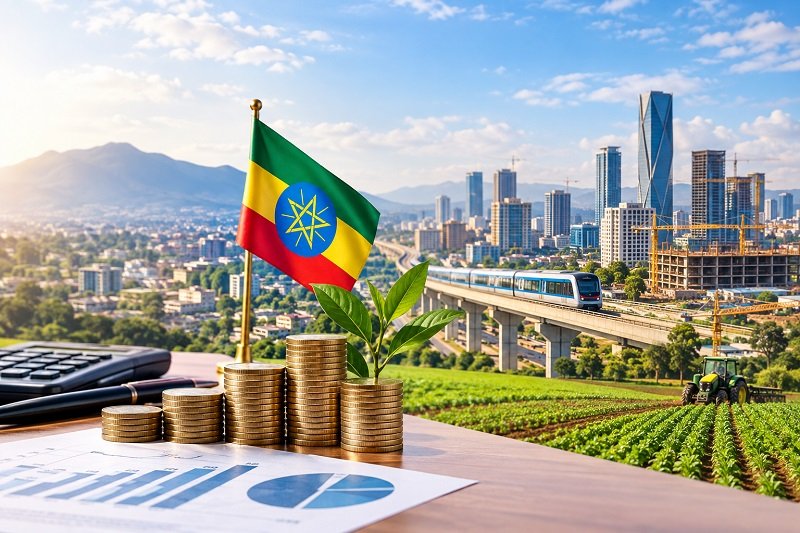
Ethiopia’s current economic reform program represents an important departure from the economic model of the past. The IMF-supported program has helped address some of the country’s most serious macroeconomic imbalances, while the government has undertaken significant reforms to the foreign-exchange regime, monetary policy, fiscal system and financial sector.
The results so far are encouraging. The IMF has reported stronger-than-expected growth, exports, revenue mobilization and reserve accumulation, together with declining inflation. The Fund describes the program as laying the foundations for private-sector-led growth.
These achievements deserve recognition.
But I believe Ethiopia now needs to take the next step.
Macroeconomic stabilization should be the foundation of reform, not its destination.
The ultimate objective should be to create an economy in which Ethiopians are free and able to invest, establish businesses, innovate, compete, employ others and build productive enterprises without unnecessary political, institutional, regulatory or security constraints.
The missing link: from stability to productive freedom
The IMF’s principal responsibility is macroeconomic stability. It is not primarily an institution-building organization.
That distinction matters.
A country can stabilize its currency, improve its reserves, reduce inflation and restore debt sustainability without necessarily creating the institutional environment required for millions of people to become productive entrepreneurs.
For Ethiopia, therefore, the IMF program should be complemented by a broader reform framework involving the IMF, the World Bank, IFC and other development partners.
The objective should be straightforward:
Turn macroeconomic stabilization into an environment in which private enterprise can flourish.
This is particularly important because Ethiopia does not suffer from a shortage of entrepreneurial people. What it has often lacked is an environment in which entrepreneurial energy can be converted into productive investment at scale.
Recent World Bank consultations with Ethiopian businesses illustrate the problem. Businesses reported unpredictable implementation of tax, customs and competition rules, inadequate access to finance, scarcity of long-term capital, unreliable electricity, logistics constraints and insufficient digital connectivity.
These are precisely the constraints that prevent macroeconomic reform from becoming broad-based economic transformation.
A new objective: measure how much freedom the economy actually gains
The World Bank’s Business Ready (B-READY) framework offers an excellent instrument for this purpose.
B-READY measures three dimensions of the business environment:
- Regulatory Framework
- Public Services
- Operational Efficiency
It covers ten areas corresponding to the life cycle of a firm, including business entry, location, utility services, labor, financial services, international trade and insolvency. Unlike a purely legalistic assessment, it also examines how regulations and public services actually work in practice.
This makes B-READY particularly useful for Ethiopia.
Rather than merely asking whether the government has passed a particular reform, the question becomes:
Has it become easier for an Ethiopian to establish, finance, operate and expand a productive business?
That is a much more meaningful measure of economic reform.
Make B-READY improvement a formal reform objective
I would therefore like to see the IMF and World Bank incorporate a measurable improvement in Ethiopia’s business environment into the broader reform program.
For example, Ethiopia could commit to:
Achieving a predetermined annual improvement in its B-READY score, measured both in absolute terms and, where appropriate, relative to comparable economies.
The exact annual target should be established objectively from Ethiopia’s baseline position rather than arbitrarily imposed.
The important principle is that the target should be measurable, transparent and difficult to satisfy merely by passing legislation.
The government should have to demonstrate that the entrepreneur actually experiences improvement.
For example:
- How long does it take to start a business?
- How easily can an entrepreneur obtain electricity?
- Can a small business obtain financing without prohibitive collateral?
- How predictable are tax and customs procedures?
- How long does it take to enforce a commercial contract?
- How easily can a company import machinery?
- Can an unsuccessful business exit the market without being trapped indefinitely?
- Are government contracts genuinely competitive?
- Do state-owned enterprises compete on equal terms with private companies?
- How frequently do important regulations change?
- Can investors reliably repatriate legitimate profits?
These are the questions that determine whether an economy is actually becoming freer and more productive.
The dashboard: measure reform by what it makes possible
I would propose a public Ethiopian Economic Transformation Dashboard, updated annually.
It could contain five broad pillars.
| Pillar | Examples of indicators |
|---|---|
| 1. Macroeconomic stability | Inflation, reserves, fiscal balance, debt sustainability, FX-market functioning |
| 2. Business environment | B-READY score, business-entry time, licensing, taxation, contract enforcement, insolvency |
| 3. Competition & private investment | Private investment, access to credit, SOE neutrality, competitive procurement, market entry |
| 4. Peace & institutional predictability | Conflict and displacement, property protection, regulatory predictability, contract enforcement |
| 5. Human outcomes | Employment, real wages, poverty, electricity reliability, education, health and essential services |
The important principle is that GDP should be only one indicator among many.
A country can report impressive GDP growth while households remain under severe pressure.
The ultimate test is whether economic growth is producing greater productive capacity, employment, incomes and human welfare.
Competitive neutrality should be non-negotiable
One of the most important reforms should be ensuring that state-owned enterprises and private companies operate under genuinely comparable conditions.
If an SOE receives preferential access to foreign exchange, credit, land, infrastructure or government contracts, then liberalization remains incomplete.
The objective should not simply be to make state enterprises more financially efficient.
It should be to create a competitive economy.
The best company should be able to win because it is productive and competitive—not because it has privileged access to the state.
That principle would unleash enormous entrepreneurial energy.
Peace is an economic reform
There is another condition that cannot be separated from economic reform: peace and security.
A businessperson considering a ten- or fifteen-year investment is not only calculating taxes, interest rates and expected returns.
They are asking:
Will my factory still be operating five years from now?
Will my property remain secure?
Will contracts be enforceable?
Will the rules remain reasonably predictable?
Will my employees be safe?
No amount of monetary reform can compensate for fundamental insecurity.
Conflict therefore should not be regarded merely as a humanitarian or political problem. It is also a direct economic constraint.
The relationship works in both directions:
insecurity → lower investment → fewer jobs → lower opportunity → greater instability
while the opposite cycle can also occur:
peace → predictability → investment → jobs → higher incomes → stronger institutions → greater stability
Peace and economic reform are therefore complements.
The state does not need to create every successful business
Perhaps the most important philosophical shift would be to change the role of the Ethiopian state.
The state does not need to decide which Ethiopian businesses will succeed.
It needs to create the conditions in which Ethiopians can discover that for themselves.
A productive market economy works through:
entry → experimentation → competition → failure → reallocation of capital → expansion of successful firms → higher productivity.
Government cannot predict all the businesses, technologies and industries that Ethiopian entrepreneurs might create.
Nor should it have to.
Ethiopia’s enormous domestic market, agricultural potential, strategic geography, young population and entrepreneurial culture provide a remarkable foundation.
The state should provide the infrastructure, security, institutions and rules.
Entrepreneurs should provide the experimentation.
Markets should determine which ideas succeed.
From reform milestones to human outcomes
This is ultimately why I would like to see the current reform agenda broadened.
The IMF’s macroeconomic reforms are important because an unstable macroeconomic environment makes productive investment almost impossible.
But stabilization should lead somewhere.
The World Bank’s new ten-year Country Partnership Framework for Ethiopia already moves substantially in this direction, putting job creation, private-sector-led growth, human capital, infrastructure and stronger institutions at the center of its engagement.
The next logical step would be to connect these objectives through a common, transparent dashboard.
The sequence should be:
Macroeconomic stability
↓
Better institutions and business environment
↓
Greater economic freedom and competition
↓
More private investment
↓
Higher productivity
↓
More productive jobs
↓
Higher real incomes
↓
Better public services and human development
That is the bridge between an IMF stabilization program and a genuine transformation of Ethiopian society.
The ultimate measure
I would therefore judge Ethiopia’s reform program not simply by whether it meets IMF targets or achieves a particular GDP growth rate.
I would ask a much simpler question:
Is it becoming progressively easier for an Ethiopian with an idea, some capital and hard work to build a successful business without political connections or unnecessary government intervention?
If the answer becomes increasingly yes, the reform is working.
And if millions of Ethiopians can exercise that economic freedom, the consequences should extend far beyond business.
More businesses mean more jobs.
More jobs mean higher household incomes.
Higher incomes create demand for better housing, education, healthcare and services.
Successful businesses generate tax revenue.
Competition improves productivity.
Productivity raises living standards.
And a larger, more prosperous middle class creates a broader foundation for capable institutions.
In that sense, economic freedom is not the final objective either. It is one of the mechanisms through which human conditions improve.
Ethiopia does not primarily need the government to create prosperity.
It needs the government to create the conditions in which Ethiopians are free to create it themselves.
The IMF can help provide the macroeconomic foundation.
The World Bank and IFC can help build the institutional and investment environment.
But ultimately, it is Ethiopian entrepreneurs, workers and citizens who must produce the transformation.
The measure of reform should therefore be not merely what the government has done, but what Ethiopians are increasingly free and able to do.
Editor’s Note: Views in the article do not necessarily reflect the views of borkena.com
__
Join our Telegram Channel: t.me/borkena
Like borkena on Facebook
To submit a press release, send the submission to info@borkena.com
Add your business to Ethiopian Business Listing / Ethiopian Business Directory
Join the conversation. Follow us on X (formerly Twitter) @zborkena to get the latest Ethiopian news updates regularly.