
By Eng. Abdi Ali Barkad
The Case for Recognizing Stable States in Strategic Locations

The international community is facing one of the most dangerous periods of geopolitical instability in the modern history of the Middle East and the Horn of Africa. The crisis is no longer limited to conventional disputes between neighboring states. It has increasingly developed into a network of proxy conflicts, armed non-state actors, foreign military intervention, maritime insecurity and competition over strategic sea routes.
At the center of this increasingly complicated environment is the expanding influence of Iran and Iranian-supported armed movements across the region. The consequences are being felt far beyond the borders of the Middle East. The security of international shipping, energy supplies, commercial trade and global supply chains is increasingly connected to developments stretching from the Persian Gulf through the Red Sea and into the Gulf of Aden.
Armed organizations and political-military networks operating in Lebanon, Yemen and Somalia have become part of a wider regional security problem. Hamas operates in the Israeli-Palestinian conflict, while the Houthis in Yemen have demonstrated their ability to threaten maritime navigation in and around the Red Sea. In Somalia, Al-Shabaab remains a major security threat and continues to exploit political instability and weak governance.
These conflicts should therefore not be viewed as isolated local problems. They are increasingly interconnected by the broader geopolitical competition taking place across the region.
The international community must consequently rethink its approach.
A policy based solely on military intervention, temporary security arrangements and political compromises between unstable governments has failed to provide lasting security. What is required is a long-term geopolitical strategy based on stable governments, accountable institutions, secure maritime corridors and strong regional partnerships.
The Gulf of Aden and the Bab el-Mandeb Strait are too strategically important to be left vulnerable to permanent instability.
1. The Strategic Importance Of The Gulf Of Aden And Bab El-Mandeb
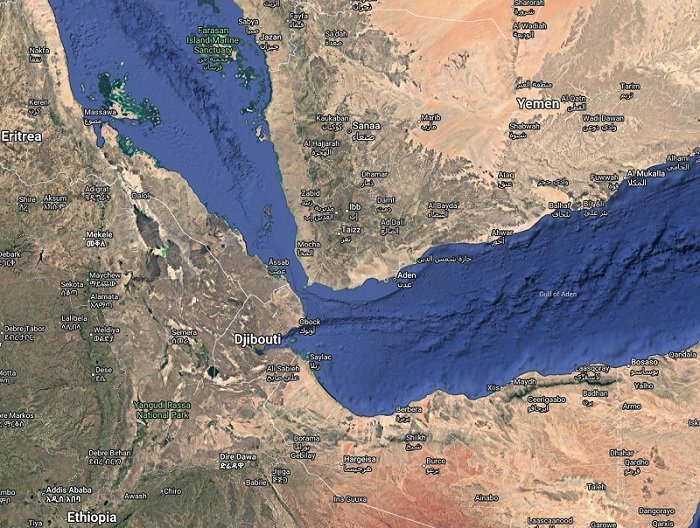
The Bab el-Mandeb Strait is one of the world’s most strategically important maritime chokepoints. It connects the Red Sea with the Gulf of Aden and provides a critical maritime route between the Indian Ocean, the Middle East, Europe and global markets.
Any prolonged instability around this corridor can have consequences far beyond the countries immediately surrounding it.
A serious disruption of navigation can increase shipping costs, insurance premiums, transportation times and energy prices. It can also force commercial vessels to take much longer routes around the Cape of Good Hope.
This means that the security of the Gulf of Aden is not simply a regional issue.
It is a global economic and security issue.
Yet the international community continues to respond largely to individual crises after they occur rather than addressing the geopolitical structure that allows instability to develop.
This approach must change.
The international community should develop a permanent strategic framework for the Gulf of Aden based on three fundamental principles:
- Secure maritime navigation;
- Stable and accountable governments on both sides of the Gulf of Aden;
- Prevention of the expansion of foreign-backed armed networks and proxy conflicts.
This requires political solutions, not military responses alone.
2. South Yemen: A Political Question That Cannot Be Ignored
The political future of South Yemen must be addressed as part of any serious strategy for regional stability.
North and South Yemen were separate political entities before their unification in 1990. Since unification, Yemen has experienced repeated political crises, civil wars, institutional collapse and external intervention.
The international community should therefore recognize that the question of South Yemen cannot simply be dismissed as an internal Yemeni matter.
The future status of South Yemen should ultimately be determined through a peaceful, internationally supervised political process, reflecting the wishes of its population.
If the people of South Yemen genuinely seek a separate political status, the international community should not automatically reject that aspiration.
A stable and internationally recognized South Yemen could potentially become an important partner in securing the Gulf of Aden and the approaches to the Bab el-Mandeb Strait.
The strategic importance of Aden cannot be overstated.
Aden is naturally positioned at one of the world’s most important maritime crossroads. A stable government controlling Aden and committed to freedom of navigation, international maritime law and regional cooperation could make an important contribution to the security of the entire region.
Therefore, rather than continuously attempting to preserve political arrangements that have repeatedly produced instability, the international community should be prepared to consider new political frameworks based on the wishes of the people and the realities on the ground.
3. The Republic Of Somaliland A Stable State At A Strategic Location
The case of the Republic of Somaliland deserves equally serious consideration.
Somaliland declared the restoration of its independence in 1991, following the collapse of the Somali state and the end of the political union that had existed since 1960.
For more than three decades, Somaliland has developed its own political institutions, security structures and governmental systems. It has also maintained a comparatively stable environment in a region affected by conflict, terrorism and political instability.
This reality should not be ignored simply because the international community has historically maintained a policy of preserving Somalia’s territorial framework.
The international community must distinguish between political preference and geopolitical reality.
Somaliland occupies one of the most strategically important locations on the African side of the Gulf of Aden. Its coastline faces one of the world’s most important maritime corridors, and the port of Berbera has significant potential as a commercial and strategic gateway connecting the Gulf of Aden with the Horn of Africa and beyond.
A stable Somaliland can therefore contribute to:
- Maritime security;
- Counter-piracy efforts;
- Protection of international commercial shipping;
- Regional trade;
- Port and logistics development;
- Counter-terrorism cooperation;
- Stability along the Gulf of Aden.
The question should therefore be asked:
Why should the international community continue to leave a relatively stable political entity outside the formal international system while struggling to stabilize areas suffering from prolonged conflict?
Recognition should not be viewed only through the traditional lens of Somali politics.
It should also be considered through the wider interests of regional security, international trade and freedom of navigation.
4. The Failure Of The Current Approach
For decades, the international community has invested enormous political, military and financial resources in Somalia and Yemen.
Yet the fundamental problems remain.
In Somalia, international assistance has not eliminated terrorism, political fragmentation or institutional weakness.
In Yemen, international efforts have failed to produce a durable political settlement capable of securing the entire country.
Meanwhile, armed movements and external powers have continued to exploit political divisions.
This raises a fundamental question:
Should the international community continue repeating the same policies and expecting a different result?
A new approach is urgently required.
The objective should not be to redraw borders simply for geopolitical convenience. Rather, the objective should be to create political structures that are legitimate, stable, representative and capable of maintaining security.
Where existing political arrangements have consistently produced instability, the international community must have the courage to consider alternative political solutions.
5. The Iranian Factor And The Proxy War
Iran’s regional strategy has demonstrated the power of non-state armed networks as instruments of geopolitical influence.
The Iranian model has relied heavily on relationships with armed and political movements that can operate beyond the conventional boundaries of state power.
The Houthis in Yemen have demonstrated how a powerful armed movement can threaten international maritime traffic from territory close to one of the world’s most important shipping corridors.
This should be a warning to the international community.
The same strategic logic must be considered when assessing instability elsewhere in the region.
The objective should not be to label every armed movement as an Iranian proxy without evidence. Instead, the international community must examine financial networks, weapons transfers, military training, political relationships and logistical connections using verifiable intelligence.
The international community should prevent the Gulf of Aden from becoming another arena for an expanding regional proxy war.
The worst possible outcome would be for instability on the southern Red Sea to merge with instability in the Horn of Africa, creating a continuous arc of insecurity from the Middle East to East Africa.
6. Somaliland And South Yemen As Strategic Partners
The international community should consider a new strategic concept:
Stable political entities on both sides of the Gulf of Aden.
On one side is Somaliland, with its strategic coastline and Berbera port.
On the other side is South Yemen, with Aden and its strategic position near Bab el-Mandeb.
If both areas develop stable, internationally recognized governments committed to maritime security and regional cooperation, they could form an important security and economic partnership.
Such a framework could support:
- Protection of commercial shipping;
- Counter-piracy operations;
- Counter-terrorism cooperation;
- Intelligence sharing;
- Port development;
- Energy infrastructure;
- International investment;
- Regional trade;
- Protection of freedom of navigation.
This would not eliminate all regional problems.
But it could create a much stronger geopolitical foundation for dealing with them.
7. A Call To The United States, Eu, India, Uae And Saudi Arabia
Countries with major economic and strategic interests in the Indian Ocean and Red Sea, particularly the United States, European Union, India, United Arab Emirates and Saudi Arabia should reconsider their approach to the Gulf of Aden.
These countries have a direct interest in protecting international trade and maritime security.
They should therefore support governments and institutions that demonstrate:
stability, accountability, peaceful governance and commitment to international maritime security.
Recognition of Somaliland and a peaceful political settlement concerning the future status of South Yemen should be considered within this broader strategic framework.
The objective should not be directed against any particular country or population.
The objective should be to establish a regional security architecture capable of preventing the Gulf of Aden and Bab el-Mandeb from becoming permanent theaters of proxy warfare.
8. A New Policy For The Gulf Of Aden
The international community needs a new doctrine for the region.
- Support peaceful political self-determination where populations have demonstrated sustained political aspirations.
- Strengthen stable governments rather than rewarding armed groups.
- Protect international maritime navigation as a fundamental global interest.
- Investigate foreign weapons transfers and military support to non-state armed organizations.
- Create stronger economic partnerships with stable coastal states.
- Develop permanent regional maritime-security cooperation between the states surrounding the Gulf of Aden.
- Use diplomacy and political recognition as instruments of stability, not merely as rewards after conflicts have already ended.
The Time For A New Strategy Is Now
The world cannot continue treating the Gulf of Aden as a collection of separate crises.
Yemen, Somalia, Somaliland, Djibouti, the Red Sea and the Bab el-Mandeb are part of one interconnected geopolitical system.
The security of this system affects billions of dollars in international trade and the stability of global supply chains.
If the international community continues to ignore the political realities of the region, armed movements and foreign powers will continue filling the vacuum.
The alternative is a new geopolitical strategy based on stable states, legitimate institutions, maritime security, political self-determination and regional cooperation.
South Yemen and Somaliland should therefore be seriously considered within this new strategic framework.
The international community should not be afraid to reconsider old assumptions when those assumptions have failed to deliver peace.
The strategic question is no longer simply how to manage instability.
The real question is:
How can the international community build a political and security order that prevents instability from becoming permanent?
The answer requires courage, realism and a willingness to rethink established policies.
The Gulf of Aden cannot be allowed to become another permanent battlefield of proxy warfare.
The Bab el-Mandeb cannot be left vulnerable to armed groups and geopolitical coercion.
And the people living on both sides of this strategic corridor should not be condemned to decades of instability because the international community is unwilling to reconsider outdated political frameworks.
A stable Somaliland, a peaceful and politically legitimate South Yemen, secure maritime routes, and responsible regional partnerships could become essential pillars of a new security architecture for the Gulf of Aden.
The time has come for the international community to move beyond crisis management and begin building a long-term geopolitical strategy for peace, stability and freedom of navigation in the Gulf of Aden and Bab el-Mandeb.
Engineer Abdi Ali Barkhad is Ethiopian, has also become known as a political analyst and writer on the Horn of Africa, particularly on Somaliland, Somalia, Ethiopia, regional geopolitics, diplomacy, and international relations. His author profile describes him as a senior consultant who has studied international diplomacy. He can be reached via email : tra50526@gmail.com
Editor’s Note: Views in the article do not necessarily reflect the views of borkena.com
__
Join our Telegram Channel: t.me/borkena
Like borkena on Facebook
To submit a press release, send the submission to info@borkena.com
Add your business to Ethiopian Business Listing / Ethiopian Business Directory
Join the conversation. Follow us on X (formerly Twitter) @zborkena to get the latest Ethiopian news updates regularly.