
From Exclusion to Expulsion: Is Ethiopia’s Expanding Campaign Against Amharas Crossing the Genocide Threshold?
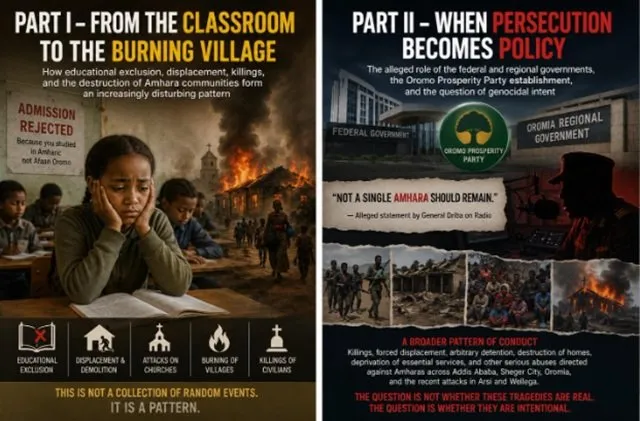
PART II — When Persecution Becomes Policy
By Caleb Ta (Dr.)
Independent Researcher in African Political Affairs; Human Rights Advocate
The role of the federal and regional governments, the Oromo Prosperity Party establishment, and the question of genocidal intent
Introduction
The most difficult questions begin where Part I ends.
A burned village can be investigated. A destroyed home can be documented. A killing can be recorded. A displaced family can tell its story. But when similar events occur repeatedly across different communities, investigators must eventually look beyond the immediate perpetrators and ask whether the institutions responsible for protection knew what was happening, how they responded, and whether their actions—or their inaction—formed part of a broader pattern.
That is the point at which persecution becomes a question of policy.
Part II, therefore, follows the evidence upward. It examines the concerning federal and regional authorities, the role attributed by critics to the Oromo Prosperity Party political establishment, the possibility of coordination between political, administrative, and security structures, and the radio exchange involving General Driba.
Most importantly, it examines the question that is central to any genocide inquiry:
Was there specific intent to destroy the Amhara ethnic group, in whole or in part?
The answer cannot be established by rhetoric alone. It must be established through evidence. But if words, policies, institutional conduct, killings, displacement, destruction, and other abuses are shown to be connected, the cumulative pattern becomes impossible to dismiss as a collection of unrelated incidents.
The most disturbing part of this story may not be what happens when an attacker enters a village.
It may be what happens afterward—and who does nothing.
Families and community members say they have repeatedly sought protection from federal and regional authorities following attacks against Amhara civilians. Yet, according to victims and their families, the response has not simply been inadequate. They describe silence, inaction, and an apparent unwillingness to provide meaningful protection.
That raises a far more serious question:
Is the state merely failing to protect Amhara civilians—or are elements within the state itself enabling, coordinating, or orchestrating their persecution?
The distinction is fundamental.
A government unable to protect civilians during an isolated outbreak of violence may be demonstrating institutional weakness.
But when attacks against the same ethnic population repeatedly occur in different locations, when homes are destroyed and communities displaced, when civilians are killed, when people encounter discrimination in housing and education, and when authorities repeatedly fail to provide effective protection, the possibility of something more deliberate demands investigation.
When the State Fails to Protect—or When the State Is Orchestrating the Persecution?
The allegations become particularly serious because Ethiopia’s federal and regional political structures do not operate independently of one another.
Critics contend that institutions controlled or heavily influenced by the Oromo Prosperity Party political establishment have pursued policies and taken actions that disproportionately affect Amhara communities.
From this perspective, the question is no longer simply whether local officials are failing to respond to violence.
It is whether political and administrative structures are being used to facilitate, coordinate, or orchestrate a broader campaign of ethnic exclusion, displacement, and destruction.
That is an allegation requiring evidence.
But the pattern itself demands investigation.
If federal authorities are aware of repeated attacks against Amhara civilians yet fail to deploy adequate protection; if regional authorities possess knowledge of attacks but do not effectively intervene; if homes and villages are destroyed without meaningful accountability; if displaced families cannot return; and if discriminatory practices appear simultaneously in education, housing, employment, property rights, security, and freedom of movement, then the explanation of isolated administrative failure becomes increasingly difficult to sustain.
The question becomes whether inaction itself has become an instrument of persecution.
More seriously, the active coordination between political authorities, administrative institutions, and security actors.
Who benefits from the resulting demographic transformation?
A state can participate in persecution through more than direct physical violence.
Institutional decisions concerning education, housing, property, security, and access to public services can collectively determine whether an ethnic population can safely remain in a particular area.
That is why the exclusion of Amharic-speaking children cannot be separated from the allegations of displacement and violence.
Nor can the destruction of homes be separated from restrictions on renting to Amhara families.
Nor can housing discrimination be separated from the killing of civilians and the burning of villages.
The investigation must follow the pattern—not merely the individual incident.
The evidence demonstrates that federal and regional institutions knowingly facilitated, encouraged, coordinated, or deliberately failed to prevent systematic attacks against Amharas; the issue would extend far beyond governmental negligence. It could raise questions of institutional and individual responsibility for persecution and potentially other international crimes, depending on the evidence and applicable legal standards.
The most disturbing possibility is therefore not simply that the state has failed to protect its citizens.
The machinery of the state contributes to the conditions that those citizens need protection from.
The Oromo Prosperity Party Strategy
Critics of Prime Minister Abiy Ahmed’s Prosperity Party argue that the treatment of Amharas reflects a broader political strategy in which ethnic exclusion is becoming institutionalized through government structures.
They contend that federal-level policies are being implemented through Addis Ababa, Sheger City, Oromia regional institutions, and local authorities.
The most serious version of this allegation is that there is a coordinated or concealed strategy to weaken, displace, and ultimately destroy Amhara communities.
That allegation must be tested against evidence.
If written directives, internal communications, meeting records, administrative instructions, security orders, or other documents connect federal officials to discriminatory policies affecting Amharas, those materials could be critical in determining whether the pattern is coordinated.
The question, therefore, is not merely whether Prime Minister Abiy Ahmed personally issued a secret instruction.
The larger question is:
Does a state or organizational policy exist—and if so, who authorized it, who implemented it, and what consequences were intended or foreseeable?
The General Driba’s Radio Statement: The Question of Genocidal Intent
This is where the issue becomes especially grave.
Among the material provided for this article is radio exchange involving General Driba.
The reported exchange includes the statement:
“አንድም ዐማራ እንዳይተርፍ አጽዱት።”
Translated:
“Clear them out so that not a single Amhara remains.”
The conversation continues with a discussion of resistance and requests for military protection. The speaker reportedly responds by instructing those involved to remain strong and “clear” the area.
The exchange includes a discussion of burning a church and the failure to burn what the speaker describes as an extremist camp.
The reported conversation continues:
“አይይ እነሱ እምቢ ብለዋል። እናንተ ጠንክሩ፣ አጽዱ ይላል።”
Another portion reportedly concerns leaving the area and subsequently returning to “stabilize” it.
The speaker (General Driba ) asks whether an extremist camp was burned.
The response reportedly says that no camp was found, that the forces were surrounded, and that the day’s fighting was difficult.
The response from General Driba includes:
“አንተ ደደብ እንደዝህ ዓይነት መልስ ለኔ አትመልስ።”
The conversation then refers to burning a church:
“አቦ የሚሉትን ቤተክርስቲያን ልናቃጥል ክብሪት መጫር ሲቀረን ኃይላቸው ከበደን…”
And when asked whether they fled, the reported response is:
“አዎን።”
These statements must be independently authenticated, accurately translated, correctly attributed, and properly contextualized before they can be treated as established evidence.
But if the recording is genuine, its significance could be extraordinary.
A statement explicitly calling for not a single member of an ethnic group to survive would potentially constitute highly significant evidence concerning the specific intent element of genocide. It is evidence of a commander’s specific intent.
When Intent Meets Conduct
Genocide ultimately turns on intent.
And intent can sometimes be revealed by comparing what perpetrators said with what happened on the ground.
Consider the pattern:
Amharas were killed in different parts of the country.
Families are forced from their homes.
Homes demolished or burned.
Villages were destroyed.
Churches were attacked or burned.
Property confiscated or destroyed.
Civilians are detained.
Families are prevented from returning.
Amhara residents are facing discrimination in housing.
Amhara children are denied educational opportunities because of the language in which they are taught.
And, according to the radio recording, a military figure reportedly said that “not a single Amhara should remain.”
All this evidence demonstrates that these incidents are connected; the cumulative picture becomes increasingly difficult to characterize as ordinary ethnic conflict.
It begins to resemble something much more systematic.
Does the Evidence Meet the Genocide Threshold?
The Genocide Convention establishes two interconnected requirements: prohibited underlying acts against a protected group and the specific intent to destroy that group, in whole or in part.
The recognized underlying acts include killing, causing serious bodily or mental harm, deliberately inflicting conditions of life calculated to bring about physical destruction, imposing measures intended to prevent births, and forcibly transferring children.
Several of the evidence described above in this article fall within these categories.
Killing becomes relevant if evidence establishes that Amhara civilians were deliberately killed because they belonged to the group.
Serious bodily or mental harm becomes relevant when violence, persecution, detention, terror, and systematic targeting are established to have inflicted harm of the required severity.
The educational form is part of a broader campaign involving ethnic persecution, terror, physical violence, displacement, and other serious abuses; it may become relevant to the cumulative assessment of harm.
Conditions of life become relevant where evidence establishes deliberate conduct calculated to bring about the physical destruction of the group, rather than mere discrimination or displacement for another purpose.
This is where the destruction of homes, burning of villages, displacement, denial of housing, deprivation of protection, and destruction of the community occur. Then comes the most difficult and decisive question:
Was there specific intent to destroy the Amhara ethnic group, in whole or in part?
That is where the statement that not a single Amhara should survive becomes potentially critical; it can be authenticated and linked to on-the-ground conduct.
Livestock Seizure: Another Dimension of Dispossession
Another dimension of the campaign in East Wollega. While I am writing this article, I received the report that Ethiopian federal forces and regional government-affiliated armed groups seized cattle from communities in Andode Dicha, Fendeka, Shashober, Mender 3, and Mender 22 and transported them toward Nekemte using military vehicles, including Military Ural and Kasoni trucks. The report further alleges that some of the remaining cattle were being offered to local Oromo residents under pressure to purchase them.
Such conduct would represent more than the loss of livestock. For rural families, cattle are a source of food, income, agricultural capacity, and economic security. Their confiscation and forced sales could therefore contribute to the broader pattern of economic dispossession, displacement, and the destruction of civilian livelihoods.
The Pattern Matters More Than Any Single Incident
The strongest case for an investigation does not rest on a single school’s admissions policy.
Nor does it rest on one village.
Nor one killing.
Nor one recording.
It rests on the possibility that all of these events belong to the same pattern.
A child was excluded from school because of an Amharic-language education.
A family denied housing.
A home was demolished.
A village emptied.
Civilians killed.
Churches burned.
Property destroyed.
Families displaced.
People detained.
Communities left without protection.
And a military command to ensure that not a single Amhara survives.
All these events are independently established and shown to be connected; they could constitute evidence of a much broader campaign of ethnic persecution.
The Children Are Not the Beginning of the Story—They May Be the Warning
Perhaps the most disturbing feature of this story is that it reaches children.
Children have no responsibility for Ethiopia’s political conflicts.
They did not choose the language in which they were educated.
They did not choose their ethnicity.
They did not choose where their parents were born.
Yet families say their children are now discovering that their educational background may determine whether they are permitted to access opportunities that should be based on merit and established criteria.
Education determines who gets a future.
When an ethnic population is excluded from educational opportunities, displaced from housing, deprived of security, subjected to violence, and driven from its communities, the consequences do not end with one generation.
They can extend across generations.
The issue, therefore, is not merely today’s school application.
It is about whether an entire community is being progressively deprived of the conditions necessary to survive, remain in its community, educate its children, worship, work, and participate equally in society.
Conclusion: A Question Ethiopia Can No Longer Escape
The question confronting Ethiopia is simple but terrifying:
What happens when discrimination becomes exclusion, exclusion becomes displacement, displacement becomes destruction, and destruction is accompanied by language suggesting that an entire ethnic group should not survive?
The answer cannot be determined by political affiliation.
It cannot be determined by whether the victims belong to a favored or disfavored community.
And it cannot be determined by government statements alone.
Credible evidence demonstrates that Amhara civilians have been deliberately killed, subjected to serious harm, driven from their communities, deprived of conditions necessary for survival, and targeted through a coordinated campaign accompanied by specific intent to destroy the group in whole or in part, then the international community would have a duty to confront the possibility of genocide.
Unavoidable conclusion:
The suffering of Amhara civilians cannot responsibly be reduced to isolated incidents when the same allegations repeatedly appear across different regions and across different dimensions of civilian life.
The schoolchild.
The displaced family.
The demolished home.
The burned church.
The emptied village.
The murdered civilian.
The detained family.
The survivor was forced to flee.
These are not necessarily separate stories.
They may be pieces of the same story.
The command that “not a single Amhara should remain” is authenticated and connected to the violence reported on the ground, then Ethiopia and the international community will face a question that can no longer be postponed:
Is this merely another episode of Ethiopia’s ethnic conflict—or is the evidence pointing toward an organized campaign aimed at the destruction of an ethnic population?
That is not a question that political slogans can answer.
Only an independent investigation can.
The evidence reveals that government institutions moved beyond failing to protect civilians and instead facilitated, coordinated, or orchestrated their persecution; responsibility cannot stop at the village level.
It must reach whoever designed the policy, whoever authorized it, whoever implemented it, and whoever knowingly allowed it to continue.
When the victims keep coming from the same ethnic community, the world has a right to ask why.
And the Oromo Prosperity Party has a responsibility to answer.
Conclusion — The Question That Cannot Be Buried
The evidence presented in these two parts raises a question that Ethiopia can no longer escape.
It is a question that begins with a child denied an opportunity because of the language in which that child was educated. It continues through families pushed from their homes, communities deprived of security, villages burned, churches attacked, property destroyed, civilians killed, and survivors forced to flee.
It ultimately comes down to the question of intent.
Are these isolated tragedies, or are they connected elements of a broader campaign against Amharas?
The answer cannot be determined by political affiliation, government declarations, or competing narratives. It must be determined through credible evidence, independent investigation, authentication of recordings, documentation of killings and displacement, examination of government policies and orders, and identification of those who authorized, implemented, facilitated, or knowingly permitted the conduct.
The legal threshold for genocide is deliberately high. Not every act of discrimination is genocide. Not every displacement is genocide. Not every killing is genocide. But when allegations of killing, serious harm, destructive conditions of life, displacement, ethnic exclusion, and systematic persecution converge, and when credible evidence indicates an intent to destroy members of a protected ethnic group, the possibility of genocide cannot simply be dismissed.
The schoolchild.
The displaced family.
The demolished home.
The burned church.
The emptied village.
The murdered civilian.
The detained family.
The survivor forced to flee.
And the command that “not a single Amhara should remain.”
These cannot be understood responsibly without asking whether they are separate tragedies or pieces of a larger pattern.
The evidence ultimately establishes that government institutions moved beyond failing to protect civilians and instead facilitated, coordinated, or orchestrated their persecution; responsibility cannot stop at the village level.
It must reach whoever designed the policy, whoever authorized it, whoever implemented it, and whoever knowingly allowed it to continue.
Because when the victims repeatedly come from the same ethnic community, the world has a right to ask why.
And when the question is whether an ethnic population is being systematically persecuted, displaced, or destroyed, the answer cannot be buried with the victims.
Editor’s Note: Views in the article do not necessarily reflect the views of borkena.com
__
Join our Telegram Channel: t.me/borkena
Like borkena on Facebook
To submit a press release, send the submission to info@borkena.com
Add your business to Ethiopian Business Listing / Ethiopian Business Directory
Join the conversation. Follow us on X (formerly Twitter) @zborkena to get the latest Ethiopian news updates regularly.