
By Brook Kidané
A year ago, in an article for Borkena titled “Strategic Coalition-Building in Ethiopia: Drawing Lessons from the Crucible of Historical Conflict,” I examined a proposition rather than a fact: that Ethiopian opposition forces coming from very different political and historical backgrounds might eventually need to build a strategic coalition despite the absence of trust between them. At the time, it was an argument about a possibility. It is starting to look like a description of an emerging reality.
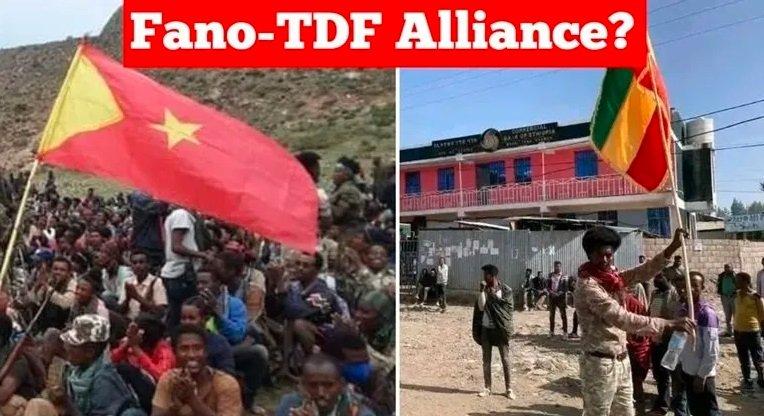
In mid-August, Fano’s chairman, Zemene Kassie, told the Swiss newspaper Le Temps that a broader political and military alignment was taking shape, one that, notably, includes Tigrayan forces alongside Amhara, Oromo and other regional actors who fought each other, or fought the same government from separate and often hostile positions, only a few years ago. Zemene did not present this as a finished project. He described a direction: the establishment of a unified command inside Fano and the pursuit of coordination with other armed and political actors around a shared objective of removing the current government in Addis Ababa.
I raise this not to claim foresight. An argument about coalition-building was always a modest one that fragmented opposition movements which distrust each other still sometimes find reasons to cooperate, because history offers many precedents for exactly that kind of arrangement. What has changed is that the argument now has a live case to test itself against, in real time, inside Ethiopia itself. That is reason enough to look carefully at how comparable coalitions have actually worked elsewhere, not to predict Ethiopia’s future, but to think seriously about the structural problems any such alignment will have to solve.
Afghanistan’s United Front, commonly known as the Northern Alliance, is one of the most instructive cases available. It is not offered here as a model to copy. It is a case study, and in important respects a warning, about what happens when organizations that never resolved their differences make cooperation the price of survival.
Cooperation Without Reconciliation
The Northern Alliance was not born as a unified movement. It was assembled out of organizations that had, in the recent past, fought each other directly. Ahmad Shah Massoud’s Jamiat-i Islami forces and Abdul Rashid Dostum’s Uzbek-based Junbish-i Milli had been on opposite sides during the brutal factional fighting that followed the collapse of the Soviet-backed government in 1992, fighting that helped destroy Kabul, and discredited the mujahideen government in the eyes of many Afghans. Dostum had allied with Gulbuddin Hekmatyar against Massoud at various points; alliances among the post-1992 factions shifted repeatedly and often violently. Hazara forces under Hizb-i Wahdat had their own grievances and their own history of confrontation with rival factions. None of this had been resolved, apologized for, or forgotten by the time these same organizations found themselves needing each other again.
What changed their calculation was not reconciliation. It was the Taliban’s capture of Kabul in September 1996 and its subsequent drive northward. Facing a common force that could defeat them one at a time, Massoud, Dostum and other commanders concluded that continued fighting among themselves served only the Taliban’s interests. The United Front took shape not because its constituent leaders had settled their disputes, but because each of them understood that surviving separately had become harder than surviving together.
This is the central lesson worth extracting for Ethiopia’s Fano, Tigrayan and Oromo actors, whatever the final shape of their alignment turns out to be. A coalition is not a marriage. It is a contract. It does not require affection, shared history, or a common account of who wronged whom. It requires an accurate, shared judgment that the parties are jointly better off cooperating than competing and a way of making that cooperation durable enough to survive the distrust that inevitably remains underneath it.
Strategic Necessity, Not Sentiment
It would be too simple to describe the Northern Alliance merely as an alliance of convenience built on a shared enemy. Coalitions built purely on “the enemy of my enemy” logic tend to dissolve as soon as the enemy’s threat recedes, or as soon as one member calculates it can do better by cutting a separate deal. What sustained the Northern Alliance for several years, imperfectly but genuinely, was something more specific: its constituent groups came to see themselves as jointly defending a plural Afghanistan against a single force that intended to monopolize the country’s political future. The alliance included Tajik, Uzbek, Hazara and, at various points, Pashtun elements, and international human rights monitoring at the time treated it as a coalition rather than a single command.
That distinction matters for Ethiopia. A coalition that defines itself only as “anti-government” is fragile, because removing the government does not by itself answer any of the harder questions that follow. A coalition that can articulate what political space it is jointly protecting, what happens to Fano, Tigrayan, Oromo and other constituencies after the common adversary is gone, has a stronger foundation. The purpose the coalition serves must survive the victory it is fighting for, or the coalition itself will not survive the victory either.
Autonomy as the Price of Cooperation
Perhaps the most technically important feature of the Northern Alliance was what it did not attempt: it never became a unified national army under single command. Massoud remained the dominant military figure and the alliance’s most visible political voice, but Dostum’s Junbish retained its own command structure, its own territorial base in the north, and its own decision-making. Hazara forces, and later Ismail Khan’s forces around Herat, similarly kept their own organizations intact. The coalition coordinated strategy without demanding organizational merger.
This was not a failure of ambition. It was a functional response to the underlying distrust. Had Massoud demanded that Dostum dissolve Junbish and submit to a single chain of command, Dostum would have had every reason to refuse, surrendering command to a former adversary is precisely the kind of exposure that makes cooperation feel more dangerous than standing alone. The alliance instead separated what had to be decided jointly, broad strategic objectives, coordination against the Taliban, a shared political horizon, from what each organization retained control over: its own commanders, its own local governance, its own recruitment and internal structure.
This is a distinction Ethiopian actors would do well to make explicit rather than leave ambiguous. Strategic coordination does not require organizational merger. A coalition of Fano, Tigrayan and Oromo organizations does not need to become a single army to be effective; it needs a clear boundary between coalition-level decisions, external representation, red lines, dispute resolution, a transition framework and organization-level decisions that remain each member’s own business. Leaving that boundary undefined is what eventually produces the corrosive internal question every fragile coalition asks itself: who is really in charge, and who is quietly trying to dominate whom?
The Limits of a Loose Coalition
Autonomy that makes cooperation psychologically possible can, past a certain point, also make coordination impossible. This was the Northern Alliance’s genuine vulnerability, and it is worth being honest about it rather than treating the coalition as a success story to be imitated uncritically. The constituent factions had different foreign patrons with different interests, Iran, Russia, and Central Asian states each supported different parts of the alliance for their own reasons, and Pakistan supported the opposing Taliban government. Coordination among the factions was frequently inconsistent, and the alliance’s military effectiveness before 2001 was real but limited: it held territory and prevented total Taliban consolidation, but it could not, on its own, dislodge the Taliban from power.
The most serious demonstration of this vulnerability came in 1997. Abdul Malik Pahlawan, one of Dostum’s own senior commanders, entered into secret negotiations with the Taliban, reportedly in exchange for a promise of authority over northern Afghanistan, and helped deliver a rival commander, Ismail Khan, to Taliban custody while opening the way for Taliban forces to enter Mazar-i-Sharif in May of that year. Dostum was forced into exile. The arrangement collapsed within days, when the Taliban began disarming Malik’s own fighters in violation of their agreement, triggering an uprising that drove Taliban forces back out of the city at heavy cost to both sides. Malik himself was later defeated and exiled when Dostum returned.
The episode illustrates something coalitions cannot afford to treat as a footnote: an alliance is only as reliable as its weakest internal guarantee against unilateral defection. A coalition must make defection more costly than cooperation, and it must draw a clear line between the organization and any individual commander who might, under pressure or temptation, believe he can cut a better private deal. That requires more than a rule against unauthorized negotiations. It requires that every member has enough representation, information, and confidence in the coalition’s internal fairness that defection stops looking like the rational option. A member who believes the coalition would sacrifice him when convenient has already been given a reason to consider leaving first.
The lesson extends to external sponsorship as well. Foreign support should strengthen a coalition rather than turn its members into competing clients. Where patrons pursue divergent interests through different factions inside the same alliance, external backing becomes a tool for dividing the coalition rather than reinforcing it, a dynamic Ethiopian organizations seeking outside support would be wise to guard against explicitly, through transparency about what any member receives and from whom.
Winning Is Not the Same as Governing
By the time the United States entered the war after September 2001, the Northern Alliance had survived for five years without defeating the Taliban outright. It took American airpower and support to change that calculation decisively: within weeks, Taliban positions collapsed, and Northern Alliance forces entered Kabul in November 2001. But the more important lesson for Ethiopia lies in what happened next, not in the military victory itself.
The coalition that had been good enough to resist was not automatically good enough to govern. The Northern Alliance had built mechanisms adequate for survival and battlefield coordination. It had not built an inclusive mechanism for governing the whole country, and its own constituent commanders did not represent the full range of Afghan political and ethnic constituencies, the Taliban’s own base among southern Pashtuns most conspicuously. That gap is why the fall of the regime required a separate political process. The Bonn Conference, convened in December 2001, brought together the Northern Alliance and other Afghan political figures, but not the defeated Taliban, to negotiate an interim government, precisely because a coalition capable of winning a war was not, by itself, a government capable of claiming legitimacy across the country.
The deeper problem was not confined to who sat at Bonn. In the years that followed, former Northern Alliance commanders retained substantial political and security influence within the new Afghan state, and the entanglement of armed and political authority proved difficult to unwind. Factionalism, regional power centres and armed networks did not disappear simply because a political settlement had been signed; they migrated into the new order rather than being resolved by it.
What Ethiopia Should Settle Before, Not After
This is the point at which the Afghan case becomes most directly useful to Ethiopia, precisely because it identifies problems that are far easier to solve in advance than after a coalition has already succeeded militarily. Fano, Tigrayan and Oromo actors, and any broader alignment among them, do not need to answer these questions today with the government still in place. But an alliance serious about its own future would be wise to start answering them now, rather than discovering the hard way that resistance and governance are different currencies.
What exactly is the coalition’s common political objective, beyond the removal of the current government? What decisions genuinely belong to the coalition as a whole, and what remains under each organization’s own control? Who represents the coalition externally, and who is authorized to negotiate on its behalf? What mechanism resolves disagreements among members without one side needing to appeal to an outside patron to settle the argument? What guarantees do smaller members have against domination by larger ones? And, perhaps most importantly, what happens to armed structures, to commanders and to political organizations once the objective that justified their formation has actually been achieved, can former allies become peaceful political competitors, or does the coalition become a permanent feature of the political order it was meant to transform?
None of these questions implies that the parties distrust each other more than necessary. They imply the opposite: that serious political actors plan for disagreement precisely because they understand it is inevitable. The armed organizations that initiate a transition should not automatically own the political order that follows it. An alliance with an explicit pathway from armed political organization toward political competition under a shared civilian framework is a fundamentally different kind of project than one that simply substitutes new armed powerholders for old ones.
Staying Together Has to Become the Safer Option
The deepest lesson of the Northern Alliance is not really about tactics. It is about what actually makes distrustful actors cooperate in the first place. Massoud did not need to believe Dostum shared his political vision for Afghanistan. Dostum did not need to believe Massoud would always defend Uzbek interests as if they were his own. What both understood, along with the Hazara and other commanders inside the alliance, was a harder and more useful fact: alone, each of them was more vulnerable than together. That calculation, not sentiment, is what coalitions are actually built on.
The practical test for any Ethiopian alignment will not be whether Fano, Tigrayan and Oromo actors come to trust one another, that is not a realistic near-term goal, and pretending otherwise would only set the coalition up for disappointment. The real test is narrower and more achievable: can the coalition make staying inside it safer than leaving it? Can it build institutions, rules for representation, dispute resolution, external relations, and eventual transition, strong enough that no member needs to calculate whether a private deal with the government, or with a foreign patron, might serve it better than the alliance does? The objective is not to manufacture trust where none exists. It is to create institutions in which cooperation becomes rational even among actors who remain distrustful of one another.
Return to the Ethiopian Moment
None of this means Fano and Tigrayan forces have resolved what divided them during the war in the north, any more than Massoud and Dostum resolved what divided them before 1996. It does not mean Oromo organizations now share a common political vision with either. The significance of what Zemene Kassie described to Le Temps is not that former enemies have reconciled. It is that organizations which had been calculating their political futures separately are beginning to calculate that their futures might be safer calculated together.
That is the beginning of coalition politics, not its completion. Afghanistan’s experience suggests the harder work still lies ahead, not in the announcement of alignment, but in whether that alignment can be turned into institutions capable of surviving both victory and the disagreements that will inevitably follow it. History does not offer Ethiopian actors the luxury of reconciliation before cooperation. It offers something more modest and more useful: the chance to study, before events force the lesson on them, how coalitions elsewhere have made distrust survivable, and where they failed to.
The first achievement of a coalition is not that former enemies suddenly trust one another. It is that they discover a way to cooperate despite their distrust. The harder achievement — the one Afghanistan’s factions never fully secured — is making that cooperation durable enough that none of them needs to fear the others again.
Editor’s Note: Views in the article do not necessarily reflect the views of borkena.com
__
Join our Telegram Channel: t.me/borkena
Like borkena on Facebook
To submit a press release, send the submission to info@borkena.com
Add your business to Ethiopian Business Listing / Ethiopian Business Directory
Join the conversation. Follow us on X (formerly Twitter) @zborkena to get the latest Ethiopian news updates regularly.
Sir, you went too far as Afghanistan mountains pushutun area for consequencesal disastrous coalition among bloodthirsty,undemocratic insurgents supported by notorious dictator of Isaiahs Afewerki. What benefit will Ethiopian citizens gian from these coalition except devastation to their livelihood
Very helpful idea for the alliance of Ethiopian Government oppositions. Trust can be built by working together than by trying to eliminate differences to reconcile.