
Fikeru Zewdie
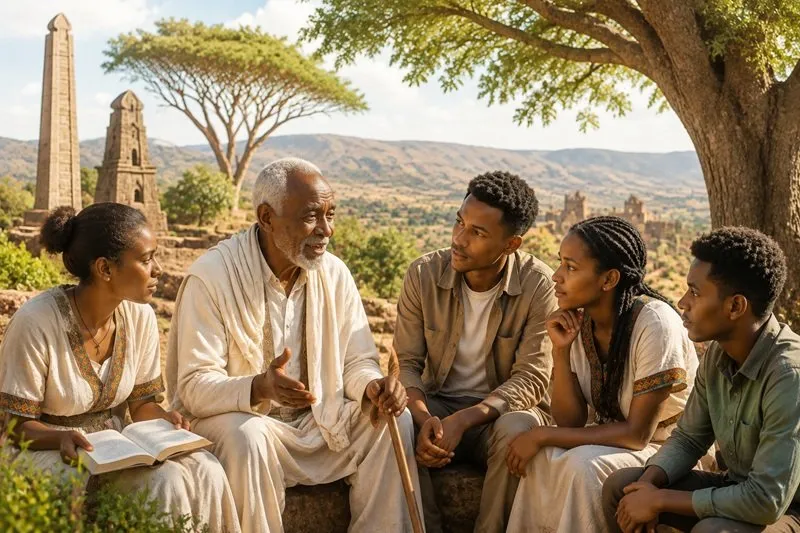
Dawit W. Giorgis’s article, “Why Young People Should Learn from Healthy, Educated, Experienced Elders,” affected me deeply because it addresses more than the question of age. It reveals a painful generational disconnect that has been developing in Ethiopia for nearly half a century.
At the center of this problem are two generations that need one another but increasingly struggle to communicate.
On one side stands an older generation carrying decades of education, professional experience, public service, cultural knowledge, institutional memory, and lessons learned through success and failure. On the other stands a younger generation searching for identity, opportunity, dignity, and a meaningful place in the future of its country.
The tragedy is that the bridge between them has been severely damaged.
For the past forty to fifty years, successive generations of Ethiopians have lived through revolution, political repression, civil war, displacement, ethnic division, institutional breakdown, economic hardship, and mass migration. These forces did more than change governments. They interrupted the natural transmission of knowledge, culture, responsibility, and civic values from one generation to the next.
Young people should not be blamed entirely for this disconnection. Many were raised in circumstances they did not create. Some grew up without stable educational institutions. Others were separated from their cultural inheritance through displacement or migration. Many entered adulthood in an environment where political loyalty was rewarded more consistently than independent thought, professional merit, or public responsibility.
They are not merely a lost generation. In many respects, they are an interrupted generation. Yet interruption does not have to become permanent separation.
Elders possess something that cannot be downloaded, hurried, or manufactured: lived experience. Books can teach principles, but experience reveals consequences. A person who has witnessed governments rise and fall, institutions weaken, communities fracture, and promising ideas produce unintended results carries a form of knowledge that no social-media platform can replicate.
This does not mean every elder is wise or that every old idea should be preserved. Age alone does not guarantee sound judgment. Elders must also remain willing to listen, reconsider their assumptions, admit their mistakes, and understand the world the younger generation is inheriting.
Mentorship cannot be a one-way command. It must be a relationship.
Young people need the memory, perspective, and experience of their elders. Elders need the energy, creativity, technological fluency, and new questions of the young. Neither generation possesses everything necessary to rebuild the nation alone.
The purpose of mentorship is therefore not to make young people replicas of their elders. It is to help them avoid preventable mistakes while giving them the confidence to create something better. Likewise, the responsibility of the young is not to accept every inherited belief without examination. It is to listen seriously, question respectfully, preserve what remains valuable, and improve what no longer serves the country.
Respect must travel in both directions.
A society that silences its elders loses its memory. A society that dismisses its young loses its future. Ethiopia cannot afford either loss.
The country has already paid an enormous price for broken institutions and interrupted relationships. Families have been separated. Communities have been divided. Teachers, professionals, civil servants, writers, artists, and community leaders have been scattered across the world. Much of the knowledge they acquired through decades of service now remains disconnected from the young people who could use it.
This is not simply a cultural concern. It is a national-development problem.
A nation cannot continually lose the knowledge accumulated by each generation and expect the next generation to begin again from nothing. Roads, buildings, and technology may support development, but development also depends upon the transmission of judgment, professional ethics, institutional memory, and civic responsibility.
We therefore need deliberate spaces where generations can meet: mentorship programs, public conversations, professional associations, schools, universities, cultural institutions, community organizations, and digital platforms designed for serious dialogue rather than insult and polarization.
Elders should not wait to be invited before offering guidance, but they must offer it with humility rather than entitlement. Young people should not surrender their independence, but they must recognize that independence without historical understanding can lead a generation to repeat the very failures it believes it has escaped.
The question is not whether the future belongs to the young or whether the past belongs to the old. A nation belongs to every living generation, and each carries a different responsibility.
The elders carry memories.
The young carry possibility.
The work before us is to reconnect them.
Dawit W. Giorgis is right to insist that healthy, educated, and experienced elders should continue to speak, write, advise, and mentor. Their participation should not be treated as interference with the future. Properly understood, it is an investment in that future.
But this responsibility extends beyond elders who have held prominent positions. Ethiopia possesses teachers, farmers, soldiers, civil servants, businesspeople, artists, religious leaders, parents, and ordinary citizens whose experiences contain valuable lessons. Their stories and knowledge should be recorded and shared before they disappear.
Our elders should not be treated as obstacles waiting to be removed. Nor should our young people be condemned as though they chose the historical conditions that shaped them.
Both generations have been wounded by Ethiopia’s long period of fragmentation. Both are needed for its renewal.
A nation cannot build its future by abandoning its memory. And memory cannot serve the nation unless it reaches the generation that must carry the work forward.
The bridge may be damaged, but it has not disappeared. We still have time to rebuild it—if the elders are willing to guide without controlling, and the young are willing to listen without surrendering their right to question.
Ethiopia’s future will not be secured by one generation defeating or dismissing another. It will be secured when experience and possibility finally learn to work together.
Editor’s Note: Views in the article do not necessarily reflect the views of borkena.com
__
Join our Telegram Channel: t.me/borkena
Like borkena on Facebook
To submit a press release, send the submission to info@borkena.com
Add your business to Ethiopian Business Listing / Ethiopian Business Directory
Join the conversation. Follow us on X (formerly Twitter) @zborkena to get the latest Ethiopian news updates regularly.
Axum and Gonder didn’t represent for the major of Ethiopia anytime before
Thank you, Abdisa. My article does not claim that Axum or Gondar represented the majority of Ethiopia. The broader point is that Ethiopia’s national memory—including the contributions and experiences of all its peoples—should not be abandoned. If you would like to elaborate on what you believe has been excluded, I would welcome the discussion.