
Can Ethiopians Enter the Twenty-First Century or Will the Country Retreat into the Sixteenth?
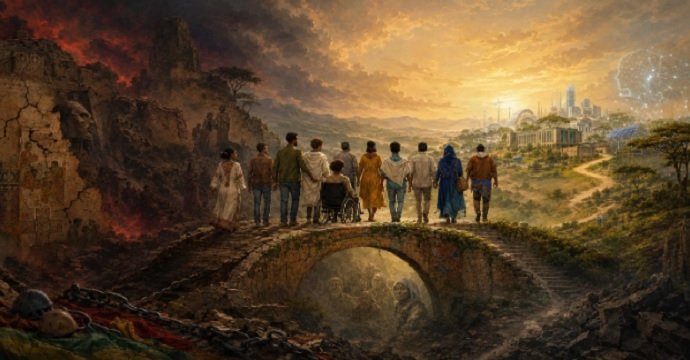
By Ewunetu Teshale
Introduction
Ethiopia has undergone complex and often controversial processes of state formation, territorial integration, resistance, modernisation, revolution, and political restructuring. Yet Ethiopians do not share a common interpretation of this history. Events celebrated by one community as nation-building may be remembered by another as conquest, dispossession or cultural domination. Leaders regarded by some as national heroes may be viewed by others as agents of oppression.
These disagreements partly reflect the perspectives from which Ethiopian history has been written. European and Arab travellers, diplomats, missionaries and scholars interpreted Ethiopia through the political, religious and intellectual frameworks of their societies. Ethiopian chroniclers and Orthodox Christian scholars often wrote within institutions connected to the Church, the monarchy or the state. Later Ethiopian academics were influenced by changing ideological environments, including nationalism, Marxism, ethnonationalism, postcolonialism and the priorities of international scholarship.
This does not mean that every historian was dishonest or deliberately serving a hidden interest. Rather, it reminds us that no historical account is entirely free from context, institutional influence or human perspective. Political authority, religious affiliation, funding, language, access to archives and the identity of the writer can influence which events are recorded, whose experiences are recognised and how the past is interpreted.
The central problem is therefore not that Ethiopia has different historical narratives. Every diverse society does. The deeper problem is that history is increasingly being used as a political weapon—with the living prosecuted for the actions of the dead.
A Nation Imprisoned by Competing Memories
Ethiopia’s history contains extraordinary achievements: ancient statehood, resistance to colonial occupation, religious civilisation, diplomatic continuity and the preservation of political independence. It also contains warfare, coercive incorporation, exclusion, land dispossession, cultural suppression, authoritarian rule, revolution and recurring violence.
A mature society should be able to acknowledge both sides of its history. National pride should not require denying the suffering of communities. Likewise, recognising historical injustice should not require rejecting every shared national achievement.
Yet public debate frequently demands unconditional allegiance to one interpretation. People are expected to choose among Ethiopia and its nations, unity and identity, and national continuity and historical justice. Each camp presents its memory as complete and treats competing memories as betrayal.
Under such conditions, history ceases to be a source of knowledge. It becomes evidence in a permanent political trial in which every generation is summoned to answer charges originating centuries before its birth.
Ethiopianists and Nation-Nationalists
The political conflict between Ethiopian nationalism and ethnonationalism reflects two competing fears.
Many Ethiopianists fear that strong ethnonationalism will fragment the country, weaken common citizenship and eventually transform administrative boundaries into international borders. Many nation-nationalists fear that calls for Ethiopian unity will restore political centralisation, cultural domination and the denial of historically marginalised identities.
Neither fear is entirely imaginary. Ethiopia’s political history gives both sides reasons for anxiety. The problem is that each camp often recognises only its own wounds while questioning or dismissing the wounds remembered by others.
The solution cannot be to declare one identity legitimate and the other illegitimate. Ethiopia needs a political settlement in which people can belong fully to their cultural communities and fully to their country. National identity and Ethiopian citizenship should reinforce each other rather than cancel each other out.
A person should not be forced to choose between being Oromo, Amhara, Tigrayan, Somali, Afar, Sidama, Gurage, Wolayta or another identity and being Ethiopian. A stable Ethiopia must provide political and psychological space for both.
State Structure and Federalism
Federalism was introduced to recognise Ethiopia’s diversity, address historical inequality and decentralise political power. Nevertheless, its form and implementation remain among the country’s most controversial political questions.
Supporters regard multinational or ethnic federalism as protection against central domination. Critics argue that organising political administration and competition mainly around ethnicity institutionalises division, generates territorial and identity disputes, and encourages political elites to mobilise communities through fear.
The discussion should not be reduced to a choice between centralisation and disintegration. Ethiopia can examine different possibilities: improved multinational federalism, territorial federalism, a carefully designed hybrid system, stronger local government and meaningful constitutional protection for minorities living within every regional state.
No constitutional arrangement should be treated as sacred or permanently untouchable. A federal system should be evaluated by whether it protects citizens, distributes power fairly, resolves disagreements peacefully and enables diverse communities to build a common future.
When Violence Becomes a Political Language
Ethiopia’s unresolved historical wounds repeatedly reappear in contemporary conflicts. Armed confrontations, displacement, ethnic targeting and retaliatory narratives demonstrate how easily painful memories can be converted into political mobilisation.
Political actors sometimes present current violence as repayment for historical injustice. But inherited suffering cannot justify creating new victims. A child living today cannot be held personally responsible for an emperor, regional ruler, army or political movement that acted before that child was born.
Every cycle of retaliation creates fresh grievances. Today’s avenger becomes tomorrow’s historical oppressor. The person who believes that violence will correct an old injustice may be creating the next generation’s justification for revenge.
Unless this cycle is deliberately interrupted, Ethiopia will continue producing the very trauma it claims to be correcting.
Disagreement Without Dialogue
The same division appears even in peaceful meetings. Conferences, community discussions, academic debates, political negotiations and social-media exchanges frequently become contests of accusation. Participants often enter discussions not to understand one another but to defend predetermined historical verdicts.
Dialogue becomes impossible when acknowledging another community’s suffering is interpreted as surrender. Yet recognition is not surrender. Two communities may remember the same event differently, and both memories may contain genuine experiences of dignity, humiliation, achievement or loss.
Ethiopia needs spaces where historical claims can be examined through evidence, archives, oral histories, multiple languages and comparative scholarship. The objective should not be to impose a single authorised narrative. It should be to develop a shared ethical principle:
No community’s dignity requires the erasure of another community’s memory.
Ethiopians must learn to disagree without dehumanising one another. Political disagreement should not automatically turn neighbours into enemies or citizens into suspected agents of another group.
The Future of Ethiopian Youth
The greatest victims of Ethiopia’s historical imprisonment are its young people. They inherit unemployment, weak institutions, displacement, insecurity and limited economic opportunities. They are then handed centuries of unresolved grievances and encouraged to defend them as their primary political inheritance.
The tragedy is even deeper: Ethiopian youth are not only debating past conflicts—they are repeatedly being sent to the front lines of present internal wars.
Young people who should be attending universities, developing businesses, learning technologies, building families and contributing to national development are recruited, mobilised or pressured into armed conflicts against other Ethiopian youth. They confront one another on battlefields, often without having personally created the political disagreements for which they are asked to fight.
On one side of an internal war stands a young Ethiopian. On the other side stands another Ethiopian young person. Both may come from struggling families. Both may have mothers waiting for them. Both may have ambitions that extend far beyond the battlefield. Yet they are turned into enemies by political disputes, inherited grievances and the failure of leaders to resolve disagreements peacefully.
Those killed are not merely statistics. They are students who will never graduate, entrepreneurs who will never establish businesses, farmers who will never cultivate their land, professionals who will never serve their communities, and parents whose children may grow up without them. Every young life lost also represents knowledge, labour, creativity and national potential that Ethiopia can never recover.
Even those who survive may return with physical injuries, psychological trauma, interrupted education and limited prospects. Families carry grief, communities inherit resentment, and the country creates another generation whose memories can be mobilised in future conflicts.
At the same time, young people elsewhere are studying artificial intelligence, biotechnology, renewable energy, robotics, advanced manufacturing and digital entrepreneurship. They are building companies, developing new technologies and preparing their societies for the future. Ethiopian youth are equally intelligent and capable, but far too many are diverted into arguments and wars over boundaries, identities, rulers and battles that began long before they were born.
History must be studied, but it should educate the young rather than conscript them. Ethiopia’s youth deserve an inheritance of knowledge, opportunity and citizenship, not an obligation to continue unfinished wars.
Who Will Heal and Deliver Ethiopia?
Ethiopia should not wait for one heroic deliverer. The expectation that a single leader will rescue the country has repeatedly produced disappointment and encouraged the concentration of power. Healing requires institutions, responsible leadership and a new civic culture, not another political messiah.
The deliverer must therefore be collective:
- Historians who distinguish evidence from political mobilisation
- Religious leaders who preach reconciliation rather than hostility
- Political leaders who refuse to profit from ethnic or communal fear
- Teachers who present multiple historical perspectives responsibly
- Media institutions that do not commercialise hatred
- Courts that protect individuals rather than punish communities
- Security institutions that serve citizens rather than political factions
- Citizens who can recognise another community’s suffering without abandoning their own identity
- Young Ethiopians who refuse to inherit hatred as their destiny
Ethiopia may also need an independent truth, memory and reconciliation process. Such a process should document suffering across different historical and political periods without becoming a tribunal organised by one group against another. Its purposes should be recognition, accountability, institutional reform, healing and the prevention of future violence.
Healing does not mean forgetting. Reconciliation does not mean denying injustice. It means remembering in a way that prevents repetition instead of preparing the next retaliation.
From the Sixteenth Century to the Twenty-First
The world is already deep into the twenty-first century. Artificial intelligence is transforming employment, education and production. Digital trade, climate change, regional integration, renewable energy and technological competition are reshaping the prospects of nations.
Ethiopia cannot participate effectively in this world while conducting its politics through unresolved arguments inherited from the sixteenth, nineteenth and twentieth centuries.
The question is not whether Ethiopians should forget history. Forgetting would be neither possible nor desirable. The real question is whether they can remember their history without becoming its prisoners.
Before Ethiopia can compete successfully in the twenty-first century, it may first need to develop the political habits that many societies struggled to establish during the twentieth: constitutional citizenship, institutional accountability, peaceful transfer of power, respect for difference and the capacity to disagree without violence.
Who, then, will deliver Ethiopia into the twentieth century and prepare it for the twenty-first?
No emperor, revolutionary, prime minister, political party or opposition leader can accomplish this alone. Ethiopia will begin to heal when its citizens stop searching for a saviour and start building institutions that do not require one.
The decisive choice is not between Ethiopia and its nations. It is between a future built together and a past repeatedly weaponised against one another.
Ethiopia’s young people should no longer be sent to fight wars inherited from history. They should be equipped to fight poverty, ignorance, technological backwardness and hopelessness.
That would be the beginning of Ethiopia’s true deliverance.
Editor’s Note: Views in the article do not necessarily reflect the views of borkena.com
__
Join our Telegram Channel: t.me/borkena
Like borkena on Facebook
To submit a press release, send the submission to info@borkena.com
Add your business to Ethiopian Business Listing / Ethiopian Business Directory
Join the conversation. Follow us on X (formerly Twitter) @zborkena to get the latest Ethiopian news updates regularly.
Dear Ewunetu:
You have mentioned historical conflicts as a possible cause for the mess we are in today. I would like to ask you to mention a country that has achieved its current form without military pressure from some leader in the past. Italy, Germany, Japan and USA have their current boundaries and unity through civil wars in the 19th. century. So is the case for today’s Ethiopia.
Ab Lincoln, Bismarck and other unifiers are honored by their respective nations, including those that were most damaged by the civil wars. Menilik did what all others elsewhere did to restore the 15th. century boundaries of the Empire, but even his modest palace is resented by the very beneficiaries of his extraordinarily modern and benevolent leadership in spite of the fact he had done so much for them and for the country.
Menilik constructed the railway from Djibouti to Addis and the principal beneficiaries were the coffee growing regions who are, today, in the forefront of Menilik’s condemnation and vilification; he instituted a modern administration, ensured respect for rule of law through good leadership, introduced electricity, modern roads, piped water, telephones and postal services, established schools and hospitals, abolished slavery which was widely practiced, mainly by traditional leaders, and controlled the excesses of local feudal lords; he also succeeded in defending Ethiopia from Imperialism through his foresight and huge popularity that helped to mobilize all regions of the country with a simple call to come to his help in defending the motherland. Lack of recognition for Menilik extends to almost all other leaders in our history.
Menilik and all other leaders of the royal line have done their level best to give us a country as wide, rich and historic as that of the 1960s. They had no education to build a modern Ethiopia, but we ought to be grateful to them for our rich fertile land, proud heritage and independence from colonial incursion that never spared the rest of Africa in the 19th century. I know it is almost futile to tell this to the youth.
Today, we have Professors and Doctors in many areas of specialisation, and these are also products of our self-educated leaders of the 1960s and earlier, but what we have achieved so far under our elite is famine, poverty, civil war, and wide-spread displacement within Ethiopia and extensive out-migration to all parts of the world. Cleary, the performance of our elite over the last 50 years has been a total disgrace.
Ewunetu, our elite are at the core of our national misery. Like the South Africans of the 1980s, our delivery from the current mess must come from us alone, if we still claim we are as human as the South Africans, with some natural sense from God. The critical elements that are missing are (i) an elected leadership of the caliber of Emperor Menilik or Nelson Mandela, and (ii) a genuinely democratic constitution for a republican government, and (iii) a non-selfish elite with some sense to meaningfully participate in a democratic political system.
Your raised the fundamental elements to uplift Ethiopia from 15th to 20th century eventhough we are in 21th . What a tragedy for Ethiopian’s youth born in 21st century but dragged on and suffering from curse of 15th century by its own blood enterpnorors elites of many stripes .