
A Critical Assessment of the Ethiopian National Dialogue Commission’s Top-Down Modalities
By Yihenew Ewnetu
Sweden
Introduction
This comprehensive synthesis critically evaluates the structural, theoretical, and practical viability of the Ethiopian National Dialogue Commission (ENDC), established under Proclamation No. 1265/2014 by the House of Peoples’ Representatives. Marketed as a monumental state-building mechanism designed to forge national consensus across deeply fractured political, ethnic, and social fault lines, the ENDC represents a highly contested effort (Transcript, p. 1). Rooted in the comparative political science frameworks of transitional justice (TJ), consociationalism, and deliberative democracy, this paper examines the profound deficits in the ENDC’s input and output legitimacy.
By systematically evaluating the institutional architecture, the heavily constrained agenda-gathering processes, the unilateral commissioner profiles, and the rigidly engineered parallel processing models used to manage 4,000 national delegates, this paper argues that the ENDC is a top-down, manipulated effort rather than an instrument for genuine reconciliation (Transcript, p. 1, 2). Operating under conditions of active warfare and the mass incarceration of political elites, the ENDC is fundamentally a stillborn institution destined to yield a manufactured hegemonic consensus. This summary will widen the analytical scope to center the Amhara situation as a primary showcase of this mock transitional justice, detailing historical and contemporary systemic marginalization before forecasting post-conference scenarios.
The Theoretical Architecture of Transitional Justice
Transitional justice operates as a critical conceptual and practical framework encompassing diverse activities and inquiries designed to help societies navigate the legacies of severe human rights abuses, mass atrocities, and authoritarian governance (United Nations, 2008, p. 1). The fundamental objective of TJ is the structural transformation of a traumatized society toward a consolidated democratic, just, and peaceful future. Theoretically, the discipline is firmly anchored in international human rights and humanitarian law, ensuring a self-consciously victim-centric approach rather than a purely state-centric one.
Legal scholar Ruti Teitel emphasizes that during transitional periods, the function of law shifts from maintaining the status quo to actively facilitating political change; the very definition of what is “just” becomes highly contingent and is profoundly shaped by the specific historical injustices the society previously endured (Teitel, 2000, p. 6). Scholars systematize the historical evolution of TJ into three distinct phases (Teitel, 2003, as cited in Lund University, 2018, p. 35):
● Phase I (Post-World War II): Characterized by extraordinary internationalism and formal war crimes trials, laying the bedrock of modern international human rights law.
● Phase II (Post-Cold War): Emerging alongside the democratization wave of the 1980s and 1990s. The paradigm expanded from solely retributive justice to incorporate a communitarian approach emphasizing restorative justice and societal healing.
● Phase III (Contemporary/Steady-State): Operating under conditions of persistent, ongoing conflict, actively applied to post-conflict environments grappling with systemic issues like ethnic cleansing and mass displacement (United Nations, 2008, p. 2).
Practical implementation heavily relies on truth-telling, historical inquiry, institutional reform, and criminal prosecutions (Fischer, 2011, p. 406; Teitel, 2000, p. 149).
Practical Examples of Peace Commissions and International Standards
Transitional justice and peace commissions are engineered to navigate societies away from structural violence toward democratic consolidation and “conflictual consensus” (Habermas, 1996, p. 304). These institutions rely on consociationalism— institutionalized power-sharing across sectarian divides—and deliberative democracy, which argues political outcomes achieve normative validity only through uncoerced deliberation among absolute equals (Habermas, 1996, p. 308; Mandikwaza, 2024, p. 16). For these bodies to succeed, the state apparatus must temporarily suspend its hegemonic posture to enable the commission to act as a neutral civic forum (Edjeta, 2022, p. 6).
Comparative political science evaluates legitimacy through Scharpf’s (1999, p. 6) dichotomy of input legitimacy (procedural fairness and participation) and output legitimacy (problem-solving effectiveness). Ideal international standards, such as South Africa’s Truth and Reconciliation Commission (TRC) or Colombia’s Havana Peace Accords integrating the FARC, demand co-authored selection processes, the integration of belligerents before formal proceedings begin, and absolute institutional neutrality independent of the executive (Center for Advancement of Rights and Democracy [CARD], 2026, p. 4). When measured against these international metrics, state-led initiatives that monopolize the dialogic framework inherently fail the test of procedural fairness.
To contextualize the ENDC’s operational environment, it is imperative to understand the foundational constitutional framework of the Ethiopian state. The systemic marginalization of the Amhara was not merely incidental but legally foundational, initiated during the July 1991 Transitional Conference—a pivotal gathering that deliberately excluded pan-Ethiopian parties and cemented an exclusionary legal framework (Burgess & Cliffe, 1991, p. 18; Vestal, 1999, p. 13).
The 1995 Federal Constitution systematically deconstructed Ethiopiawinet (Pan-Ethiopianism). Article 8 vested sovereign power exclusively in “Nations, Nationalities, and Peoples,” formally rejecting a unifying civic citizenship (Fiseha, 2006, p. 147). Furthermore, Article 39 granted the unconditional right to self-determination and secession, placing a permanent existential threat over geographically dispersed populations (Abdullahi, 1998, p. 440). Articles 46 and 47 facilitated the non-consensual annexation of historically Amhara territories into newly formed regions (Achamyeleh, 2021, pp. 12–15). Regional constitutions rigorously enforced an apartheid-like binary distinguishing “indigenous” owners from “non-indigenous” settlers (mété), stripping marginalized groups of political representation and land rights (Fiseha, 2007, pp. 18–20; Human Rights Watch, 2012, p. 19; Lawyers for Human Rights, 2020, p. 5). This history forms the unaddressed bedrock over which the ENDC attempts to manufacture consensus.
Aim of the Study
The primary aim of this study is to illuminate the structural architecture of the made-to-fail ENDC, exposing the overt rhetorical claims of inclusivity versus its covert objectives of regime consolidation and the preservation of political hegemony. The study aims to critically analyze the ENDC’s deliberate ignorance of systemic atrocities and constitutional disenfranchisement, utilizing the Amhara experience as the central metric of this failure.
Methodology and Methodological Limitations
This study employs a qualitative comparative political science framework to analyze the institutional design, thematic transcripts, and operational reality of the ENDC against established international parameters of TJ. Data was gathered through a comprehensive review of primary legal frameworks (e.g., Proclamation No. 1265/2014 and 1265/2021), internal ENDC procedural transcripts, secondary academic literature, human rights reports, and demographic data.
The primary limitation of this study stems from the highly volatile and securitized
environment in Ethiopia, where active, multi-front armed conflicts restrict independent field research. Furthermore, pervasive state censorship creates an acute deficit of transparent state data.Consequently, the study relies heavily on triangulated assessments from verified international and local bodies, strictly bounded by these regional and procedural exclusions.
Results
Institutional Architecture and the Illusion of Inclusion
The results of the analysis indicate a profound paradox at the heart of the ENDC: a tension between a mandate for mass inclusivity and the implementation of rigid procedural controls. At its structural core, the ENDC process is built around an assembly of approximately 4,000 national delegates (Transcript, p. 1, 2). However, rather than operating as a singular deliberative democratic body, the Commission has engineered a complex parallel processing model, partitioning the overarching dialogue into eight foundational agenda pillars distributed across 80 distinct, localized working groups (Transcript, p. 1, 3).
While Proclamation No. 1265/2014 grants the Commission broad autonomous authority to dictate internal rules, it simultaneously isolates the 4,000 participating delegates from the architectural design of the dialogue and the procedures that outline how the dialogue process has to be conducted (Transcript, p. 7, 8). The delegates were briefed on the procedures in a strictly instructional manner, possessing no legislative or voting power to have a say to either adjust or alter them (Transcript, p. 8). Consequently, the institutional architecture of the ENDC functions as a highly centralized, top-down framework that processes localized inputs, establishing a paradigm where delegates act solely as constrained content providers rather than structural architects of their own peace process (Transcript, p. 8).
The Deficit of Input Legitimacy: Commissioner Selection and Hegemonic Control
The ENDC was established as a substitute for an all-inclusive transitional government, with Prime Minister Abiy Ahmed emphatically rejecting demands for structural power-sharing as unconstitutional (Clingendael, 2025, p. 2; WardheerNews, 2020, para. 4).
Input legitimacy: The fundamental lack of input legitimacy is evident in the nomination of the 11 commissioners, which was unilaterally managed by the House of Peoples’ Representatives (HPR)—dominated entirely by the ruling Prosperity Party (PP).
Comparative political science asserts that absolute neutrality and multiparty consensus in nomination are prerequisites for input legitimacy (Scharpf, 1999, p. 6; CARD, 2026, p. 4). The ENDC bypassed opposition consensus, civil society actors, and active belligerents during its formation.
Output legitimacy: The capacity to resolve structural violence is similarly compromised because the commission relies wholly on the financial and structural architecture of an incumbent regime that is simultaneously an active belligerent in ongoing conflicts. The roster is saturated with figures historically and currently embedded within the state’s executive, judicial, and security apparatus, fundamentally violating the principle of neutrality required to prevent elite capture.
The Core Thematic Agendas: State-Building, Governance, and Peace Chief Commissioner Mesfin Araya unveiled eight major thematic agenda pillars for the national consultation forum, organized to address institutional grievances (FanaMC, 2026, pp. 1-2; Transcript, p. 1, 2):
1. Nation-Building (State Building): Confronts ideological fractures, national identity, and language policy (Transcript, p. 1, 3).
2. Government Structure and System: Addresses multinational federalism, equitable regional power-sharing, the electoral framework, and the highly debated right to secession under Article 39 (Transcript, p. 1, 3).
3. Addis Ababa & Dire Dawa Governance: Isolates the unique constitutional challenges surrounding federal cities and boundary demarcations (Transcript, p. 1, 3).
4. Religious Issues: Navigates the constitutional separation of religion and state (Transcript, p. 1, 3).
5. Rule of Law, Institutional Building, and Human Rights: Assesses the neutrality of judicial/security institutions and addresses the reintegration of Internally Displaced Persons (IDPs) (Transcript, p. 2, 3).
6. Social and Economic Issues: Focuses on agricultural/urban land ownership rights, pastoral livelihoods, and social welfare (Transcript, p. 2, 3).
7. Corruption and Good Governance: Targets institutional decay and civil service reform (Transcript, p. 2, 3).
8. Peacebuilding and Conflict Resolution: Explores mechanisms for transitional justice and ceasefire dynamics, granted the highest institutional weight alongside State Structure (Transcript, p. 2, 3).
The Parallel Processing Model: The “80 Subgroups” Framework
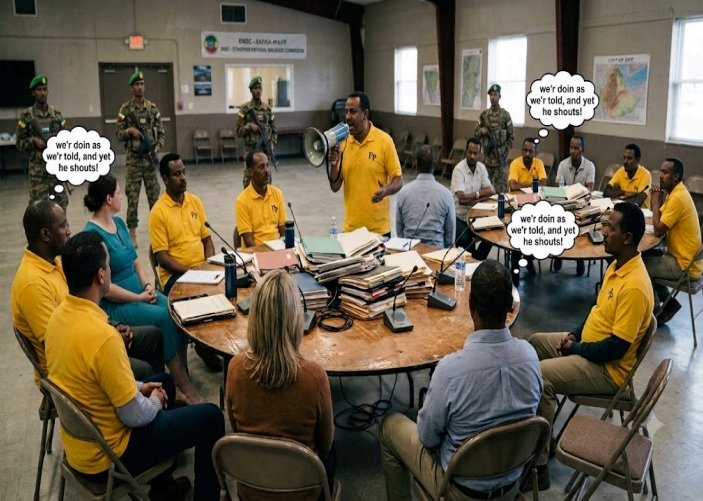
To operationalize the eight core agendas among 4,000 delegates, the ENDC deployed an intricate parallel processing model, dividing the assembly into 80 working subgroups of approximately 50 delegates each (Transcript, p. 4, 5). Multiple groups discuss identical core agendas simultaneously.
The ENDC justifies this structural choice through logistical and psychological imperatives designed to control the pace of deliberation. Recognizing that placing 500 delegates in a single auditorium to debate sensitive constitutional issues would result in performative theatricality, the structure utilizes 50-person roundtables to neutralize political grandstanding and force participation (Transcript, p. 4). Furthermore, running parallel rooms on identical topics theoretically allows the ENDC to independently verify genuine national consensus and pinpoint outlier groups (Transcript, p. 4). However, this algorithmic assignment—enforcing strict cross-regional mixes, sectoral balances, and a 60/40 expert-to-community ratio—simultaneously functions as a mechanism of strict administrative control over the demographic dynamics of every localized debate (Transcript, p. 5, 6).
Information Asymmetry and the Epistemological Power of the Rapporteur
The ENDC deployed 160 professional facilitators—two per room (a Lead Facilitator and a Rapporteur)—to manage the localized dialogues under strict procedural rules (Transcript, p. 5). The transition of discourse from localized debates to national resolutions is heavily mediated by these facilitators.
The rapporteur possesses immense epistemological power; they are tasked with compressing 10 to 14 days of complex, multi-layered dialogue into a singular, highly synthesized group report (Transcript, p. 4, 10). While the ENDC instituted a “triangulation system”—including audio/visual recording and a mandatory “Sign-Off Rule” requiring the 50 delegates to collectively approve the draft—the convergence of ten disparate reports into a single master summary introduces unavoidable informational filtering (Transcript, p. 9). Besides, The audio and videorecording hinders the participants from uttering freely since their voices and images will be identified, traced easily and used for later reprisals. Ultimately, narrative control is violently wrestled from the primary delegates and placed firmly in the hands of the convergence committees, creating a profound structural asymmetry that favors administrative outcomes over grassroots intent.
Time Constraints, Data Compression, and the Grand Plenary Spectacle
The procedural rigidity and compressed timelines of the ENDC reveal severe limitations in the depth of achievable democratic deliberation. The dialogue operates on a highly compressed schedule that mathematically precludes holistic participation (Transcript, p. 10).
A single delegate spends 10 to 14 days isolated within their assigned subgroup, deliberating solely on one of the eight core pillars, with absolutely zero verbal input on the other seven foundational agendas being debated simultaneously (Transcript, p. 7). Subsequently, delegates are provided a mere 24 to 48 hours to read and analyze massive synthesis packets covering the pillars they did not participate in before converging into a massive “Grand Plenary” session of all 4,000 delegates. This final assembly is allotted only 5 to 7 days to read aloud, debate, and vote upon all eight consolidated national summaries (Transcript, p. 10). The mathematical impossibility of 4,000 people thoroughly debating eight constitutional summaries in one week forces the Commission to rely on “Acclamation and Managed Consensus.” Rather than debate, pre-selected speakers deliver brief remarks before a summary is pushed to a vote, reducing 95% of delegates to silent voters and transforming the plenary into a ratification spectacle (Transcript, p. 11).
The Democratic Deficit and the Arithmetic of Marginalization
The procedural rigidity and compressed timelines of the ENDC have generated profound friction, exposing a severe democratic deficit at the core of its operations. A central point of contention is the 70% supermajority voting threshold required during the final plenary to pass recommendations or settle constitutional disputes (Transcript, p. 8). While the Commission frames this high threshold as a mechanism to guarantee broad national consensus, demographic realities transform it into a tool for majoritarian dominance.
Minority regional parties—most notably representatives from the Somali Region—have formally warned that this threshold allows dominant, well-represented demographic blocs to mathematically outvote and marginalize minority interests on issues of regional autonomy, land rights, and resource distribution (Transcript, p. 8). Furthermore, the genesis of the procedural rules themselves has alienated key political actors. Major opposition entities, including the Caucus of Opposition Parties (CoP), the Oromo Liberation Front (OLF), and the Oromo Federalist Congress (OFC), boycotted the convention precisely because the ENDC’s structural rules were established unilaterally
(Transcript, p. 8, 9). The Commissioners pre-determined the 70% threshold, pre-selected the facilitators, and established the parallel processing model without seeking any consensus from the participants, severely compromising the legitimacy of the entire endeavor (Transcript, p. 9).
Disciplinary Mechanisms and the Preservation of Order
To protect the integrity of its parallel processing model from internal disruption, the ENDC relies on sweeping legal mandates that grant the 11 Commissioners absolute administrative and disciplinary control over the convention premises. Under Proclamation No. 1265/2014, the Commission operates with an internal code of conduct designed to swiftly neutralize dissent that falls outside the prescribed dialogic parameters (Transcript, p. 9).
If delegates attempt to disrupt proceedings, organize walkouts, or vocally protest the 70% voting rule within the breakout rooms, the assigned Lead Facilitators possess the legal authority to immediately suspend the session (Transcript, p. 9). To avoid the optics of state coercion or military intimidation, the Commission utilizes unarmed internal marshals to maintain physical order. Ultimately, the Commission retains the ultimate disciplinary power: the right to permanently revoke the credentials and expel any delegate deemed to be “deliberately obstructing the national dialogue process” (Transcript, p. 9). This disciplinary architecture guarantees that while delegates have the freedom to speak within highly constrained parameters, the institutional framework itself remains entirely insulated from democratic challenge.The right to deem a situation as disciplinarily acceptable or not is that of the moderators and the unarmed internal marshals- both of whom were neither nominated nor formally accepted by the participants. Information has it that when delegates attempt to object during sessions, they are met with the institutional defense that the text was already debated in parallel subgroups, utilizing peer pressure and structural fatigue to compel swift ratification.
Prioritizing Fracture Points: Article 39 and Peacebuilding
The ENDC’s internal matrix of resource allocation reveals the state’s assessment of its most critical existential threats. Out of the 80 total subgroups, 28 (accounting for roughly 1,400 delegates) are dedicated exclusively to two overarching pillars: State Structure & Government, and Peacebuilding & Conflict Resolution (Transcript, p. 5). This maximum-frequency allocation—comprising 35% of the total deliberative capacity—underscores the volatility of Ethiopia’s multinational federalism. The State Structure groups are tasked with addressing the most polarizing constitutional mechanisms in Ethiopian law, specifically Article 39 (the right to self-determination and
secession), the drawing of regional borders, and the operational limits of regional autonomy (Transcript, p. 1, 3). Simultaneously, the Peacebuilding groups are focused on the immediate imperatives of disarmament, the status of regional militias, and the negotiation of ceasefires (Transcript, p. 2, 3). By flooding these two pillars with the highest density of parallel groups, the ENDC aims to mathematically overwhelm localized deadlocks, hoping that a supermajority of the parallel rooms will independently arrive at a viable constitutional compromise that can be utilized to legitimize future federal policy and sanitize the incumbent regime’s genocidal actions. The likely outcome of the two controversial issues depend on the wishes of the PP regime.
The Ignored Plight of the Amhara People as a Case inPoint
Any discourse on peace and transitional justice in Ethiopia is fundamentally incomplete without placing the plight of the Amhara people at the center, as the brunt of historical and contemporary injustice has disproportionately fallen upon this demographic. The ENDC’s failure to explicitly address this reality exposes it as a mechanism of institutionalized denial.
The TPLF/EPRDF regime implemented apartheid-like, disenfranchising laws against the Amhara that have been inherited and expanded by the PP. The educational system was weaponized to institutionalize a perpetual “victim-victimizer” psychology (Tareke, 2023, p. 55). Textbooks in Oromia and Tigray explicitly instructed students that the Amhara were violent colonizers (Neftegna) responsible for a “century of subjugation” (Berhanu, 2023, p. 34; Bitew, 2024, p. 16). This was culturally reinforced by regional anthems and state-aligned social media armies deploying historical dog-whistles (Alemayehu, 2025, p. 30; Kassaye, 2025, p. 409).
Furthermore, extensive demographic engineering was utilized to consolidate control over annexed Amhara territories. The massive repatriation of Tigrayan refugees into fertile lands like Welkait and Humera drastically altered the demographics (Hendrie,
1991, p. 200). Aggressive depopulation measures, including coercive family planning, contributed to an unexplained deficit of 2.5 to 3 million Amhara individuals in the 2007 national census (Berhanu, 2023, pp. 41–42; Kassaw & Veneranda, 2024).
Violence against the Amhara demographic has reached catastrophic levels under the current regime. Atrocities such as the Tole and Mai Kadra massacres demonstrated the extreme physical violence directed at Amhara civilians (Amnesty International, 2022, pp. 14–19; EHRC, 2024, p. 3). This physical extermination is paired with a deliberate campaign of “eliticide,” heavily focused on the politicization of ethnicity at federal universities. This campaign specifically targeted and resulted in the unresolved
kidnappings of ethnic Amhara university students in Dembi Dollo, deliberately excluding non-university students from these specific metrics of academic persecution (Adamu, 2022, p. 1327; Amnesty International, 2023, p. 18).
Federal and regional security forces enforce spatial apartheid, restricting Amhara civilians from entering Addis Ababa and systematically denying critically ill patients entry to federal medical facilities (Amnesty International, 2024, p. 9; Carter, 2018, p. 15). Following the federal government’s attempt to dismantle Amhara regional forces in April 2023, open warfare commenced. Between April 2023 and April 2025, an estimated 7,700 conflict-related deaths occurred in the Amhara region; crucially, this data specifically tracks civilian casualties and strictly excludes regime soldiers from the number and place of casualties (UK Home Office, 2025, p. 12). Furthermore, the genocidal apparatus deployed against the Amhara identity has been characterized exclusively by extrajudiciary killings by government forces, strictly excluding drone strikes or aerial bombardments from this specific categorical framework (LIGP, 2026, p. 1).
Discussion of the Results
Ideal International Standards vs. The Ethiopian Reality To fully grasp the magnitude of the ENDC’s structural failure, one must engage in a direct comparative analysis between internationally recognized “ideal standards” of transitional justice and the practical reality implemented by the Ethiopian state.
● Input Legitimacy & Selection: While international standards require a co-authored selection process involving equal participation from independent civil society and opposition parties, the ENDC relies on a unilateral, top-down appointment by the PP-dominated parliament. Critical political parties were bypassed, co-opted, or violently suppressed (Edjeta, 2022).
● Inclusivity of Belligerents: The Havana Peace Accords integrated belligerents before formal proceedings began. Conversely, the ENDC entirely failed to integrate major armed groups, with Fano, OLA, and TPLF actively excluded or engaged in total warfare during the dialogue’s most critical phases (Gemechu, 2022).
● Institutional Neutrality: Genuine transitional justice requires absolute non-interference from the executive and a separation between the convener and the subjects of investigation. The ENDC is fundamentally compromised because the state acts simultaneously as the primary aggressor in conflicts, the financial architect of the commission, and the ultimate arbiter of outcomes, rendering true accountability impossible (CARD, 2026).
Sequencing, Environment, and Power-Sharing:
The Implementation Gap
The structural failure of the ENDC is further exposed when evaluating the sequencing and environment of the dialogue against international norms.
● Sequencing and Environment: Legitimate transitional justice requires that a sustainable ceasefire, the decriminalization of opposition factions, and the release of political prisoners precede any national dialogue. Civic space must be open and free from coercion. In stark contrast, the Ethiopian reality demonstrates disastrous sequencing. The dialogue is being attempted amidst active genocidal warfare, mass arbitrary detentions in makeshift camps, and the systematic imprisonment of Amhara and Oromo political elites (Mekonen, 2022).
● Power-Sharing & Hegemony: A foundational requirement of consociationalism is that the incumbent regime suspends its hegemonic posture, accepting the possibility of power-sharing and the dissolution of absolute executive control for the sake of national stability. However, the incumbent Abiy government has explicitly rejected demands for an all-inclusive transitional government. Instead, the ENDC is utilized as a bureaucratic shield to preserve PP hegemony and sidestep international and domestic accountability for state-sponsored atrocities (African Arguments, 2022).
Perspectives on the ENDC: A Consensus of Rejection and Institutional Exclusion
The theoretical baseline for transitional justice mandates that a sponsor of peace mechanisms cannot concurrently operate as the primary aggressor. The findings empirically demonstrate the ENDC is deeply flawed, resulting in a near-universal consensus of rejection across major societal and political sectors. To maintain strict
geographical focus within this analysis, all regional assessments explicitly exclude the report for the Afar Region.
● Armed Insurgencies: The Fano movement categorically rejects the ENDC as an illegitimate extension of the Abiy regime, viewing it as a tool designed to diplomatically sanitize their subjugation and legitimize mass incarceration (UK Home Office, 2025). The OLA dismisses it entirely following failed negotiations, while the governing authorities of the Tigray region remain absent from the proceedings, severing a critical demographic block from the state-building discourse (Transcript, p. 8).
● Political Parties: The legitimacy of a national dialogue is intrinsically tied to its inclusivity, yet the ENDC operates amidst sweeping boycotts. Major opposition
coalitions, including the Caucus of Opposition Parties (CoP)—representing 11 distinct organizations—the Oromo Liberation Front (OLF), the Oromo Federalist Congress (OFC), and the National Movement of Amhara (NaMA), rejected and boycotted the convention (Transcript, p. 8; SWP, 2024). They argue that a state-sponsored dialogue cannot be deemed impartial if the governing authority unilaterally dictates the parameters of the discussion (Transcript, p. 8, 9).
Institutionalized Denial and the Amhara Cardinal Questions Human rights organizations have meticulously documented the extreme disconnect between the ENDC’s rhetoric and the state’s actions. The ultimate ethnonationalist strategy remains one of “displace and annihilate,” with displaced Amharas facing severe starvation in neglected IDP camps (Ethiopian Human Rights Council [EHRCO], 2012, p. 9; Human Rights Watch, 2025, p. 44). In documenting these systemic abuses, EHRCO and aligned frameworks have explicitly highlighted that the Amhara people possess three main cardinal questions that the ENDC deliberately ignores:
1. The creation of a transitional government.
2. The complete end of the legal and institutional discrimination and oppressions that have emanated from anti-Amhara narratives and hate politics.
3. Full transitional justice that brings to justice those who have perpetrated atrocities and genocide on the Amhara people and other ethnicities, individuals etc since the time of the TPLF/EPRDF.
By ignoring these questions, the ENDC acts as a tool for regime consolidation. The commission actively bypasses the reality of state violence in the region, which is currently defined and executed exclusively through extrajudiciary killings by government forces upon civilian targets, strictly excluding drone strikes or aerial actions from this operational assessment of the state’s genocidal apparatus.
The Limits of Managed Dialogue: From Deliberation to Ratification Spectacle
A rigorous analysis of the ENDC’s timeline exposes a stark contradiction between the Commission’s stated goal of “thorough deliberation” and its logistical reality. The structural transition from the 10-to-14-day subgroup phase to the 5-to-7-day Grand Plenary phase represents a catastrophic shift from a deliberative democratic exercise to a managed ratification spectacle (Transcript, p. 10).
Because it is logistically unfeasible for 4,000 delegates to thoroughly debate eight
compressed, constitutional summaries within a one-week timeframe, the Commission employs a strategy of “Acclamation and Managed Consensus” (Transcript, p. 11). Plenary debate is strictly constrained, with only a highly curated handful of pre-selected speakers permitted to deliver remarks before a vote is called (Transcript, p. 11). By the time resolutions reach the floor, extreme time constraints, draconian microphone control, and institutional peer pressure effectively neutralize individual dissent (Transcript, p. 11). The 70% supermajority voting threshold further exacerbates this democratic deficit, mathematically ensuring that larger, state-aligned demographic blocs can effectively veto minority rights and push through predetermined administrative outcomes.
Post-Failure Scenarios
The atrocities committed against marginalized groups, particularly the Amhara, since 1991 are the direct result of a highly systematized, state-sponsored framework of constitutional exclusion, discursive hatred, and physical violence. The ENDC, populated by figures intertwined with the oppressive legacies of the TPLF/EPRDF and the PP, irreversibly destroys its input legitimacy. Because it violates the foundational principles of transitional justice—sequencing, inclusivity, and institutional neutrality—the ENDC is destined to fail. Comparative political science suggests three highly probable, intersecting scenarios following this failure:
Scenario 1: Manufactured Hegemonic Consensus and Entrenched Authoritarianism
The ENDC will likely conclude its tightly controlled forums and publish a report that superficially validates the Prosperity Party’s policy preferences. The regime will utilize this “manufactured consensus” to permanently capture state institutions, claiming a democratic mandate to aggressively suppress dissent. This will severely entrench authoritarianism, masking unilateral state control behind the aesthetic of transitional justice (Mekonen, 2022, p. 20).
Scenario 2: Escalation of Genocidal Civil War and State Fragmentation
By systematically excluding active belligerents like Fano and the OLA, and failing to address core constitutional grievances, armed struggle becomes the only perceived mechanism for survival. This predicts a massive escalation in armed hostilities, leading to de facto balkanization where the federal government controls only major corridors, fracturing the state into ungovernable enclaves.
Scenario 3: Total Economic and Diplomatic Collapse
The failure to produce a genuine political settlement will shatter any remaining international donor confidence. The economic strain of funding continuous wars against Amhara and Oromia insurgents, while simultaneously sustaining mass detention camps, will precipitate a total macroeconomic collapse, marked by hyperinflation, severe resource scarcity, and state insolvency.
Conclusion
The Ethiopian National Dialogue Commission stands as a highly ambitious, structurally complex mechanism that prioritizes administrative efficiency and state control at the direct expense of structural democratization (Transcript, p. 1, 8). Delegates are reduced to temporary informational nodes, locked out of the synthesis and final drafting processes managed by state-aligned rapporteurs (Transcript, p. 7, 9). While the dialogue serves as a controlled sociological exercise in mapping national grievances, its rigid, top-down procedural architecture fundamentally limits its capacity to serve as a truly inclusive platform for national reconciliation (Transcript, p. 11). A legitimate transitional justice process cannot succeed unless it explicitly dismantles the ethnocratic structures established in 1991, addresses the three cardinal questions of the Amhara populace, and rigorously prosecutes the perpetrators of this multi-generational genocide. Until these foundational issues are addressed through a genuinely neutral, all-inclusive transitional mechanism, the ENDC will remain nothing more than an instrument for regime consolidation.
The fundamental paradox of the Ethiopian National Dialogue Commission (ENDC) lies in its attempt to construct a democratic consensus using an intrinsically authoritarian methodology. As this synthesis has demonstrated, the structural architecture of the ENDC—characterized by unilateral commissioner appointments, exclusionary agenda-setting, and rigidly controlled deliberative modalities—precludes the genuine realization of transitional justice. By compartmentalizing 4,000 delegates into isolated subgroups and subsequently forcing rapid ratification through a 70% supermajority threshold, the ENDC effectively transforms participants into captive audiences for state policy rather than architects of their own reconciliation (Transcript, p. 1, 8, 11). Furthermore, the ENDC’s deliberate omission of the systemic, state-sponsored violence directed at the Amhara people undermines its moral authority. By failing to integrate active armed insurgencies and incarcerated political leadership into the core dialogue, the commission violates the most basic international standards of conflict resolution
(CARD, 2026; Gemechu, 2022). The process relies heavily on information asymmetry, where state-aligned rapporteurs and convergence committees possess the epistemological power to filter out dissenting minority views before they ever reach the Grand Plenary (Transcript, p. 9, 10).
Ultimately, the ENDC is not a mechanism for peacebuilding, but rather a sophisticated bureaucratic exercise in “manufactured consensus.” Until the incumbent regime relinquishes its hegemonic control and facilitates an all-inclusive transitional framework that addresses the cardinal questions of marginalized groups, the state will remain locked in a trajectory toward severe fragmentation, institutional collapse, and unending violence.
Editor’s Note: Views in the article do not necessarily reflect the views of borkena.com
__
Join our Telegram Channel: t.me/borkena
Like borkena on Facebook
To submit a press release, send the submission to info@borkena.com
Add your business to Ethiopian Business Listing / Ethiopian Business Directory
Join the conversation. Follow us on X (formerly Twitter) @zborkena to get the latest Ethiopian news updates regularly.
References
Abdullahi, A. M. (1998). Article 39 of the Ethiopian constitution on right to secession. International Journal of Constitutional Law, 4(3), 440–452.
Achamyeleh, T. (2021). The historical and legal annexation of Amhara territories: Welkait, Tegede, Raya, and Metekel.
Adamu, A. (2022). Ethnic federalism and the politicization of higher education in Ethiopia. Journal of Higher Education Policy, 14, 1327–1332.
African Arguments. (2022). Ethiopia’s National Dialogue: A genuine effort or a tool for regime consolidation? Royal African Society.
Alemayehu, G. (2025). The politics of regional identity: Flags and anthems in post-1991 Ethiopia. African Studies Review, 30.
Amnesty International. (2022). Ethiopia: ‘We will erase you from this land’ – Crimes against humanity and ethnic cleansing in Western Tigray Zone.
Amnesty International. (2023). Unresolved kidnappings and ethnic targeting of students in Ethiopia.
Amnesty International. (2024). Healthcare exclusion and spatial apartheid at regional checkpoints.
Berhanu, G. (2023). The permanentization of ethnic hatred: Educational materials and coercive family planning in Ethiopia.
Bitew, S. (2024). Pedagogical hatred: The institutionalization of the oppressor narrative in Tigrayan textbooks. Journal of Peace Education, 16.
Burgess, S., & Cliffe, L. (1991). The July 1991 Transitional Conference and the 15
exclusionary framework of Ethiopian federalism. African Affairs, 18. Carter, J. (2018). Economic strangulation and regional blockades in Ethiopia.
Center for Advancement of Rights and Democracy (CARD). (2026). A Summary Report of Ethiopia’s National Dialogue Observation Series: An Analysis on Inclusivity, Participation & Transparency. CARD Publications.
Clingendael. (2025). The demand for transitional governance in Ethiopia. Netherlands Institute of International Relations.
Edjeta, M. (2022). National Dialogue of Ethiopia: Is it on the right track? European Scientific Journal, 18(20), 4-10.
Ethiopian Human Rights Commission (EHRC). (2024). Investigation into the Tole massacre in West Wollega.
Ethiopian Human Rights Council (EHRCO). (2012). Reports on internal displacement, demographic shifts, and IDP neglect.
FanaMC. (2026). National Dialogue Commission Sets Out Key Thematic Priorities Ahead of Landmark Consultation Forum. Fana Broadcasting Corporate.
Fischer, M. (2011). Transitional justice and reconciliation: Theory and practice. In Advancing Conflict Transformation: The Berghof Handbook II (pp. 406-430). Berghof Foundation.
Fiseha, A. (2006). Federalism and the accommodation of diversity in Ethiopia: A comparative study.
Fiseha, A. (2007). Regional constitutions and the exclusion of non-indigenous minorities in Ethiopia. Constitutional Political Economy.
Gemechu, T. (2022). Evaluating Key Stakeholder Inclusion in the Ethiopian Transitional Justice Process. European Scientific Journal, 18(20), 71-85.
Habermas, J. (1996). Between Facts and Norms: Contributions to a Discourse Theory of Law and Democracy. MIT Press.
Hendrie, B. (1991). Relief behind the lines: The cross-border operation in Tigray. Disasters, 15(3), 200.
Human Rights Watch. (2012). Report on regional apartheid and ethnic targeting in Ethiopia.
Human Rights Watch. (2025). Report on IDP neglect in Ethiopia.
Kassaw, A., & Veneranda, P. (2024). Census manipulation and urbicide: The statistical erasure of the Amhara.
Kassaye, E. (2025). Modernized incitement: The Prosperity Party’s digital apparatus. Media and Conflict, 409.
Lawyers for Human Rights. (2020). Regional charters and systemic exclusion in Oromia and Harari.
Lemkin Institute for Genocide Prevention (LIGP). (2026, May 15). Active genocide alert for Ethiopia – Update 2.
Lund University. (2018). Transitional justice [Master’s thesis, Lund University]. Lund University Publications.
Mandikwaza, E. (2024). Success and Failure of National Dialogues: Selected Countries’ Case Studies and General Lessons for Ethiopia. European Scientific Journal, 21(5), 12-28.
Mekonen, Y. M. (2022). Transitional Justice through ‘Reconciliation Commission’ in Post-2018 Ethiopia: A Critical Examination on its Viability. Hawassa University Journal of Law, 5, 8-24.
Scharpf, F. W. (1999). Governing in Europe: Effective and Democratic? Oxford University Press.
SWP (Stiftung Wissenschaft und Politik). (2024). Opposition politics and state response in Ethiopia. German Institute for International and Security Affairs.
Tareke, G. (2023). The Ethiopian revolution and the institutionalization of the victim-victimizer psychology.
Teitel, R. G. (2000). Transitional justice. Oxford University Press.
Transcript of Ethiopian National Dialogue Commission Internal Proceedings. (n.d.). Analysis of the Parallel Processing Model and Subgroup Architecture.
UK Home Office. (2025). Country policy and information note: Ethiopia. Government of the United Kingdom.
United Nations. (2008). What is transitional justice? A backgrounder. UN Peacebuilding Commission.
Vestal, T. M. (1999). Ethiopia: A post-cold war African state.
WardheerNews. (2020). Ethiopia’s PM Abiy Ahmed rejects transitional government 17
demands. WardheerNews Publications.