

By: Habte H.
Key Messages:
- Ethiopia’s record export earnings of USD 10.7 billion are heavily concentrated in just gold and coffee, which together account for nearly 80% of total export revenues.
- Gold alone generated USD 5.5 billion (51.4%), largely driven by record global prices and the National Bank of Ethiopia’s gold purchasing policy—not by a fundamental transformation of the mining sector.
- The government has portrayed the export surge as a policy success, but much of the increase was driven by exceptionally favorable global commodity prices and external market conditions rather than by structural reforms or export diversification.
- While the export performance is an important economic achievement, long-term structural transformation will require greater diversification, higher domestic value addition, and increased competitiveness beyond primary commodities.
The ruling PP and its allied media are portraying this year’s export performance as a remarkable and unprecedented milestone for Ethiopia’s economy. Official statistics indicate that export earnings reached above USD 10.7 billion in FY2025/26, the highest level in the country’s history. For an economy that has struggled with chronic foreign-exchange shortages, this achievement deserves recognition.
Yet, headline figures alone do not answer the more important policy question: Do these higher export earnings reflect a genuine structural transformation of Ethiopia’s economy, or are they primarily the result of favorable commodity prices, policy incentives, and temporary external market conditions?
The distinction matters because the sustainability of export growth depends not only on how much foreign exchange is earned today, but also on how it is earned. Temporary export booms driven by high global commodity prices can quickly reverse, whereas structural transformation generates sustained growth through productivity improvements, industrialization, innovation, technological upgrading, and higher domestic value addition. Understanding the sources of Ethiopia’s recent export growth is therefore essential for assessing whether the country is building a more resilient export economy or simply benefiting from an unusually favorable external environment.
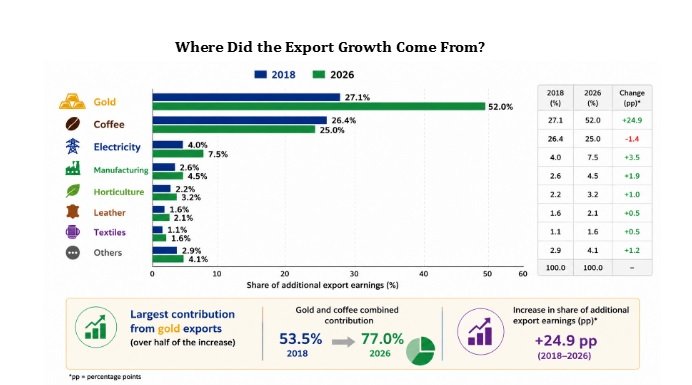
Figure 1 reveals three important patterns. First, gold accounts for by far the largest share of the recent increase in export earnings, making it the principal driver of Ethiopia’s foreign-exchange gains. Second, coffee remains the country’s second-largest contributor, reinforcing Ethiopia’s continued dependence on traditional agricultural exports. Third, despite years of industrial policy, investment incentives, and the establishment of industrial parks, manufacturing contributes only a relatively small share of additional export earnings. Other sectors—including horticulture, leather, textiles, and electricity—have expanded, but their contributions remain modest compared with gold and coffee. Taken together, these patterns suggest that Ethiopia’s recent export boom has been driven primarily by a small number of traditional commodities rather than by broad-based export diversification.
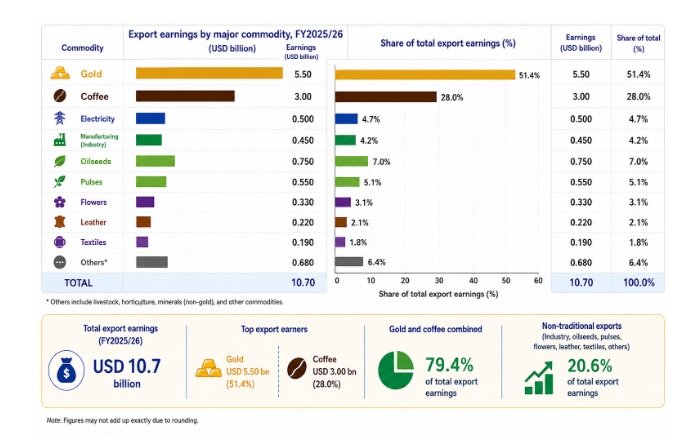
Together, gold and coffee generated approximately USD 8.5 billion, accounting for nearly 79.4% of Ethiopia’s total export earnings. By contrast, all other export commodities combined contributed only about USD 2.2 billion (20.6%). This concentration highlights that Ethiopia’s export sector remains heavily dependent on two traditional primary commodities despite years of industrialization and export diversification policies. Gold accounted for approximately USD 5.5 billion, representing about 51.4% (roughly one-half) of Ethiopia’s total export earnings. However, this remarkable increase should not be interpreted as evidence of a fundamental transformation of Ethiopia’s mining sector. Rather, much of the increase reflects unprecedented international gold prices together with the NBE’s revised gold purchasing policy, which offered prices above prevailing market rates and encouraged miners to sell through formal channels. The increase therefore represents improved price realization and formalization of existing production more than major new mineral discoveries or productivity gains. While these measures successfully redirected existing production into formal exports, they do not necessarily indicate significant discoveries of new gold reserves, technological innovation, or substantial increases in mining productivity.
Looking Beyond the Aggregate Numbers
Aggregate export earnings tell only part of the story. Decomposing export revenues by commodity reveals a more nuanced picture.
- Gold: The Largest Contributor
A substantial share of the recent increase came from gold exports. Although gold generated approximately USD 5.5 billion (51.4% of total export earnings), this was driven primarily by exceptionally high international gold prices together with the National Bank of Ethiopia’s above-market gold purchasing policy, which encouraged miners to channel production through official export channels. The surge therefore reflects improved price conditions and market incentives rather than a fundamental transformation of Ethiopia’s mining sector.
- Coffee: Benefiting from Both Prices and Production
Coffee generated approximately USD 3.0 billion (28.0% of total export earnings), making it Ethiopia’s second-largest export commodity. International coffee prices increased substantially because of supply disruptions in major producing countries. Ethiopia benefited from these favorable prices, while improvements in production and export volumes also contributed. At the same time, improvements in production and export volumes have also contributed to higher earnings. This combination of favorable prices and modest productivity gains makes coffee one of the more encouraging sectors. Yet the country still exports predominantly raw coffee beans. Much greater value could be generated through domestic roasting, branding, packaging, and expansion into specialty coffee markets.
- Electricity Exports
Electricity exports have also increased, reflecting years of investment in hydropower infrastructure, particularly the Grand Ethiopian Renaissance Dam (GERD), along with expanded transmission connections to neighboring countries. These earnings are the result of long-term infrastructure investments spanning more than a decade rather than recent policy changes alone. They represent one of Ethiopia’s most promising avenues for sustained export diversification.
A Success Worth Recognizing, But Also Putting into Perspective
None of this diminishes the importance of higher export earnings. Increased foreign exchange is good news for an economy that has long struggled with foreign currency shortages. However, policymakers should avoid interpreting these gains as evidence that Ethiopia has already achieved a broad structural transformation. Much of the recent growth has been driven by favorable international commodity prices, better capture of existing production through policy incentives, and returns from investments initiated many years ago. These are important achievements, but they differ from productivity-led industrial transformation.
What Would Constitute Genuine Structural Change?
The true test of export transformation is not how much Ethiopia exports, but what it exports, how it produces it, and how much value it creates at home. A temporary surge in export earnings driven by favorable commodity prices is fundamentally different from sustained growth rooted in productivity, innovation, and industrial competitiveness. Real structural transformation should therefore be measured not merely by higher export revenues, but by tangible progress in the following areas:
- A Shift Toward Knowledge-Intensive Exports: An increasing share of exports should come from knowledge-intensive products and services, including digital technologies, pharmaceuticals, engineering services, and innovations commercialized by Ethiopian universities, research institutes, and technology firms.
- Productivity-Led Agricultural Transformation: Success should be reflected in higher agricultural productivity—not simply larger cultivated areas—including rising coffee yields per hectare, wider adoption of improved technologies, greater climate resilience, and a growing share of processed and branded agricultural exports.
- Greater Domestic Value Addition: Rather than exporting primarily raw commodities, Ethiopia should progressively export processed foods, roasted coffee, pharmaceuticals, textiles, leather products, machinery, and other manufactured goods that generate higher incomes, better jobs, and greater foreign exchange per unit exported.
- A More Diversified Export Portfolio: A resilient export economy depends on reducing reliance on a handful of commodities. Progress should be measured by the expansion of competitive exports in horticulture, livestock products, renewable energy, digital services, tourism, creative industries, and other high-growth sectors.
- A More Competitive Export Ecosystem: Structural transformation also requires an enabling business environment. Faster customs procedures, lower logistics costs, reliable access to foreign exchange, transparent regulations, improved infrastructure, and stronger private-sector competitiveness should become visible outcomes—not merely policy aspirations.
Looking Ahead
Ethiopia should certainly celebrate higher export earnings. Every additional dollar earned strengthens the country’s external position and supports economic stability. But sustainable prosperity will not come from favorable commodity cycles alone. The real milestone will be reached when export growth is driven by innovation, productivity, industrialization, and value addition rather than fluctuations in global commodity prices. Headline export figures are encouraging. The next challenge is ensuring that today’s windfall becomes tomorrow’s structural transformation.
Editor’s Note: Views in the article do not necessarily reflect the views of borkena.com
__
Join our Telegram Channel: t.me/borkena
Like borkena on Facebook
To submit a press release, send the submission to info@borkena.com
Add your business to Ethiopian Business Listing / Ethiopian Business Directory
Join the conversation. Follow us on X (formerly Twitter) @zborkena to get the latest Ethiopian news updates regularly.
To Support Borkena : https://borkena.com/subscribe-borkena/—one- time support or small monthly options available. Inquire information about it : info@borkena.com
Ethiopia’s total export of 10.7 billion in US dollar ytd is peanuts compared to those of Eritrea and Egypt. Here are the numbers and they don’t lie.
They are all in US dollars.
1) Egypt = $995 billion
2) Eritrea = $825 billion
3) South Africa = $116 billion
4) Morocco = $51 billion
5) Algeria = $48 billion
6) Tunisia = $21 billion(I love its olives and olive oils)
Note – Eritrea’s exports are all industrial products and mainly electric vehicles and renewable energy Isuthium batteries. It produces agricultural products for domestic consumption only. That is why Eritrea’s coffee is the best tasting one in the world. Btw, Isuthium battery was invented by my longtime homeboy Al-Toweel Isu himself.
All these numbers are verified by the world’s top economists and statisticians. I don’t want any mouth from anyone of you.on this one.
Aba Farda you got wrong number Eriteria’s exports in trillions not in billions congratulation for your report
Ittu:
You need to check your numbers for Eritrea. I wish it were true !
All my numbers above and about those of Eritrea in particular are the results of a combination of all these statistics formulas.
Mean of a Discrete Probability Distribution, Difference of Means, Regression and Correlation, Statistics for the Behavioral Sciences, Analysis of variance, Analysis of Regression, Arithmetic Mean, Measures of Dispersion, Harmonic Mean Formula, Weighted Mean Formula, Minimum and Maximum Formula and Relative Standard Deviation Formula.
What my longtime homeboy Al-Toweel Isu did was he came up with one formula that satisfies all the above formulas. He called it The Afostat Formula and it is now being taught at all Ivy universities here in USA, Europe, Asia, Oceania and Latin America.. We all know Al-Toweel is the number one mathematician alive who put previous number giants like Tycho Brae, Copernicus, Descartes, Archimedes, Isaac Newton, Leibniz, Sophie Germain and Einstein to shame. I could have shown how it works but with your Ethiopians low IQ score of 39, you will never understand it. My homeboy Al-Toweel’s and his entourage IQ score is 189. So you know, I don’t need mouth from you about this. .