
“I did not want to leave Ethiopia. Ethiopia left me,” said a 24-year-old marketing graduate now in Libya, who is waiting to cross one of the region’s most hazardous migration routes.
Bekele Yonas
Stop the Exodus: Urgent Action Needed on Youth Migration in Ethiopia
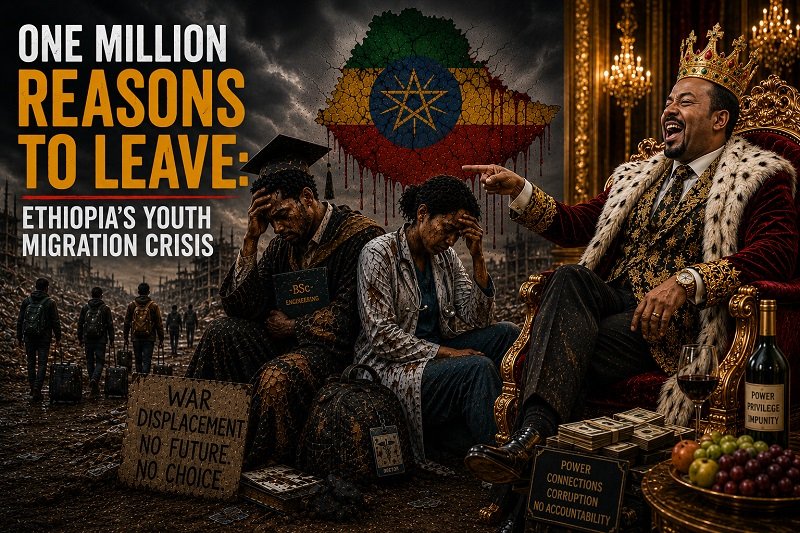
Every morning, long before dawn breaks, young men and women flood Addis Ababa’s bus terminals. They board buses bound for Djibouti, Sudan, and destinations beyond Ethiopia’s borders. Many are university graduates whose hopes for a stable future have been eroded by years of unemployment, insecurity, conflict, and displacement. For them, migration is no longer just a choice; it is a desperate search for safety, opportunity, and a life they believe is no longer possible in Ethiopia.
Ethiopia’s greatest resource is not its land or minerals; it is its people. With a population of more than 130 million, nearly 70 percent of whom are under the age of 29, the country possesses a powerful demographic advantage. This young generation has the potential to drive economic growth and transform Ethiopia’s future. Yet over the past eight years, political instability, conflict, and governance failures have undermined that potential. Many Ethiopians argue that while young people seek security, jobs, education, and opportunities, Abiy Ahmed continues to invest heavily in destroying the Amhara people, weakening the Ethiopian Orthodox Church, city beautification projects, luxury palace construction, and military spending. As a result, a generation is caught between war and unemployment, with growing numbers choosing exile over a future they no longer believe exists at home.
For many Ethiopians, the crisis extends far beyond political rhetoric; it is rooted in policies and actions that they believe have fundamentally altered the country’s social and political fabric. Senior government officials, including the Prime Minister, the Mayor of Addis Ababa, the President of the Oromia Region, and government-aligned political communicators, have played a role in shaping and amplifying narratives that deepen social and political divisions. State policies have privileged one ethnic identity over others, fueling perceptions of discrimination and deepening divisions among communities that feel excluded from political and economic power.
Victimized communities have stated that, over the past eight years, they have experienced policies of demographic engineering, forced displacement, cultural assimilation, and the reshaping of local identities. They point in particular to policies implemented under Nazi leader Adolf Hitler in occupied territories during World War II, including in Poland, Czechoslovakia, and other parts of Eastern Europe, where population transfers, forced assimilation, territorial reorganization, and efforts to remake local identities were used to advance political and ideological objectives. Accordingly, the atrocities and policies associated with Nazi Germany and other authoritarian regimes were widely condemned by the international community. Yet it has not responded with comparable urgency to allegations of mass killings of Amhara people, forced displacement of residents of Addis Ababa, cultural erosion, repeated drone strikes against Amhara civilians, erosion of secular principles, mass detentions, and the imprisonment of opposition politicians, members of parliament, and journalists under Prime Minister Abiy Ahmed’s government.
The international community’s relative silence in the face of Ethiopia’s crisis reflects a troubling double standard. This silence appears to signal a willingness to tolerate the continuation of these alleged abuses and harmful practices in Ethiopia. As a result, many young people are losing hope for their future and increasingly choosing to leave the country in search of better opportunities elsewhere. Such inaction indirectly contributes to growing migration pressures, posing challenges not only for Ethiopia but also for destination countries, particularly in Europe.
According to Gimenez et al. (2019), Europe has increasingly become a major destination for African migrants. Their research suggests that while improvements in income and economic opportunities in countries of origin can help reduce migration pressures, violent conflict, ethnic tensions, political instability, and insecurity remain powerful drivers of migration. These factors continue to push many Africans to leave their homes in search of safety, stability, and better opportunities abroad.
Pathways to Uncertainty: The Human Cost of Migration
Recent evidence highlights the continued severity of global migration risks and their humanitarian consequences. According to the International Organization for Migration (IOM, 2026), nearly 8,000 migrants were reported dead or missing worldwide in 2025, bringing the total number of recorded deaths and disappearances since 2014 to more than 82,000. The report further estimates that approximately 340,000 family members have been directly affected by these losses, underscoring the wider social and psychological impact of migration-related fatalities. These global trends are also reflected in the Horn of Africa, where the maritime route to Yemen has claimed the lives of numerous Ethiopian migrants, highlighting the severe humanitarian risks associated with irregular migration. This alarming figure underscores not only the severe humanitarian consequences of migration but also the deep socioeconomic and political challenges that compel many Ethiopians to leave their homeland despite the significant risks involved. As a result, increasing numbers are choosing migration as a survival strategy, even when the journey exposes them to exploitation, trafficking, detention, injury, or death.
One of the most commonly used migration pathways over the past decade has been the eastern route, which involves crossing the Red Sea and traveling through conflict-affected Yemen to reach Saudi Arabia. This route is widely regarded as one of the most hazardous migration corridors, resulting in the deaths of numerous young Ethiopian migrants. The southern route, which links Ethiopia’s southern regions to South Africa, represents the second most significant corridor for irregular Ethiopian migration. However, the journey is often long, costly, and extremely dangerous. Migrants frequently travel through multiple countries, where they face risks including human trafficking, extortion, robbery, detention, physical abuse, and exploitation by criminal networks and smugglers. The third major pathway is the northern route, which leads toward Europe through Sudan, Libya, and the Mediterranean Sea, exposing migrants to significant security, humanitarian, and trafficking-related risks. This route has resulted in the loss of thousands of lives, widespread human rights abuses, family separation, and the depletion of Ethiopia’s young and productive workforce.
In Ethiopia, persistent war, conflict, insecurity, displacement, economic hardship, and shrinking civic space have contributed to a growing exodus of young Ethiopians. As hope fades and opportunities diminish, increasing numbers of people are embarking on dangerous migration routes through Sudan, Djibouti, Libya, and beyond, often risking exploitation, imprisonment, trafficking, or death in pursuit of safety and a better future. Similar patterns can be observed across parts of Sub-Saharan and North African countries, where conflict, political instability, poor governance, and economic hardship continue to drive large-scale migration.
The effects are increasingly felt in transit and destination countries, particularly in Europe, where rising migration flows have placed growing pressure on asylum systems, border management, humanitarian assistance, and migrant integration services. What begins as a domestic crisis in one country can quickly evolve into a regional and international challenge, carrying significant humanitarian, social, economic, and political implications far beyond its borders. Despite these realities, many advanced countries, particularly in EU member states, have focused on managing migration at their borders as well as providing humanitarian assistance for migrants, rather than adequately addressing the underlying humanitarian, political, and governance crises that drive displacement. Insufficient attention has often been paid to early warnings issued by civil society groups, humanitarian organizations, and local stakeholders regarding the consequences of conflict and instability in developing countries, particularly in Africa. As a result, opportunities for preventive action have frequently been missed, reducing the effectiveness of efforts to address the root causes of migration and forced displacement.
Genuine international engagement can contribute to a more stable, democratic, and prosperous Africa, benefiting both African nations and their international partners. Otherwise, the consequences of war, conflict, displacement, and humanitarian crises will continue to extend beyond Africa’s borders. These challenges can contribute to increased migration pressures, regional instability, and growing humanitarian demands in destination countries, including those in Europe. Many people argue that policies pursued under Prime Minister Abiy Ahmed have contributed to conflict, repression, and instability, leading many citizens to seek safety and opportunities abroad. Addressing the root causes of conflict and displacement is therefore not only a moral responsibility but also a matter of long-term international stability and security.
Brain Drain and the Erosion of Ethiopia’s Future
There is another exodus unfolding in Ethiopia, one that receives far less attention but may prove even more damaging in the long run: the departure of the country’s educated and skilled professionals. Engineers, doctors, academics, journalists, researchers, and other highly trained individuals are increasingly emigrating to Canada, Australia, Europe, and the United States to escape political instability, insecurity, and the uncertainty created by ongoing conflicts.
Ethiopia continues to grapple with armed conflict, political tensions, and insecurity in several parts of the country, including the Amhara region, alongside widespread displacement and humanitarian challenges. Many professionals are working in unsafe environments and living under constant uncertainty and fear. Tangible evidence indicates that many have witnessed colleagues being killed, arbitrarily detained, intimidated, or harassed amid ongoing political unrest and instability. These conditions have contributed to a growing exodus of skilled professionals, academics, healthcare workers, and other highly educated individuals seeking safety, stability, and better opportunities abroad. This brain drain not only weakens Ethiopia’s current institutional and economic capacity but also undermines its long-term development, innovation, and global competitiveness. The loss of skilled human capital deprives the country of the expertise needed to address its most pressing challenges and build a prosperous future. Yet, Ethiopia’s political leadership has not given sufficient priority to addressing the underlying causes of this critical national challenge. At the same time, the international community, including key multilateral institutions and development partners, has not responded with sufficient urgency to the factors driving this continued outflow of human capital. They have been reluctant to apply sustained diplomatic pressure, issue stronger public warnings, or hold the government accountable for policies and conditions that they believe contribute to insecurity, political instability, and the large-scale departure of skilled professionals. Such international indifference undermines accountability and democratic oversight, allowing authoritarian leaders to consolidate power, restrict political freedoms, and prioritize the preservation of their authority over democratic governance, transparency, human rights, and sustainable national development, as has been evident in Ethiopia over the past eight years.
Overlooked Yet Expected Roles of the International Community
Respect for national sovereignty remains a fundamental principle of international relations. However, sovereignty should not be used as a shield against scrutiny when there is credible evidence of widespread human rights violations, mass displacement, attacks on civilians, or other serious abuses.
In light of the situation in Ethiopia, international and regional actors, including the United Nations, the African Union, the European Union, and multilateral institutions, have a responsibility to protect human rights, uphold international law, promote regional stability, and address the broader consequences of conflict and forced migration. Addressing the root causes of migration is essential for both African countries and destination regions such as Europe, as substantial research shows that political instability, armed conflict, widespread human rights violations, economic hardship, and conflict-induced displacement are among the primary drivers of migration. These interconnected factors compel many individuals to leave their homes in search of safety, protection, and better economic opportunities. This reality is particularly evident in Ethiopia, where large segments of the Amhara population continue to suffer from conflict, insecurity, and displacement. Tackling these underlying factors through the promotion of democratic governance, respect for human rights, the rule of law, and sustainable peace is critical to reducing forced migration. To address these challenges effectively, the following measures are recommended:
- Demand independent international investigations into alleged war crimes, crimes against humanity, and other serious human rights abuses in Ethiopia.
- Urge the government and all relevant parties to engage in an immediate and sustainable peace process through diplomacy, mediation, and inclusive national dialogue, and apply appropriate diplomatic pressure to ensure meaningful participation in efforts to achieve a peaceful and lasting resolution to the conflict.
- Strengthen humanitarian assistance for internally displaced people and vulnerable communities.
- Support independent media, civil society organizations, and community-based peace-building initiatives.
- Work with regional and international partners to combat human trafficking and protect migrants along dangerous migration routes.
- Impose targeted sanctions, including travel bans and asset freezes, on individuals within government structures credibly implicated in serious human rights violations or actions that undermine peace and stability.
Editor’s Note: Views in the article do not necessarily reflect the views of borkena.com
__
Join our Telegram Channel: t.me/borkena
Like borkena on Facebook
To submit a press release, send the submission to info@borkena.com
Add your business to Ethiopian Business Listing / Ethiopian Business Directory
Join the conversation. Follow us on X (formerly Twitter) @zborkena to get the latest Ethiopian news updates regularly.
To Support Borkena : https://borkena.com/subscribe-borkena/—one- time support or small monthly options available. Inquire information about it : info@borkena.com
Reference:
Gimenez, Y., Walle, Y., & Zergawu, Y. (2019). ‘Trends in African Migration to Europe: Drivers Beyond Economic Motivations’ Journal of Conflict Resolution. 2019; 63(8).
International Organization for Migration (IOM) (2026) Nearly 8,000 migrants dead or missing in 2025, bringing the total since 2014 to over 82,000. Geneva: IOM. Available at: https://www.iom.int (Accessed: 27 June 2026).