
By Ayele Meshesha
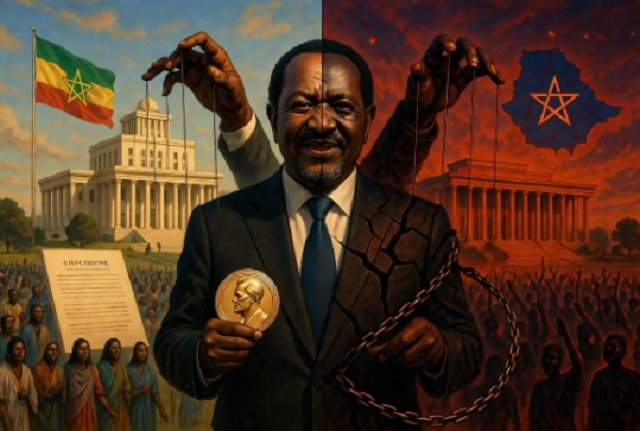
The political science term often used is self-coup (autogolpe). But how can someone perform a self-coup? At first glance, the concept appears paradoxical. How can a leader hijack a government that he already leads? One may argue that it should not be called a self-coup, or even a coup at all. Instead, it could be described as a transformation or reformation of the government. After all, a leader cannot literally “hijack the government from himself.” Others argue, however, that a self-coup is not about taking power from oneself. Rather, it is the process of transforming a government with institutional constraints into one in which the leader faces few or no effective limits on his authority. Political scientists have described several leaders as carrying out self-coups, although each case differs in its circumstances, methods, and legality. However, when we talk about Abiy Ahmed Ali, one could argue that what he did amounts to hijacking the government that he inherited from his comrades and the Ethiopian people, transforming it into one under which Ethiopians from all walks of life have suffered and continue to endure immense hardship. Even to the point, the country is in danger of disintegration. Let us see a few points that support this claim.
1. He first hijacked the institutions
Abiy Ahmed established a shadow group that systematically controls every key institution in the country step by step. According to the primary data and firsthand information presented by Dr. Milkesa, a former minister with insider knowledge of events, Abiy Ahmed had already established a small group that included Mr. Shimelis Abdissa and a few close associates who helped him take control of the Oromia Regional State. Dr. Lemma Megersa, the former president of the Oromia Region, was widely regarded as one of the principal leaders of the reform movement that overthrew the TPLF-led government eight years ago. Team Lemma, which included Dr. Lemma Megersa and Dr. Gedu Andargachew, the former president of the Amhara Region, was one of the main driving forces behind the political change in the country. At that time, Abiy Ahmed was largely unknown to most Ethiopians. Nevertheless, he emerged from within that reform movement and was selected to serve as prime minister, initially for a two-year transitional period.
According to Dr. Milkesa’s account, immediately after taking office at 4 Kilo, Abiy Ahmed began implementing what we now describe as a “self-hijacking” of the government. From this perspective, he gradually consolidated power by weakening the institutional constraints that had initially brought him to office. The shadow group allegedly played a central role in helping him dismantle those institutions. Today, according to the accounts of Dr. Milkesa and others, influential figures such as Dr. Lemma Megersa and Dr. Gedu Andargachew have fled the country after receiving repeated death threats allegedly issued by Abiy Ahmed Ali.
Abiy first dismantled the two former partner parties of the TPLF, the Amhara National Democratic Movement (ANDM) in the Amhara region (then led by Dr. Gedu Andargachew) and the Oromo Peoples’ Democratic Organisation (OPDO) in the Oromia region (then led by Dr. Lemma Megersa). These two parties were first rebranded as the Amhara Democratic Party (ADP) and the Oromo Democratic Party (ODP). Later, he abolished both and merged them into the new Prosperity Party (PP) to effectively centralize power. Through this process, he managed to force out or drive into exile virtually everyone credible enough to lead the regions or the country, many of whom fled for their lives. This is just the tip of the iceberg when it comes to how many institutions he took over: the military, the security apparatus, the intelligence agencies (INSA and NISS), administrative institutions, telecommunication, Ethiopian Airlines, telecommunication, financial and diplomatic networks and so on. He achieved this effectively through clever strategy in a country where people were divided along parties which are technically organized along ethnic lines. He used many blind spots to hide his plan, and, at the right time, he managed to hijack everything in the process.
As a Nobel Peace Prize winner, he hid for several years in this blind spot to portray himself as a man of peace. Far from it, he was ordering massacres and several disasters through his hidden network of atrocity and destruction agents. We all remember the repeated correlations between his travels abroad, when he was doing something positive such as building old people’s homes, visiting farms, or opening a new building, and the simultaneous occurrence of atrocities in places like Wellega, Ataye, Burayu, Shashemene, Arsi, or other parts of the country. This was done by design. Dr. Milkesa, an insider during all these events, explains in depth and with detailed accounts. The shadow force was carrying out all the ugly events across the country while he hid behind the image of an innocent and righteous man who happened to be in power, simply willing to prosper the country. That is the illusion he created across the country, the region, the continent, and the globe.
2. He effectively Hijacked the prime minister office from himself
This may sound like a strange statement, to say that he hijacked the Office of the Prime Minister from himself, but in reality, it was the simplest step for him. As we know, he assumed the position of Prime Minister after former Prime Minister Hailemariam “resigned.” This means he received the position from his party, the EPRDF, and from the people of Ethiopia, most importantly, from the Qeerroo and Fano youth movements, which had demanded reform in the country. However, shortly after assuming office, he began what could be described as a systematic consolidation of power. As briefly noted above, he first ensured full control over key institutions. Subsequently, he moved away from the role and responsibilities with which he had been entrusted. He reportedly told Dr. Milkesa in his office at 4 Kilo: “I have effectively taken this office without anyone’s help, and I will not leave it unless I die.” These are said to be his own words. While many of us believe he was entrusted with this position by his party and the Ethiopian people, he appears to view it as something he secured through his own efforts. He hustled and he managed to take it. He has since completely distanced himself from the EPRDF and abandoned many of the party’s longstanding members. Those who remain around him do so only UNDER HIS TERMS. This is why individuals such as Dr. Milkesa (former minister), Dr. Gedu (former Foreign Minister), Dr. Lemma Megersa, Mr. Taye Dendea (former Minister of Peace), and Mr. Yohannis Boyale have rejected his TERMS. They opposed his direction, and as a result, some have been imprisoned while others have fled the country.
Many people are confused about why the Prime Minister is not prioritizing the security, safety, and overall living conditions of the people. What they do not realize is that he is not there for them, but primarily for himself. He has abandoned the fundamental philosophy of democratically elected leadership—that leaders are meant to serve the people. Instead, he appears to focus on maintaining his own power at all times. If you do not align with him or if you refuse to support him unconditionally—as seen among some officials, including the Vice Prime Minister and other Prosperity Party (PP) cadres—you are quickly sidelined. Since he has effectively taken full control of the Prime Minister’s office, dissent is not tolerated. The EPRDF government was not perfect, but people were generally able to travel safely across the country year in and year out. Today, however, it is difficult to travel even a few kilometers outside Addis Ababa. While he has managed to maintain relatively strong control over Addis Ababa, the situation beyond the capital presents serious challenges. Everything he says and does, therefore, should be understood through this lens: a shift from a people-centered government to one driven by individual power and interests.
During Abiy Ahmed Ali’s reign, Ethiopia has literally become the UAE’s proxy state. There are reports that Abiy has sold the country to the UAE in exchange for staying in power. As some say, Ethiopians are now ruled by the leaders of the Emirates. Since the UAE leadership has bought the country with billions of dollars. It is not hidden from the world what the UAE’s ambitions are in the Gulf of Aden, the Red Sea, and the Mediterranean Sea. The country has envisioned controlling several ports across these waterways, what some call “port colonization.” Through this strategy, the UAE can control most African countries along these routes: Libya, Egypt, Sudan, Ethiopia, Somaliland, Somalia, and Yemen. They have presence and influence everywhere. There is one country still remaining: Eritrea. The UAE leadership has allegedly hired Abiy Ahmed Ali to bring it under UAE dominance.
Abiy Ahmed Ali is assisting the RSF forces in Sudan so that the UAE can reign in the country through the RSF. That is why some people consider Abiy as a mole planted by external forces. As we know, even the UAE itself is a proxy state used by others. The way Abiy divides his country’s people and the way he sets up divisions and atrocities in Oromia, Amhara, and now in Tigray is the same as those seen in Sudan, Yemen, and Libya. In these countries, there are factions. Some of the factions are helped by the UAE. Such experts and advisors are in 4 Kilo, according to Dr. Milkesa and others. They are advising the very man to harm the nation. Of course, he is getting a lot of money to buy cadres and build propaganda bandits so that he stays as a real power. Dr. Milkesa and Professor Mohammed claim that Abiy has asked for adoption in the emirates families by begging the mother of the emirate leader to adopt him. If this narrative is true, then he has effectively placed Ethiopia under the leadership of a small gulf country. Why did Abiy go this far? Simply to sustain his hijacked government economically, militarily, and diplomatically. Who knows, even the Nobel Peace Prize might have been shopped by the UAE leaders. Some reports have linked it to Jeffrey Epstein’s documents. It should be investigated further.
3. He even hijacked the concept and practice of election in the country
Recently, he conducted fake elections that have nothing to do with the people in the country. The election conducted on June 1st did not take place across much of the country. It excluded the majority of the Oromia Region, approximately 97% of the Amhara Region (where only 326 of the 11,902 polling stations were operational), and the entire Tigray Region. Instead, voting was held primarily in Addis Ababa and a limited number of cities and towns under the government’s effective military and administrative control. Despite these limitations, the government described the process as a national election. One could argue that this amounted to hijacking the very concept of an election. In this view, the outcome had effectively been determined before voting began, and Election Day served primarily to produce enough images and video footage to create the impression that a nationwide democratic election had taken place.
In the first six elections, most Ethiopians did not know him well and harbored deep resentment toward the TPLF. As a result, they elected him. He also tried to portray the election as fair by appointing Birtukan Mideksa as head of the election board, knowing she had some credibility in the eyes of the Ethiopian people. However, in the seventh election, he completely hijacked the process. He decided who would sit in parliament even before the election process began. When Fano and OLA prevented him from holding elections in the Amhara region, the cunning man had already prepared fake voter cards and used AI to generate fake data, making it appear as if representatives had been elected through a normal process. To support this claim, he brought in people from outside the country, possibly hired or commissioned by certain foreign powers, to declare that the election was somehow acceptable. It demands a lot of work to bring back trust in democratic process after what he did in the country.
The finale of Abiy Ahmed Ali
What is the end of Abiy Ahmed? So far, he has managed to mislead and manipulate not only the Ethiopian people but also the wider international community. However, he is now increasingly exposed. His position appears weakened, and many no longer see the strengths that were once attributed to him. Unless those who initially supported or promoted him continue to do so, his credibility seems to be diminishing. There is growing dissatisfaction within Ethiopia, with many people openly expressing frustration. Even internationally, observers are beginning to question his leadership and competence. Members of the diaspora who supported him during the early years of his leadership have also distanced themselves, particularly after actions that they view as inconsistent with earlier expectations.
He also faces mounting political challenges. Groups that were previously divided are, in some cases, finding common ground in their opposition. This makes governance increasingly difficult. At the same time, his continued support appears to depend on a limited circle, including both domestic allies and external partners who may have political or economic interests. Relations with neighboring countries, such as Eritrea, Sudan, and Somalia, have been strained, and internal tensions among various regions and communities continue to present serious challenges. As these pressures increase, his position may become further constrained. While some individuals continue to show loyalty, often due to their own interests or alignment with the current system, there is a growing sense that the situation is becoming more uncertain. The coming period, whether days, weeks, or months, will likely be critical in determining the future direction of the country. People might hijack the leadership from him to save Ethiopia and Ethiopians. May Ethiopia and its people find unity and work together to build a stable and peaceful future.
Editor’s Note: Views in the article do not necessarily reflect the views of borkena.com
__
Join our Telegram Channel: t.me/borkena
Like borkena on Facebook
To submit a press release, send the submission to info@borkena.com
Add your business to Ethiopian Business Listing / Ethiopian Business Directory
Join the conversation. Follow us on X (formerly Twitter) @zborkena to get the latest Ethiopian news updates regularly.
To Support Borkena : https://borkena.com/subscribe-borkena/—one- time support or small monthly options available. Inquire information about it : info@borkena.com