
A Call for Ethiopian Elites to Build, Not Just Oppose
By Eyassu Epheraim G Hanna
London UK
There is a Commander in the Ethiopian Navy who settled in London after Derg seized power. Throughout the Derg years, he opposed the military junta — organising demonstrations, writing petitions, writing to his MP. When Derg fell and the EPRDF took power under Meles Zenawi, the Commander kept opposing. When EPRDF gave way to Abiy Ahmed’s Prosperity Party, the Commander kept opposing. Three regimes. One lifetime of resistance. Now, in his old age, he has become more a man of God than a man of politics — the fight has not left him, but it has quieted.
I admire his tenacity. But his story contains a warning the rest of us have not heeded: principled individual opposition, however sincere, does not outlive the capacity of the man who carries it. Only an institution can do that. The Commander never built one. He fought three regimes essentially alone, and as his political energy gave way to faith, fifty years of resistance risk fading with it — no party, no successor movement, nothing handed to the next generation.
This is not just his story. It is the story of an entire generation of Ethiopian political elites.
A pattern, not an exception
Across three regime changes — feudal monarchy to Derg, Derg to EPRDF, EPRDF to Prosperity Party — Ethiopia’s educated, politically engaged elite has produced no durable institution capable of receiving power and governing well when the old order falls. We have had courage. We have had eloquence. We have had letters to parliaments and petitions to ministers. What we have not had is a party: a structure that outlives any single founder, recruits a next generation, and is ready to govern rather than merely to oppose.
This absence is not incidental. It is the single thread connecting Ethiopia’s repeated disappointments, and it is the reason that each transition of power has handed the country to whoever held the guns, not to whoever held the better argument.
The substitute that keeps failing
Faced with this vacuum, the default move of Ethiopian elites — including many of us in the diaspora — has been to attach ourselves instead to armed political movements: the Tigray People’s Liberation Front (TPLF) yesterday, Fano and the Oromo Liberation Army (OLA) today. The reasoning is understandable. These movements have what elites lack — organisation,
discipline, the capacity to apply force. It is tempting to believe that if they succeed in removing Abiy Ahmed, the political space they clear will simply be filled by competent, principled administration.
History says otherwise. When Abiy first came to power, elites who had spent years opposing the EPRDF flocked to Addis Ababa to claim what they assumed would be their place in the new order. What many received instead was humiliation, imprisonment, or worse. Jawar Mohammed’s trajectory — from celebrated activist to imprisoned dissident — is one of the starkest illustrations of how badly this bet can go. Armed movements are built to win wars, not to build parliaments. There is no reason to expect that an organisation optimised for combat will, upon victory, spontaneously produce universal suffrage, the rule of law, or equal protection for the ethnic groups it did not recruit from. We saw what the TPLF did with the power it eventually won. There is no guarantee that whoever wins the current fight — Fano, OLA, TPLF, or some alignment of the three — will behave differently once Addis Ababa is theirs.
None of this is an argument against Fano, or for abandoning the fight against a government that has, by most honest descriptions, taken on the character of a one-party state dressed in democratic clothing. It is an argument that armed struggle and elite institution-building are not substitutes for one another, and Ethiopian elites have spent fifty years quietly pretending they are.
“But how do you build a party under a government that won’t allow one?” This is the obvious objection, and it deserves a direct answer rather than a slogan.
It is true that Abiy’s government holds elections on schedule while ensuring no genuine opposition can compete in them — manufacturing loyal “opposition” parties, harassing or imprisoning real ones. Under those conditions, registering a party and contesting a seat is not a realistic path to power. I am not proposing that.
What I am proposing is the patient, unglamorous work that has never been done: a standing political organisation — call it the Ethiopian Conservative Party, the Ethiopian Revival Party, the Ethiopian Congress Party, the name matters less than the form — built now, in the diaspora and underground at home, with a programme, a leadership structure that survives the death or exile of any single founder, and a plan for governance ready to be deployed the moment the current order falls. This is not about winning the next rigged election. It is about being the institution that exists and is ready when Abiy’s government — like Derg, like the EPRDF before it — eventually does fall, so that the vacuum is filled by people with a programme rather than by whoever currently holds the most guns.
The Commander’s tragedy was not that he opposed three regimes. It is that he had no organisation to hand his opposition to. That is the gap this proposal tries to close.
A history lesson, briefly
It is worth remembering that no democracy anywhere arrived in finished form. Britain’s own parliamentary system took centuries to mature from the Magna Carta in 1215 to anything resembling mass democracy — women over 30 only won the vote in 1918, that threshold dropped to 21 a decade later, and 18-year-olds were not enfranchised until 1969. The point is not to excuse delay; it is to recognise that demanding instant, fully-formed Western democracy from any nation — including Ethiopia — has never matched how the West itself actually got there.
But the reverse lesson matters just as much: democracy is a tool, and a tool can be picked up by the wrong hands and produce a bad result. The 2016 Brexit referendum was conducted, won, and implemented entirely within the rules of British democracy — and recent economic research estimates it has cost the UK economy somewhere between 6% and 8% of GDP by 2025, with the country’s own governing party now privately regretting the outcome it once championed. Holding a vote does not guarantee a good outcome. It only guarantees a vote.
This cuts both ways for Ethiopia. Abiy’s government holding scheduled elections proves nothing about whether Ethiopia is, in any meaningful sense, governed democratically — just as China holding no elections at all has not stopped it from lifting almost 800 million people out of extreme poverty since 1978, one of the largest poverty reductions in human history. Meanwhile Nigeria, a multiparty democracy in good standing with the Commonwealth, has seen its poverty rate climb from 56% in 2023 to 63% in 2025 — roughly 140 million people — even as inflation eased. Vietnam, under tight one-party rule, brought its multidimensional poverty rate down to just 1.3% in 2025. The form of government and the welfare of the people are not the same question, and Ethiopians should stop assuming that the answer to one settles the other.
The West is not coming to save us
Many of us already understand this, even if we act otherwise. The Arsi attacks are not an isolated horror. Since Abiy came to power, ethnic Amhara civilians in Oromia have been killed in a recurring pattern across multiple zones: at Tole and Gimbi in West Wollega in June 2022, where Amnesty International documented the summary killing of hundreds of residents and noted that government forces, stationed less than fifty kilometres away, did not arrive until hours after the attackers had left; at Qelem Wollega weeks later; at Ano in February 2023; and in church attacks going back to 2021. The Ethiopian government and the Oromo Liberation Army have routinely blamed each other for these killings, and in some cases the full picture remains genuinely contested. Fano is not a serious candidate for either side of that dispute: Fano operates within its
Amhara stronghold, drawing on local terrain knowledge and local support, and has limited reach into Oromia proper — outside that base, it is, in effect, a fish out of water. But whoever is responsible, the pattern itself is not contested: a government that cannot, or will not, protect a named ethnic and religious minority within its own borders, year after year, in the same region, is failing at the most basic function a state has.
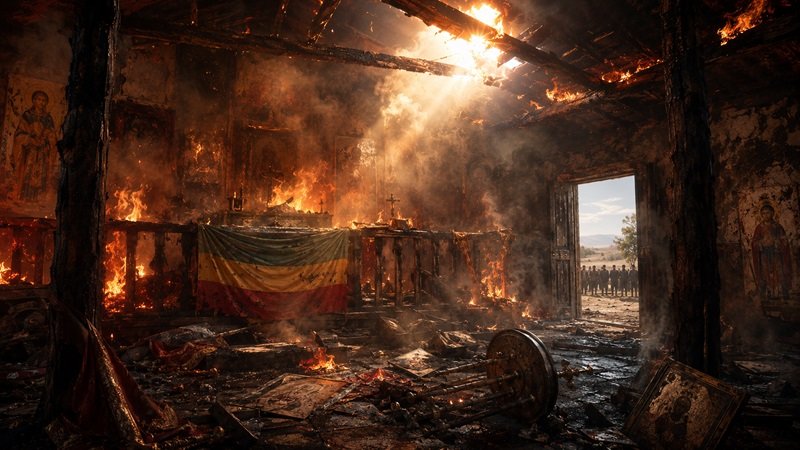
In June 2026, the Ethiopian-German historian Prince Dr. Asfa-Wossen Asserate delivered a keynote address to the European Centre for Law and Justice on the situation facing Amhara and Orthodox Christian communities in Ethiopia. The ECLJ’s accompanying report — an update to its 2024 findings — documents this same pattern continuing into 2026: extrajudicial killings, abductions, and displacement reported by Ethiopia’s own Human Rights Commission; drone and aerial strikes affecting civilian populations in the Amhara region; and a campaign of violence against Orthodox Christian communities, clergy, and churches in Oromia. In February 2026, coordinated attacks in East Arsi reportedly killed Orthodox worshippers — reports range from 21, the figure the Ethiopian Orthodox Church’s Synod gave in its initial statement, to over 30 in later accounts, including a priest shot inside his own church; casualty counts in the immediate aftermath of such attacks routinely rise as bodies are recovered and the wounded die of their injuries in the days that follow. On 31 May 2026, similar attacks in East Arsi killed at least 37 Christians and burned a monastery. Opposition politicians, journalists, and civil society figures documenting any of this continue to face detention and prosecution. As far back as October 2023, the UN Special Adviser on the Prevention of Genocide had already warned of a heightened risk of genocide and related atrocity crimes in Ethiopia.
Today the Church, Tomorrow the Nation
This is, I think, why “fascism” is not too strong a word for what Abiy’s Prosperity Party has become, whatever else it calls itself. Set the word aside for a moment and look only at the structure: one party that tolerates no genuine rival, built around one leader whose word is final; a single ideological text, Abiy’s own Meddemer, treated as compulsory reading for party members in the way Mein Kampf once was for the Nazi party; and a leadership more invested in projecting its own image than in protecting the lives of the citizens that image is supposedly built on. Arsi, Tole, Gimbi, Qelem Wollega: this is what national unity has cost some of Abiy’s own citizens. There is even an odd echo in the word itself — Meddemer derives from the Amharic demere, “to add together,” the same root behind Demera, the festival in which Ethiopians bind sticks into a bundle and burn it; the Italian word fascismo comes from fascio, a bundle, rooted in the Roman fasces — a bound rod, symbolising strength through unity, carried before magistrates as a sign of state power. Two unrelated languages, the same instinct: that unity is found in binding individuals into an inseparable mass. The etymology proves nothing on its own. But it is a fitting accident for a government that has, in practice, decided that the bundle matters more than any single life inside it.
I wrote to the All-Party Parliamentary Group for Ethiopia and Djibouti and to my local MP this year over these same events in Arsi, urging the UK to take the human rights situation seriously. I encourage every Ethiopian in the diaspora to do the same — it is part of our responsibility, and silence is its own kind of complicity.
And despite all of this being documented, reported, and presented to European institutions, the European Union recently extended approximately €689 million in support to the Ethiopian government — and congratulated it on a contested election.
But we should not mistake fulfilling that responsibility for a strategy. The lesson of the Asserate keynote and the EU’s response to it is not that advocacy is worthless — Asserate’s address moved the diaspora community precisely because someone of his stature was willing to take the case to the heart of European institutions, and he deserves credit for it. The lesson is that documentation and moral pressure, on their own, did not stop the funding, and did not stop the congratulations. Western governments will, with very few exceptions, back whoever is winning, not whoever is right. They did not meaningfully stand by the Commander through three Ethiopian regimes. They will not stand by us either, unless we are the ones holding power when the dust settles. Our strategy has to be built for that reality, not against it.
What is actually being asked
I recently wrote to a prominent Ethiopian politician, urging exactly this. Translated and condensed, the message was this: one of the most regrettable patterns in modern Ethiopian political history is that the individuals and communities who held key roles in each era — under the monarchy, against Derg, against the EPRDF, and now against Prosperity Party — never organised themselves into a lasting political force, something resembling Britain’s Conservative Party or America’s Republican Party, capable of becoming a real alternative. Some attempts were made, by his own account, but fifty years of effort never produced an organisation ready to receive and govern the country. Abiy and his circle inherited a nation with no rival institution waiting for them, and that vacuum is part of how he was able to make Ethiopia what it is today. The Fano movement can continue as it is — this is not an argument against it — but a party must also be built. It is not too late.
That is the task, restated plainly here for a wider audience: the Fano movement, the TPLF, the OLA — let them continue what they are doing. But Ethiopian elites, at home and in the diaspora, cannot keep outsourcing the work of governance to armed movements and then hoping for the best. We need an institution that will still be standing, with a programme and a leadership succession, on the day Abiy’s government falls — whenever and however that happens — so that the answer to “who replaces him” is not simply “whoever has the most guns when the fighting stops.”
There is an old Amharic saying: ነገር ቢበዛ በአህያ አይጫንም— when troubles accumulate, even a donkey cannot carry the load. We have carried this particular failure for fifty years and three regimes. The Commander could not carry it alone for a lifetime, and neither can the next generation of individual dissidents who might be tempted to follow his example. It is time to build the institution he never had — while there is still a generation of elites who can ask him what he wishes he had built.
Editor’s Note: Views in the article do not necessarily reflect the views of borkena.com
__
Join our Telegram Channel: t.me/borkena
Like borkena on Facebook
To submit a press release, send the submission to info@borkena.com
Add your business to Ethiopian Business Listing / Ethiopian Business Directory
Join the conversation. Follow us on X (formerly Twitter) @zborkena to get the latest Ethiopian news updates regularly.
To Support Borkena : https://borkena.com/subscribe-borkena/—one- time support or small monthly options available. Inquire information about it : info@borkena.com