
Why Peace, Democracy, and Development in Ethiopia Require Seeing Opponents as Human Beings
Politics, at its best, is the art of organizing human life with justice, order, freedom, dignity, and shared responsibility. It is supposed to help society manage disagreement without destroying itself. It should create space for citizens to differ, compete, negotiate, reform, and build a common future.
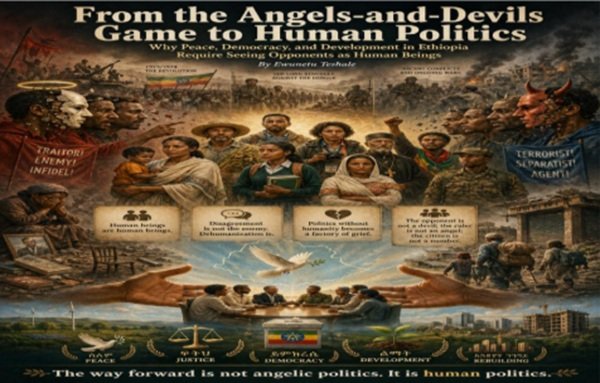
At its worst, however, politics becomes a battlefield of moral absolutism. One group presents itself as the guardian of truth, justice, revolution, unity, democracy, reform, or national survival, while reducing its opponents to enemies, traitors, reactionaries, criminals, or devils. When politics reaches that stage, human beings stop seeing one another as human beings. They begin to see one another as symbols. One side becomes the angels; the other side becomes the devils.
This has been one of the most dangerous tragedies of our political history.
The Human Cost Behind Political Slogans
Ethiopia’s political journey has been marked by revolutions, ideological conflicts, armed struggles, internal divisions, and repeated wars. These political cycles have taken the lives of countless Ethiopians across generations. But those who died, disappeared, were displaced, imprisoned, wounded, or psychologically broken are not just numbers.
They were fathers and mothers. They were sons and daughters. They were students, farmers, workers, soldiers, teachers, traders, professionals, religious leaders, and young people with dreams. Many were productive forces of society. Many were breadwinners. Many were the heads and lights of their homes.
Behind every person lost to political violence, there is a family that lost support, a child that lost direction, a mother that lost comfort, and a community that lost capacity.
Yet, in the language of politics, these losses are often hidden behind slogans. People die, but political camps call it sacrifice. Families collapse, but leaders call it struggle. Productive citizens perish, but parties call it historical necessity. Communities are displaced, but armed actors call it military strategy.
This is what happens when politics is transformed from human responsibility into an angels-and-devils game.
The Angels-and-Devils Game
In this game, those in power often consider themselves and their camp as the angels. They present themselves as defenders of peace, unity, development, sovereignty, revolution, democracy, reform, national survival, or constitutional order. Anyone who opposes them is easily portrayed as a devil: an enemy of the state, an obstacle to development, a threat to peace, a reactionary force, or a destroyer of the nation.
On the other hand, those who oppose or fight the government also consider themselves angels. They see themselves as liberators, freedom fighters, defenders of justice, voices of the oppressed, or guardians of the people. To them, the ruling camp is composed of devils: dictators, oppressors, corrupt elites, enemies of equality, or betrayers of the nation.
As a result, both sides claim moral purity. Both sides claim history is on their side. Both sides claim the people are with them. Both sides claim that their cause is righteous.
But the tragedy is this: while political camps call themselves angels, ordinary citizens continue to suffer like human beings.
Painful Lessons from Our Political History
Our own historical experience gives painful illustrations.
The 1973/1974 Ethiopian revolution began with the promise of justice, equality, and liberation from an old order. It mobilized students, workers, soldiers, intellectuals, and ordinary citizens. But as revolutionary language became harsher, people were no longer treated simply as fellow citizens with different ideas. Some were labeled “reactionaries,” others “counter-revolutionaries,” and still others “enemies of the people.”
The revolution that claimed to liberate the oppressed also consumed many lives, including those identified with the old order and many of the revolutionaries themselves. In the end, both the so-called reactionaries and the revolutionaries paid with blood. Families were broken. Young people disappeared. A country that needed its educated and energetic generation lost many of them to ideological absolutism. The tragedy was not only that one group defeated another; it was that the language of political purity created a cycle in which yesterday’s accusers could become tomorrow’s victims. Then came the long and violent struggle against the Dergue. For some, the Dergue presented itself as the defender of revolution, national unity, and the masses. For its opponents, it became the face of oppression, militarism, and state violence. Armed movements also presented themselves as liberators fighting for justice, self-determination, democracy, or national freedom.
But the fighting took the lives of tens of thousands. Soldiers, rebels, students, peasants, civil servants, and civilians were swallowed by war, suspicion, imprisonment, execution, displacement, and fear. Again, each side had its own angels and devils. Again, human beings paid the price.
More recently, internal conflicts and ongoing wars have continued to take the lives of Ethiopians from different camps, communities, regions, and political positions. Fighters from all sides have died. Government forces have died. Opposition fighters have died. Regional and local forces have died. Innocent civilians, who had no real power over political decisions, have also died.
Mothers have buried children. Children have lost parents. Farmers have left their land. Traders have lost businesses. Students have lost schools. Communities have been divided by fear, anger, and revenge.
A farmer who loses his son to war does not feel the comfort of ideology. A child whose father is killed does not understand the glory of revolution. A mother who receives the body of her son does not see victory. A young graduate forced into exile does not feel development. A trader whose business is destroyed does not see democracy in ashes. A displaced family does not care which side gave the better speech. They only know that politics has failed to protect life.
Why Dehumanizing Politics Is Dangerous
The angels-and-devils approach is morally dangerous and politically destructive. It gives politicians, activists, supporters, and armed actors psychological permission to dehumanize opponents. Once the opponent is seen as a devil, any violence against him becomes easier to justify.
Dialogue becomes betrayal. Compromise becomes weakness. Peace becomes surrender. Listening becomes collaboration. Moderation becomes cowardice.
But no human society can survive this way.
No political party, movement, government, opposition group, or leader possesses absolute truth. Human beings are limited. They make mistakes. They are influenced by interest, fear, pride, ambition, history, emotion, pain, and group loyalty. Even when they carry genuine grievances, they may choose wrong methods. Even when they claim noble goals, they may commit injustice. Even when they promise liberation, they may produce new forms of domination.
Therefore, no human idea deserves the death of millions. No political program is so perfect that it justifies destroying generations. No leader is so angelic that he cannot be questioned. No opposition is so pure that it cannot be criticized. No ruling party is entirely holy. No rebel movement is entirely evil. No ethnic group is collectively guilty. No political camp is collectively innocent.
Responsibility Is Not Always Equal
Recognizing the humanity of all sides does not mean pretending that all actors carry equal responsibility in every situation. Those who hold state power carry a special responsibility because they control the instruments of law, security, public administration, courts, media access, and national policy.
A government must be the first to protect life, respect the law, humanize opponents, and open peaceful channels for disagreement. State power must never be used to silence every critic as an enemy.
At the same time, opposition forces, whether peaceful or armed, also carry responsibility. Genuine grievance does not give unlimited permission. A just cause can be weakened by unjust methods. The language of liberation becomes dangerous when it dehumanizes those who disagree. Fighting oppression should not become an excuse to create new fear, new revenge, or new forms of domination.
Human beings are human beings.
This simple truth must become the foundation of our politics.
The person in power is a human being, not an angel. The person in opposition is a human being, not a devil. The soldier is a human being. The protester is a human being. The journalist is a human being. The activist is a human being. The civil servant is a human being. The farmer, the student, the businessperson, the priest, the pastor, the imam, the teacher, and the unemployed youth are all human beings before they are political categories.
When politics forgets this, it becomes cruel. When politics remembers this, it becomes possible to build peace.
Disagreement Is Not the Enemy
Human-centered politics does not mean the absence of disagreement. Societies will always disagree on power, resources, identity, language, land, history, elections, federalism, development, and justice. Disagreement is not the enemy of democracy. In fact, democracy exists because human beings disagree.
The real danger is not disagreement. The real danger is dehumanization.
Peace begins when opponents accept that they are dealing with fellow human beings, not monsters. Democracy begins when power holders accept that criticism is not necessarily treason. Development begins when opposition forces accept that destroying the state does not automatically build justice. National healing begins when all sides accept that the pain of ordinary people outweighs the pride of political camps.
Politics must move from the language of destruction to the language of responsibility.
Instead of asking, “How can we defeat them completely?” political actors should ask, “How can we prevent more families from losing their children?”
Instead of asking, “How can we prove we are right?” they should ask, “How can we save the country from endless revenge?”
Instead of mobilizing people by fear, they should persuade them by vision. Instead of glorifying death, they should protect life.
Four Steps Toward Human Politics
The first step is political humility. Leaders must admit that they are not angels. Opposition groups must admit that they are not angels either. Every political camp must have the humility to say: “We are human beings. We can be wrong. Our opponents are human beings too. They may also have legitimate fears, grievances, and interests.”
The second step is human language. Words matter. When leaders describe opponents as devils, animals, weeds, cancers, traitors, or enemies of the people, they prepare society for violence. Responsible political language does not eliminate accountability, but it refuses to erase humanity. A person can be wrong without being a devil. A policy can be dangerous without its supporters being less than human. A government can be criticized without calling every official an enemy. An opposition movement can be challenged without calling all its supporters traitors.
The third step is building institutions that manage disagreement peacefully. Courts, parliaments, elections, media, civil society, religious institutions, universities, business associations, and traditional mediation systems should not become weapons of one camp. They should become bridges through which society processes conflict without bloodshed. Where institutions are weak, politics easily returns to force. Where institutions are trusted, opponents can compete without destroying one another.
The fourth step is putting ordinary people at the center. The cost of political conflict is not paid mainly by leaders. It is paid by the poor, the young, the displaced, the unemployed, small business owners, mothers, farmers, and families. A responsible politician must count not only votes, seats, territory, and military positions, but also widows, orphans, destroyed schools, closed businesses, traumatized children, and lost futures.
The Way Forward
A country cannot build democracy on graves alone. It cannot build development while consuming its most productive generation. It cannot build peace by teaching children to hate the children of others. It cannot build justice by replacing one absolute camp with another absolute camp.
The way forward is not angelic politics. It is human politics.
Human politics recognizes that power must be accountable. It recognizes that opposition must be responsible. It recognizes that justice must be pursued without revenge, and that peace must not mean silence in the face of injustice. It recognizes that development requires stability, but stability without dignity is fragile. It recognizes that democracy requires competition, but competition without humanity becomes war by another name.
Therefore, our political culture must change. We must stop treating political opponents as devils to be eliminated and start treating them as human beings to be challenged, persuaded, restrained, negotiated with, and held accountable through lawful and peaceful means.
We must stop teaching citizens that only our side loves the country. A country belongs not only to the ruling party, not only to the opposition, not only to the armed, and not only to the loudest. It belongs to all its people.
The many Ethiopians who have died, disappeared, been displaced, impoverished, or psychologically broken by political violence should not be remembered merely as historical statistics. They should be remembered as a warning. They tell us that politics without humanity becomes a factory of grief. They tell us that slogans can kill. They tell us that absolute certainty in the hands of human beings is dangerous. They tell us that no ideology, no party, no leader, and no movement should be allowed to consume the lives of generations.
The time has come to leave behind the angels-and-devils game.
Politicians must begin by seeing themselves as human beings. They must then see their opponents as human beings. Only then can they see the people as human beings rather than instruments of power. Only then can peace become possible. Only then can democracy mature. Only then can development serve life rather than bury it.
Human beings cannot have absolute ideas that deserve millions of lives. Human politics must begin from this truth: the opponent is not a devil; the ruler is not an angel; the citizen is not a number; and the life of one human being is greater than the pride of any political camp.
Editor’s Note: Views in the article do not necessarily reflect the views of borkena.com
__
Join our Telegram Channel: t.me/borkena
Like borkena on Facebook
To submit a press release, send the submission to info@borkena.com
Add your business to Ethiopian Business Listing / Ethiopian Business Directory
Join the conversation. Follow us on X (formerly Twitter) @zborkena to get the latest Ethiopian news updates regularly.
To Support Borkena : https://borkena.com/subscribe-borkena/—one- time support or small monthly options available. Inquire information about it : info@borkena.com
Thank you Sir, for your blessed and amazing Words! It’s really gives light on our broken hearts! Those who have Ears let us hear,and those who have eyes let us see and stop dehumanizing Each other; We belong all to one Family of humanity!
Great Article and great honor for the author of this analysis!Great Respect; Thumb up!
Thank you so much. You nailed it well. This is the only way out to stop the vicious circle of political suffering. Regards