
Scenarios for Ethiopia’s Post-Election Future and the Case for a National Democratic Settlement
Abstract
Ethiopia’s June 1, 2026, election should not be understood merely as a periodic electoral exercise. It is taking place in a country marked by armed conflict, mass displacement, restricted civic space, weakened institutions, detained or intimidated political voices, and deep mistrust among communities. The central question is therefore not only who wins the election, but whether the election produces legitimacy, peace, and a path toward national repair. This revised paper adds a post-election diagnostic section on what June 1 revealed: the difference between legal procedure and political legitimacy, the limits of voting under insecurity, the weakness of civic space, and the danger of treating electoral victory as a substitute for national settlement. Drawing on five analytical lenses – the Unicorn, Glitch, Owl, Potato, and Goldfish prompts – the paper examines possible post-election scenarios for Ethiopia: negotiated national reset, managed instability, authoritarian consolidation, expanded fragmentation, and delayed civic awakening. It concludes that Ethiopia’s survival depends not on ballots alone, but on civilian protection, constitutional reform, transitional justice, press freedom, humanitarian access, security-sector reform, and a national civic covenant rooted in equal citizenship.
I. Introduction: Why June 1 Is Not the End
Ethiopia’s June 1, 2026, election comes at a time of severe national strain. Voting has been affected by insecurity in parts of Amhara and Oromia, Tigray has remained outside the election process for the second consecutive national cycle, and the ruling Prosperity Party is widely expected to dominate the results. More than fifty million Ethiopians registered to vote, but the electoral environment has been shaped by conflict, opposition weakness, and concern over political restrictions.
This matters because elections do not automatically create democracy. Ballots are meaningful only when citizens are free to speak, organize, criticize, campaign, vote, observe, and challenge results without fear. A vote held amid war, mass detention, media pressure, displacement, and institutional imbalance may produce officeholders, but it cannot by itself produce national legitimacy.
The earlier version of this paper argued that Ethiopia stands at one of the most dangerous political moments in its modern history, and that the June 1 election could either open a path toward negotiated renewal or become a mechanism through which power is consolidated and dissent is criminalized under the appearance of democratic legitimacy. This revised paper extends that argument beyond election day.
The central question is: What kind of Ethiopia emerges after June 1?
The answer is not one future. Ethiopia faces several futures. It may move toward national dialogue and constitutional repair. It may enter a deeper phase of authoritarian consolidation. It may continue in managed instability. It may fragment further under the combined pressure of war, ethnic mistrust, and state failure. Or it may eventually generate a disciplined civic awakening after a period of deeper crisis.
This paper uses five lenses to clarify these possibilities:
The Unicorn lens asks what the best credible future could look like.
The Glitch lens examines the hidden failures beneath formal state functioning.
The Owl lens studies historical patterns and institutional lessons.
The Potato lens centers ordinary people who carry the burden of elite failure.
The Goldfish lens warns against Ethiopia’s dangerous habit of forgetting unresolved wounds.
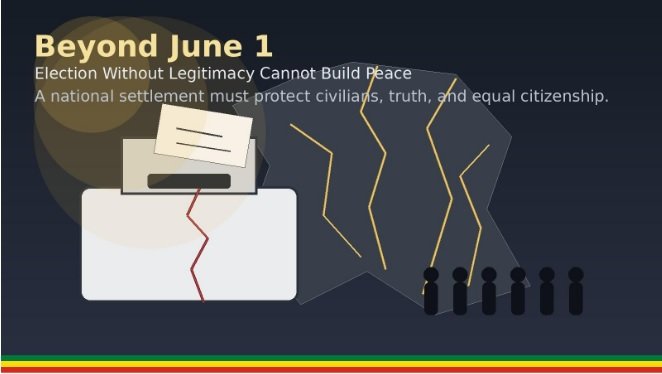
Together, these lenses lead to one conclusion: Beyond June 1, Ethiopia does not need the illusion of victory. It needs a national settlement.
II. What June 1 Revealed
June 1 revealed that Ethiopia’s crisis is not simply an election-management problem. It is a legitimacy problem. The vote took place while major political and security questions remained unresolved: insecurity affected parts of Amhara and Oromia, Tigray remained outside the federal electoral process, opposition actors complained of a narrowed political field, and citizens faced the daily burden of war, fear, inflation, displacement, and uncertainty.
The most important lesson is that formal participation cannot substitute for meaningful inclusion. The Associated Press reported that the electoral commission identified security incidents in Oromia and Amhara and that voting did not resume at 143 polling stations. AP also reported that Tigray did not participate again, leaving the region without federal representation after years of conflict and political rupture. These facts do not make every ballot meaningless, but they do show why the election cannot be treated as a full national settlement.
June 1 also revealed the ruling party’s institutional advantage. Abiy Ahmed’s Prosperity Party was widely expected to dominate the election, while opposition parties and human-rights voices raised concerns about shrinking political space. Al Jazeera, citing Reuters, described the ruling party as projected to win decisively even as polling did not take place in Tigray and some parts of Amhara because of insecurity.
The election further exposed the danger of normalizing democratic rituals without democratic substance. Amnesty International warned before the vote that Ethiopian authorities had intensified pressure on press freedom, while Reporters Without Borders ranked Ethiopia 148th of 180 countries in its 2026 World Press Freedom Index and stated that recent pressfreedom gains had been reversed amid conflict and fear of reprisals. When journalists fear punishment, citizens cannot fully know what they are voting for, voting for, or voting against.
Therefore, what June 1 revealed is not simply who is likely to control parliament. It revealed a deeper national question: can Ethiopia still build a political order where citizens trust the law more than force, institutions more than personalities, and citizenship more than ethnic patronage?
III. What This Paper Is Not Saying
This paper does not argue that elections are meaningless. Nor is it arguing that Ethiopia should abandon constitutional politics, peaceful civic struggle, or electoral participation. The argument is narrower and more urgent: an election held amid war, fear, displacement, restricted civic space, and unresolved constitutional crisis cannot by itself resolve Ethiopia’s legitimacy problem.
Ballots matter. But ballots without freedom, security, accountability, and trust risk becoming instruments of political closure rather than democratic renewal.
This paper is also not written against any Ethiopian people. Criticizing Abiy Ahmed’s government is not an attack on the Oromo people. Naming Amhara suffering is not a denial of
Oromo, Tigrayan, Afar, Somali, Sidama, Gurage, Gambella, Benishangul-Gumuz, Wolayta, Harari, or other suffering. Demanding justice for Tigray is not a defense of every TPLF decision. Defending Oromo civilians is not a justification for violence against Amhara civilians. Supporting Amhara civilian protection is not a call for revenge or domination.
The central argument is that all Ethiopians are endangered when state power becomes arbitrary, when institutions become instruments of one party or one leader, and when ethnic pain is used as a weapon.
IV. Legality Is Not Legitimacy
A government may claim legal victory while still facing a legitimacy crisis. Legality refers to procedures: voter registration, polling stations, counting, certification, and formal recognition. Legitimacy is deeper. It asks whether citizens believe the process was meaningful, whether opposition groups were free, whether journalists could report without fear, whether voters could participate without intimidation, and whether major regions and communities were politically included.
This distinction is essential for Ethiopia after June 1. A technically completed election may produce officeholders, but it cannot by itself heal war, displacement, arbitrary detention, ethnic mistrust, constitutional breakdown, or the collapse of confidence in national institutions.
If the election is used to silence these unresolved questions, it will deepen the crisis rather than resolve it.
A legal result may answer the question of who controls the state. It does not answer whether the state is trusted, whether citizens feel protected, whether communities believe they belong, or whether the political order has moral authority.
That is Ethiopia’s post-election danger.
V. The National Crisis Behind the Election
Ethiopia’s crisis did not begin with the June 1 election. It is rooted in deeper structural failures.
First, the post-1991 ethnic federal order organized political life around collective identity rather than equal citizenship. While it recognized diversity, it also hardened ethnic boundaries, territorialized identity, and created recurring competition over land, history, administrative control, and representation.
Second, Ethiopia’s ruling-party tradition has weakened independent institutions. Courts, election bodies, media regulators, security services, universities, and civil society organizations have often been vulnerable to ruling-party influence.
Third, the country lacks a trusted transitional justice process. Atrocities and abuses under successive regimes and recent conflicts remain unresolved. Each community remembers its own wounds while doubting the wounds of others.
Fourth, armed conflict has become a substitute for political settlement. The Tigray war, continuing instability in Oromia, the war in Amhara, and insecurity in other regions reveal the collapse of constitutional trust.
Fifth, civic space has narrowed. Amnesty International recently warned that Ethiopian authorities intensified pressure on press freedom ahead of the June 1 election, citing arrests, surveillance, accreditation problems, and media restrictions. Reporters Without Borders has also stated that many recent press-freedom gains in Ethiopia have been reversed amid conflict and fear of reprisals.
Sixth, the humanitarian situation remains severe. The International Organization for Migration’s 2026 Ethiopia Crisis Response Plan identifies continuing needs linked to conflict, displacement, climate shocks, disease outbreaks, and the search for durable solutions.
The election therefore takes place not above the crisis, but inside the crisis.
VI. The Unicorn Scenario: A Difficult but Possible National Reset
The Unicorn scenario is the best credible future. It is not fantasy. It is the narrow but real possibility that Ethiopia’s leaders, opposition actors, civic forces, religious institutions, diaspora organizations, and international partners recognize the danger before the country falls deeper into authoritarian consolidation or fragmentation.
In this scenario, June 1 does not become a final mandate for unchecked rule. Instead, it becomes a trigger for a national settlement.
The government would recognize that electoral victory is different from national legitimacy. Opposition actors would recognize that fragmented outrage is not a strategy. Armed groups would recognize that military struggle without political vision can deepen civilian suffering. Civic and religious leaders would recognize that silence is not neutrality.
A national reset would require several steps.
First, the government must open civic space. Political detainees, journalists, activists, and opposition figures should be released or given transparent due process. Media organizations should be allowed to report without intimidation. Civil society should be allowed to monitor abuse, document displacement, and advocate for victims.
Second, Ethiopia needs a credible national dialogue. Such a dialogue must not be symbolic. It must address constitutional reform, security-sector reform, transitional justice, regional autonomy, minority rights, political representation, and the future of ethnic federalism.
Third, civilian protection must become the non-negotiable foundation of politics. Amhara civilians, Oromo civilians, Tigrayan civilians, afar civilians, Somali civilians, Benishangul-Gumuz civilians, Gambella civilians, Gurage civilians, Sidama civilians, Wolayta civilians, Harari civilians, and all other Ethiopians must be protected equally.
Fourth, transitional justice must include all victims. Ethiopia cannot build peace if truth is divided by ethnicity.
The Unicorn scenario is difficult because it requires humility from those in power, discipline from those in opposition, and courage from those with moral authority. But it remains possible because Ethiopia still has civic energy, religious institutions, intellectual resources, women’s leadership, youth networks, diaspora capacity, and a long memory of survival.
VII. The Glitch Scenario: The State Appears to Function While Breaking Inside
The Glitch scenario is one of the most likely dangers.
In this scenario, Ethiopia continues to display the outer symbols of state functioning: elections, parliament, official speeches, development projects, diplomatic meetings, national ceremonies, and economic announcements. But underneath, the system continues to fail.
The election may be declared successful. The ruling party may claim a mandate. State media may present the result as proof of stability. International partners may use cautious diplomatic language. Yet the deeper reality may remain unchanged: conflict in Amhara and Oromia, unresolved political exclusion in Tigray, pressure on journalists, weakened opposition, continued displacement, and public fear.
This is the “glitch” of authoritarian electoral systems. The institutions exist, but their democratic meaning weakens.
Courts exist, but citizens doubt fairness.
Parliament exists, but citizens see domination rather than representation.
Media exists, but journalists fear punishment.
Federalism exists, but communities fear both the center and regional actors.
Elections exist, but competition is unequal.
The constitution exists, but citizens do not feel protected by it.
Human Rights Watch’s 2026 Ethiopia chapter reported that armed conflict between the government and Fano militia in Amhara continued through 2025, with warring parties accused of war crimes and serious abuses. It also described the broader human-rights situation as precarious, involving government security forces, militias, and non-state armed groups.
The Glitch scenario is not immediate collapse. It is managed instability. The state maintains enough control to claim order, but not enough justice to produce peace.
This scenario is dangerous because societies can live in managed instability for years while institutions quietly rot.
VIII. The Owl Scenario: Historical Wisdom and the Pattern of Consolidation
The Owl lens asks Ethiopians to step back from the immediate emotion of election day and observe the historical pattern.
Ethiopia has repeatedly experienced cycles of revolutionary promise, centralized power, militarized politics, elite fragmentation, ethnic fear, and unfinished transitions. Leaders often rise in the language of reform and national rescue. Over time, institutions weaken, dissent becomes suspect, and the state becomes personalized.
Prime Minister Abiy Ahmed came to power in 2018 with the language of reform, reconciliation, and democratic transition. Early optimism was real. Political prisoners were released, exiled groups returned, and many Ethiopians believed a new chapter had opened. But the country later experienced the Tigray war, continued conflict in Oromia, war in Amhara, widespread displacement, and growing concerns about democratic backsliding. Reuters reported that Abiy’s Prosperity Party is expected to dominate the 2026 election while opposition forces remain fragmented and weakened, with allegations of arrests and suppression that the government denies.
The Owl scenario warns that authoritarianism often arrives in the language of necessity. It says the country is too fragile for dissent. It says critics are enemies. It says journalists are destabilizers. It says opposition is sabotage. It says war requires emergency measures. It says elections confirm legitimacy even when competition is narrowed.
This is how power consolidates.
The lesson is not that Ethiopia is doomed. The lesson is that Ethiopia cannot survive another political cycle in which hope is invested in a leader instead of institutions.
A leader can inspire. Institutions protect.
A leader can promise. Institutions restrain.
A leader can mobilize. Institutions endure.
If Ethiopia is to survive, it needs constitutional limits, independent courts, professional security forces, free media, accountable parliament, regional protections, civic citizenship, and mechanisms for peaceful transfer of power.
The Owl scenario teaches that no ethnic group is permanently safe under arbitrary power. Today’s favored elite can become tomorrow’s prisoner. Today’s loyal region can become tomorrow’s suspected region.
Today’s silent intellectual can become tomorrow’s target. Authoritarian power respects only obedience.
IX. The Potato Scenario: Ordinary Ethiopians Carry the Weight
The Potato lens is humble and human. It asks what all this means for ordinary Ethiopians.
For the farmer, politics means whether he can plant without being displaced.
For the mother, politics means whether her son is detained, recruited, killed, or disappeared.
For the student, politics means whether school is open or interrupted by war.
For the merchant, politics means whether roads are safe.
For the journalist, politics means whether truth-telling leads to prison.
For the displaced family, politics means whether home still exists.
For the poor, politics means whether food, rent, transport, medicine, and school fees are still possible.
This scenario warns that elite politics can become detached from human life. Governments speak of development while citizens fear kidnapping, detention, inflation, drones, checkpoints, displacement, and hunger. Parties speak of victory while ordinary people ask how to survive tomorrow.
The Potato scenario insists that any national plan must begin with civilian protection.
Not slogans.
Not propaganda.
Not symbolic elections.
Not palace projects.
Not ethnic revenge.
Civilian protection.
A government that cannot protect civilians cannot claim full legitimacy. An opposition that ignores civilian suffering cannot claim moral leadership. A diaspora that turns pain into performance cannot claim seriousness. A religious institution that stays silent cannot claim moral authority.
The ordinary Ethiopian is not a footnote to the national question. The ordinary Ethiopian is the nation.
X. The Goldfish Scenario: Ethiopia Forgets Too Quickly
The Goldfish lens warns about political memory.
Ethiopia suffers not only from violence but also from forgetting. One crisis replaces another before truth is established. One massacre disappears beneath another. One region’s grief is weaponized against another region’s grief. One wave of arrests replaces the previous wave. One war overshadows another. One community remembers its own suffering while denying or minimizing the suffering of others.
This is how a country becomes trapped in competing wounds.
The Tigray war produced mass trauma. The Amhara conflict has produced deep fear, displacement, and insecurity. Oromia has suffered prolonged violence, repression, insurgency, and civilian vulnerability. Smaller communities have endured neglect, insecurity, and political marginalization. Yet instead of building a national memory, Ethiopia often builds ethnic memory.
The Goldfish scenario is dangerous because a country without memory cannot build justice.
Without justice, it cannot build trust.
Without trust, it cannot build citizenship.
Without citizenship, it cannot build peace.
This is why transitional justice is not a luxury. It is a survival mechanism.
Ethiopia needs a process that remembers all victims without blaming entire peoples. It must separate civilians from armed actors, communities from perpetrators, truth from propaganda, and accountability from revenge.
If Ethiopia forgets too quickly, June 1 will become only another date in a long history of missed opportunities.
XI. Five Possible Futures After June 1
- Authoritarian Consolidation
In this scenario, the ruling party claims a strong mandate and uses the result to deepen control. Opposition parties remain fragmented. Journalists and activists face more pressure. The state presents the election as proof that criticism is illegitimate. Conflicts in Amhara and Oromia continue. Tigray remains politically unresolved. International actors prioritize stability over democratic pressure.
This scenario may produce surface order, but it will not produce durable peace.
- Managed Instability
This is the Glitch scenario in practice. Ethiopia remains neither fully collapsed nor genuinely stable. The government controls major cities and institutions, but insecurity continues in contested regions. The economy struggles under the weight of conflict, displacement, and mistrust. Citizens become exhausted and politically numb.
This scenario is dangerous because it normalizes suffering.
- Expanded Fragmentation
In this scenario, conflicts worsen after the election. Armed actors gain recruits. Regional mistrust deepens. The state responds with more force, which produces more resistance. Tensions involving Tigray, Eritrea, Amhara, Oromia, or other regions become more dangerous. Local conflicts become national risks.
This scenario could turn Ethiopia from a troubled state into a permanently fragmented battlefield.
- Negotiated National Reset
This is the Unicorn scenario. The election becomes a wake-up call. The government, opposition, civic leaders, religious institutions, diaspora actors, and international partners recognize that Ethiopia cannot be governed through force alone. A serious national dialogue begins. Detainees are released or given due process. Civic space is restored. Constitutional reform is becoming unavoidable. Transitional justice begins.
This scenario is difficult, but it is the only path that offers durable legitimacy.
- Delayed Civic Awakening
In this scenario, the immediate post-election period worsens. But over time, citizens, intellectuals, religious leaders, women, youth, diaspora professionals, and democratic actors build a disciplined civic movement around minimum principles: civilian protection, constitutional reform, release or fair trial of detainees, media freedom, humanitarian access, and equal citizenship.
This scenario does not require immediate victory. It requires organized endurance.
XII. Minimum Agenda for a National Settlement
Ethiopia’s post-election crisis requires a minimum national settlement. Such a settlement should not wait for every historical disagreement to be solved. It should begin with shared principles necessary for survival.
A minimum national settlement should include:
- Civilian protection in every region.
- Release or fair trial of political detainees, journalists, activists, and opposition figures.
- Humanitarian access to conflict-affected communities.
- Independent review of election conditions.
- National dialogue with real authority, not symbolic consultation.
- Constitutional reform addresses ethnic federalism, minority rights, regional autonomy, equal citizenship, and freedom of movement.
- Transitional justice for all victims, without collective blame.
- Security-sector reform that prevents both centralized tyranny and regional warlordism.
- Protection of freedom of movement, residence, property, work, worship, and political participation across Ethiopia.
- A civic covenant that separates communities from perpetrators and citizens from ethnic stereotypes.
This minimum agenda is not a complete solution. It is the foundation without which no solution can survive.
XIII. The International Community Should Not Confuse Stability with Silence
International actors often prefer the language of stability when dealing with fragile states. But in Ethiopia, silence should not be mistaken for stability.
A country can appear calm in diplomatic meetings while civilians live under fear.
A government can speak of development while journalist’s self-censor.
An election can be completed while major regions remain politically excluded.
A state can claim sovereignty while citizens feel unprotected by law.
External partners should avoid treating election results as a substitute for political settlement. Ethiopia’s partners should prioritize civilian protection, humanitarian access, due process, press freedom, inclusive dialogue, constitutional reform, and transitional justice.
Supporting institutional reform is not hostility to Ethiopia. It is support for the survival of a state whose instability would affect the entire Horn of Africa.
The international community should also avoid the false comfort of “strongman stability.” Ethiopia does not need stability built on fear. It needs stability built on legitimacy.
XIV. What Democratic Ethiopians Should Do After June 1
The first task is to reject despair. Despair helps authoritarian power because it convinces citizens that nothing can change.
The second task is to reject reckless confrontation. Anger without strategy can cost civilian lives.
The third task is disciplined civic organization. Ethiopians need a national civic coordination platform that brings together credible voices from all communities. Its purpose should not be to erase political differences. Its purpose should be to defend minimum national principles.
Those principles should include civilian protection, due process, media freedom, humanitarian access, national dialogue, constitutional reform, transitional justice, and equal citizenship.
Amhara democratic actors must frame Amhara protection as part of a national rights agenda, not revenge or domination.
Oromo democratic actors must distinguish between Oromo dignity and the ambitions of any ruling elite.
Tigrayan democratic actors must demand justice for Tigray while joining a broader national process that recognizes all victims.
Smaller and marginalized communities must not be treated as bargaining chips among larger groups.
Religious leaders must defend the sanctity of civilian life.
Intellectuals must move from commentary to organized strategy.
Diaspora organizations must stop confusing noise with influence.
The country needs disciplined democratic leadership: leaders willing to subordinate ego to survival, faction to principle, and short-term advantage to national rescue.
XV. Why This Matters to All Ethiopians
The crisis of legitimacy matters to every Ethiopian because arbitrary power never remains confined to one region or one community. A system that can silence journalists today can silence religious leaders tomorrow. A system that can detain opposition figures in one region can criminalize dissent in another. A system that can normalize collective suspicion against one community can later redirect the same logic against any community that refuses obedience.
For Amhara, the crisis is existential because civilian protection, mass detention, displacement, and security abuse have created deep fear and anger. For Oromo, the crisis is also real because Oromia has suffered prolonged violence, insurgency, repression, kidnapping, and civilian vulnerability despite the prime minister’s Oromo background. For Tigray, the unresolved consequences of war and political exclusion continue to shape the region’s place in the federation. For smaller and marginalized communities, the danger is that their rights become bargaining chips in struggles among larger political forces.
This is why the article’s central message must be national rather than sectional: protecting Amhara civilians, defending Oromo civilians, acknowledging Tigrayan trauma, and protecting smaller communities are not competing causes. They are parts of one democratic principle. No Ethiopian community is safe when the state becomes unaccountable, and no national settlement can succeed if one people’s grief is used to deny another people’s pain.
The path forward must therefore be framed as a civic covenant. The minimum promise should be simple: no civilian should be targeted because of identity; no journalist should be punished for truth-telling; no region should be excluded from national decision-making; no political leader should stand above accountability; and no Ethiopian should have to choose between ethnic dignity and equal citizenship.
XVI. Conclusion: The Election May End, but the Crisis Will Continue
June 1 will pass. Speeches will be made. Results will be announced. The ruling party may claim victory. Some international actors may use diplomatic language. Government media may speak of mandate. Opposition voices may protest. Citizens may return to daily survival.
But Ethiopia’s real question will remain unanswered: Can the country build a state that protects all its citizens?
If the answer is no, then no election can save Ethiopia.
If the answer is yes, then June 1 can still become more than a ritual. It can become a warning that forces Ethiopians to organize before the state breaks further.
The question after June 1 is not whether the ruling party can claim victory. The question is whether Ethiopia can still imagine a political future beyond fear. A government can win an election and still lose the trust of its people. A country can hold a vote and still fail to build peace.
Beyond June 1, Ethiopia’s survival will depend not on the announcement of results, but on whether Ethiopians can build a national settlement rooted in truth, civilian protection, constitutional reform, transitional justice, and equal citizenship.
Without that settlement, the election may end, but the crisis will continue
Editor’s Note: Views in the article do not necessarily reflect the views of borkena.com
__
Join our Telegram Channel : t.me/borkena
Like borkena on Facebook
To submit Press Release, send submission to info@borkena.com
Add your business to Ethiopian Business Listing / Ethiopian Business Directory
Join the conversation. Follow us on X (Formerly Twitter) @zborkenato get the latest Ethiopian News updates regularly.
To Support Borkena : https://borkena.com/subscribe-borkena/ – one time support or small monthly options available. Inquire information about it : info@borkena.com