
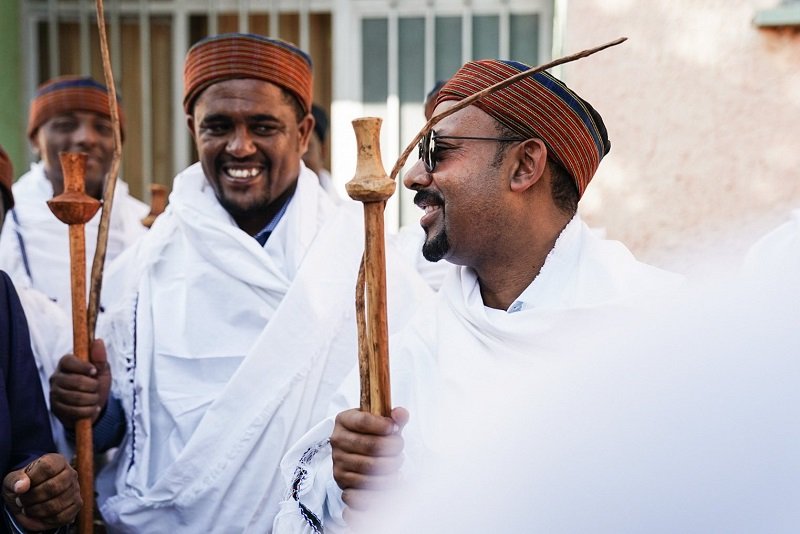
In fractured societies like those in Ethiopia and the larger Horn of Africa, politics often becomes a marketplace where ethnicity is a gateway, and loyalty is traded for advantage. “Ethnic entrepreneurs” are individuals or groups who mobilize ethnic identity not primarily for collective welfare but as a vehicle for personal or factional gain. This phenomenon has gained traction globally and become ubiquitous in Ethiopia, particularly since the 1990s.
This week has been very busy with ethically aligned and orchestrated defenses of Prime Minister Abiy Ahmed Ali amid sharp international scrutiny. Such blind allegiance includes Paul Delkaso’s rebuttal to The Economist’s latest article on Ethiopia’s political trajectory, illustrate this dynamic.
To set the record straight, Delkaso is a diaspora businessman with expanded investments in East Africa, including Ethiopia. He attempted to chastise The Economist’s coverage as “misreading Ethiopia’s complexities through noisy analysis framed in a little box.” Delkaso’s futile rebuttal was to The Economist’s article that provided incontrovertible and yet devastating accounts of Abiy’s centralizing ambitions, failed economic reforms, and regional posturing as carrying dire risks of authoritarian drift and instability in the Horn. With elections looming, the article raised several critically important issues. These include suppressing dissent, intimidating and imprisoning rivals, ongoing conflicts in the Amhara and Oromia regions, unresolved Tigray war, and a vision of Ethiopian dominance that could inflame internal ethnic tensions and entrench devastating wars in the Horn of Africa.
Opportunity in Turmoil
We clearly see something familiar in Delkaso’s rebuttal that it is not a principled, but a calculated opportunism aimed at extracting benefits from the ethnocratic system at colossal cost to the nation, the economy, and its citizens.
Paul Delkaso serves as President and CEO of Tristar Group LLC and Tritente Global Energy Group (TGEG). He has a track record in large-scale energy (wind, solar), mining, commodity trading, and infrastructure projects across Sub-Saharan Africa. His companies have pursued multi-billion-dollar deals in Ethiopia, including wind farms with Ethiopian Electric Power. Delkaso’s interests further extend explicitly into port logistics and multimodal infrastructure. He has a long-standing involvement in rail, port, and related projects. More recently, he has promoted ambitious concepts for Ethiopian sea access, such as new deep-water port developments and integrated corridors involving Djibouti, Eritrea, and Somaliland. This aligns closely with Ethiopia’s ongoing push to liberalize and partially privatize its logistics sector, including the state-owned Ethiopian Shipping & Logistics Services Enterprise (ESLSE). The claimed reforms under Abiy aim to attract foreign direct investment, modernize dry ports, rail, and freight operations in a country still seeking reliable maritime outlets since losing its coastline. Those exploiting any available business opportunities are ethnic entrepreneurs along with ethnically moulded political parties.
Moreover, Delkaso has publicly championed partnerships with DP World, the Dubai-based global ports and logistics giant. He has described potential collaboration as “thrilling” for the Horn, highlighting enhanced Red Sea connectivity, trade efficiency, economic gains, and even security benefits. DP World already operates Berbera port in Somaliland (with historical Ethiopian transit interest) and has engaged Ethiopian officials on dry ports, logistics modernization, and privatization opportunities. While no formal direct partnership between Delkaso’s firms and DP World is publicly confirmed, the alignment is clear: vocal political advocacy can serve as effectivesignaling in environments where government relationships influence tender access, joint ventures, and advisory roles.
This fits the pattern of ethnic entrepreneurship thriving in state fragility and vulnerability. Crises—post-conflict reconstruction, debt pressures, and infrastructure gaps—create voids filled by well-connected players. Defending the regime often becomes a pathway to extractive opportunities: energy contracts, logistics concessions, and regional corridor projects. It is not merely about supporting policy; it is about positioning for profit maximization amid the very instability critics highlight.
Moral Compass and Accountability
There are well-documented research findings that clearly show that ethnic entrepreneurs lack a moral compass, particularly on matters of democracy or free and fair elections. Delkaso’s arguments in defense of Abiy and his autocratic governance resonate because accountability should transcend identity or self-interest. Ethiopia has seen more than its share in terms of postponed elections, imposed media restrictions, intimidated and arrested opponents, and state-sponsored violence that killed and displaced millions. Abiy entered with a reformist promise and a Nobel Peace Prize, yet his governance has trended toward centralization, autocracy, and arch dictatorship. This notwithstanding, his supporters highlight infrastructure gains, skyscrapers, a clean capital city, and economic opening. The records, however, paint grim realities: repression, deception, pathological lies, recurring violence, and conflicts. Honest analysis requires weighing both, not a reflexive defense that conveniently overlaps with business interests and prospects.
True statesmanship prioritizes modern and dynamic institutions over strongmen, conflicts, or ethnic cleavages. Greed-driven and ethnically facilitated maximization of profit, notably through investments in infrastructure, logistics, or energy privatization, undermines the fostering of credible, legitimate, and functioning democratic institutions. History shows that ethnic entrepreneurship often exacerbates fractionalization: it entrenches zero-sum thinking, deters broad-based investment, and leaves ordinary citizens bearing the costs while elites secure rents.
Broader Lessons
This phenomenon is not confined to Ethiopia or one individual. From the Balkans to post-colonial Africa, identity entrepreneurs have exploited transitions for advantage, often prolonging suffering. They destroyed nations, divided citizens, and led to the most heinous crimes on earth. Practical and forward-looking solutions demand:
• Stronger, ethnicity-neutral institutions, governance, and rule of law.
• Transparent procurement that reduces patronage in sectors like infrastructure, including logistics and energy.
• Media and civil society scrutinizing all sides, including diaspora business voices.
• Diaspora contributions focused on genuine value addition rather than apologia for power just for the sake of exploiting opportunities or extracting profits.
Defending a leader or critiquing foreign media is legitimate. But when advocacy consistently aligns with extractive opportunities—such as eyeing privatized logistics corridors and DP World-style collaborations amid “the crisis engulfing Ethiopia and the Horn”—skepticism is warranted. Citizens deserve leaders and advocates guided by conscience, not just self-interest or profit calculations. Until ethnic entrepreneurship yields to genuine public service, unfortunately, Ethiopia’s political messes will persist—profitable for a few, ruinous for the large majority.
Editor’s Note : Views in the article do not necessarily reflect the views of borkena.com
__
Join our Telegram Channel : t.me/borkena
Like borkena on Facebook
To submit Press Release, send submission to info@borkena.com
Add your business to Ethiopian Business Listing / Ethiopian Business Directory
Join the conversation. Follow us on X (Formerly Twitter) @zborkenato get the latest Ethiopian News updates regularly.
To Support Borkena : https://borkena.com/subscribe-borkena/ – one time support or small monthly options available. Inquire information about it : info@borkena.com
“Citizens deserve leaders and advocates guided by conscience, not just self-interest or profit calculations. Until ethnic entrepreneurship yields to genuine public service, unfortunately, Ethiopia’s political messes will persist—profitable for a few, ruinous for the large majority.”
PP is following the same script its stepfather ‘TPLF+’ that used the same tactic to enrich it self and its clicks for nearly 30 years; and we all know how that ENDED.
We also seen the same similar GLEE shown in the picture from the previous scoundrels (wolfs in sheep-clothing) that lasted their group-looting for a while but NO LONGER.
Ethiopians didn’t fight foreign invaders multiple times for centuries, to capitulate to local (homegrown) LOOTS.
POWER & Money are intoxicating by their nature, as history repeatedly show individuals or groups without deep rooted unshakable CONVICTIONS are destined to fail to way side at some point in time, eventually (all of a sudden) no one can escape that TRAP; (2017-18 serves as a recent example, if not the one before it in the 1990’s). As Ethiopia North to South, East to West, marches forward in seeking genuine & uncompromising LEADERSHIP.
” How Power Works”
link = youtube.com/watch?v=ajFXykT9Joo
“‘ምከረው፤ ምከረው ፤ ካልሰማ (አለበለዚያ) መከራ ይምከረው።”
Be well.
Why is this author using photos these officials dressed up in Oromo costume? What wrong in it he is trying to tell us? Is he pointing to the readers it is how bad people dress up. It is like saying that attractive hairdo by our beautiful Tigre women belongs to bad people. That is wrong and outright bigotry.