
By Ewunetu Teshale
Introduction
Few political phrases have shaped modern Ethiopian history as profoundly as the simple demand: “Must Go.”
For more than a century, successive generations of Ethiopians have challenged rulers, governments, and political movements, believing that national renewal begins when those in power leave the political stage.
One generation opposed Menelik II. Another challenged Lij Iyasu. Later generations mobilized against Haile Selassie, the Derg, the EPRDF, and subsequent administrations. Today, similar debates continue to shape the political landscape.
Yet despite repeated political transitions, many of the nation’s fundamental challenges persist.
This reality raises an uncomfortable but necessary question:
Can a nation transform itself merely by replacing leaders?
Different periods have produced different leaders, different governments, and different ideological struggles, yet the underlying political narrative has remained remarkably consistent.
The names have changed.
The political parties have changed.
The ideologies have changed.
Yet the recurring belief remains: national renewal begins when the current leadership leaves.
This article argues that while leadership transitions are an essential feature of political development, no nation achieves lasting transformation merely by replacing leaders. Ethiopia’s political history suggests that political succession, though important, is not sufficient. Sustainable national progress depends on something deeper: the strength of institutions, the culture of citizenship, the quality of public dialogue, the rule of law, and the collective capacity of citizens to build a shared future.
The challenge facing Ethiopia today is therefore not simply political transition. It is political transformation.
The question is not merely who should govern.
The more fundamental question is:
What kind of nation do Ethiopians seek to build together?
The Endless Cycle of Political Replacement
Modern Ethiopian history reveals a recurring pattern. Political dissatisfaction grows, opposition movements gain momentum, and citizens increasingly become convinced that the existing order has exhausted its legitimacy. Demands for change intensify, the old political order eventually gives way, and a new generation of leaders assumes office amid high public expectations. For a period, optimism flourishes. Citizens anticipate reform, prosperity, justice, and national renewal. Yet over time, structural realities reassert themselves. Economic challenges persist, political disagreements continue, and new grievances emerge. Gradually, hope gives way to disappointment, and another generation begins to repeat the familiar demand: “They must go.”
This phenomenon is not unique to Ethiopia. Many societies have experienced similar cycles. Yet Ethiopia’s experience raises a critical question: Can a nation transform itself merely by changing leaders?
History suggests otherwise.
Leadership matters, but leadership alone is insufficient. Durable national development requires strong institutions, independent courts, accountable government, economic opportunity, public trust, and a shared civic culture. Nations are strengthened not only by who governs them but by the institutions and values that endure beyond individual administrations.
From Political Exclusion to Political Conversation
One of the most persistent challenges in Ethiopian political culture has been the tendency to treat politics as a contest in which one side must ultimately defeat, silence, or exclude the other. Political disagreement is frequently interpreted as hostility, criticism as betrayal, and opposition as enmity. Yet societies are rarely strengthened by permanent exclusion. No democracy can flourish when political competition becomes a struggle for survival rather than a contest of ideas.
The metaphor of the roundtable offers an alternative vision.
Unlike a throne, a roundtable has no permanent ruler. Unlike a battlefield, it has no permanent enemy. Every participant has a voice. Every seat possesses dignity. Its symbolism is dialogue rather than domination, participation rather than exclusion, construction rather than destruction.
This vision does not require political agreement. It requires political maturity.
The future of Ethiopia cannot be built by one party, one region, one ideology, one generation, or one political tradition alone. It must be built through conversation, compromise, institutional development, and a commitment to the common good.
The Empty Chair at the Center
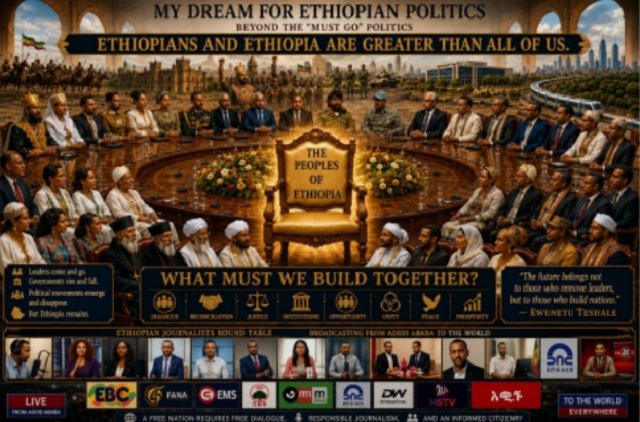
Imagine a large national roundtable where representatives of Ethiopia’s many historical experiences and political traditions are gathered. Emperors and revolutionaries, reformers and opposition leaders, religious voices and civic actors, all occupy seats around the table.
At the center stands a single empty chair.
Upon it are written the words: THE PEOPLES OF ETHIOPIA
Ethiopia is home to many peoples, languages, cultures, religions, and historical experiences. Yet despite this diversity, all citizens share a common stake in the nation’s future. The chair therefore represents both unity and diversity, the collective sovereignty of Ethiopia’s peoples and their shared ownership of the state. The chair remains intentionally vacant because it belongs to no government, no political party, no military establishment, and no ideological movement. It belongs to the peoples.
The empty chair symbolizes a fundamental democratic principle: political leaders are stewards rather than owners of the state.
Governments rise and fall.
Political movements emerge and disappear.
Leaders come and go.
But the people remain.
The chair serves as a reminder that every political decision should ultimately answer a simple question: Does this serve the people seated in the empty chair?
A Dream for Ethiopia
My dream is not that one political group triumphs over another. My dream is for Ethiopia to develop a political culture mature enough to place the nation above factional interests.
I dream of a politics where ideas matter more than personalities, institutions matter more than individuals, service matters more than power, and competence matters more than slogans.
I dream of a country where criticism is not considered treason, disagreement is not considered hatred, and political competitors are not considered enemies.
Most importantly, I dream of a political culture in which leaders are judged by integrity, accountability, vision, and results rather than by ethnic, regional, or partisan loyalties.
Conclusion: From “Must Go” to “Must Build”
There is a popular proverb in Ethiopia that says:
“The known devil is better than the unknown angel.”
Whether one agrees with the proverb or not, it reveals an important feature of human nature: our tendency to prefer the familiar over the uncertain, even when the familiar has repeatedly disappointed us.
For generations, Ethiopian politics has often been shaped by this tension between dissatisfaction with the present and fear of the unknown future. Political transitions have frequently revolved around personalities rather than institutions, loyalties rather than principles, and political replacement rather than national transformation.
Yet, Ethiopia’s challenge is not merely deciding who should govern next.
The greater challenge is creating a political environment in which capable, ethical, visionary, and service-oriented leaders can emerge, compete fairly, and contribute to the nation regardless of their political background.
Every generation produces individuals of wisdom, courage, integrity, and public spirit. Unfortunately, political polarization, exclusion, and mutual suspicion often prevent the nation from benefiting fully
from their contributions. When politics becomes a struggle between permanent winners and permanent losers, the country loses access to some of its best ideas, its most talented citizens, and its most constructive voices.
The future of Ethiopia will not be secured by the permanent victory of one political tradition over another. It will be secured by building institutions strong enough to outlast political cycles, disagreements, and leadership changes.
This is why the image of the empty chair matters.
At the center of the national roundtable sits a chair labeled: THE PEOPLES OF ETHIOPIA
The chair remains empty because no leader owns it.
No government owns it.
No political party owns it.
No ideology owns it.
It belongs to the people.
The empty chair reminds every generation that political power is temporary, but the nation endures.
Leaders come and go. Governments rise and fall. Political movements emerge and disappear. But Ethiopians and Ethiopia remain.
The measure of political success is therefore not simply who wins power or who loses it. The true measure is what is left behind for future generations.
Will they inherit stronger institutions? Will they inherit greater trust?Will they inherit justice, opportunity, and peace? Will they inherit a political culture capable of managing disagreement without division?
These are the questions that matter.
Perhaps the next chapter of Ethiopian politics should no longer be defined by the phrase “Must Go.”
Perhaps it should be defined by a new national commitment:
“Must Build”
Must build institutions that outlast leaders.
Must build trust that transcends political divisions.
Must build a culture of citizenship stronger than ethnic, regional, or partisan loyalties. Must build a political system where competition strengthens rather than weakens the nation. Must build a future worthy of Ethiopia’s history and its people’s aspirations.
For history does not ultimately remember nations for how many leaders they removed. History remembers nations for what they built.
And the future will belong not to those who merely inherit power, nor to those who merely oppose it, but to those who possess the wisdom, courage, and vision to build a stronger Ethiopia for generations yet unborn.
Editor’s Note : Views in the article do not necessarily reflect the views of borkena.com
__
Join our Telegram Channel: t.me/borkena.
Like borkena on Facebook
To submit a press release, send the submission to info@borkena.com
Add your business to Ethiopian Business Listing / Ethiopian Business Directory
Join the conversation. Follow us on X (formerly Twitter) @zborkenato to get the latest Ethiopian news updates regularly.
To Support Borkena : https://borkena.com/subscribe-borkena/—one-time support or small monthly options available. Inquire information about it : info@borkena.com