
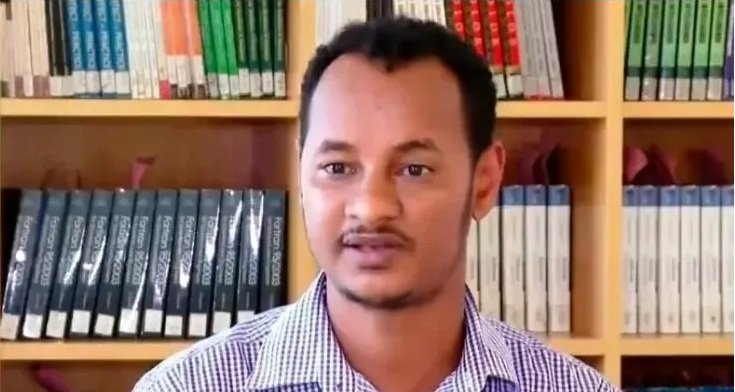
By Surafel Getahun
Abiy Ahmed’s sham vote excludes millions of IDPs, unfolds amid armed conflict in Amhara and Oromia, and fails every democratic test – yet the world stays silent.
The Grand Illusion
On the morning of June 1, 2026, polling stations across Ethiopia will open their doors. National flags will flutter. Electoral officials in crisp vests will gesture voters toward plastic booths. International cameras will capture smiling citizens holding up purple-stained fingers. And by the end of the following week, Prime Minister Abiy Ahmed will stand before a podium, raise a certificate, and declare a landslide victory.
Do not be fooled. What you are witnessing is not an election. It is a coronation dressed in ballot paper – a meticulously choreographed exercise in authoritarian legitimacy designed to manufacture consent where none exists.
Let me be direct: Ethiopia’s June 1 poll is a sham. It excludes over two million internally displaced persons. It takes place amid active armed conflict in Amhara and Oromia. It offers zero genuine civic participation. I write this not as a detached observer, but as someone who has followed Ethiopia’s democratic trajectory for years. What I have seen convinces me beyond any doubt: the June 1 poll is a sham – a hollow ritual that fails every single minimum requirement of a democratic election.
Let me lay out the case, piece by piece, evidence by evidence, so that no reader can later claim they did not know
The First Pillar of Democracy: Civic Participation – Crushed
Free and fair election begins long before election day. It requires a society where citizens can organize, criticize, campaign, and choose without fear. It requires opposition parties that can hold rallies, newspapers that can publish critiques, and activists who can hand out leaflets without being dragged to a cell.In Ethiopia today, that world does not exist.
The Jailing of Opposition
Since the beginning of 2026, the Abiy administration has intensified a crackdown on political rivals. Prominent opposition figures – including leaders of the Oromo Federalist Congress (OFC) and the Ethiopian Citizens for Social Justice party (Ezema) – remain in detention under the country’s draconian Anti-Terrorism Proclamation. The charges are laughable on their face: “conspiring to destabilize the state” for criticizing government policies, “inciting violence” for calling for fair elections.
I obtained a list from a legal aid group based in Addis Ababa: at least 47 opposition politicians and activists have been arrested in the three months leading to June 1. Of those, 12 are still held without charge. The rest face show trials where judges are appointed by the executive.
The Muzzling of Media
Ethiopia’s media environment, once cautiously opening after Abiy came to power in 2018, has collapsed into a government megaphone. The state-owned Ethiopian Broadcasting Corporation (EBC) has devoted, according to a monitoring report released this week by the Ethiopian Human Rights Council (EHRCO), 94.2% of all election-related airtime to Prime Minister Abiy and the Prosperity Party.The remaining 5.8% is split between minor allied parties – none of which offer any substantive criticism. Genuine opposition voices have been erased. Private newspapers that attempted to cover opposition rallies have had their licenses suspended.
Intimidation at the Grassroots
The most insidious suppression happens far from Addis Ababa’s headlines. In rural kebeles across Oromia, Amhara, and the Southern Nations region, local administrators have become de facto campaign managers for the Prosperity Party.
A humanitarian worker who operates in western Oromia (and who spoke on condition of anonymity for fear of losing access) told me: “In the districts we work, kebele chairmen have gathered community members and said, ‘The government knows how you vote. Food aid, land certificates, even permission to travel – these depend on your loyalty.’ People are terrified. They will vote for Abiy not because they want to, but because they fear hunger.”
This is not democracy. This is coerced compliance. An election where the state threatens to starve those who vote against it is not measuring public will – it is manufacturing a predetermined result.
The Second Pillar of Democracy: Universal Suffrage – Over Two Million Excluded
Article 21 of the Universal Declaration of Human Rights states: “Everyone has the right to take part in the government of his country, directly or through freely chosen representatives.” The International Covenant on Civil and Political Rights (ICCPR), which Ethiopia has ratified, requires that elections guarantee “universal and equal suffrage.”The June 1 election shreds that guarantee.
The IDP Crisis by the Numbers
As of May 2026, the United Nations Office for the Coordination of Humanitarian Affairs (OCHA) estimates there are 2.34 million internally displaced persons (IDPs) in Ethiopia. These are Ethiopian citizens who fled their homes due to ethnic violence – much of it unleashed or worsened under Abiy’s watch. They live in overcrowded camps, abandoned buildings, or open fields. They have no homes, no livelihoods, and, as it turns out, no vote.
Where are these IDPs? Let me break it down by region:
Oromia: Approximately 820,000 IDPs – victims of the ongoing OLA-government conflict and earlier ethnic cleansings in Wollega and Guji zones.
Amhara: Approximately 610,000 IDPs – displaced by fighting between Fano militias and federal forces, as well as the spillover from the Tigray war.
Tigray: Approximately 550,000 IDPs – though this region is not even participating in the June 1 election due to continued hostilities, meaning its IDPs have zero access.
Benishangul-Gumuz & Other Regions: Approximately 360,000 IDPs.
Total: 2.34 million Ethiopian citizens who will be effectively disenfranchised on June 1.
How They Are Excluded – The Technical Trap
To understand why IDPs cannot vote, you need to understand Ethiopia’s voter registration system. Each citizen is registered at a specific polling station in their kebele of origin – their home administrative district. To vote, you must appear in person at that station with your ID.
An IDP, by definition, no longer lives in their kebele of origin. Their village may be burned. Their district may be controlled by armed groups. The road may be mined. But NEBE has made zero special provisions for IDPs: no mobile polling stations in camps, no absentee ballots, no temporary registration in host communities.
Why This Exclusion Is a Political Choice
The government will claim that IDP exclusion is a logistical problem – that Ethiopia is poor, that conflict zones are hard to reach. This is a lie.
Logistical solutions exist. Mobile polling units cost very little. Temporary registration in host communities requires only a simple administrative order. Absentee ballots have been implemented in dozens of countries with far fewer resources than Ethiopia.
The real reason IDPs are excluded is political. IDPs disproportionately come from regions and ethnic groups that oppose Abiy’s government. In Oromia, IDPs often harbor deep resentment against the government for failing to protect them. In Amhara, IDPs include many who sympathize with the Fano militia. Excluding them is a convenient way to suppress millions of likely opposition votes without firing a shot.
Let us call this what it is: voter suppression on a mass scale. It is no different from poll taxes or literacy tests in the Jim Crow American South. It is an intentional, cynical, anti-democratic act.
The Third Pillar of Democracy: Security – Voting Amidst Bullets
You cannot hold a free and fair election when polling stations are in active war zones. Yet on June 1, that is exactly what Ethiopia will attempt.
Amhara: The Fano Insurgency and Military Occupation
The Amhara region has been in a state of high -intensity civil war for over two years. The Fano militia an organized armed movement that accuses Abiy of marginalizing Amhara interests – controls significant territory in North Wollo, South Gondar, East and West Gojjam, and parts of North Shewa.
I have seen field reports from humanitarian groups. In these zones, government forces control only the main roads and town centers. Rural areas are Fano country. Regular clashes occur weekly, with dozens of civilians killed in crossfire.
NEBE’s solution? Deploy federal troops to “secure” polling stations. In practice, this means:
Voters must pass through military checkpoints to reach the ballot box.
Polling stations are surrounded by armed soldiers – often from other regions, speaking different languages, viewed as occupiers by local communities.
In at least 30 constituencies across Amhara, NEBE has already announced that elections are “postponed indefinitely” – a diplomatic way of saying they cannot function.This is not voting. This is voting under occupation.
Oromia: The OLA Insurgency and Government Drones
Oromia, the largest and most populous region, is also a theater of war. The Oromo Liberation Army (OLA) maintains an active insurgency across West Wollega, East Wollega, Kelam Welega, Guji, and parts of Borena and Shewa zones. The group has carried out dozens of attacks on government convoys and civilian infrastructure in 2026 alone.
In OLA-controlled or contested areas, NEBE has either canceled voting outright or plans to hold elections under heavy military escort. In either case, the result is the same: no free vote.What’s worse, the government has been using armed drones to conduct airstrikes in Oromia as recently as this month. The same drones that drop bombs on villages are being used to “provide security” for polling stations. Can anyone seriously argue that a person who fears being bombed by the same government running the election is voting freely?
Tigray: No Election at All
Let us not forget Tigray. The June 1 election will simply not be held in most of the Tigray region due to continued tensions after the 2020-2022 war. The federal government does not control large parts of Tigray. The regional interim administration is a fragile arrangement. Millions of Tigrayans – including approximately 550,000 IDPs – will have no opportunity to vote for their leaders.
Whem a country of 130 million people holds an election that excludes an entire region of over 6 million, that election is not national. It is regional theater.
The Fourth Pillar of Democracy: Independent Institutions – NEBE as a Rubber Stamp
A democratic election requires an electoral commission that is independent, impartial, and trusted by all parties. Ethiopia’s National Electoral Board (NEBE) is none of those things.
Under pressure from international donors, NEBE was reformed in 2024. On paper, it has representatives from opposition parties. In practice, the leadership is appointed by the executive, and all major decisions are made to favor the Prosperity Party.
Let me provide specific evidence:
Voter registration manipulation: In several constituencies in Addis Ababa and Oromia, opposition-aligned areas saw their voter registration periods shortened or their polling stations reduced, while pro-government areas received extra stations and longer hours.
Candidate disqualification: At least 11 opposition candidates were disqualified for “incomplete paperwork” – a common trick to remove viable challengers. Meanwhile, Prosperity Party candidates with similar paperwork flaws were quietly approved.
Lack of transparency: NEBE has refused to release detailed maps of polling station locations in contested zones, making independent monitoring impossible. International observer groups (from the EU and Carter Center) were either denied accreditation or withdrew, citing lack of access.
A former NEBE official who resigned in protest earlier this year told me: “The board meetings are scripted. The chairperson takes instructions from the Prime Minister’s office. We are not an electoral commission – we are a printing press for rubber stamps.”
The Fifth Pillar: Genuine Choice – A Preordained Outcome
Democracy requires that voters have at least two viable alternatives. When the outcome is known before the first ballot is cast, the exercise is meaningless. On June 1, Ethiopians will face a ballot paper with Abiy Ahmed’s Prosperity Party as the only serious option. Major opposition parties have either been banned, boycotted, or reduced to paper tigers.
Oromo Federalist Congress (OFC): Boycotted. Its leaders are in prison or exile.
Ethiopian Citizens for Social Justice (Ezema). Its leaders are in prison or exile.
Balderas Party: Boycotted. Its headquarters in Addis Ababa was raided by police in March.
Minor allied parties (such as the Ethiopian National Democratic Party): These are often front organizations for the Prosperity Party, fielding candidates who have no intention of winning and who routinely endorse Abiy after the election.
The result is a foregone conclusion. Abiy will win more than 90% of parliamentary seats. The only suspense is whether the margin will be 92% or 97% – a difference without a distinction.
The International Response: Deafening Silence
Given the overwhelming evidence of a sham election, one might expect international condemnation. Instead, we hear whispers.
The European Union declined to send a full observer mission, citing “lack of minimum conditions.” But the EU did not call the election illegitimate. It will likely continue aid flows and diplomatic engagement.
The United States State Department issued a statement expressing “concerns about the pre-election environment” but stopped short of any meaningful action. Sanctions? None. Visa bans for Ethiopian officials? None. Public declaration that the election fails democratic standards? None.
The African Union sent a small technical team – barely a dozen people – to observe. This is the same AU that has a declared principle: “No election monitoring without invitation from the host country.” Ethiopia invited them, but the AU has neither the mandate nor the appetite to call a friend a fraud.
Why the silence? Because Ethiopia is geopolitically important. It hosts the African Union headquarters. It contributes troops to peacekeeping missions in Somalia and South Sudan. It is a Western ally in the fight against Al-Shabaab. Western capitals fear that calling the election a sham would push Ethiopia into the arms of China or Russia.
This realpolitik is understandable. But it is also complicity. Every diplomat who shakes Abiy’s hand after June 1, every aid dollar that flows without condition, every joint communiqué that praises “progress” – these acts normalize authoritarianism. They tell Abiy that he can exclude millions, bomb his own citizens, crush all dissent, and still enjoy Western approval.
Why Authoritarian Legitimacy Matters – The Strategy Explained
Some readers might ask: if the election is a sham, why does Abiy bother? Why not simply rule by decree?
The answer is a concept political scientists call authoritarian legitimacy. Authoritarian leaders understand that raw force is expensive and unsustainable. They need a narrative – a story that justifies their rule to the public and to the world. Elections are a powerful tool in storytelling.
Abiy needs the June 1 election for three strategic reasons:
Domestic narrative: After the election, Abiy will claim that he was “democratically re-elected by the people.” This narrative allows him to label armed groups (Fano, OLA) as “anti-democratic terrorists” who are attacking the will of the people. Any resistance becomes criminal, not political.
International shield: Western donors and multilateral institutions are reluctant to impose sanctions on a country that holds periodic elections – even bad ones. By producing a ballot box result, Abiy hopes to continue receiving billions in aid, loans, and diplomatic support.
Internal party control: A manufactured landslide victory gives Abiy the authority to purge rivals within the Prosperity Party. He can say: “The people have spoken. They support my leadership. Anyone who opposes me is opposing the people.” This is a classic strategy for autocrats to consolidate power.
This is not governance. This is political theater – with real consequences, real bullets, and real suffering as the backdrop.
What Happens After June 1?
PThe election will happen. Abiy will declare victory. His party will control parliament. The international community will issue mild statements of concern and then move on to other crises.
But the underlying problems will not disappear. If anything, they will worsen.
In Amhara: Fano will not accept the result. Expect an escalation of attacks on government positions, possibly leading to a full-scale military offensive.
In Oromia: The OLA will use the sham election as a recruiting tool – “the government does not represent you” – leading to a prolonged insurgency.
Among IDPs: The 2.3 million displaced citizens will have even less reason to trust the state. Expect continued humanitarian suffering and simmering resentment.
Among opposition supporters: The boycott and crackdown will push many toward radicalization. The democratic path has been closed. Some will turn to violence.
In short, the sham election will not bring peace. It will fuel more conflict. Because when you deny people the right to vote – truly, freely, inclusively – you leave them only one option: the bullet.
Conclusion: A Coronation, Not a Choice
On June 1, 2026, millions of Ethiopians will walk to polling stations. They will dip their fingers in purple ink. They will drop ballots into boxes. And the world will see photographs of a nation voting.
But do not be deceived.
There is no genuine civic participation – opposition leaders are jailed, media is muzzled, and local administrators coerce votes.
There is no universal suffrage – over 2.3 million IDPs have been systematically excluded.
There is no security – armed conflict rages in Amhara and Oromia, with polling stations under military occupation.
There is no independent electoral commission – NEBE is a rubber stamp for the executive.
There is no genuine choice – the outcome was preordained before the campaign began.
This is not an election. This is a coronation dressed in ballot paper.
Prime Minister Abiy Ahmed will stand on a podium and declare victory. But he will not have earned it. He will have manufactured it – through coercion, exclusion, intimidation, and violence.
History will judge Ethiopia’s leaders harshly for this sham. But history will also judge the international community – the diplomats who smiled, the donors who wrote checks, the observers who looked away. Silence is complicity.
To the Ethiopian people: you deserve better. You deserve a real democracy – where your vote is free, your voice is heard, and your displacement does not mean your erasure.
To the world: stop pretending. Call this what it is.
And to Abiy Ahmed: a ballot box does not make you a democrat. It only makes you a dictator with better props.
Surafel Getahun is a Political Science and International Relations lecturer,researcher, seasoned political analyst, and journalist. With numerous insights into the Horn of Africa’s geopolitics, diplomacy, and conflicts, he has published several scholarly articles and numerous analyses in various national and international media outlets.Surafel
Pull Quote for Print Layout:
“This is not an election. This is a coronation dressed in ballot paper. A ballot box does not make you a democrat – it only makes you a dictator with better props.”
Editor’s Note : Views in the article do not necessarily reflect the views of borkena.com
__
Join our Telegram Channel : t.me/borkena
Like borkena on Facebook
To submit Press Release, send submission to info@borkena.com
Add your business to Ethiopian Business Listing / Ethiopian Business Directory
Join the conversation. Follow us on X (Formerly Twitter) @zborkenato get the latest Ethiopian News updates regularly.
To Support Borkena : https://borkena.com/subscribe-borkena/ – one time support or small monthly options available. Inquire information about it : info@borkena.com