
By Emedo Farda
There is a particular kind of intellectual dishonesty that masquerades as moral clarity. It is the dishonesty of the person who has already reached their conclusion and works backward, selecting only the facts that confirm it, discarding the ones that complicate it, and dressing the entire exercise in the language of analysis. Much of what has been written about Ethiopia’s June 1, 2026 election — including the piece by Dr. Teshome Abebe that occasioned this essay — falls into exactly that trap.
That said, let us be equally clear about something else: a broken clock is right twice a day. And on the fundamental question of whether this election meets the minimum conditions for democratic credibility, the critics are not entirely wrong. The problem is not that they are lying. The problem is that they are telling only part of the truth — and presenting that partial truth as if it were the whole story.
What the Critics Get Right — and Why It Matters
The structural problems surrounding June 1 are real and documented. Ethiopia is still prosecuting active armed conflicts in Amhara and Oromia. Millions of internally displaced persons have no realistic access to polling stations. The National Election Board of Ethiopia, whatever its formal independence, operates in a political environment that makes genuine institutional neutrality extraordinarily difficult to sustain. The opposition, weakened by years of imprisonment, exile, and legal harassment, cannot mount a meaningful challenge to the Prosperity Party. These are not opposition talking points. They are observable realities confirmed by the IMF, the World Bank, Freedom House, and the African Development Bank, among others. Dr. Abebe is also correct that an election conducted under these conditions carries serious risks. When political expression is squeezed out of formal channels, it does not disappear. It relocates — into underground movements, into armed resistance, into the kind of deep popular alienation that makes future governance nearly impossible. This is not a theoretical concern. It is the lived pattern of Ethiopian political history.
Where the Argument Collapses
But here is where the author — and the broader ecosystem of commentary he represents — loses the analytical thread. Dr. Abebe writes as though the only alternative to this election is a better election. He does not seriously grapple with what a postponement would actually look like in practice, who would govern during an extended transitional period, or whether the conditions required for a “genuine” election could realistically be achieved within any foreseeable timeframe. Sudan postponed its elections and descended into a catastrophic civil war. The lesson of the Horn of Africa is not that delayed elections produce better democracies. Sometimes they simply produce longer periods of unresolved power.
The comparison to Lebanon-style paralysis or Sudan-style collapse, invoked without elaboration, is the kind of rhetorical move that sounds alarming but explains nothing. Ethiopia is not Lebanon. Its ethnic federal structure, for all its tensions, is a different architecture entirely. These analogies require the argumentative work the author declines to do.
There is also a significant absence in the piece: any serious engagement with what the Prosperity Party government has actually achieved during its tenure. The Grand Ethiopian Renaissance Dam is now fully operational (at least for the number of turbines that are installed)— a generational infrastructure achievement that has fundamentally altered Ethiopia’s energy capacity and its regional geopolitical standing. The Addis Ababa–Djibouti railway corridor has deepened trade access. GDP growth, even accounting for the distortions of inflation, has remained among the highest on the continent. Poverty reduction gains made in the 2010s, while partially eroded by the birr’s 2024 depreciation, have not been entirely reversed. None of this appears in the analysis. It is as if the government’s record consists entirely of its worst chapters, which is precisely the selectivity that turns commentary into advocacy.
On Abiy Ahmed: Neither Savior Nor Demon
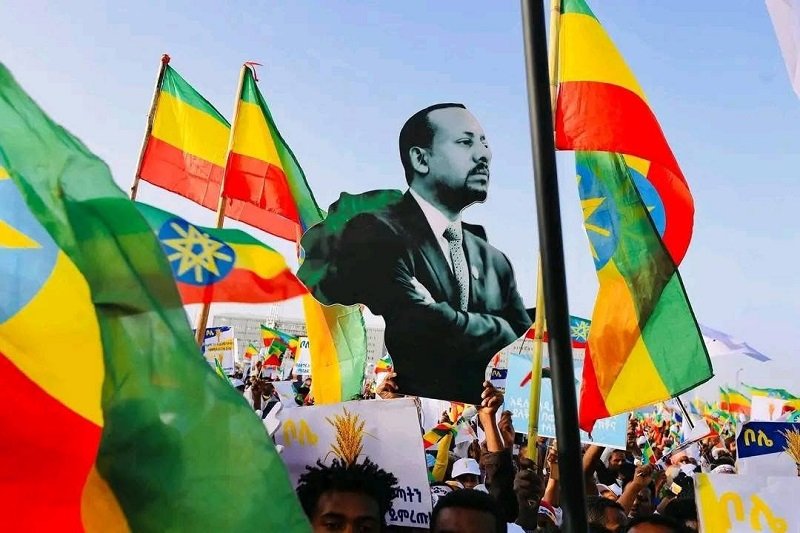
The portrait of Abiy Ahmed that emerges from Dr. Abebe’s essay — and from much of the opposition press — is of a straightforwardly authoritarian leader consolidating power for its own sake. This characterization is too simple to be useful. Abiy Ahmed is a genuinely complex political figure who came to power on a wave of extraordinary popular energy, introduced real reforms in his first two years, and has since presided over a period of devastating internal conflict and democratic regression. Both of these things are true simultaneously. The early Abiy — who released political prisoners, opened civic space, and signed the Algiers-framework peace agreement with Eritrea — was real. So is the later Abiy, whose government has used drone strikes in civilian areas and allowed the humanitarian situation in conflict zones to deteriorate to catastrophic levels.
A leader can be both a genuine reformer and a source of serious harm. Acknowledging this complexity is not a defense of abuse. It is the minimum required for honest analysis. When critics reduce Abiy to a simple villain, they make themselves easier to dismiss — and they make it harder for policymakers to design responses that are proportionate to the actual situation rather than to a caricature of it.
The Diaspora Echo Chamber and Its Consequences
One thing the article does not say — but which any honest assessment must include — is that the intellectual community producing this kind of commentary is not a neutral cross-section of Ethiopian society. It is predominantly diaspora-based, predominantly opposition-aligned, and predominantly drawn from communities that have specific ethnic and regional grievances against the current government. This does not make them wrong. But it does mean their analysis carries a particular angle of vision that should be named rather than concealed behind the language of universal democratic values. The Borkena-Zehabesha media ecosystem, which distributes much of this commentary, has essentially no mechanism for internal debate or rejoinder. Authors write parallel indictments that never engage each other’s arguments. Readers who already agree are confirmed in their views. Readers who might be persuadable by evidence are never reached. This is not the function of a democratic press. It is the function of a community reinforcing its own grievances — which is understandable humanly but limited analytically.
What an Honest Assessment Requires
If we are going to assess Ethiopia’s June 1 election honestly, we need to hold several things in mind at once. The election is taking place under conditions that fall well short of international democratic standards. That is true. The government’s claim that this vote represents a genuine democratic mandate will be difficult to sustain globally. That is also true. But it is equally true that the alternatives — indefinite postponement, internationally supervised transition, or some form of power-sharing — each carry their own substantial risks in a country of 130 million people, with active internal conflicts, a debt-stressed economy, and no neutral institutional arbiter to manage a transition.
The question is not whether this election is perfect. No one seriously argues that it is. The question is whether, imperfect as it is, it opens or closes pathways toward eventual stabilization. That is a harder question, and it does not have an obvious answer. It requires the kind of careful, evidence-based, multi-variable thinking that op-ed advocacy — however passionate and however sincerely intended — is structurally unsuited to provide.
A Final Word
Dr. Teshome Abebe ends his piece by saying Ethiopia deserves better than this election. On that narrow point, there is no argument. Ethiopia does deserve better. It deserves better governance, better institutions, better civic space, and better leadership. It also deserves better analysis — analysis that is willing to sit with complexity rather than dissolve it into polemic, that credits achievements without excusing abuses, and that treats the Ethiopian people as actors navigating an extraordinarily difficult situation rather than simply as victims of a story whose ending has already been written.
June 1 will come and go. What Ethiopia does with the day after is the more important question. And that question deserves the most rigorous, most honest, and least partisan thinking that those who care about the country can offer.
This essay was written in response to Dr. Teshome Abebe’s op-ed “Ethiopia’s June 1, 2026, Election Is Not a Vote — It Is a Verdict on a Collapsing State,” published May 29, 2026.
…
Editor’s Note : Views in the article do not necessarily reflect the views of borkena.com
__
Join our Telegram Channel : t.me/borkena
Like borkena on Facebook
To submit Press Release, send submission to info@borkena.com
Add your business to Ethiopian Business Listing / Ethiopian Business Directory
Join the conversation. Follow us on X (Formerly Twitter) @zborkenato get the latest Ethiopian News updates regularly.
To Support Borkena : https://borkena.com/subscribe-borkena/ – one time support or small monthly options available. Inquire information about it : info@borkena.com