
Voluntary Activism, Moral Consistency, and Ethiopia’s Struggle for Collective Resilience
Author’s Remark
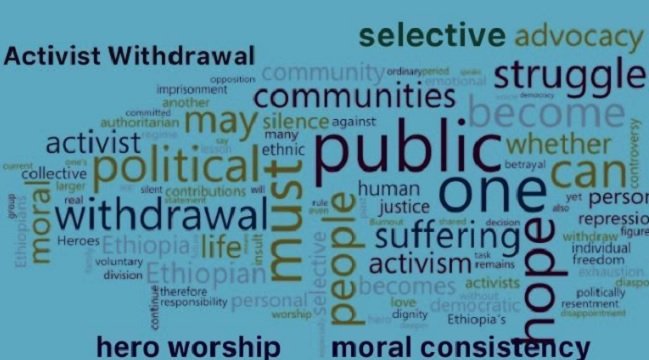
This piece principally centers on civic reflection, focusing on hope, activism, and selective advocacy, hero-worship, moral consistency, organization, people-centered democratic struggle, and collective responsibility, even though the activist’s withdrawal served as the catalyst.
Introduction
In the life of any nation, moments arise when the words or actions of a prominent public figure generate more than ordinary debate or disagreement. They expose deeper tensions within the community: between gratitude and disappointment, personal exhaustion and public responsibility, loyalty and criticism, hope and despair. The recent statement by a well-known Ethiopian artist-activist and human rights advocate, Tamagne Beyene, announcing his withdrawal from public activity related to Ethiopia after years of advocacy has become one such moment.
His statement, framed around social and emotional injury, resentment, personal sacrifice, and the desire to focus on family and health, has produced intense debate among Ethiopians. Some see his decision as understandable, even overdue, after decades of insult, abuse, emotional exhaustion, and public pressure. Others question the timing and meaning of his withdrawal, especially when Ethiopia is facing grave political repression, war, mass suffering, displacement, imprisonment, and deepening authoritarian rule.
The activist’s statement presents him as someone who feels deeply wounded, misunderstood, and targeted by public hostility. He also suggested that he may later disclose more about what he has endured. Those future details may provide additional personal context. Still, they do not alter the broader public question already raised by his statement: how should a community respond when a prominent advocate withdraws during a period of national suffering?
This article does not seek to erase his past contributions, nor does it aim to reduce the complex life of activism to a single controversial statement. Any fair assessment must recognize his significant role in Ethiopian advocacy over the decades. This began the day after the TPLF-EPLF takeover of Addis Ababa and continued throughout the EPRDF era, during which he spoke passionately against anti-democratic practices and emerged as a prominent voice in diaspora activism.
Yet gratitude for past contributions should not prevent moral reflection. Public advocacy carries responsibility, and when a prominent activist withdraws at a time of national suffering, the public naturally asks difficult questions. Why now? Why silence during certain periods of repression? Why does advocacy sometimes appear forceful against one regime but muted against another? Why do communities become so emotionally dependent on individual activists that one person’s withdrawal can create division, resentment, and confusion?
The deeper issue, therefore, is not merely one activist’s decision. The most important lesson involves the Ethiopian community itself. A national struggle cannot depend on one individual, however famous, decorated, or influential. Activists may rise, contribute, tire, disappoint, contradict themselves, or withdraw. But the people’s longing for freedom, dignity, justice, democracy, and national renewal must not withdraw with them.
Never losing hope in one’s country is not a simplistic slogan. It is a demanding civic discipline. It means refusing to let insult, betrayal, exhaustion, elite division, or the silence of prominent figures extinguish the larger struggle for justice. Ethiopia’s future cannot be built on hero-worship. It must be built on collective resilience, moral consistency, and the courage of ordinary people who continue to believe that the country can be better than its rulers, its divisions, and its current suffering.
I. Activism Is Voluntary, But Public Advocacy Carries Moral Weight
Activism, by its nature, is a voluntary moral act. No individual can be permanently conscripted into public struggle. No community has the right to demand endless sacrifice from one person. Human beings have limits. Burnout is real. Family responsibility is real. Emotional exhaustion is real. The wounds created by insult, public criticism, character assassination, and political hostility can be painful and lasting.
For this reason, it would be unfair to argue that any activist must remain in public struggle forever. A person may step back. A person may choose family over public life. A person may decide that their health, children, or private peace now requires priority. In this sense, withdrawal is not automatically betrayal. Sometimes it is simply a human decision made under emotional and personal pressure.
Martha Nussbaum’s account of objectification is helpful here. One form of objectification is the denial of subjectivity: treating a person as if his inner life, pain, fear, exhaustion, and personal boundaries do not matter (Nussbaum, 1995). Public figures are especially vulnerable to this. Communities often treat them as instruments of a cause rather than as human beings with families, wounds, limits, and private burdens. In this sense, the activist’s withdrawal should also be read as a reassertion of his humanity and autonomy. To recognize this does not require agreement with every aspect of his public posture, nor does it exempt his record from moral scrutiny. It simply means that criticism must not become dehumanization. A community committed to human rights must not deny the humanity of the very people it criticizes.
But the voluntary character of activism also means that public credibility depends on consistency. When a person presents themselves for decades as a national advocate, speaks in the name of justice, mobilizes communities, receives public honor, and becomes a symbol of resistance, their silence or withdrawal in the face of later suffering becomes politically meaningful. Public activism creates public expectations. Those expectations may be demanding, but they are not irrational.
The issue, therefore, is not whether an activist has the right to withdraw. He does. The issue is what the withdrawal reveals about the relationship between personal choice and public responsibility. One may enter activism voluntarily, but once one becomes a moral voice in public life, the community will judge whether that voice remains consistent as victims, regimes, ethnic alignments, and political circumstances change and become uncomfortable.
This distinction is essential. To criticize inconsistency is not to deny personal freedom. Recognizing burnout is not excusing selective silence. To appreciate past service is not to surrender moral judgment. A mature political community must be capable of holding all these truths together.
II. Contribution, Recognition, and the Danger of Hero-Worship
The activist at the center of this controversy has had a long and visible public life. For many years, he was viewed by supporters as a committed defender of Ethiopian causes and a strong critic of anti-democratic rule. His voice reached diaspora communities, public gatherings, media platforms, and political spaces. He inspired many Ethiopians, especially during periods when speaking against repression carried moral and emotional significance.
That contribution should not be dismissed casually. Political communities often make the mistake of treating public figures as either saints or traitors. This binary thinking is unhealthy. A person can make real contributions and still later become silent. A person can serve an important role in one historical period and fail morally or politically in another. A person can deserve gratitude for what he did and criticism for what he does not do.
This balanced judgment is especially necessary in Ethiopian political culture, where public figures are often elevated too quickly and condemned too absolutely. Hero-worship creates fragile politics. When a public figure speaks, people exaggerate his importance. When he withdraws, they feel abandoned. When he disappoints, they become bitter. This emotional dependence weakens the community.
No individual should be treated as the owner of national hope. A nation’s struggle must not be personalized to the point that the withdrawal of one activist creates collective confusion. The Ethiopian people have endured empires, revolutions, military dictatorship, ethnic authoritarianism, civil war, displacement, imprisonment, famine, propaganda, and state violence. Their survival has never depended on a single individual. It has depended on families, communities, prisoners of conscience, religious leaders, students, farmers, workers, writers, artists, journalists, and ordinary citizens who continue to carry memory, identity, and hope.
Therefore, while the activist’s past contributions may be acknowledged, the community must learn a larger lesson: do not build a national struggle on celebrity activism. Build it on institutions, principles, shared discipline, moral consistency, and collective responsibility.
III. The Question of Selective Advocacy
The controversy surrounding the activist’s withdrawal is intensified by timing. Some critics argue that his activism was most forceful during the TPLF-led EPRDF period, when opposition to the regime was often framed around resistance to TPLF domination. During that period, he was vocal, energetic, and publicly engaged. But under the current government, Ethiopia has faced devastating wars, mass displacement, imprisonment, drone attacks, extrajudicial killings, repression of dissent, and deepening authoritarian rule across multiple regions.
For many Ethiopians, especially those suffering today in Amhara, Oromia, Tigray, and other affected areas, silence is not experienced as neutrality. It is experienced as abandonment. Whether this judgment is entirely fair or not, it reveals a serious problem in Ethiopian political life: advocacy loses moral authority when it appears selective.
If one condemns repression only when committed by one regime but remains silent when another regime commits similar or greater abuses, the public will naturally question the moral foundation of that advocacy. Was the activism rooted in universal principles of justice, democracy, and human rights? Or was it driven by opposition to a particular ruling group? Was the concern for Ethiopia as a whole, or was it shaped by political preference, ethnic resentment, personal calculation, fear, or exhaustion?
These questions are difficult, but they cannot be avoided. Ethiopia’s tragedy lies not only in authoritarian rule but also in the fragmentation of moral outrage. Many Ethiopians condemn injustice selectively. They speak loudly when their own group suffers, but become silent when others suffer. They denounce repression when committed by their opponents but rationalize it when committed by those they support. This selective morality has weakened the democratic struggle and deepened mistrust among communities.
One of the deeper sources of selective advocacy is hatred. Hatred does not merely express political disagreement; it distorts judgment, weakens principles, and allows people to justify today what they condemned yesterday. In Ethiopia, anti-TPLF resentment, much of it rooted in real historical grievances from the EPRDF era, has often been manipulated into a substitute for a democratic vision. During moments of national crisis, this resentment has led some political and media elites to support or excuse repression not because justice was served, but because the perceived enemy was being punished. This is morally dangerous. A politics built on hatred cannot produce freedom; it only changes the target of domination. Ethiopia’s democratic future requires a transition from enemy-centered politics to principle-centered politics, in which injustice is consistently opposed regardless of who commits it or who suffers it.
A genuine national advocate must resist this pattern. The measure of democratic commitment is not whether one condemns the suffering of one’s friends, allies, or ethnic group. The true test is whether one condemns injustice consistently, even when the victims are politically inconvenient, ethnically different, or emotionally distant.
This is one of the most important lessons from the current controversy. Ethiopia does not suffer from a shortage of people who love the country rhetorically; it suffers from a shortage of people who consistently apply justice.
Comparative examples also help clarify what consistent advocacy can look like. Kenyan activist Wangari Maathai endured imprisonment and threats while advocating for environmental and democratic reforms. Despite these daunting challenges, she remained an outspoken critic of various regimes, eventually earning the Nobel Peace Prize for her inclusive efforts. Her example contrasts sharply with the divisions in Ethiopia and underscores the need for consistent advocacy across ethnic lines and political regimes.
IV. Hope, Burnout, and the Philosophy of Endurance
The activist’s withdrawal raises a deeper philosophical question: What does it mean to continue hoping when one has been insulted, wounded, disappointed, or exhausted?
The belief that one should never lose hope in one’s country may sound simplistic to some people. It may appear naïve, especially in a country where political betrayal is common, where peaceful dissent is punished, where communities are divided, and where the cost of speaking truth can include prison, exile, humiliation, or death. Yet hope, properly understood, is not naïve optimism. It is not the belief that things will automatically improve. It is not a denial of suffering. Hope is a disciplined commitment under difficult conditions.
Stoic philosophy helps clarify this point. The Stoics taught that human beings cannot control all external events: insults, imprisonment, political defeat, betrayal, public misunderstanding, or the cruelty of rulers. What they can control is their response: whether they surrender their moral judgment, whether they become consumed by resentment, whether they abandon principle, or whether they continue to act with dignity under pressure.
This does not mean that people should ignore pain or romanticize suffering. Burnout is real, and human beings are not machines. But Stoicism reminds us that insult alone should not determine the fate of one’s public commitments. If every insult destroys our hope, then our hope still requires deeper discipline. If every disappointment makes us abandon the struggle, then our struggle was too dependent on approval.
Nietzsche offers another powerful insight. For Friedrich Nietzsche, a life worth living is not merely a life of comfort, safety, or happiness. It is a life marked by struggle, self-overcoming, and the creative affirmation of existence. His call to “live dangerously” should not be misunderstood as recklessness. It means refusing to reduce life to self-protection, mediocrity, or passive resentment. It means pursuing difficult, even seemingly impossible, goals because such struggle gives depth and meaning to human existence.
Applied to public life, Nietzsche’s insight challenges both activists and communities. For activists, it asks whether their commitment can survive insult, loss of applause, and the burden of disappointment. For communities, it asks whether they can transform the withdrawal of one figure into renewed collective strength rather than despair. People committed to freedom cannot be psychologically defeated whenever a prominent individual falls silent, grows tired, or becomes contradictory.
Hope, then, is not comfort. Hope is self-overcoming. It is the refusal to let suffering define the limits of possibility. It is the capacity to say: the struggle is painful, the road is long, the leaders may disappoint us, the activists may withdraw, but the moral necessity of freedom remains.
V. The Political Danger of Division
The most troubling consequence of the activist’s statement is not simply his withdrawal. It is that his withdrawal has created division among Ethiopians and shifted attention away from the larger struggle. Instead of focusing on the ongoing fight against authoritarian rule, repression, war, and national fragmentation, many people are now consumed by arguments over one individual: whether he is a hero, a victim, a hypocrite, a burned-out activist, or a selective advocate.
This is politically dangerous. Authoritarian systems benefit when opposition communities become distracted by personality conflicts. They benefit when public energy is redirected from institutions to individuals, from strategy to resentment, and from collective struggle to internal accusation. When communities spend more time debating one activist’s emotional statement than organizing against repression, the regime gains indirectly.
This does not mean the controversy should be ignored. It should be discussed. But it should be discussed as a lesson, not allowed to become a permanent division or a substitute for Ethiopia’s urgent democratic agenda. The real questions are larger than one person:
How can Ethiopians build a democratic culture that does not depend on heroic personalities?
How can advocacy become more consistent across ethnic and regional lines?
How can diaspora activism become more accountable, principled, and institutionally grounded?
How can communities support activists without worshiping them?
How can people recognize burnout without allowing exhaustion to become a justification for silence in the face of injustice?
These are the questions that matter. If the debate remains trapped in personal accusation, it will deepen division. If it is elevated into civic reflection, it can strengthen the community.
VI. The Suffering of the People and the Moral Test of Advocacy
The activist’s withdrawal comes at a time when Ethiopia is not experiencing ordinary political disagreement. The country is facing profound national suffering. Wars have devastated multiple regions. Families have been displaced. Political prisoners remain behind bars. Communities live in fear. Reports of drone attacks, killings, destruction of property, burning of farmland, and attacks on civilian life have become part of the national tragedy. Many Ethiopians feel abandoned not only by the state but also by intellectuals, religious leaders, opposition figures, diaspora elites, and former activists who once claimed to speak for justice.
This context matters. Withdrawal during a quiet period would have one meaning. Withdrawal during escalating suffering carries a different political meaning. When people are suffering more deeply, silence from prominent figures becomes more painful. It may be understandable on a personal level, but politically, it cannot be treated as insignificant.
The Amhara people, for example, continue to assert their Ethiopian identity even while experiencing immense suffering under the current conflict. Many Oromo communities have also suffered under prolonged violence and repression. Tigray has endured devastating war and trauma. Other communities have faced displacement, insecurity, and political marginalization. In such a context, advocacy must not be selective. The suffering of one group should not be used to erase the suffering of another. The moral task is to defend human dignity everywhere.
This is where Ethiopian politics has repeatedly failed. Too often, grief becomes ethnicized. Outrage becomes selective. Victimhood becomes competitive. Instead of building solidarity from shared suffering, communities retreat into isolated pain. This weakens the possibility of national democratic renewal.
A principled activist, intellectual, or political leader must resist this fragmentation. The test is not whether one speaks when it is easy. The test is whether one speaks when the victims are politically inconvenient, when the perpetrators are former allies, when the truth complicates one’s previous position, and when silence would be personally safer.
VII. Hope Beyond Heroes
One of the most important lessons from this controversy is that Ethiopia must move beyond hero-centered politics. Heroism has emotional power, but it is a weak foundation for democratic transformation. Heroes age, tire, make mistakes, become selective, and may be co-opted, misunderstood, exhausted, or disappointed. Some may withdraw. Some may contradict their own legacy.
A mature political community should neither worship nor destroy its public figures. It should appreciate contributions, criticize inconsistencies, and then continue the struggle with or without them.
The people’s hope must be deeper than the voice of one activist. It must belong to the mother who loses her child but refuses hatred. It must belong to the prisoner who suffers without surrendering conscience. It must belong to the displaced family that still dreams of return. It must belong to the young person who refuses propaganda. It must belong to the citizen who insists that Ethiopia’s future should be built on law, dignity, accountability, and freedom rather than fear.
When hope is attached to individuals, it becomes fragile. When hope is rooted in principles, it becomes durable. Ethiopia needs durable hope.
Durable hope does not deny betrayal. It does not deny disappointment. It does not deny that some who once spoke loudly may later become silent. It simply refuses to let those disappointments define the nation’s destiny.
VIII. Lessons for the Ethiopian Community
The current controversy offers several lessons for Ethiopians at home and in the diaspora.
First, we should respect the voluntary nature of activism. No person should be forced to sacrifice indefinitely. Public work can wound the soul, damage family life, and exhaust the body. A humane community should recognize this.
Second, we should reject selective advocacy. Human rights are not ethnic possessions. Democracy is not a slogan to be used against one regime and abandoned under another. Justice must be defended consistently, or it loses credibility.
Third, we should stop idolizing individuals. Appreciation is healthy; worship is dangerous. A community that depends too heavily on public personalities will always be vulnerable to disappointment.
Fourth, we should transform controversy into civic education. Instead of allowing one activist’s withdrawal to divide us, we should use it as an opportunity to ask how Ethiopian advocacy can become more principled, more organized, more accountable, and more inclusive.
More importantly, Ethiopian elites must redirect their energy from personality-centered debates toward the harder work the national struggle requires: organization, a shared vision, and clarity about the country’s desired democratic end state. The central problem is not the withdrawal of one activist; it is the absence of a disciplined political structure capable of converting public anger into democratic transformation. Without organization, popular frustration remains scattered. Without a common idea of the nation’s future, opposition becomes reactive rather than constructive. The task of elites, therefore, is not to make themselves permanent guardians of the people, but to help create conditions in which the people become the true decision-makers of their destiny.
At the same time, withdrawal need not be treated as a permanent moral exit. Human beings change, reflect, recover, and sometimes return with greater clarity than before. If the activist one day chooses to reengage, the question should not be whether he returns to reclaim personal prestige, but whether he returns with a broader, more consistent, and more inclusive commitment to justice. A meaningful return would require moving beyond selective advocacy, beyond personality-centered influence, and beyond the politics of grievance. It would mean rejoining the struggle not as an indispensable hero, but as one citizen among many, contributing to a more organized, democratic, and people-centered national project.
Fifth, we should remember that hope is collective. The struggle for Ethiopia’s future belongs not only to activists, politicians, artists, or intellectuals. It belongs to ordinary people whose endurance rarely receives awards, applause, or public recognition.
Finally, we should refuse despair. Authoritarian regimes thrive when people lose confidence in collective action. They thrive when communities become cynical, divided, and emotionally exhausted. To preserve hope is therefore not merely a personal virtue; it is a political act.
Conclusion: To Never Lose Hope
The withdrawal of a prominent activist from Ethiopian public life is a moment worthy of reflection. Still, it should not become a source of national discouragement or a prime agenda item. His past contributions can be acknowledged. His personal exhaustion can be understood. His right to step back can be respected. At the same time, his silence during periods of grave suffering can be questioned, and the broader problem of selective advocacy must be confronted.
The lesson is not that every activist must remain in struggle forever. Activism is voluntary, and human beings have limits. The lesson is also not that past contributions should be erased because of later silence. A just society must be able to honor what was done while questioning what is now absent.
The deeper lesson is that a national struggle cannot be built on hero-worship. Individuals may rise, contribute, tire, withdraw, disappoint, or contradict themselves. But the people’s longing for freedom, dignity, democracy, and justice must not withdraw with them.
Therefore, the debate over one activist’s withdrawal should not consume the political imagination. The more urgent task is organization. The more urgent task is developing a common idea of Ethiopia’s democratic end state. The more urgent task is building a political culture and institutional path through which the people—not self-appointed elites, armed actors, celebrities, or diaspora personalities—become the decision-makers of their own destiny. Hope becomes meaningful only when it is organized.
A friend once shared with me a powerful reflection whose original source I do not know. I have preserved its core lines while adapting and expanding a few phrases for this context. It imagines Ethiopia speaking to those who proclaim love for her while retreating from the burdens that love requires:
“You say you love the rain, yet you open an umbrella when the storm of commitment arrives. You say you love the sun, yet you seek the shade when engagement demands warmth. You say you love the breeze, yet you close your windows when renewal begins to whisper. That is why I tremble when you say you love me.“
For Ethiopia, hope must be larger than any activist. It must be larger than any party, region, ethnic group, or political generation. It must survive insult, betrayal, imprisonment, exile, propaganda, and war. It must survive the silence of those who once spoke and the withdrawal of those who once inspired.
Never losing hope is not the same as denying pain. It is to refuse to let pain have the final word. It is to affirm, even in darkness, that Ethiopia can still become a country governed not by fear, selective outrage, or authoritarian power, but by justice, dignity, freedom, and shared responsibility.
No activist owns the hope of a people. Hope belongs to the people themselves. And as long as the people refuse to surrender it, Ethiopia’s future remains open. Hope must therefore outlive individual withdrawal, and Ethiopia’s struggle for democracy, unity, and mutual respect among all its peoples must become organized, collective, and people-centered.
Author’s Final Note
Honoring and respecting the activist for his contributions was the appropriate course of action, and I followed through with that intention.
Based on the preceding analysis of the article and available information, the activist’s retreat should neither elicit pity nor inspire collective lamentation. Such responses risk perpetuating hero-worship, which frames the struggle as an individual matter rather than fostering it as a shared, enduring commitment. Pity can be subtly undermining, as it may elevate the sympathizer while confining the individual to a state of perceived affliction, even in the absence of direct harm. Genuine growth necessitates transcending past identities of suffering or victimhood, breaking free to evolve beyond them. Pity does not heal wounds; it often sustains their shadow.
Excessive sympathy can diminish one’s capacity to confront and reshape the circumstances of withdrawal. As Nietzsche asserts—a summary and paraphrase of his idea—pity is no benign virtue; it may weaken resolve, blur accountability, and entrench a culture of victimhood. Pity is a depressant. By framing an individual primarily as an object of pity, we diminish his autonomy and the impetus for self-reflection and change.
This moment calls for clarity over sentimental solace: the struggle neither originates nor concludes with a single individual. If it falters in the absence of one voice, it reveals not merely misfortune but a need for robust collective foundations and organization. Rejecting pity in this context is not an expression of indifference; rather, it affirms that both the individual and the cause draw strength from accountability, resilience, and the rejection of victimhood. It is an active affirmation of another person’s strength, potential for growth, and ability to overcome alleged suffering. The goal is to help others overcome their suffering, not to be “cold” or wallow in it with them.
Intellectual honesty compels us to abandon comforting narratives and to view the activist’s withdrawal as a potential crucible for growth. In the spirit of Nietzsche, true strength lies in self-overcoming and rejecting victimhood, allowing us to harness the vital energy necessary for the endurance and resilience of the activist, as well as for the fortitude and transformation of the community, which should be led by an organization rather than by individuals.
Let us conclude with the following:
“The man dies in all who remain silent in the face of tyranny.” — Wole Soyinka
Silence is never neutral—it is a position. It does not hover above injustice or tyranny; it kneels beside it. Every day we choose not to speak, we grant permission for the intolerable and horrifying to continue, to calcify, and to become the inheritance we leave behind.
This is not someone else’s burden. It belongs to each of us—wherever we are, whatever wrongs we witness and let pass unchallenged. Ask yourself if your conscience is with you: What am I authorizing with my silence? What am I fortifying by choosing comfort over conviction?
If the death Soyinka speaks of is a moral one—a slow erosion of conscience, of dignity, of humanity, of integrity—then the choice to speak or to stay silent is never small. It is the choice between being truly alive and merely existing.
Reference:
Nussbaum, M. C. (1995). Objectification. *Philosophy & Public Affairs, 24*(4), 249–291. [https://doi.org/10.1111/j.1088-4963.1995.tb00032.x](https://doi.org/10.1111/j.1088-4963.1995.tb00032.x)
Editor’s Note : Views in the article do not necessarily reflect the views of borkena.com
__
Join our Telegram Channel : t.me/borkena
Like borkena on Facebook
To submit Press Release, send submission to info@borkena.com
Add your business to Ethiopian Business Listing / Ethiopian Business Directory
Join the conversation. Follow us on X (Formerly Twitter) @zborkenato get the latest Ethiopian News updates regularly.
To Support Borkena : https://borkena.com/subscribe-borkena/ – one time support or small monthly options available. Inquire information about it : info@borkena.com
This is a thoughtful and honest piece. One thing that stands out is the reminder that no country can rely on “heroes” forever—real progress comes from strong institutions, civic culture, and shared responsibility. It also reflects something many Ethiopians feel but do not always say: after years of conflict, polarization, exile, imprisonment, and political disappointment, activist exhaustion is very real.
The article could go even deeper on Ethiopia’s long-standing institutional weakness, where politics has often revolved around powerful personalities rather than durable systems that can manage leadership transition, internal accountability, and continuity in times of crisis. Alongside that, rigid ideological projects, whether imperial, socialist, ethnic-nationalist, or prosperity-focused—have often overshadowed the slower work of building democratic habits, civic trust, and independent institutions.
For me, the deeper challenge is learning how to build a political culture that outlives individual leaders—where institutions matter more than charisma, where we normalize participation and disagreement without turning opponents into enemies, and where accountability, civic education, and cross-ethnic organizing become everyday habits rather than exceptional moments. That may be one of the most important lessons for Ethiopia’s future.
The article makes a strong case that true activism demands courage, integrity, and unwavering commitment to justice and democracy. Sirak Zena demonstrates clearly that lasting change is possible only when activists consistently choose to do what is right, even in difficult times. His clear and thoughtful analysis not only educates but also inspires us to support those who fight for justice and equality, reminding us to persist in hope.
Ethiopian politics is sadly divided along ethnic lines. When one ethnic group is attacked by the regime, the other must stand, and activists should be a voice for all victims. This approach requires both the courage and integrity required to advocate for justice in challenging circumstances.
Real change requires speaking up for justice and equality for all, not just our own group, and opposing injustice wherever it appears, acting with courage and fairness even when it’s difficult. Only by standing up for everyone can we break the cycle of division that holds Ethiopia back.
When any group is targeted or oppressed, silence is complicity. We must speak out and stand together, because justice denied to one is justice denied to all.
Sirak delivers convincing insights into the vital qualities of an activist and hope.
With sincere appreciation!
Biruk
Dear Amsal,
Thank you, Amsal, for such a thoughtful and reflective engagement with the article. Your observation about Ethiopia’s deeper institutional weakness is especially important. One of the recurring tragedies in our political history is that personalities, ideologies, and emotional mobilization often advance faster than the slow and difficult work of building durable civic institutions, democratic habits, and a culture of accountable disagreement.
I also appreciate your point that activist exhaustion is real. A society that repeatedly depends on individual “heroes” without developing resilient institutions inevitably produces cycles of emotional overinvestment, disappointment, fragmentation, and burnout. That is one of the central lessons I hoped to raise through the piece.
Your emphasis on creating a political culture that can outlive individual leaders, where participation, civic trust, accountability, and cross-ethnic cooperation become normalized rather than exceptional, is, in many ways, the larger democratic challenge Ethiopia still faces. Thank you again for contributing such a constructive and intellectually serious reflection to the discussion.
Sirak
Dear Biruk,
Thank you very much, Biruk, for your thoughtful and principled reflection. I especially appreciate your emphasis that justice and human dignity cannot be defended selectively. One of Ethiopia’s deepest political tragedies has been the fragmentation of moral outrage along ethnic and political lines, where suffering is often recognized only when it affects one’s own group.
As you rightly noted, genuine activism requires courage, consistency, and the willingness to speak for all victims, not only for those who are politically or emotionally close to us. A democratic future cannot be built on selective compassion or silence in the face of another community’s suffering.
Your point that “justice denied to one is justice denied to all” captures the broader spirit of the article very well. Ethiopia’s hope ultimately depends on developing a civic culture in which solidarity, moral consistency, and shared humanity outweigh fear, resentment, and division. Thank you again for the sincere engagement and encouragement.
Sirak