
By Eyassu Epheraim G Hanna
London UK
One of the hardest things in politics is toppling a regime. History teaches that regimes are usually toppled by brute force. Nations have fought other nations for political power, and within nations, adversaries have fought each other for the same. Human history is also a history of war. Let me put this in historical perspective: Rome has one of the longest well-documented governance histories. Hence, the story of Rome may provide a concrete example for my argument. According to studies, 30 to 36 Roman emperors were directly assassinated; 62% (43 out of 69 in one study) died violent deaths—by assassination, suicide, or combat. Within the core 490-year period (14 BC–AD 476), more emperors were assassinated than died of natural causes. One prominent assassination is that of Julius Caesar. He was assassinated on March 15 (the Ides of March), 44 BC, by a group of Roman senators who stabbed him 23 times in the Curia of Pompey in Rome. Here we have a fascinating story: the Romans were among those who adopted democracy and elected their senate and leaders, yet they still sorted out their differences with daggers. In most parts of the world, the story and the practice have hardly changed. In fact, democracy as a modern mode of political administration emerged after the American and French revolutions.
Hence, the United States (late 18th century): following the 1787 Constitution, the US established a representative republic that many historians consider the first modern democracy. France (1789): the French Revolution erupted, challenging absolute monarchy and leading to the rise of democratic ideologies and early, though interrupted, efforts toward universal suffrage. United Kingdom (19th century): the UK accelerated its shift toward modern democracy through parliamentary reform acts, notably the Representation of the People Act 1832, which began expanding voting rights, according to History World. Despite this, mainland Europe did not adopt democratic systems until the end of World War II. In modern history, most European countries adopted (or returned to) democratic systems during two main periods: right after World War II (1945–1950s) in Western Europe, and after the collapse of the Soviet Union (1989–1991) in Central and Eastern Europe. While democratic ideals developed in the 19th century, universal suffrage and stable parliamentary regimes solidified in the mid- to late 20th century, with authoritarian regimes in Southern Europe falling in the 1970s. As far as acquiring political power goes, for most nations, Rome still exists—and a dagger is still needed to remove the Caesar.
This is particularly true in a context such as Africa. Someone may argue: what about Kenya, South Africa, or Nigeria? But I say they are few among 52 nations. Africa is a breeding ground of modern Caesars.
In this short essay, I cannot discuss the entire political drama of African nations, but I will focus on Ethiopia. Ethiopia is one of the oldest nations in Africa. Ethiopian civilization was among the ancient civilizations parallel to Persian, Roman, Greek, and Indian civilizations. So, no one can teach us how to govern a nation. We had one of the longest dynasties in the world. Our style of government was absolute monarchy; we used to say: “The king cannot be judged, just as the sky cannot be ploughed” ንጉስ አይከሰስ ሰማይ አይታረስ until the 1970s, or the so-called revolution which brought a military junta—a new Caesar, Mengistu Hailemariam. Mengistu’s era was an era of blood and war. Seventeen years passed, beginning with blood and ending with blood. The struggle between Mengistu and would-be kings such as the TPLF, EPLF, EPRP, OLF, and others cost the nation a generation. The wound has not yet healed. Those who fought Mengistu became new Caesars: Meles Zenawi in Addis Ababa, and Isaias Afwerki in Asmara—one died of natural causes, but the latter is still alive and has been bleeding the nation for the last 30-plus years.
For the last eight years, the self-proclaimed messiah Abiy Ahmed has governed Ethiopia. When Abiy came to power, he declared himself the 7th king of Ethiopia. But he forgot that we had many kings before him. The message is political: by saying that, Abiy signalled that he has no intention of relinquishing power. That means; to remove him, the Ethiopian people must sharpen their daggers. In fact, they have done so: Fano in the Amhara region, OLA in the Oromia region, and the TPLF in the Tigray region have been fighting Abiy’s regime. And he is fighting back with drones, tanks, planes, and the modern weapons at his disposal. On top of that, Abiy deployed a political weapon known as elections, democracy, and the people’s voice. Abiy conducted his first election five years ago. Those who know politics and Abiy’s game know the outcome: Abiy won—or he said he won the election. According to the National Election Board of Ethiopia, the ruling party won 410 out of 436 contested seats in the federal parliament, leaving dozens vacant after one-fifth of constituencies failed to vote due to unrest or logistical problems.
Now he is preparing for the second election. Again, Ethiopia’s election board has announced that 40,448 polling stations will be established for the country’s upcoming national vote—a reduction of 9,000 compared with the 2021 elections, despite the inclusion of constituencies in Tigray this time. The National Election Board of Ethiopia (NEBE) said the directory of polling stations includes areas facing persistent security challenges, such as western Oromia and parts of Amhara. Recently, people in the Amhara region demonstrated against the election, saying they cannot give ballots to those who have been giving them bullets.
The story will be the same: the ruling party—Abiy—does not allow a meaningful contestant to emerge. No political parties have organized themselves properly; most are collections of ragtag individuals who want to be (or pretend to be) politicians, but lack ideology, vision, mission, objectives, or proper organizational structure. Some of them are Prosperity Party clones with different local names. Most are locally organized and do not have strong local agendas, let alone national agendas. Let us look at one party as an example: the Kuchaa People Democratic Party (KPDP) የቁጫ ሕዝብ ዴሞክራሲያዊ ፓርቲ (ቁሕዴፓ), which operates in the South Ethiopia Regional State, particularly in the Gamo Zone, Kuchaa Woreda. This party—if we can call it a party—operates at the district (woreda) level, representing a small administrative area with a small population. According to studies based on population projections and data from the South Ethiopia Regional State (formerly part of SNNPR), the average population at the woreda level is quite high due to density, often ranging between 100,000 and 200,000+ residents. Let us take an average of 150,000. Of these, 55% are not eligible to vote (they are underage), leaving 82,500 potential voters if fully registered. In the last election, the KPDP got one seat. But surprisingly, the KPDP presented 15 candidates for the House of Peoples’ Representatives (HoPR). The KPDP and similar smaller political parties are better referred to as interest groups than parties. They hardly have any impact on national or local debate, except that the person elected secures wages and other benefits for themselves.
For the 7th national election, according to the National Election Board of Ethiopia, 45 or 48 (depending on late news) political organizations are registered. Among these, 65% are local and ethnic political organizations, which hardly contribute to national political debate or address national issues.
For example, the Oromo Liberation Movement has put forward 63 candidates. If they win 63 seats, what agenda will they bring to the national level—liberation? The OLM is not the only party playing the liberation card. We also have the Ogaden National Liberation Front (ONLF), a Somali nationalist armed and political organization seeking self-determination for the Somali-inhabited Ogaden. This political movement has one agenda: to liberate Ogaden from Ethiopia. Hence, it has presented six candidates for the HoPR. Let us stay in the Somali region. Here we have the Somali Federalist Party (SFP), competing for parliamentary seats. Reports indicate that in March 2025, the party alleged widespread corruption, including misappropriation of funds for infrastructure projects such as the Kebri Dehar water project. They demand accountability for missing development funds and land mismanagement in Jigjiga. I want readers to note this issue, which I will explain using a new concept I call demo-feudalism. This clearly indicates how the country’s politics are polarized and lack coherent direction.
There is another group by pseudonym they call themselves theFreedom and Equality Party, led by Dr. Abdulkadir Adem, a former Ezema member. The party has put forward 171 candidates and is the fourth largest. According to its policy, it follows moderate liberalism, but it ironically is linked with the ONLF. Even if the party calls itself liberal, when we unveil the cover, we find it is deeply influenced by religious constituency. One cannot claim to be liberal while female candidates wear the hijab, and most candidates are recruited from a single religious tradition. Now assume those 171 candidates win seats—what would be their national agenda? The implementation of Sharia law?
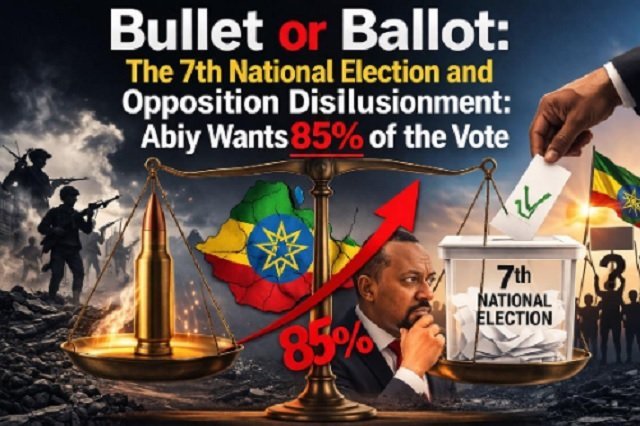
Now let us analyse the data presented by the election board. There are 45 political groups registered for the upcoming election. Among them, only 9% have more than 100 candidates. Of these, the Prosperity Party (PP) has presented 466 candidates to contest 547 seats, meaning the PP plans to win 85% of the seats. From 547 seats, the PP does not compete in 81 seats for obvious reasons. First, the Tigray region, currently under political turmoil, has 38 seats and may not fully participate. However, some local parties have registered, such as Tinsae Sebea Enderta Party (ትንሳኤ ሰብዓ እንደርታ ፓርቲ), which has six candidates. Similarly, the Amhara region is under political turmoil. Despite having 138 seats in the HoPR, the regional opposition party known as the National Movement of Amhara (NaMA) has presented only 16 candidates (11%). In the current political environment, the so-called NaMA, led by Belete Molla, is the PP under a different name. If there were a suitable environment, NaMA could field more candidates, but the numbers suggest otherwise. The HoPR is the lower house of the Ethiopian Federal Parliamentary Assembly, located in Addis Ababa, with 547 members.
To the naked eye, the election process appears democratic and legitimate. Some may argue: what is wrong with different parties with different agendas competing for the HoPR? After all, they represent the voices of their people—is that not democracy? But we must also ask whether liberation movements, religious parties, and local-interest parties contribute to national cohesion, unity, and progress, or whether they create more disintegration and chaos.
This is a deliberate arrangement by the ruling party. Here we apply the divide-and-rule Machiavellian political framework. The ruling party knows these so-called parties are simply ornaments to decorate a fake election. As I said, some of them are created or cloned by the PP for its own objectives. Others act as elected feudal lords for their respective regions, securing privileges that come with holding seats. For example, in the Afar region, which typically has eight seats out of 547, there are at least three parties contesting: the Afar Liberation Front (Party) with seven candidates, the Afar People Party with six candidates, and the PP with its own candidates. In this arrangement, the PP may allow two seats to other parties and keep six for itself. This creates demo-feudalism—democratically elected local feudal lords.
Let me explain the concept of demo-feudalism: democratically elected feudal lords. Based on political economy analysis, the Ethiopian economy is agrarian and dependent on land. Therefore, social, and political interactions are determined by this reality. To be part of the ruling class, individuals or groups must create local organizations with different names—pseudo-liberation movements, pseudo-democratic movements, or religious movements with names such as the Freedom and Equality Party. The ruling party (PP) provides a platform for these emerging local feudal lords under the name of democracy. These individuals or organizations can then control resources, land, and government budgets. This is evident in the Somali Federalist Party (SFP), which has neither a clear local nor national agenda but fulfils the role of local lords. This is also true for the TPLF and similar organizations. One cannot be part of a national agenda while promoting liberation. They use liberation rhetoric to intimidate the nation, hold politics hostage, and secure corrupt sociopolitical interests.
Demo-Feudalism: A Conceptual Framework
To better understand this system, this essay proposes the concept of demo-feudalism. The term describes a hybrid political order in which democratic institutions (elections, political parties) are used to legitimize decentralized power structures that resemble feudal relationships.
In this model:
- Local political actors function as intermediaries between the central state and regional populations.
- These actors exercise significant control over resources, particularly land and public funds.
- Political loyalty to the central authority is exchanged for local autonomy and access to state resources.
This arrangement creates a layered system of governance in which formal democratic processes coexist with informal networks of patronage and control. Rather than fostering genuine representation, elections serve to reproduce existing power hierarchies.
You may ask: what about parties competing in cities such as Addis Ababa, Harar, and other major cities? The same concept applies. City-based politicians mostly come from the middle class, which has unique characteristics—it is opportunistic. Unlike rural economies, urban political economies are based on capitalism, trade, manufacturing, and services. This class seeks to gain a share of the economy through political participation. Hence, it organizes itself into pseudo-political parties. If successful, they attach themselves like leeches to the system and drain national resources. Ezema and Dr. Birhanu Nega are examples. Ezema, as a party, has not contributed to national peace, security, or development, except praising Abiy at every opportunity. As a result, they are now rewarded as the second-largest party with 298 candidates.
So far, I have tried to give a picture of Abiy’s so-called democratic election—how the PP manipulates narrow individual and group interests and presents them as genuine democracy. By doing so, Abiy has created democratically elected feudal lords in rural areas who control local resources, and in cities, a subservient middle-class HoPR membership.
This is how I see the political reality in Ethiopia under Abiy. If that is the case, how can Abiy be legitimately removed from power? That is a serious question. In my introduction, I noted that Roman heads of state were removed by brute force. This is the grimmest reality of politics, particularly in the third world. If we accept this reality, the only way to remove Abiy is using the Roman dagger.
However, some diaspora members think differently. They call on Abiy to hand over power and establish a transitional government before elections. Their slogan is: Stop the war; let there be peace; no more brutal governance; transition before election. I wish this could be true, but the reality is that these diaspora members are living in an illusion. Many diaspora members in America have informal discussions with U.S. senators who promise support. As a result, they align their political narrative with these external actors. They oppose movements like Fano or other armed struggles, even though they aim to topple the same regime.
They believe that demonstrating on social media will topple the government. They call their approach “The Third Way.” This half-baked solution criminalizes Fano on one side, while failing to offer a viable alternative. This resembles the fox and the grapes: unable to reach them, the fox convinces itself they are sour. Similarly, they see power in Abiy’s hands but lack the means to obtain it, so they dismiss other approaches. Meanwhile, they delegitimize genuine grassroots political struggle. Fano, for example, is rooted in mass mobilization within Amhara society. History has taught us that dictators cannot be removed by noise, especially distant noise. There noise reflects middle-class disillusionment—detached from reality.
That said, I cannot claim that Fano is the only solution. Fano must undergo transformation. There are undemocratic elements within it. Fano is a byproduct of Ethiopian politics and society, inheriting undemocratic and feudal characteristics. Fano is not an angel either.
Conclusion
Ethiopia’s contemporary political system illustrates the complex interplay between democratic form and political reality. While elections are regularly conducted, their capacity to produce meaningful competition and accountability is constrained by structural factors, including centralized power, fragmented opposition, and localized patronage networks. The concept of demo-feudalism captures this dynamic, showing how democratic institutions can be adapted to reinforce—rather than challenge—existing power structures. Historical comparisons—from ancient Rome to modern hybrid regimes—suggest that such systems are inherently unstable, as they fail to provide credible mechanisms for peaceful political transition.
The future of Ethiopian democracy will depend on the development of stronger institutions, more coherent political alternatives, and a political culture that prioritizes negotiation over coercion. Without these conditions, the tension between the ballot and the bullet is likely to persist.
Editor’s Note : Views in the article do not necessarily reflect the views of borkena.com
__
Join our Telegram Channel : t.me/borkena
To Support Borkena : https://borkena.com/subscribe-borkena/– one time support or small monthly options available. Inquire information about it : info@borkena.com
Like borkena on Facebook
To submit Press Release, send submission to info@borkena.com
Add your business to Ethiopian Business Listing / Ethiopian Business Directory
Join the conversation. Follow us on X (Formerly Twitter) @zborkena to get the latest Ethiopian News updates regularly.