
Review in English – Ali Belew: alibelewmeta@gmail.com
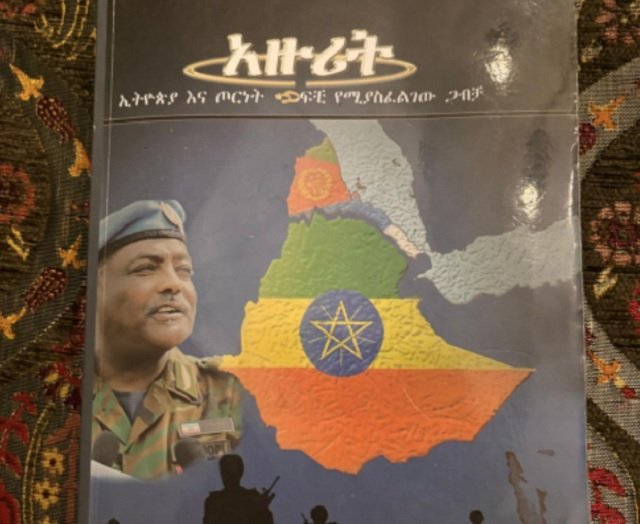
Azurit is an antiwar book written by a man of war. The author of Azurit, Let. General Yohannes Gebere Meskel is imminently qualified, both by experience and education, to write a book on the place of war in Ethiopian political history. What is pleasantly surprising is that the summation of his life experiences is the writing of a seminal book on Ethiopia’s checkered history of war and conflict going back to the state formation and Zemene Mesafint. Zemene Mesafint was a period when various regions in Ethiopia fought against each other, often to ascertain the dominance of one Mesfin or region over another. In these wars, opportunistic alliances formed and dissolved routinely. Sometimes, it is Tegray against Gojam; sometimes, it is Yeju against Gondar, sometimes it is Shoa against Wollow. There were also wars within each region. Tragically, Tigray bore the worst of these brutal fighting without a break for hundreds of years. Reading Azurit, one can conclude Tigray is a society shaped by uninterrupted conflict within and without. Add to these internal conflicts, the wars in Adowa and Maichew, it is safe to conclude Tigray is a land cursed with conflict. It should come as no surprise then that Tigray engaged in another war against the Derg. While its success against the military government, should have been the war to end all wars, tragically, we saw perhaps the ugliest and bloodiest conflict yet when another war erupted in Tigray again in 2020.
General Yohannes rose through the ranks to become Ethiopia’s Defense Forces Intelligence Chief. He led a UN Peace Keeping force in Abaye and South Sudan. He also attended the Command and Staff College in Kansas. The general gained his military leadership experience in the TPLF led war against the Ethiopian military government. He had noteworthy military successes in many battles to brag about; instead, he seems to have concluded that wars which are the mainstay of successive Ethiopian regimes, have been a net loser for Ethiopia. Surprisingly, he has even soured on the war he successfully participated in. The TPLF victory failed to end all wars. Now, he has come to the realization, in the TPLF victory and takeover of Addis Abeba, the seed of another war was planted. Instead of self-aggrandizing for having participated in a war that TPLF propagandists claim, “defeated Africa’s largest army,” he saw the tragedy of a civil war fought among people of the same country. In such a war, the general concluded, there are no winners. Even the Tigray people, whose children paid a huge price to enable not only TPLF’s but EPLF’s victory, barely gained any benefit out of it. While victory may have led to immense wealth for a class of Tegaru politicians and military leaders, the vast majority of Tigray people benefited nothing from this. Instead, the century-old fraternity they had shared with other Ethiopians was frayed. TPLF failure to create a nation that lifts all people resulted in ethnic grievances which harmed innocent Tigranes.
“I have known war since I was 18 years old. I have also experienced the horrors of war, suffered severe wounds in my leg; my bones have been crushed, my flesh was torn, and my blood gushed. The experience was so horrific that I would have preferred to die.” It is this capacity to reflect on his own experience, the Western education in leadership and strategy that he acquired, that have enabled the general to write, in my humble opinion, a seminal work on Ethiopian political and military history. Azurit should not only be read; it should be studied and discussed among scholars, politicians, military officers and influence makers.
When war drums are sounding in the North of the country, and the dogs of war are howling for blood, studying this book carries the fierce urgency of now.
“In my view, our history’s decisive character is the cycle of war.” This is the overarching theme for this book. The book surveys the major battles between the Ethiopian military and TPLF forces. During this war, the author questions TPLF’s crucial and in some engagements, decisive military support for Eritrean fighters. He specially laments the 30,000 Tigray youth trained under the Eritrean military and used as cannon fodder. The Eritrean leadership took this support for granted. And despite the military support given by TPLF, the Eritrean leadership never respected the Tigray people which it saw as inferior to its own because of its colonial experience. The author singularly accuses Aboy Sebhat as having played a role in this one sided relationship – with the benefit accruing to Eritrea mostly. He was therefore unsurprised when war broke out between the two formerly allied powers. During this war, General Youhannes led the One Hundred Tenth Corps, in his assessment, the most integrated military unit in Ethiopia. In this division, Ethiopians of all ethnic groups – Oromo, Amhara, Wurage, Afar, Somali, Wolayta, Kembata, etc. fought, bled and died as a unit. The ethnic animosities that afflict civilian leadership did not infect this army. They fought and died for Ethiopia. The general is proud of having led this unit, a microcosm of Ethiopia, against its avowed enemy. This must have shown to the general the disconnect between the Ethiopian youth wearing the Ethiopian military uniform and the political leaders who were prisoners of ethnic politics. Among the officers who fought under his leadership were Let. Colonel Asamenew Tsegie, Colonel Birhanu Jula (now Field Marshall), Colonel Kemal Gelchu, etc.
This book is an ambitious undertaking. In its 600 pages, major topics, each of which would require a book on their own, are covered
• Conflict and War in Ethiopian History
• The TPLF Led war against the Ethiopian Military Government
• The formation of EPRDF and OLF’s exit from the coalition
• The War with Eritrea
• The Politics of TPLF. The Military during the EPRDF period
• Economic and Governing Successes under EPRDF post 1997 (EC)
• Crisis within EPRDF After the death of Prime Minister Meles Zenawi and the Short, Turbulent Reign of PM Haile Mariam • The Collapse of the TPLF Leadership and the Intra-party Power Struggle Within the EPRDF Coalition
• The Emergence of PM Abiy and General Political and Security Crisis, especially in Tigray and Oromia
• The War in Tigray. Eritrean and Amhara Forces Involvement in the War. TPLF’s Defeat and Retreat to Timben. The Resurgence of Tigray Military and March to Addis.
• TDF’s Defeat and Retreat to Tigray and Ethiopia’s Decision to End the Conflict Peacefully. The Pretoria Agreement
The topics are not organized in this order, but the author covers these topics at varying levels of detail and complexity. The book is easy to read and understand the author’s take on these issues. The author’s style is direct. He does not try to embellish or exaggerate. However, what the book achieves in readability can’t
mask its lack of organization. If one is to point out weakness, it would be its organizational incoherence. Also, serious allegations, especially about Aboy Sebhat and TDF generals rely on circumstantial rather than hard evidence with supporting documentation. I don’t think these weaknesses take away from the enormous value of the book to understanding Ethiopian politics. No one who is so much in the know of what happened in Ethiopia has written such an informative and consequential book on contemporary Ethiopian politics.
There is scant information about the author’s childhood: what subjects he liked, if he played sports (soccer), or fell in love with a girl; did he have a teacher that influenced his life? He attended a school founded by his grandfather until he was in 8th grade. His grandfather, Aleka Tewldemedhin, started a modern school in a conservative state where modern education was seen as subversive. Aleka Tewlode’s grandchildren include the author, a successful military officer in his own right, Sibhat Gebreegziabher, the well known scientist, Dr. Tewolde Gebreegziabher, the politician Netsanet Asfaw and the physicist, Terfu Asfaw (42). General Yohannes’ parents were farmers. His coming of age is typical of this so-called revolutionary generation. While in Ras Alula high school, he was introduced to leftist ideology by Zemach university students. That is where he learned about such topics as “national oppression,” feudalism, etc. He joined the TPLF military and completed three months of training at age 18, before finishing high school. He was soon thrust into the war against the Ethiopian government. Therefore, it can be said, General Yohannes is a creature of war, a product of Ethiopia’s most consequential civil war that brought TPLF to victory. That is why his voice on war is so authoritative.
His initial skepticism about the war occurred when he saw Tigray children being sent to Nakfa, ostensibly for training, but as he later realized, to fight Eritrea’s war. When he was in school, his grandfather instilled in him a Biblical story: Jesus said, “let the children come to me.” He could not square his value with TPLF’s decision to send children for training in Eritrea without their parents’ consent. This must have triggered a
moral conflict; he wanted to bring the children out of Nakfa. As a retribution, he was sent away from Eritrea for his disobedience.
Another incident that might have fortified his distrust of Eritrean leadership was, during the famine in Tigray, Tigray peasants left their village to go to Sudan. EPLF blocked the route to Sudan causing enormous suffering to the peasants. He could not understand why their supposed ally would do this to the people of Tigray.
The author also mentions a series of incidents that seem to have shaken his faith in the leadership of TPLF. He kept his skepticism and doubt to himself. In their march to Addis, he saw military units that were poorly led by officers who were seen as loyal to TPLF being promoted despite their failures. He recalls the battle for Debre Tabor, where TPLF suffered heavy losses due to poor leadership, and to his dismay, regular soldiers and lower officers were punished including death (67) for the failure. Those responsible were not only reprimanded for their poor leadership but rewarded for their loyalty. He also questioned the way TPLF treated prisoners of war, especially when they were of Tigray origin. He mentions the sad case of Colonel Sereke who was captured. The author praises Col Sereke as a capable military leader who skillfully fought TPLF in different battles. The captured officer was used to train TPLF fighters and then suspiciously disappeared, never to be heard from again. This and similar incidents that he observed made him question whether TPLF was different from the Derg in any meaningful way. Repeatedly, he returns to the futility of civil war where one’s hero is the other’s villain. There’s no definite winner in a fight between brothers. Everyone is a loser.
If the wars he fought honed his leadership skills, they also made him a skeptic of wars fought for political reasons. However, it was his competitive selection to attend the Command and Staff College in America that made General Yohannes a more rounded soldier and thinker. Here, in this premier war fighting school, the general studied “military science, history, laws, war and diplomacy”. He also met many foreign officers with whom he shared his own fighting experiences. One connection with a fellow student from Albania particularly stands out for its Aha! moment. The late PM Meles saw Albania as a model of socialist society that he wanted to emulate. When General Yohannes met the Albanian student, the Socialist utopia that Albania had seemed to Ethiopia’s revolutionaries, had disappeared with the collapse of the Soviet Union. In its place had emerged a struggling nation, Europe’s poorest, to become a normal country. When the general described the Albania he had read about from the writings of Meles, the officer laughed it off. That description did not comport with the Albania he knew. General Yohannes must have realized then that what he knew of communism and socialism had little correspondence to the reality on the ground. This stands out as a moment that scrambled his worldview. More importantly, the general credits his education at this institute for having helped him provide better leadership during the war against Eritrea. His 110th army surprised the Eritrean Army by attacking from the direction that Eritrean officers expected. Knowing the impregnability of the train, the Eritrean officers had concluded that attack from that direction was impossible. This daring maneuver exposed the Eritrean army so badly that it had to pull troops from other fronts to defend it and boosted the other fronts. The 110ths successfully crossed the Mereb to control strategic positions according to the author.
Many readers who are not interested in wars but follow Ethiopian politics would find the chapters on the EPRDF status after Meles’ death, and the premiership of Haile Mariam, to be insightful. However, what I truly found mesmerizing was the power struggle within EPRDF during this period. The scorched earth tactic deployed by TPLF leadership to keep Abiy from emerging as the chairman of EPRDF, TPLF leadership retreat to Mekele to scheme its return to power, the breakout of the war which the author believes could have been avoided, are fascinating to read and full of surprises. Anyone wanting to understand the post Meles Ethiopia, the disequilibrium in the ethnic federalism under ERRDF, the new power alignment and TPLF’s arrogant but avoidable provocation of war, must read these chapters. Here, the author comes out as an enormously complicated leader. He did not flock to Mekele to defend the aggrieved Tigray nationalism. Instead, he spoke and conferred with politicians he knew on both sides to cool this brainless march to war. Being a man who understood war, he anticipated the catastrophe that would engulf Tigray. He also knew that the rest of Ethiopia would not fare any better either. Once Mekele was taken over by the Ethiopian army, the general suggested ways to rule over the State that could prevent the mayhem caused by the partnership with the Eritrean army (which he knew was on a mission of revenge) and Amhara Leyu Haile and Fano. He understood this would cause harm to the Tigray civilians. He recommended the formation of nearly 30 thousand former Tigray troops as a stabilization force to control Mekele. What he felt was a sensible plan was viciously attacked by Eritreans, Amhara politicians and the Tegaru elite which commanded enormous influence outside the country. His plan never came to fruition, so we would never know if it would have prevented the catastrophe.
He was vilified as a lucky by Tigray nationalists, a TPLF apologist by others. In this difficult, and lonesome position, one can appreciate the courage of the general to expose himself to vilification to minimize civilian deaths. Given the toxic anti TPLF propaganda which often failed to differentiate between the people and the organization, he understood the participation of the allied forces posed danger to the Tigray people. His fear was born out by subsequent events. The general reached out to influential Tigray leaders when the Ethiopian government gave hints to end the war peacefully. The role he played in facilitating contacts between the two combatants can never be fully appreciated. The book mentions this in some detail, but the full significance of this undertaking remains a mystery. The book also dispels the propaganda that PM Abiy is a war monger. The length the Ethiopian government went to end the war by peaceful means and maintain the peace once agreed, can be seen in the book. The book implies that forced mistakes were made on the part of the government because of the seriousness of the threat and the rapid deterioration of the situation in the beginning. The government’s problematic alliance with Eritrea and anti-TPLF forces were forced errors caused by the difficult military situation prevailing in the beginning of the war that TPLF was determined to exploit. So, whatever mistakes were committed were not deliberate. The same can’t be said of TPLF’s calculated attack on Ethiopia’s Northern Command. It was intended to decapitate Abay’s shaky hold on power. On the other hand, General Yohannes observes the lack of strategic vision on TPLF’s decision to go to war. TPLF successes, had they occurred, would only have empowerment OLA, Fano and TPLF in their respective regions. That would have heralded a new cycle of war among these factions both for the control of the center and the periphery. The general would know; he has travelled this road before.
During the war with TPLF, I was often puzzled by the behavior of the Eritrean army in Tigray. I read both the United Nations Human Rights and the Ethiopian Human Rights Commission reports on atrocities committed against Tigray civilians. Both reports seem to emphasize the barbarity of the Eritrean Army which committed what are referred to in these reports as “Crimes against Humanity,” and “War Crimes” These were often committed in the most gruesome way by Eritrean soldiers. Azurit, looks into the doctrine of the Eritrean military training to explain this. Eritrea military training manual covers ‘deep rooted animosity” toward Tigray people. The manual contains narratives that are meant to perpetuate inter-generational hatred of Eritrean youth towards its Tigrayan brothers. In propaganda pieces written in Tigrigna, exhort “Your ancestors were slaughtered like lamps during the Adowa war. You owe your ancestors revenge that can never be fully paid.” The author surmises this unbridled hatred taught to Eritrean youth may explain the barbarism its soldiers displayed while fighting in Tigray.
General Yohanesse writes vividly on the tragedy of wars.
“War, more than anything else, exposes us to trauma. War is a phenomenon that destroys the sense of safety of everyone. War inflicts trauma on all—from soldiers to civilians to society writ large. War destroys lives and property and results in massive disabilities. Those who survive carry guilt and trauma throughout their lives. When some societies repeatedly experience war, the population collectively experiences the trauma…” “As observed by experts, people who have experienced trauma don’t make thoughtful decisions; they act impulsively, and are prone to civil disturbances. They suffer from an impending sense of doom. They lack joy in their life, feel estranged and become desensitized.”
“Based on my own personal life, and my studies of Ethiopia’s cyclical wars, the series of wars that Ethiopians have endured, and the harm inflicted on society by these wars, I have come to believe that wars perpetuate inter-generational trauma.”
General Yohanes has even the courage to admit that he himself may not have been spared the consequences of this trauma. But, his writing shows, his life has transcended his own background. He has internalized the cost of war and does not want it to happen to others.
Reading this book can make one fatalistic: The weight of our history is such that we would never be able to overcome it. We are people doomed to endless war. Each of our ethnic groups have enough grievances to prosecute wars until their supposed oppressors are vanquished. We are feted to kill each other Ad Infinium.
But the general is hopeful that we can transcend our bloody past and chart a new future that will bequeath to our youth
Bequeathing a peaceful society to our youth is our political imperative. General Yohannes, the man who, like our society is shaped by our wars, shows the way forward.
We owe the general a debt of gratitude for making us confront our unpleasant past and show us a way out by focusing on our common humanity.
__
Support Borkena : https://borkena.com/subscribe-borkena/
Join our Telegram Channel : t.me/borkena
Like borkena on Facebook
Business Listing/Business Directory
If you wish to share information about your book and have it featured on Borkena, we encourage you to submit your book details to info@borkena.com.
Join the conversation. Follow us on twitter @zborkena to get latest Ethiopian News updates regularly. Ethiopia To share information or send submission, use info@borkena.com
The article is vague and meaningless.
Ethiopians fought legitimate wars against foreign invaders. Ethiopians, like Europeans fought feudal wars. Eritreans fought legitimate wars against H/Selasie rule and Mengistu regime. The Oromo and Tigrian separatist fought against Ethiopia.
After the fall of the Derg regime and the subsequent establishment of the EPRDF ethnocentric political system, a new type of war began taking shape. A genocidal war against the Amhara people. The EPRDF became Prosperity Party after the Oromos snatched power from the Tigrians. The Abiy led PP propelled the ethnocentric politics to its peak. After reaching their peak, the Oromo and Tigrian ethnocentric politicians have to either write new constitution or form a transitional government. The ethnocentric politics of the Oromos and the Tigrians is a problem.
Technically speaking, Ethiopia doesn’t exist. What we have is sovereign Ethnic states organized under the name of Ethiopia.
The Amharas are fighting for their survival.
The Amharas are fighting to rescue Ethiopia
Ethiopia needs a new constitution.
Thank you for this insightful summary of General Yohannes Gebere Meskel’s book. As someone with firsthand experience in the TPLF’s successive wars, the General offers a vital lesson on the ‘ugly faces’ of conflict and the urgent need to break the cycle. History has shown us repeatedly that ethnic-based wars—whether involving Tigrayans, Oromos, or currently Amharas—primarily devastate the very communities they claim to represent. This perspective from a key participant in these events is a powerful reminder that we owe it to future generations to learn from these tragedies and choose a different path.