
Editor’s Note : Views in the article do not necessarily reflect the views of borkena.com
Yonas Biru, PhD
Abstract
The escalating violence against Amhara Orthodox Christians in Ethiopia is frequently misdiagnosed as a spontaneous religious conflict. This analysis reveals that the violence is, in fact, a calculated byproduct of weaponized ethnic politics. By stripping religion of its moral authority and repurposing it as a marker of “imperial hegemony,” political actors have transformed a spiritual institution into a legitimate target for disenfranchisement and physical erasure.
Ethiopian history is undeniably marked by violence. The jihad of Ahmed Gragn, the Oromo expansion and conquest under the Gadaa system, Yohannes IV’s forced conversions of Muslims, and Menelik II’s southern expansion and conquests all involved grave atrocities. Yet these episodes were not the inevitable outcome of ethnic or religious hatred. They were, to varying degrees, elite-driven conflicts rooted in rebellion against subjugation, hegemonic contestation, consolidation of power, and ultimately the resultant state formation.
At the same time, Ethiopian history is also a history of coexistence, cultural synthesis, religious accommodation, and remarkable social resilience. Even amid contemporary radical polarization along ethnic and religious lines, everyday life continues to be sustained by inter-communal solidarity. Muslims protect Christians from extremist violence; Oromos hide Amharas fleeing ethnic reprisals; during the recent war, Amhara families sheltered and nurtured wounded Tigryan fighters. These acts are not anomalies—they are evidence of a deeply woven social fabric that has survived systemic political disruption.
To understand why Amhara Orthodox Christians have become primary targets in areas governed by Oromo ethno-nationalist political authority, one must therefore look beyond simplistic narratives of religious war. The violence is not the result of Muslim–Christian conflict. Rather, it is a symptom of the collapse of shared moral and spiritual values under the weight of weaponized ethnic politics. Religion is stripped of its ethical authority and moral imperative, repurposed to serve the politics of tribal victimhood—real, imagined, or outright fabricated.
The Imperative Comparative: Gragn Ahmed, Gadaa, Yohannes IV, and Menelik II
The distinction between the eras of Ahmed Gragn, Gadaa, Yohannes IV, and Menelik II is essential to exposing the fault lines and hidden land mines of ethnic- and grievance-based identity politics that define Ethiopia’s contemporary political order. If the goal of ethnic federalism were genuinely to address historical atrocities, its moral inquiry would be multi-directional. Instead, by focusing almost exclusively on Menelik II and the Amhara, the system reveals itself not as a project of justice, but as a mechanism for constructing and disenfranchising a targeted enemy – Amhara.
This selective villainization has tangible consequences. It legitimizes framing Amhara, and by extension the Ethiopian Orthodox Tewahedo Church (EOTC), as the root cause of all historical subjugation, thereby fueling targeted violence.
Ahmed Gragn’s Jihad: Ahmed Gragn waged a military-religious campaign against the Christian Ethiopian state using Ottoman-supplied firearms. Documented atrocities include large-scale slaughter of civilians during the sack of towns and monasteries, systematic destruction of churches, monasteries, and religious manuscripts, forced conversion, enslavement, and sexual violence.
Gadaa Ritual Expansion and Conquest: Atrocities associated with Oromo expansion involved violent conquest and mass displacement. Documented practices include the slaughter of resisting populations during territorial expansion; mutilation, including the cutting of hands, ears, breasts, or genitals; the cutting open of pregnant women and removal of unborn children as punishment or terror tactics; enslavement; forced expulsion of settled populations from ancestral lands; cultural erasure; and forced assimilation into second-class social status.
Yohannes IV’s Forced Conversions: State centralization and religious homogenization under Orthodox imperial authority involved forcing Muslims, Catholics, and Protestants to convert to Orthodox Christianity, as well as the expulsion or punishment of those who refused. Documented abuses include violent suppression of dissent, limb mutilation, enslavement, and village burning.
Menelik II: Menelik II’s southern expansion involved large-scale killings, mutilation, enslavement through the gabbar system, seizure of land, dispossession of indigenous populations, and cultural suppression. The Anole and Chalanqo massacres and the conquest of the Kingdom of Wolayta were particularly bloody. Contemporary chronicles record thousands of deaths and the enslavement of a significant portion of the population.
The four historical projects relied on violence to impose a preferred political and moral order in their own image religiously, culturally, and administratively. Ahmed Gragn sought to dismantle the Christian imperial state and replace it with an Islamic-dominated polity. Gadaa-based Oromo expansion aimed at incorporating territory and populations into a decentralized Oromo socio-political order rather than constructing a centralized state.
Yohannes IV pursued imperial survival through religious homogenization, deploying Orthodoxy as a unifying instrument of authority. Menelik II, by contrast, prioritized territorial expansion and administrative unification, governing through imperial institutions rooted in Amharic culture without pursuing systematic social assimilation.
While both Gadaa and Menelik employed systems of subordination (gabaro and gabbar, respectively), the Gadaa system emphasized conditional social incorporation that positioned conquered populations in subordinate status within Oromo society. Menelik’s imperial order functioned primarily as an extractive administrative system based on taxation and bureaucratic submission. Military and administrative elites from conquered regions were often fully integrated. Oromos such as Ras Abebe Arega, Ras Mesfin Sileshi, Dejazmach Balcha Safo, and General Jagama Kelo were the envy of Amhara nobles. Nevertheless, social relations remained structurally hierarchical, producing a durable divide between a governing class largely Amharic in culture and the conquered populace.
Simply put, the Menelik regime was largely indifferent to social identity or clan affiliation; its primary concern was control over land and the extraction of tribute and taxes. Because the language of administration and the military was Amharic and imperial legitimacy was anchored in Orthodox Christianity, populations outside that cultural sphere often experienced rule as subjection rather than full membership in the imperial polity.
This structural arrangement produced a durable hierarchy between rulers and ruled—what later came to be perceived as a “subjugator versus subjugated” dynamic. Yohannes IV’s regime operated similarly in its emphasis on administrative control, with one critical distinction: religious conformity was pursued not only as an instrument of governance, but as a project of social assimilation enforced through coercion at the communal level.
Despite being targeted as an enemy, the Amhara are not innocent in the deployment of curated historiography to legitimize power. Historically, they presented themselves as modernizers and custodians of the nation-state while narrating others – most notably Gragn Ahmed and Gadaa expansion – as destructive external invaders. This selective self-portrayal, while politically effective, contributed to the very moral asymmetries that later enabled ethnicized reinterpretations of history.
The Post-1991 Regime of Ethnic Federalism
The cornerstone of the modern ethnic-identity-based political strategy is a selective reinterpretation of history. Under the post-1991 regime of ethnic federalism, a politically curated narrative and a target enemy were required. The complex, multi-ethnic tapestry of Ethiopian state formation was flattened, and Menelik II and the Amhara were constructed as the singular ethnic villain, absorbing collective culpability for the nations historical violent past.
Central to this narrative is the recasting of the Ethiopian Orthodox Tewahedo Church (EOTC). In the ethno-nationalist lens, the Church is no longer viewed merely as a religious institution but as the cultural and administrative arm of Amhara-led imperial hegemony. This alignment is not born of sudden religious piety; it is a strategic maneuver for political weaponization.
In a systemic effort to weaken perceived Amhara political dominance, in the 1970s, Tigryan and Eritrean elites joined forces with other historically subjugated groups, primarily Oromo and southern populations, along with Islamic political forces. Though Eritrea and Tigray were integral parts of the Christian kingdom, animosity toward the Amhara proved a more powerful mobilizing force than historical accuracy or political coherence.
As a weapon of choice, ethnic federalism was socially institutionalized and legally constitutionalized to purportedly liberate and empower what the constitution defined as ‘nations and nationalities’. The unnamed oppressor, but widely understood and targeted was the Amhara. Ultimately, the hyped ethnic federalism proved an instrument of hegemonic power grab first by Tigryans and later by Oromos.
What Does AI Say About Diversity in Leadership Before and After 1991?
I asked four AI platforms the following question: Which among the Haile Selassie, Meles Zenawi, and Abiy Ahmed administrations was ethnically diverse at the top level in terms of influence, not symbolic headcount? While AI-generated analysis is not a substitute for archival research, the convergence across platforms is instructive in highlighting perceived patterns of elite power distribution.
Google Gemini: Haile Selassie ranked highest in institutionalized power sharing; Abiy Ahmed ranked highest in symbolic representation; Meles Zenawi remained the most concentrated in influence.
ChatGPT: Haile Selassie was the most diverse in real elite influence; Meles concentrated power; Abiy was symbolically diverse but centralized authority in the Prime Minister’s office.
DeepSeek: Haile Selassie scored highest in de facto power sharing; Abiy in symbolic inclusion; Meles lowest in diffusion of real influence.
Grok: Haile Selassie led in shared influence; Abiy in visible inclusion; Meles offered neither.
Post-1991: Targeting Amhara for Economic, Social, and Military Disenfranchisement
Before ethnic federalism, the population difference between Oromo and Amhara was 332,414 based on the 1984 census. This gap expanded to 4,898,228 in the 1994 census, 9,944,415 in 2007, and 13,626,137 in the 2023 official extrapolation – all in favor of Oromo populations. This has profound implications for parliamentary representation and federal budget allocation.
The economic impact is both visible and utterly discriminatory. During the TPLF era, infrastructure development was uneven. A World Bank report noted: “Remote and economically lagging regions, and Amhara Region, saw lesser increases in road density… the increase in road density was concentrated in certain regions, notably Addis Ababa, Tigray, and Oromia.”
Another indicator used by the World Bank was night-time light intensity, correlated with GDP growth. The top three cities outside Addis Ababa registering higher night-time light intensity were Mekelle (Tigray), Adama (Oromia), and Awassa (Southern Nations). Access to healthcare reflects similar disparities. A 2005 World Bank report shows that delivery care by medically trained personnel was highest in Addis Ababa (69 percent) and lowest in Amhara regions, at only three percent.
The anti-Amhara policy includes on the military front. In April 2023, the federal government announced a nationwide plan to disband and integrate armed regional special forces. The TPLF publicly refused disarmament, and its special forces and allied militias remain armed. As of 2026, Oromia’s special forces and associated militias have not been fully disarmed, and no enforcement action has been taken. The only region subjected to military force to compel disarmament has been Amhara.
From Amhara-to-Amhara Orthodox Christians as the Singular Historical Villain
Orthodox Christianity entered Ethiopia in the fourth century through Axum in present-day Tigray. Over time, the Ethiopian Orthodox Tewahedo Church became inseparably intertwined with the Ethiopian state through the Solomonic tradition. The result was a sanctified union between the Crown and the Church that anchored imperial legitimacy. The Church functioned not merely as a spiritual institution, but also as a cornerstone of political authority, social hierarchy, and state legitimacy. Ethiopia functioned, and portrayed itself, as a Christian island in a largely non-Christian region.
This fusion of faith and state was decisively broken by the 1974 revolution. The EOTC lost its landholdings, its official status as the state church, and its access to the levers of power and political authority.
Against this backdrop, the question arises: why have Amhara Orthodox Christians become the primary targets of violence in regions governed by Oromo ethno-nationalist authority?
If the violence were genuinely religious, Orthodox communities in Tigray (where Christianity first entered Ethiopia and whose king enforced Christianity as state religion) would be equally targeted. They are not. Instead, Amhara Orthodox civilians bear the brunt of attacks framed as “religious.”
This reveals a critical truth: From the Oromo perspective, the violence is not directed at the Orthodoxy faith. It is directed at Amhara as an ethnic category, with religion serving as a marker rather than a causal force.
The Misguided Alliance: Radical Amhara Muslims and Oromo Extremists
The contours of the alliance between radical Amhara Muslims and Oromo extremists are defined not by shared ethnicity or devotional solidarity, but by a convergent political goal: the dismantling of the Ethiopian Orthodox Church’s perceived socio-political hegemony.
One mechanism enabling this process is the instrumentalization of fringe Christian groups to demonize the EOTC. One such radical fringe is the Moa Tewahedo sect. There is also an off-grid network of Amhara activists who fantasize about dialing back the time to when the Amhara played a dominant role in state politics. These are not different from Tigryan extremists who believe Ethiopia is the product of Axumite civilization and Tigryans must continue to play an oversized role in Ethiopian politics.
The Moa Orthodox movement along with other Amhara extremist elements defend the union of Church and Solomonic state and espouses delusional aspirations of resurrecting it without any capacity or means to operationalize their delusion. Above all, they target the Holy Synod, accusing it of lacking political courage and ecclesiastical devotion to defend the Church, while the Synod denounces them as radical and irresponsible.
Extremist Oromo ethno-political actors and some Amhara Muslim radicals spotlight these fringe voices to portray the entire EOTC as a political threat. Ironically, many of the same actors who rightly reject conflating ISIS or al-Qaeda with mainstream Islam readily present Moa Tewahedo as representative of mainstream Orthodox Christianity.
A deeper interrogation of Ethiopian history and contemporary ethnic federalism reveals that this is not a traditional religious conflict. It is a political strategy where religion serves as a convenient marker for ethnic targeting and the deconstruction of the Ethiopian state. By attacking the Church, extremist Oromos aim to erase the symbolic remnant of the historical state.
A subset of radicalized Amhara Muslim political activists conveniently align with Oromo ethno-nationalist extremists to weaken Amhara Orthodox influence. This alignment is driven less by theology than by longstanding hostility toward the Ethiopian Orthodox establishment, which these activists continue to portray as an oppressive force within their own region. More than five decades after the Church lost its formal role in the state, Islamist political extremists still view it as the last symbolic bastion of the Old Guard. They view the Church’s architecture, its language (Ge’ez), and its historical narratives as a “soft power” barrier to their own vision of civic equality.
By adopting an explicitly anti-Orthodox posture, these actors bypass ethnic lines in favor of a shared religious-political objective in an effort to dismantle Orthodox socio-political influence, which they perceive as a prerequisite for achieving full Muslim civic equality. The result is a cross-ethnic political front in which religion functions as a connective thread rather than a devotional bond.
The grassroots reality between Muslims and Christians, and between Amhara and Oromo communities, is starkly different. Many Muslims participate in the Fano movement at both leadership and grassroots levels, particularly in Wollo, North Shewa, and parts of Gondar. There are documented cases of Oromo Muslims being killed while defending their Christian neighbors, and of imams physically intervening to prevent churches from being burned.
This alliance between Oromo and Amhara Muslim radicals is therefore discursive and political, not religious. It represents an “anti-hegemonic” strategy in which the dismantling of Orthodox influence is framed as a necessary condition for full Muslim civic equality. This dynamic is particularly visible in the Amhara region, where Muslims constitute less than one-fifth of the population (approximately 18.5 percent according to recent census data). For some political activists, weakening the social standing of the Christian majority is viewed as a pathway to elevating the Muslim minority within a competitive ethnic-political order.
What is lost is humanity grounded in moral principles and universal justice as an organizing and governing framework—one in which ethnic identity is not elevated over religious affiliation, and religious tenets are not subordinated to ethnic impulses.
Two important lessons seem lost on radicalized Amhara Muslim political actors. First is the failure to recognize the risk of being instrumentalized by Oromo nationalists who may not only discard them but also target them once the Orthodox power base is weakened. Second is by adopting an “anti-Orthodox” stance, they provide a “moral” cover for Oromo extremists to attack innocent Amhara civilians under the guise of “decolonizing” the region.
Political Rivalry Revealed in Religious Double Standard
In Islamic theology, the ultimate allegiance is Tawḥīd—the uncompromising affirmation of worshipping none but Allah. This is followed by the unity of the Ummah, signifying an unbreakable brotherhood among Muslims. In recent years we have witnessed extremist Amhara and Oromo Muslims selectively subordinate the Ummah edict to tribal identity politics.
This is manifested in their starkly different reactions when Amhara Muslims faced atrocities in the Amhara and Oromo region. When Oromo extremists burned down tens of Mosques, massacred over 400 Wolloye Muslims and forcefully displaced tens of thousands of them, the reaction from the Amhara and Oromo political Muslim community was somewhere between utter silence and short-lived muted protest. By contrast when two Mosques were burned and 15 Amhara Muslims were murdered the reaction was loud and sustained for a long time.
This selective empathy proves that the conflict is not about faith. What we observe is a brutal truth: religion does not anchor moral obligation, ethnicity does not guarantee solidarity. The campaign against Amhara Orthodox Christians is a political project. It is driven by radicals, even as many Oromo Muslims have bravely defended Christian neighbors. It ignores the reality that Muslims are integral to multi-ethnic resistance movements like Fano in parts of Wollo, Shewa, and Gondar. And it reduces the complex history of the region to a tool for contemporary power consolidation.
One of the most striking failures in this crisis is the absence of cross-ethnic Orthodox solidarity. Despite sharing theology, liturgy, and ecclesiastical heritage, Amhara and Tigrayan Orthodox communities have not united to defend the EOTC when it comes under attack. This happened decades before the war between the Tigray region and the federal government. For Tigryan political elite faith consistently yielded to ethnicity.
Servicing The State’s “Divide and Rule” Strategy
The federal government and Oromo ethno-nationalist authorities exploit this internal religious friction to weaken Amhara political unity. It fragments the Amhara political front, forcing the community to fight an internal battle over religious identity while simultaneously facing an external military threat. By highlighting fringe groups like Moa Tewahedo on one side and Amhara Muslim radicals on the other, the state creates a “clash of extremists” narrative. It effectively portrays the Amhara resistance as sectarian and chaotic, making it easier for the international community to ignore state-led atrocities.
Conclusion: Reclaiming a Complex History and Charting a Common Future
The proverbial red thread that connects radical Amhara Muslims and extremist is not a shared vision for Ethiopia, but a shared desire to dismantle the historical Amhara powerbase that drew its legitimacy from the EOTC. Ironically, this is happening as the Oromo political class is resurrecting and empowering the Gadaa power architecture whose historical conquest and subjugation is no less atrocious than the Amhara historical conquest and subjugation.
The fundamental question is: If the contemporary Muslim community is not persecuted for the atrocities Gragn Ahmed committed, if the contemporary Oromo community is seeking praise rather than condemnation for Gadaa atrocities, and the contemporary Tigray community is not held accountable for Yohannes IV’s atrocities, why is the Contemporary Amhara community is treated differently?
This article revealed that the modern Ethiopian state is not struggling with the “ghost of Menelik,” but rather with a collapse of shared values that have been replaced by a zero-sum competition for ethnic survival.
The danger today is that simplified narratives of ancient grievances are being weaponized for contemporary political power. This has accelerated the collapse of the nation’s moral order. When religion does not anchor moral obligation and ethnicity does not guarantee solidarity, victimhood is recognized only when it serves a specific political script.
Ethiopian history is not merely a chronicle of war. It is also a history of coexistence, cultural synthesis, religious dialogue, trade, and intermarriage. The path forward requires moving beyond the “ethnic villain” narrative toward a Civic Union. Breaking the cycle of incrimination requires a strategy that acknowledges the past—with all its intertwined synthesis and conflict—without instrumentalizing it for contemporary power consolidation.
Any outstanding Muslim grievances in the Amhara region can and should be addressed without animating anti-Orthodox sentiment. In like manner any outstanding Oromo equality demands can and should be addressed without animating an anti-Amhara sentiment.
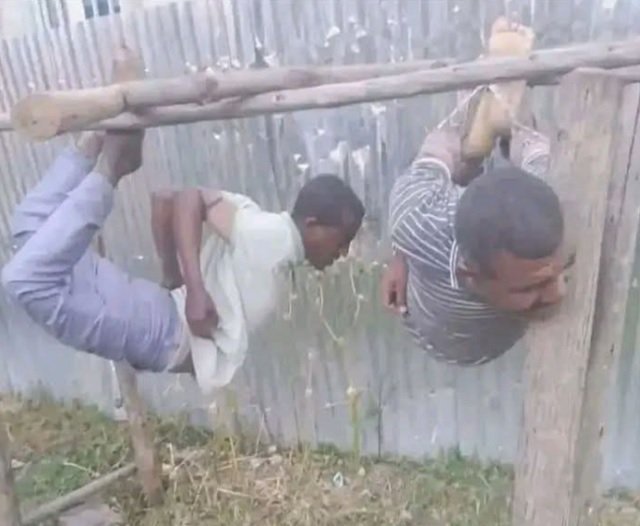
The image below serves as a visceral and harrowing manifestation of the ills of tribal politics. Shared by a prominent Oromo ethno-nationalist (Wake Jeo), the photograph captures an Oromo-on-Oromo atrocity. In the picture two young victims are tied and suspended in agonizing positions. Ironically the person attributes this violence to “The Ethiopian imperial state under Abiy Ahmed.” Despite the obvious and delusional obsession with the ghosts of Menilik, – the reality on the ground in the Arsi zone (Robe district, Sadiqa city) where the crime is alleged to have been committed reveals a more complex internal fracturing. The two victims, accused of being OLA supporters, represent what the source describes as “only one of the thousands” of incidents that have occurred since 2018. This visual evidence underscores a devastating paradox: that in the pursuit of dismantling the ghosts of Menilik, the most immediate and brutal suffering is being inflicted by Oromos upon their own people.
Indeed, tribalism, like Ebola, kills its carrier. It is past time for the silent majority to rise. We have witnessed the ills of tribalism for over 35 years. Those who are adulterating religion as a political tool should learn from it.
Editor’s Note : Views in the article do not necessarily reflect the views of borkena.com
__
Support Borkena : https://borkena.com/subscribe-borkena/
Join our Telegram Channel : t.me/borkena
Like borkena on Facebook
Borkena Ethiopian News Youtube Channel
To submit Press Release, send submission to info@borkena.com
Add your business to Ethiopian Business Listing / Ethiopian Business Directory
Join the conversation. Follow us on X (Formerly Twitter) @zborkena to get the latest Ethiopian News updates regularly.
The trickery of ‘black magic’ continues:
Those who lack ‘imagination’ (the creative power) use ‘black magic’ to make the the ‘imaginative’ beings to create the world the none-imaginative-s want, and their little game-continues to the last imaginative (connected to consciousness, (the source of CREATION) ).
CONSCIOUSNESS IS NOT SELF AWARE.
‘Self ‘realization’ (is not awareness) is what CONSCIOUSNESS is.’ = THERE IS NO ONE ELSE here. (it is all YOU).
There is no THIS or THAT ( except LOGICALLY, logic is only useful to make SENSE in a SOCIAL setting) there is only this, this , this, & this is all YOU.
But we are tricked to think/believe we are many, NOT ONE & the SAME; WITH ALL THERE IS.
See, every one (in sprite state) before coming in to this physical-world, knew ‘THE WHOLE THING & NO-THING’ is all ONE; but growing with the Earthly-‘indoctrination’, we all forget, and kill each-other (kill ourselves, thinking it is SOMEONE ELSE), only to get reminded in the LSAT 20 seconds of this life. That why a dying person’s EYE opens WIDE; as if they FORGOT /REMEMBERED something ( but it was too late by then… ( the gig is up)).
It is BEST to KNOW early enough, while there is still TIME to CHANGE.
‘Secrets of the Universe’
===================
By : Prof. Jiang Xueqin
Link = youtube.com/watch?v=TsD-8FGA84A
“Refraction is what creates ‘self-awareness’, without ‘reflection’ there is no ‘self-awareness’. There is NO expression of ‘CONSCIOUSNESSES’, because ‘THE ONE’ (the unbroken ONE) has no SELF-AWARENESS.”
JESUS was self-aware just like we all are, but he BECAME ‘Self-Realized’ ( became CONSCIOUS = one with the WHOLE ).
The beauty is, ‘everyone’ will get there, in their own sweet TIME. Knowingly become (self-realize) one with the WHOLE, or get absorbed as the ‘THE ILLUSION’ (physicality) COLLAPSE!
Be well.
Dr. Yonas,
Two observations: 1/You don’t seem to have grasped how aggressive Ethiopian Orthodox Christianity can be to proselytize those of other persuasion. 2/ You seem to have adjusted your target to your current whims. I don’t understand why you think all those other groups should remain passive to an onslaught on their cultural well-being. It is only natural to resist when one is threatened. Probably you need to read how the Orthodox felt on experiencing Oromo incursion into their space.