
By: – Habte H.
When I think about Ethiopian politics, I often return, almost unwillingly, to the era of the late Prime Minister Meles Zenawi. I disagreed with him profoundly on many fronts: governance, the political order, ethnic politics, the way power was organized, and the heavy cost citizens paid for “stability.” Yet I admit something that even his critics recognized: his thought process and speeches often carried a deeper intellectual rigor. He built arguments, moved from premise to conclusion, anticipated objections, and handled tough questions with a seriousness that made you listen, even when you resisted the message. His successor, Hailemariam Desalegn, though less compelling, still sounded like someone aware of the weight of office.
In Abiy Ahmed’s early years, I had a similar impulse to listen. His words carried the promise of renewal, and like many Ethiopians, I wanted to believe that a new chapter could open without repeating old disasters. But over the last two years, I have found myself avoiding his speeches (including videos or photos) entirely. Not because what he says is irrelevant or hate him personally, but because I have grown convinced that he uses words as tools of manipulation, polished phrases designed to confuse, not clarify; to charm, not account; to rebrand failure as vision. To me, it has become a pattern of hypocrisy: claiming unity while deepening division, claiming truth while shifting narratives, claiming reform while protecting a narrow political project.
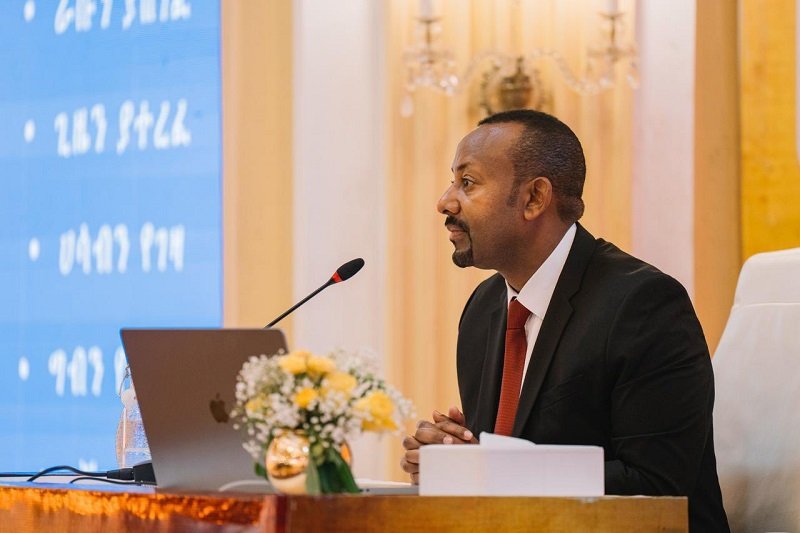
So, when he appeared at Addis Ababa University, during the institution’s 75th anniversary celebrations, delivering a guest lecture to academics and officials on “The Role of Intellectuals in National Prosperity,” I forced myself to listen, while deeply disinterested. The setting itself was meant to carry authority: the country’s flagship university, the symbolism of scholarship, the implied respect for ideas. It should have been a moment of honest engagement between state power and intellectual life. Instead, it felt like theatre.
The speech sounded meticulously prepared, too smooth, too carefully curated, like a product assembled by advisors to paint him as a deep thinker, unusually knowledgeable, and morally elevated. It was filled with the language of ideas as engines of change and intellectuals as builders of national destiny. But in a country where citizens are exhausted by insecurity, polarization, and economic pain, performative eloquence does not inspire. It provokes. Because the gap between rhetoric and reality has become too wide to ignore.
From that lecture, I came away with five troubling impressions, less about the university, and more about the leader standing at its podium.
1) The anxiety to appear intellectually superior
Abiy’s speech projected a strong desire to be seen as a man surrounded by “great minds,” and as someone qualified to instruct them. Yet the record of governance over seven years, whatever one’s political alignment, raises a hard question: where is the intellectual discipline in statecraft? Intellectual depth should show itself in policy coherence, institutional strengthening, consistency of purpose, and accountability when plans fail. What we often see instead is improvisation dressed as strategy, slogans replacing hard trade-offs, and moral certainty used to silence criticism. His prepared speeches may mimic the voice of a visionary, but his unguarded moments, and the outcomes around us, frequently reveal a narrower, more reactive style of leadership. The scripture reminds us that You will recognize them by their fruits – not by the beauty of their flowers or the sweetness of their words. The polished rhetoric may bloom impressively for a season, captivating, curated audiences, but the enduring fruits of persistent division, institutional erosion, and unaddressed crises speak far louder about the true substance beneath the performance.
2) Rebranding as “the visionary” without a credible legacy
Rebranding as “the visionary” is easiest when words are allowed to outrun record. A leader can borrow the language of prosperity, unity, and transformation, then present every new slogan as proof of depth. But vision is not a costume, it is verified by consistent choices, measurable outcomes, and institutions strengthened rather than bent. When a government’s signature years are marked by recurring crises, shifting narratives, and unresolved violence, the public naturally reads grand speeches as image repair, not direction. Without a credible legacy of results, the “visionary” label becomes a marketing strategy: polished, repeated, and ultimately distrusted.
3) The master of whitewashed tombs of scholars?
Speaking to so-called “Ethiopia’s top” scholars, many with genuine PhDs, publications, and decades of tangible contributions, Abiy carried himself as their intellectual superior. Yet true scholarship is not a label or a title; it is a disciplined practice rooted in humility before evidence, openness to rigorous critique, and the courage to revise one’s views when facts demand it. Scripture reminds us: “The one who states his case first seems right, until the other comes and examines him.” Real knowledge welcomes cross-examination, not evasion.
The true measure of an intellectual is not the robe of credentials, but the substance of independent work and the consistency of intellectual honesty in public life. When education is used mainly to polish an image rather than illuminate truth, it becomes mere credential theatre. And as Jesus warned, leaders risk becoming “whitewashed tombs”, beautiful on the outside, yet empty within. Titles may impress, but only the sustained fruits of wisdom, integrity, and accountability reveal genuine scholarship.
4) Clinging to power while public trust erodes
Perhaps the most striking contradiction is the insistence on long-term leadership in the face of deepening public discontent. In any democracy, or any society that cares about legitimacy, leaders treat shrinking trust as an alarm, not an inconvenience. Yet Abiy often speaks as if public frustration is simply misunderstanding, and as if time will eventually convert disappointment into belief. It will not. Trust is rebuilt through consistency, restraint, and measurable improvement, through deeds, not declarations. A leader who cannot recognize the scale of rejection risks governing inside a fantasy of approval.
5) A curated audience and the tragedy of silenced intellect
Finally, the composition of such events matters. A lecture hall filled through invitations and institutional pressure is not a national conversation. In environments where attendance can affect careers, applause becomes unreliable as feedback. When intellectual life is curated, when independent voices are side lined and critical engagement is replaced by loyalty, universities risk becoming stages for power rather than homes for truth. And that is how a country produces what many now call a “lost generation”: capable minds either co-opted into performance, pushed into silence, or forced to survive by staying close to the state.
A fading oratory, a deeper crisis
Looking across Ethiopia’s recent journey through the lens of political speech, one sees a decline not only in oratory, but in authenticity. I once listened to leaders, even those I opposed because their words tried to wrestle with reality. Abiy’s AAU lecture, by contrast, felt like an attempt to replace reality with image: to persuade scholars with phrases while the country bleeds with unresolved pain.
In the end, the lecture became a mirror, not of Ethiopia’s intellectual potential, but of the leadership’s growing detachment from public truth. National prosperity will not be achieved by speeches about ideas. It will be achieved when leadership respects institutions, tolerates dissent, protects citizens, and matches every grand word with a measurable deed.
Editor’s Note : Views in the article do not necessarily reflect the views of borkena.com
__
Support Borkena : https://borkena.com/subscribe-borkena/
Join our Telegram Channel : t.me/borkena
Like borkena on Facebook
Borkena Ethiopian News Youtube Channel
To submit Press Release, send submission to info@borkena.com
Add your business to Ethiopian Business Listing / Ethiopian Business Directory
Join the conversation. Follow us on X (Formerly Twitter) @zborkena to get the latest Ethiopian News updates regularly.
Thank you!!!