
ETHDefenders
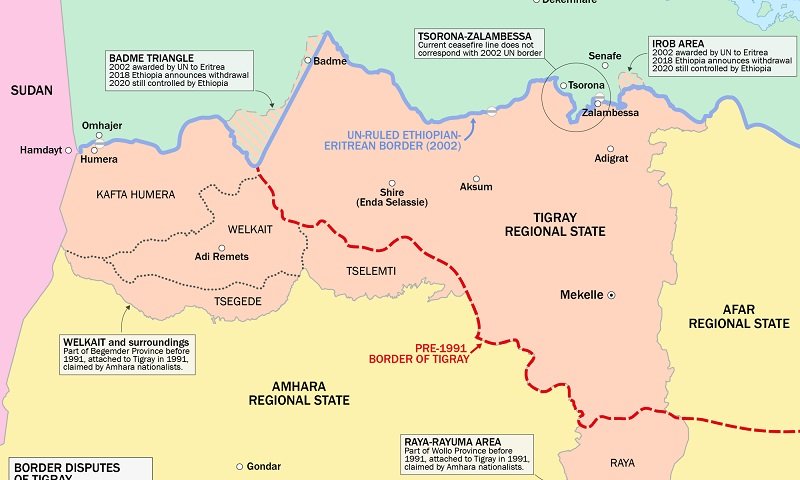
For decades, the status of Wolkait and Raya has remained one of the most contentious and emotionally charged issues in Ethiopia’s federal politics. To many Amhara communities, the matter appears straightforward: Wolkait and Raya are historically Amhara areas that were administratively annexed into the Tigray regional state in the early 1990s by the Tigray People’s Liberation Front (TPLF, commonly known as Woyane). Yet much of the international community continues to treat the dispute as ambiguous or ethnically “mixed,” rather than recognizing what local populations insist is a clear historical injustice.
Why has the world failed to understand this reality?
The Post-1991 Federal Rearrangement
After the fall of the Derg regime in 1991, Ethiopia was reorganized under a new ethnic-based federal system. Regional boundaries were redrawn largely by political elites, often without transparent consultation or local referenda. In this process, Wolkait and Raya were incorporated into the Tigray region.
Amhara residents argue that this decision ignored historical administration, language, culture, and identity. For generations, they say, these areas were governed as part of Gondar and Wollo, and their populations overwhelmingly spoke Amharic and identified as Amhara. From this perspective, the annexation was not a neutral administrative act but a political decision imposed by a dominant ruling movement at a moment when the balance of power strongly favored the TPLF.
Why International Actors Miss the Point
One major reason for international misunderstanding lies in how Ethiopia has been framed abroad. Foreign governments, humanitarian agencies, and media outlets often rely on simplified narratives that prioritize stability and humanitarian access over deep historical context. In this framing, disputes like Wolkait and Raya are treated as “competing claims” between equal parties, rather than as questions of boundary decisions made during a highly asymmetrical political transition.
Another factor is the legacy of TPLF’s international legitimacy. For nearly three decades, the TPLF was a key partner of Western governments in counter-terrorism and regional security. As a result, its version of Ethiopia’s federal arrangement became embedded in international policy circles, while Amhara grievances were often dismissed as nationalist rhetoric or political agitation.
Silencing of Local Voices
For years, Amhara activists from Wolkait and Raya have argued that expressing their identity carried serious risks, including imprisonment and repression. During that time, international human rights reporting paid little attention to these claims, focusing instead on broader national issues. This absence of documentation made it easier for outsiders to assume that the identity question was either unresolved or politically manufactured.
When local voices are marginalized domestically, they are almost always invisible internationally.
Ethnicity, Fear, and Simplification
The international community is also deeply cautious about ethnic disputes in Africa, often fearing that acknowledging one group’s claims may inflame conflict. As a result, there is a tendency to adopt neutral language that avoids judgment, even when strong historical and demographic evidence exists. Neutrality, however, can unintentionally reinforce injustice by freezing disputed arrangements in place.
In the case of Wolkait and Raya, this caution has translated into reluctance to acknowledge Amhara identity claims, even as displacement, violence, and administrative changes have affected local populations.
A Question of Self-Identification
At its core, the issue is not only about maps or borders but about self-identification. International norms emphasize the right of peoples to define who they are. When communities consistently state that they are Amhara and not Tigrayan, dismissing that claim undermines those same principles.
Conclusion
The failure of the international community to understand Wolkait and Raya is not simply a matter of missing information. It is the result of political convenience, historical oversimplification, and the marginalization of local voices. Recognizing these areas’ contested history does not require taking sides in a conflict, but it does require acknowledging that post-1991 boundary decisions were political acts — not timeless truths.
If Ethiopia is to move toward lasting peace, and if the international community wishes to support justice rather than stability alone, it must listen more carefully to the people who live in Wolkait and Raya — and take their history and identity claims seriously.
Editor’s Note : Views in the article do not necessarily reflect the views of borkena.com
__
Support Borkena : https://borkena.com/subscribe-borkena/
Join our Telegram Channel : t.me/borkena
Like borkena on Facebook
Borkena Ethiopian News Youtube Channel
To submit Press Release, send submission to info@borkena.com
Add your business to Ethiopian Business Listing / Ethiopian Business Directory
Join the conversation. Follow us on X (Formerly Twitter) @zborkena to get the latest Ethiopian News updates regularly.
Amharas must develop a credible force to get international attention.