
By Bilelegne Gashaw Mengistu and Sally Abraham
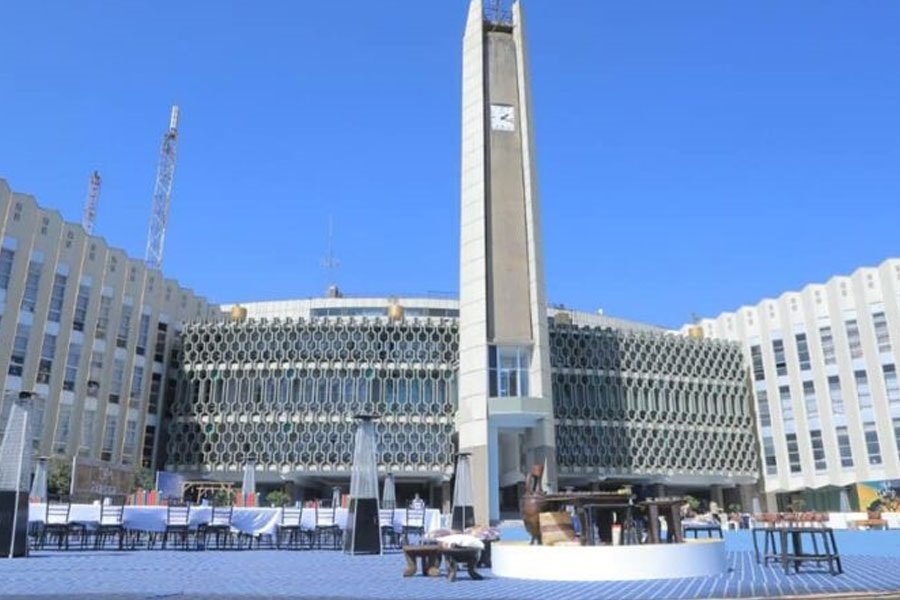
The Ethiopian People’s Revolutionary Party (EPRP) had called on a public meeting for Saturday December 6, 2025, at the De Afrique Hotel, in Addis Ababa, under the theme “Let Addis Ababa Speak.” At the meeting, Addis Ababans were urged by the Party to “cast off the cloak of fear” and participate actively. Although many people were doubtful, asking “Will this gathering really be allowed?”, given the ruling Prosperity Party’s repressive tendencies, EPRP had insisted until Friday that all preparations were complete and the meeting would proceed.
But the feared outcome happened: in a statement released on Friday, the Party announced the cancellation of the public meeting. According to EPRP officials, the hotel abruptly terminated the contract for an unspecified reason, and decided to refund the money the Party had paid for the venue. And as many expected, the event did not take place, and Addis Ababa ‘did not speak’.
The similarity of authoritarian regimes is quiet striking. The previous EPRDF government used the same tactic: parties would finalize preparations for such meetings, only to receive a last-minute call from the hotel cancelling the venue. The Prosperity-era government is continuing that tradition. In fact, it would have been surprising if Abiy Ahmed’s government had actually allowed such gathering. By every measure, Abiy’s repressive tactics are worse than those of the previous regime.
The national election is scheduled for this coming May. So far, the only party that has announced its participation is the Oromo Federalist Congress (OFC). Even OFC has stated that it does not believe this will be a free and fair election, but it is only participating out of fear that failure to do so may cost it its legality, as Professor Merera Gudina recently explained.
EPRP and other parties have not yet confirmed their participation. And if most of the opposition parties refuse to participate, even if the ruling party ‘wins’ the election through manipulation, the legitimacy cost will be significant. From this standpoint, the government’s refusal to allow even symbolic demonstrations of democratic practice—such as Saturday’s gathering—clearly shows that the people in the party are merely ruthless not smart. In its statement after the cancellation of the event, EPRP said that a government, which suppresses even basic rights like public assembly, cannot be expected to allow a fair election.
But if we were asked “Even if the government had allowed it, what benefit would this gathering have brought to the people of Addis Ababa?”, our answer would be: very little to none.
Gathering fewer than 500 Addis Ababans in a hall to discuss tyranny, repression, corruption, unemployment, displacement, and the threat to the city’s identity would likely bring more harm than benefit. First, the safety of those who attend would be at risk. Although defending rights is honourable, the danger from merely attending such a meeting outweighs any gain. And second, the government would use the event to justify further repressive measures, deepening the existing climate of fear in the city. We can boldly say that the people of Addis Ababa—especially the youth—would have been hesitant to attend even if the gathering had been allowed.
We also believe the chosen strategy itself is outdated. In this era of digital information technology, when ideas and knowledge flow like an ocean, gathering a small number of people in a hall to ‘just talk’ is far below standard, unless the goal was simply to report ‘we did that as a political party’. Even the choice of venue, the old De Afrique Hotel a funny question: were the strategists perhaps individuals who left the country back when De Afrique was still a modern hotel?
Therefore, it’s highly advised that the Party shall consider other workable strategies, especially those that reach the city’s youth more effectively.
But one disturbing voice has been heard from within the ruling party’s circles. Deacon Daniel Kibret, whom many regard as a dark-voiced spokesperson for the Prime Minister, posted a statement on his social media page invoking the history of the “White Terror vs Red Terror” of the 1970s, seemingly to vilify EPRP or hint at the possibility of returning to red-terror-like repression. His statement reads:
“In modern Ethiopian history, two types of ‘terrors’ occurred: white and red. People talk about the red terror; trials were held, justice made, a museum built. But why was the white terror overlooked? Why is it kept in the museum? Why were the perpetrators of the red terror allowed to return ‘with their eyes washed in salt’? Should we not re-examine this history?”
As we all know, EPRP is historically remembered for its key role in the student movements of the 1960s and 70s, and in the 1974 Ethiopian Revolution. It is also true that during the chaotic urban struggle after the revolution, the Party’s name became associated—fairly or not—with certain violent acts.
However, today’s EPRP leaders are young people who had nothing to do with events from over 40 years ago; they only know that history as listeners and readers. Thus, Daniel Kibret’s rhetoric about “revisiting the white terror” echoes his past patterns of incitement against various groups and should be taken as such.
Besides, EPRP leaders of today called for just a peaceful public gathering, which shows that they are not heirs of the 1970s “white terror” narrative, rather a group that has chosen peaceful struggle as the only path. To the reverse, Daniel Kibret’s statement suggests that he and the government he serves share lineage with the Derg and the Red Terror. This statement of his shall be preserved as evidence, by which he may one day be held legally accountable. Regardless of the disappointment felt by EPRP supporters over today’s cancelled public meeting, the event has revealed multiple critical issues. Among these are the obvious vindictive, revisionist position of Daniel Kibret and the high-risk tactic of concentration adopted by the EPRP. It should be recalled that not too long ago, politically active Addis Ababans were detained and torched by security forces merely for attending Balderas party meetings. At that time, the Prosperity Party (PP) had not yet clearly abandoned the principles of the rule of law and democracy. Tactically, the cancellation averted potential arrests and abductions, an outcome that would have generated far more fear than the meeting’s intended objective. We hope that, as the organizers have indicated, a tactic of dispersion will be utilized in the near future.
Editor’s Note : Views in the article do not necessarily reflect the views of borkena.com
__
Support Borkena : https://borkena.com/subscribe-borkena/
Join our Telegram Channel : t.me/borkena
Like borkena on Facebook
Borkena Ethiopian News Youtube Channel
To submit Press Release, send submission to info@borkena.com
Add your business to Ethiopian Business Listing / Ethiopian Business Directory
Join the conversation. Follow us on X (Formerly Twitter) @zborkena to get the latest Ethiopian News updates regularly.