
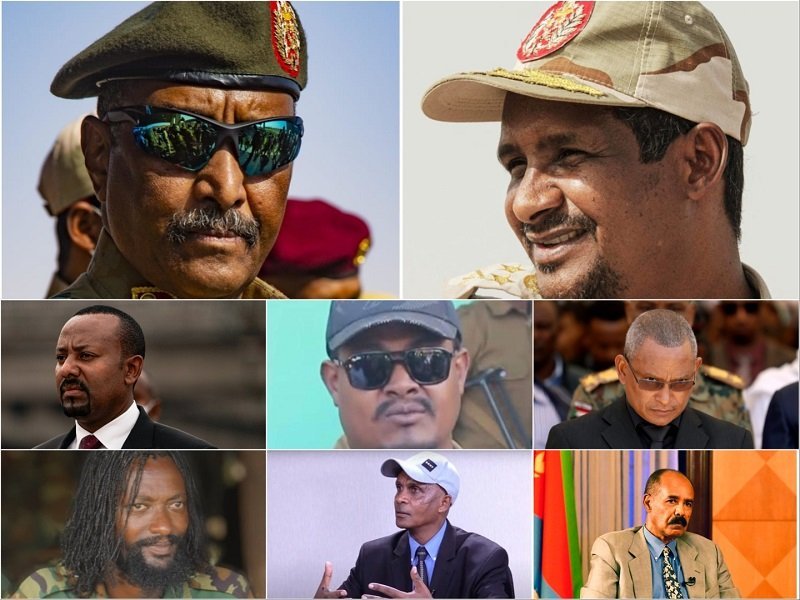
As Sudan descends into one of the 21st century’s deadliest wars, questions arise about whether Ethiopia, grappling with armed insurgencies in Amhara, tensions in Tigray, and violence in Oromiya, might follow a similar path toward state collapse. This analysis examines whether Ethiopia faces Sudan’s fate.
Sudan’s Catastrophic Civil War
Since April 2023, Sudan has been engulfed in brutal conflict between the Sudanese Armed Forces (SAF), led by General Abdel Fattah al-Burhan, and the Rapid Support Forces (RSF), commanded by Mohamed Hamdan Dagalo. What began as a power struggle in Khartoum has become a nationwide catastrophe that has divided the country. By 2025, Sudan operates under two rival governments: the SAF’s administration in Port Sudan and the RSF’s entity in Nyala.
The humanitarian situation is apocalyptic. More than 12.4 million people have been displaced in the world’s largest displacement crisis, with over 3.3 million refugees in neighboring countries. Approximately 25 million people face acute food insecurity, with famine confirmed in multiple regions. The United Nations calls this the “world’s largest hunger crisis.”
Roots and Actors of the Conflict
The war originated from Sudan’s failed democratic transition after the 2019 revolution that ousted dictator Omar al-Bashir. A fragile military-civilian power-sharing arrangement collapsed with an October 2021 coup. Tensions over integrating the RSF, descended from the notorious Janjaweed militias, into the regular army proved insurmountable. When negotiations reached an impasse in April 2023, both sides chose war.
The SAF, controlling eastern Sudan and much of Khartoum, receives support from Egypt, Iran (drones), Russia (fighter jets), and Turkey. The RSF, dominating western Sudan including Darfur, is backed primarily by the United Arab Emirates, which has supplied weapons, fuel, and financial support.
The Horrific Human Cost
Death toll estimates are staggering. Official counts record over 28,700 fatalities, including 7,500 civilians killed in direct attacks. However, research suggests that in Khartoum State alone, over 61,000 people died between April 2023 and June 2024, more than 26,000 from violence directly. Some estimates place the total death toll between 150,000 and 400,000 when accounting for starvation, disease, and healthcare collapse.
Both sides have committed egregious war crimes. The SAF launched airstrikes on Tora market in March 2025, killing at least 350 civilians. The RSF’s April 2025 offensive on El Fasher killed at least 527 people, including over 270 in displacement camps. The RSF and allied militias have perpetrated systematic ethnic violence in Darfur, killing between 10,000 and 15,000 people in West Darfur in 2023 alone. The United States has accused the RSF of genocide against non-Arab ethnic minorities, with over 235 villages burned.
Widespread rape and sexual slavery have been employed as weapons of war, with victims as young as 12. Both sides have engaged in summary executions, with children as young as 14 targeted in reprisal campaigns. Both factions have deliberately used starvation as a weapon, with over 635,000 people currently experiencing famine conditions. Sudan’s infrastructure has been systematically destroyed, with over 90% of the country’s 19 million school-aged children lacking access to education.
Ethiopia’s Multiple Fronts: A Nation Under Strain
While Ethiopia is not experiencing a single unified civil war like Sudan, it faces multiple concurrent armed conflicts that collectively pose an existential threat to state cohesion. Each conflict has distinct origins, actors, and dynamics, yet they interconnect in ways that could trigger broader collapse.
The Amhara Conflict: The Fano Insurgency
The Amhara region has been engulfed in armed conflict since April 2023, when the federal government’s attempt to dissolve regional special forces sparked resistance from Fano militias. Fano, rooted in Amhara nationalism and historical traditions of irregular warfare, had previously allied with the government during the Tigray War but felt betrayed by the 2022 peace agreement.
The insurgency has become Ethiopia’s most intense active conflict. Fighting has displaced over 100,000 people and left 4.7 million children out of school. From April 2023 to April 2025, sources estimate at least 7,700 conflict deaths in Amhara. The war escalated dramatically in 2024, with Fano launching offensives against major cities, including Gondar, and in September 2024, capturing the strategic border town of Metemma.
Fano claims to control over 80% of rural Amhara, with government forces largely confined to major towns and highways. The movement operates as a decentralized coalition of six major factions in Gondar, Gojjam, Wollo, and Shewa, each with its own leadership. In May 2025, four factions unified to form the Amhara Fano National Force under a 13-member central command, though significant divisions remain.
The Ethiopian National Defense Force has conducted extrajudicial executions, including a massacre in Merawi in January 2024 that killed at least 89 civilians, and another in Birakat in March 2025 that killed at least 40 civilians. Government forces have extensively used drone strikes, with more than 300 civilians killed in 2024 alone, and a drone strike in April 2025 killed over 100 people at a primary school. More than 5,000 women have sought medical treatment after sexual abuse, representing only a fraction of the actual toll.
Thousands of Amhara have been arbitrarily detained, with estimates suggesting over 10,000 young people held in detention centers outside Addis Ababa. The government has blocked mobile communications across much of the region and restricted journalists’ access.
Tigray: Fragile Peace and Internal Division
Tigray should be recovering from the devastating 2020-2022 war that killed an estimated 600,000 people. Instead, the region faces renewed instability driven by internal fractures within the Tigray People’s Liberation Front (TPLF). The TPLF has split between factions led by chairman Debretsion Gebremichael and interim administrator Getachew Reda, paralyzing governance.
Critical provisions of the November 2022 Pretoria peace agreement remain unimplemented. Western Tigray remains under Col. Demeke Zewdu’s administration, preventing hundreds of thousands of displaced Tigrayans from returning home. Eritrean forces continue occupying border areas. Over 270,000 Tigray Defense Forces fighters remain armed, with demobilization stalled.
Tensions between Ethiopia and Eritrea have escalated dangerously, with both countries accusing each other of backing domestic opposition groups, threatening renewed conflict.
Oromiya: The OLA Insurgency
Oromiya has faced continuous conflict since 2018, when the Oromo Liberation Army (OLA) broke from the Oromo Liberation Front and refused to disarm. The OLA claims to fight for Oromo self-determination and cultural rights, including autonomy over Addis Ababa (Finfinnee). The conflict has displaced hundreds of thousands and affected millions. Both sides are accused of serious abuses: the OLA of attacks on Amhara civilians and the government forces of extrajudicial killings, mass detentions, and airstrikes harming civilians.
Ethnic tensions along the Amhara and Benishangul-Gumuz borders worsen the crisis. Clashes between the OLA and the government’s military forces have led to repeated civilian attacks and further displacement, with some areas becoming unsafe for Oromo residents. Overall, insurgency, counterinsurgency, and ethnic violence have created widespread insecurity across Oromiya.
Comparing the Crises: Key Differences
Despite similarities in failed transitions, ethnic tensions, foreign involvement, and severe humanitarian crises, Ethiopia is not automatically on Sudan’s path. However, if current political repression and escalating conflicts persist, Ethiopia risks a Sudan-like deterioration.
State Capacity: Ethiopia’s federal government maintains functional control over Addis Ababa and most urban territory. The military has not fractured. Sudan’s state is effectively split between two rival military factions, each controlling significant territory and operating separate governments.
Nature of Conflicts: Sudan faces a binary power struggle between two military factions vying for control of the entire state. Ethiopia confronts multiple regional insurgencies with distinct grievances about autonomy and ethnic rights within a federal structure, not primarily about seizing national power.
Political Space and Peace Processes: Although Ethiopia claims to maintain political space and openness to negotiation, in reality, the political environment remains highly restricted, and peace initiatives lack genuine credibility. The government presents the 2022 agreement with the TPLF and the so-called 2024 deal with an OLA faction as successful peace processes, but these are widely viewed as incomplete, non-inclusive, or merely symbolic arrangements that have not resolved the underlying conflicts. Large segments of the population and key armed groups remain excluded, and violence continues in many regions. Similarly, Sudan’s warring parties have repeatedly rejected mediation, each believing military victory is attainable, leaving little room for meaningful negotiation.
Scale and Intensity: Sudan’s conflict has reached an extremely catastrophic scale, with estimates ranging from 28,700 confirmed deaths to potentially over 400,000, alongside 12.4 million displaced people. While Ethiopia’s numbers after the Pretoria agreement may not exceed Sudan’s, the scale and intensity of violence across the country remain extremely severe and widespread. Millions have been displaced across multiple regions, including Tigray, Amhara, Oromia, and Benishangul-Gumuz, and large areas continue to face active conflict, extrajudicial killings, mass arrests, and systematic human rights abuses. Ethiopia is also experiencing severe food insecurity affecting millions, and in the case of Tigray, the situation reached the level of systemic, conflict-induced famine, resulting from deliberate blockade, restricted aid access, and the destruction of essential infrastructure. Even outside Tigray, many communities face starvation-level conditions, making the overall humanitarian situation extremely dire.
Fragmentation vs. Fracture: Sudan has fractured into two opposing military entities in a zero-sum struggle. Ethiopia has fragmented, with regional conflicts challenging federal authority but not producing a complete parallel state structure. This decentralization creates spillover risks but also means progress in one conflict doesn’t require resolution of others.
Conclusion: Preventing the Worst
Ethiopia stands at a crossroads. It has not become Sudan yet. But the warning signs are clear: multiple armed conflicts, ethnic polarization, widespread atrocities, massive displacement, and political deadlock. The risk of cascading failure into comprehensive civil war is real and increasing.
Preventing Sudan’s fate requires urgent action on multiple fronts. The Ethiopian government must move beyond military-first approaches toward genuine political dialogue that addresses fundamental grievances about representation, autonomy, and ethnic rights. Regional actors need inclusive peace processes, not selective deals with individual factions. The international community should prioritize sustained engagement, including pressure for accountability, while supporting negotiated settlements.
Most critically, Ethiopians themselves political leaders, civil society, religious institutions, and ordinary citizens, must choose negotiation over violence, inclusion over exclusion, and national cohesion over ethnic supremacy. The alternative, as Sudan tragically demonstrates, is almost unthinkable horror.
Ethiopia’s path forward is not predetermined. Unlike Sudan, where the moment for preventing war passed in April 2023, Ethiopia still has narrowing opportunities but can realistically step back from the abyss. Whether those opportunities are seized or squandered will determine not just Ethiopia’s future but the stability of the entire Horn of Africa.
The question “Will Ethiopia end up like Sudan?” should be reframed: not as an inevitable trajectory, but as a warning. Sudan shows what happens when conflicts metastasize beyond control, when political processes collapse entirely, when foreign powers prioritize their interests over peace, and when military leaders choose total victory over compromise. Ethiopia’s leaders and people must learn from Sudan’s catastrophe and choose differently before it’s too late.
Sources
- United Nations Office for the Coordination of Humanitarian Affairs (OCHA) – Sudan Humanitarian Updates and Key Facts (2024-2025)
https://www.unocha.org/publications/report/sudan - Human Rights Watch – “World Report 2024: Sudan” & “World Report 2025: Ethiopia”
https://www.hrw.org/world-report/2024/country-chapters/sudan
https://www.hrw.org/world-report/2025/country-chapters/ethiopia - International Rescue Committee (IRC) – “Crisis in Sudan: What is Happening and How to Help”
https://www.rescue.org/article/crisis-sudan-what-happening-and-how-help - UN High Commissioner for Refugees (UNHCR) – Sudan Emergency Situation Reports
https://reporting.unhcr.org/operational/situations/sudan-situation - UN Office of the High Commissioner for Human Rights (OHCHR) – “Update on the Human Rights Situation in Ethiopia” (June 2024)
https://www.ohchr.org/sites/default/files/2024-06/OHCHR-Update-HR-situation-in-Ethiopia-in-2023.pdf - Human Rights Watch – “Ethiopia: Military Executes Dozens in Amhara Region” (April 2024)
https://www.hrw.org/news/2024/04/04/ethiopia-military-executes-dozens-amhara-region - U.S. Department of State – “2024 Country Reports on Human Rights Practices: Ethiopia”
https://www.state.gov/reports/2024-country-reports-on-human-rights-practices/ethiopia
Editor’s Note
This article provides a comparative analysis of the ongoing conflicts in Sudan and Ethiopia based on the most recent available data as of December 2025.
Editor’s Note : Views in the article do not necessarily reflect the views of borkena.com
__
Support Borkena : https://borkena.com/subscribe-borkena/
Join our Telegram Channel : t.me/borkena
Like borkena on Facebook
Borkena Ethiopian News Youtube Channel
To submit Press Release, send submission to info@borkena.com
Add your business to Ethiopian Business Listing / Ethiopian Business Directory
Join the conversation. Follow us on X (Formerly Twitter) @zborkena to get the latest Ethiopian News updates regularly.